 English
 Español
 Português
 Deutsch
 Français
 Italiano
 Nederlands
 العربية
 日本語
 한국어
 ไทย
Quick Answer
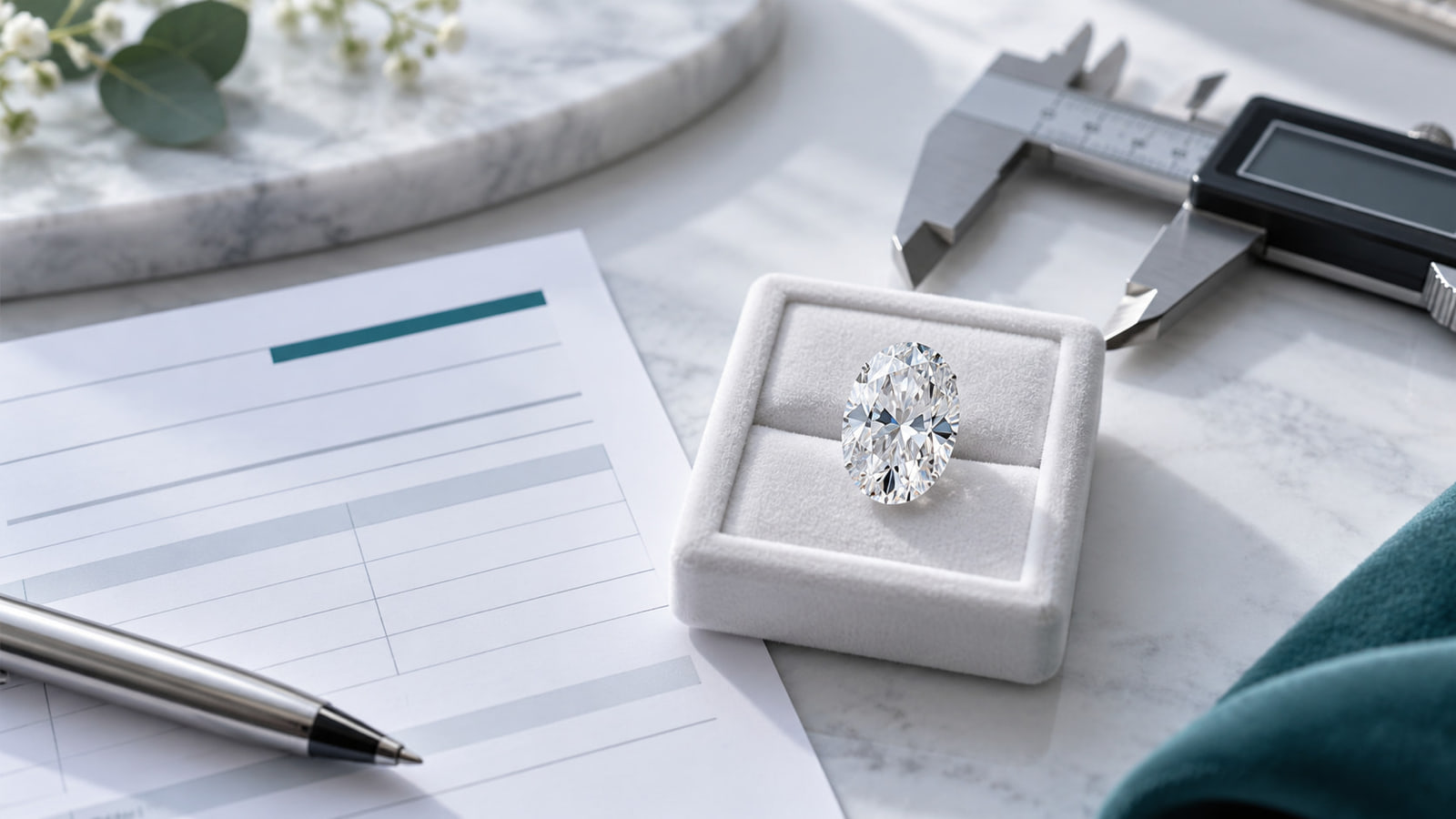
How much is a 2 carat lab grown diamond? The amount must be obtained for a specified stone and selling scope, not weight alone. This guide uses transparent hypothetical figures rather than claiming live retail or wholesale prices. If an assumed 2.00 ct loose center costs $600 and separately stated services and freight total $80, the order amount is $680 before any other excluded charges. A finished ring would require its own metal, setting and service costs. To compare current offers, match shape, actual measurements, appearance criteria, document scope, date and commercial terms. Then calculate stone amount and complete order cost separately. Do not compare a 2.00 ct total-weight ring or earring pair with one 2.00 ct center as though they were the same purchase.
What Exactly Is Included in a Two-Carat Lab-Grown Diamond Price?
Identify whether the price is for one loose center, a complete ring or several stones totaling two carats. A listing can be accurate while still answering a different buying question from yours. The first task is therefore scope normalization, not selecting the lowest visible number.
For one center, record actual weight and dimensions. For a ring, add the metal, center, accents, setting work and any included services. If the offer says starting from, identify which exact specification and availability support that figure. A quotation for a representative design is different from a reserved actual stone.
Distinguish retail and wholesale. A dated retail listing can describe that seller’s retail offer; it should not be relabeled as a wholesale benchmark. For trade buying, request a current quotation for the actual assortment and order terms. No universal number can account for all those differences without obscuring the goods.
For customer-facing weight language, consult FTC jewelry guidance. Keep center weight and total weight separate in the product database so a clear supplier offer does not become a confusing retail headline. The commercial scope should survive from the quote through the invoice to the customer’s receipt.
Same Two-Carat Weight Versus Same Design Fit: What Matters More?
A two-carat target does not establish face-up size or setting fit. Shape, outline, proportions and depth can produce different dimensions at similar weights. A buyer should compare actual measurements and appearance, not assume that all two-carat centers can use the same setting.
The table shows which comparison fields prevent false equivalence. It is a procurement checklist, not a current price chart or a ranking of shapes.
| Comparison field | Insufficient shortcut | Useful two-carat check |
|---|---|---|
| Weight | Both say 2 ct | Confirm actual center weight and whether one stone is meant |
| Shape | Both are oval | Compare actual length, width, depth and outline |
| Face-up impression | Same carat means same visible size | Review actual dimensions and consistent visual evidence |
| Setting | A standard two-carat mount will fit | Ask the setter to approve the actual geometry |
| Quality | Same broad grade label | Review the actual stone and relevant service scope |
| Documents | Both are certified | Identify laboratory, current service and actual record |
| Price | Compare headline amounts | Normalize loose versus finished scope and excluded charges |
| Availability | Listed online means allocated | Confirm stock reference, hold period and substitution rule |
If a setting has already been ordered, dimensional fit may be a hard acceptance condition. If the design is still flexible, the buyer can compare alternatives, but the workshop cost of each route should remain visible.
How Can a Buyer Compare Two Hypothetical 2.00 Ct Offers?
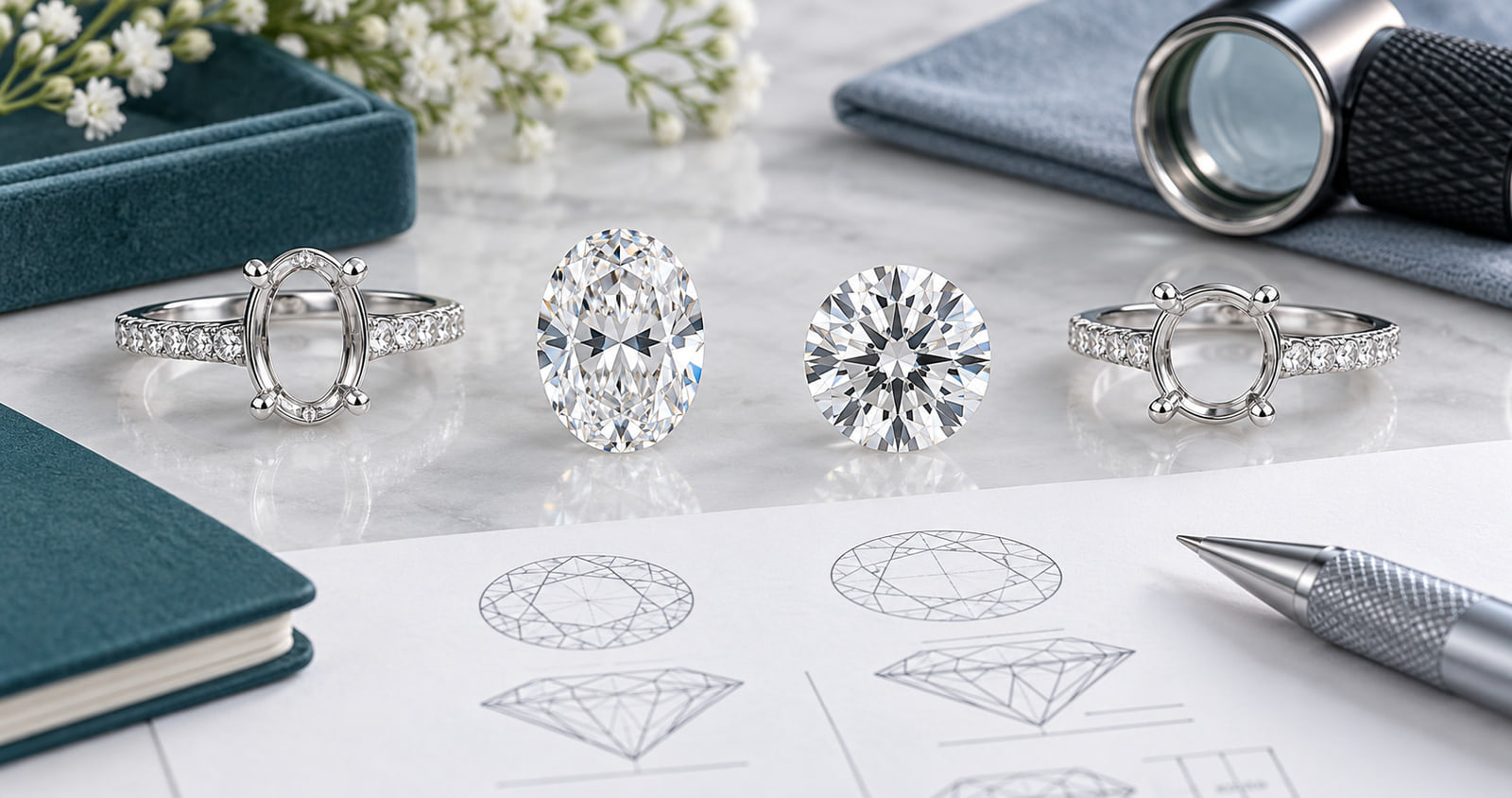
Assume two offers for a bridal pilot, solely to demonstrate the method. Offer A is a 2.00 ct loose center at $600, with an assumed $30 requested service and $50 freight allocation. Its modeled order amount is $680. Offer B is a 2.00 ct center at $660 with the required service included and $20 freight allocation, totaling $680.
The lower stone price does not produce a lower modeled total in this example. Next, compare actual fit. Suppose A’s hypothetical dimensions are 10.8 by 7.1 mm and B’s are 10.5 by 7.3 mm. Those dimensions are illustrative, not standard sizes or claims about available stock. The setter must determine whether either fits the approved oval design and depth limits.
If A requires an assumed $70 setting adjustment while B fits the existing design, the modeled usable cost becomes $750 for A versus $680 for B, before other excluded costs. The adjustment should be confirmed by the workshop, not invented by the buyer to justify a preferred stone. If both fit, the comparison returns to visual approval, documents and terms.
The conclusion is specific: under these assumptions, B better supports the existing design budget even though its stone line is higher. Replace every assumption with current actual offers. See wholesale pricing guidance to build the supplier request behind the calculation.
How Should Retailers Build a Two-Carat Shortlist Before Buying?
Start with the intended customer and design. Define shape, center-weight requirement, length-to-width preference, depth constraints and visual acceptance. Then request a small set of actual candidates. A broad catalogue of every two-carat stone can consume time without resolving the setting or customer decision.
Ask for clean, consistent views of each candidate and preserve its stock reference. For fancy shapes, assess the outline and visible pattern as well as the document. A selected stone should not be replaced by an equal-weight alternative without renewed approval. The customer may have chosen a particular appearance rather than a generic weight class.
Confirm the chosen document service. GIA’s current laboratory-grown service page distinguishes its colorless to near-colorless assessment from colored services. Do not assume a current GIA laboratory-grown document automatically presents traditional color and clarity grades. If a different service is required, identify it before comparing quotes.
Review loose center options with bridal application requirements. MEITUO can help coordinate a shortlist based on those constraints. The buyer should retain final visual and dimensional approval so supplier coordination produces a usable selection, not only a list of nominal two-carat weights.
What Costs and Remedies Belong in the Final Two-Carat Order?
Separate the stone amount, requested services, setting or metal charges where relevant, packing, transport and other agreed costs. Identify exclusions rather than assuming the quotation is all-inclusive. Record currency, date, validity and the point at which actual stock is reserved. A low expired quote is not a current buying option.
Define the receiving period and discrepancy remedy. If the selected stone arrives with a condition or measurement issue, preserve the evidence and resolve it before setting. A workshop change made without supplier agreement can complicate a return. The buyer should know who approves the next step and who carries any agreed cost.
For rings with accents, specify side stones or melee separately. A two-carat center does not establish the quantity, matching or cost of the rest of the design. Keep the complete bill of materials visible when estimating the finished ring budget.
Finally, ask whether later reorders will use the same dimensional limits. The repeat-order guide helps turn a successful two-carat pilot into a controlled program. A realistic quote comparison ends with identified acceptable goods, a complete cost boundary and a remedy process, rather than a universal dollar figure detached from an actual purchase.
How Should Buyers Qualify Suppliers in the USA, China and India?
A two-carat shortlist should solve the same design problem across every channel. Give sellers the center-weight requirement, dimensional limits and quote scope, then request actual candidates. These market questions help bridal buyers compare a distributor offer with an overseas sourcing response without confusing retail listings, total weight or unallocated stock.
USA / CENTER VERSUS RING
What Should US Bridal Retailers Compare in Two-Carat Offers?
A US bridal retailer should separate a loose-center quote from the price of a complete engagement ring. Ask the distributor or seller to identify the exact stone, document scope, setting options and included services. A retail website amount may be useful as a dated retail reference, but it should not be used as a wholesale supply quote.
If the store already owns settings, send the actual dimensional limits before requesting candidates. Ask whether the selected stone can be held while the bench jeweler confirms fit and the customer approves appearance. Keep the allocation expiry visible so a delayed approval does not lead to an unapproved equal-weight substitution.
For the final customer quote, distinguish the two-carat center from accents and total ring weight. Confirm what happens if the receiving inspection finds a discrepancy before setting. The seller’s location does not establish that every two-carat stone is on hand, so request current actual-stock evidence and a release plan tied to the identified item.
Stuller documents a trade-only US channel. Qualify the particular offer independently.
CHINA / DIMENSIONAL MATCH
How Should China-Based Sourcing Structure a Two-Carat Shortlist?
For a China-based sourcing program, provide the intended shape and setting dimensions before asking for the lowest two-carat price. A coordinator can then request candidates that solve the actual design problem. Ask for current item references, measurements, clean visual evidence and the relevant document choices for each candidate.
Keep center and accent requirements on separate lines. If the order includes a small bridal collection, confirm whether the seller can repeat the dimensional limits rather than simply supply several stones around two carats. A lower center quote may be less useful if the workshop must redesign every setting.
MEITUO is based in Qingdao, Shandong, and coordinates laboratory-grown diamond selection and supplier follow-up. Confirm availability, MOQ, documents, treatment information and shipping terms per order. Do not infer a universal two-carat China wholesale price or a growing location from its address. Evaluate the actual offered goods and complete commercial scope against the buyer’s approved design.
GIA’s 2024 review documents Chinese HPHT melee production. This industry context does not verify a specific seller.
INDIA / ACTUAL-STONE OFFERS
What Should an India-Based Polished Seller Provide for 2 Ct Comparisons?
With an India-based polished seller, request actual-stone offers rather than a weight-only indication. Each candidate should have a stock reference, actual measurements, relevant document information and a clear price boundary. Ask whether the seller owns the stock or is coordinating another party’s availability so the buyer understands how reservation works.
For ovals or other fancy shapes, compare actual outlines and visual patterns under consistent conditions. Do not assume that two candidates with the same carat weight have the same face-up presence or fit the same setting. The workshop should approve the selected geometry before the order is treated as ready for production.
Confirm export and discrepancy terms and identify any separately charged services. A public retail example, if used, should remain labeled retail and dated. The useful purchasing conclusion concerns the total cost of an acceptable identified center, not a national average or an unsupported claim that every two-carat stone should cost the same amount.
GreenLab lists Surat manufacturing and a Mumbai office. Distinguish those roles in any supplier comparison.
How Can MEITUO Support This Sourcing Decision?
MEITUO is a Qingdao, Shandong-based sourcing and supply-chain coordination partner serving jewelry brands, wholesalers, retailers and designers. For a two-carat center request, its useful role is helping the buyer turn a broad weight target into a comparable shortlist with defined shape, dimensions, appearance and document requirements.
The product range includes loose center stones, melee, side stones, matched pairs and sets, and fancy-color options. MEITUO supports product selection, supplier coordination, quality-requirement confirmation and order follow-up. Buyers can request the center and accompanying stones as separate lines so the complete design budget remains understandable.
Availability, documents, MOQ, lead time, treatment information and shipping terms require confirmation per order. Send [email protected] the intended application, setting limits and required quote scope. MEITUO does not guarantee a fixed two-carat market price, savings or stock availability. Its supplier response should be evaluated against the actual accepted selection and the commercial terms agreed for that particular order.
What Should Your Purchasing Brief and Acceptance Record Contain?
Before approval, reconcile the actual center weight, measurements and stock reference across the quotation and visual record. Confirm that the setter has reviewed the geometry and that all required charges are either included or explicitly excluded. Keep any provisional cost assumption labeled until the responsible party confirms it.
At release, preserve the exact selected item and prohibit unapproved equal-weight substitutions. At receiving, inspect before setting and use the agreed discrepancy process. A well-formed two-carat quote comparison answers what this acceptable stone and this order will cost, while keeping its scope separate from a complete ring or a different assortment.
Please quote [quantity] individual laboratory-grown centers around [exact weight requirement], shape [shape], dimensions [length, width and depth limits], for [bridal design or application]. Provide actual stock references, clean visual views, document service, treatment information and matching requirements where relevant. Separate stone amount from requested services, accents, setting, packing and freight. State currency, quote date, validity, allocation expiry, MOQ, lead time and shipping terms. Confirm receiving inspection and discrepancy remedies. A two-carat total-weight ring or pair is not an equivalent offer. No substitution or dimensional change is authorized without written approval.
FAQ: 2-Carat Lab-Grown Diamond Prices: How to Compare Quotes
How Much Should a Two-Carat Lab-Grown Diamond Cost?
Obtain a current quote for the actual stone and scope. Weight alone cannot establish one universal amount. Compare shape, dimensions, appearance, documents and terms, then calculate the stone amount and complete order cost separately. The dollar examples here are explicitly hypothetical arithmetic.
Is a Two-Carat Ring Always a Two-Carat Center?
No. A total-weight description can include accents, while a center-weight description concerns one stone. Confirm the individual center weight and the complete bill of materials before comparing it with a loose two-carat center quotation.
Do All Two-Carat Diamonds Look Equally Large?
No. Shape, proportions and depth influence face-up dimensions and appearance. Use actual length, width and depth rather than weight alone, and have the setting workshop review the selected stone’s geometry before committing to a mount.
Can a Higher Stone Quote Produce a Lower Usable Cost?
Yes, if the complete scope or design fit differs. Compare separately charged services and any confirmed workshop adjustments. Do not invent a fitting charge to favor one candidate; obtain the actual cost and keep assumptions labeled until confirmed.
Can I Use a Retail Listing as a Wholesale Price?
No. A retail listing describes a retail offer with its own scope and date. Preserve that label and obtain trade quotations for the actual wholesale order. Public examples should not be treated as proof that every supplier has comparable stock at that amount.
What Is the Final Approval Checklist?
Match the actual stock reference, weight, dimensions, visual record, document scope and complete cost boundary. Confirm allocation and receiving remedies before release. A different two-carat stone needs renewed approval if its appearance, measurements or terms differ from the accepted selection.