 English
 Español
 Português
 Deutsch
 Français
 Italiano
 Nederlands
 العربية
 日本語
 한국어
 ไทย

Quick Answer
How much is a 5 carat lab-grown diamond? A public listing snapshot retrieved for this guide displayed US$5,108 for a 5.09 ct round E/VVS2 stone with IGI reference 681516691. That is one near-five-carat retail example, not a universal price or a MEITUO quotation. The final cost also depends on the actual stone, selection terms and any separately ordered setting. For a custom B2B purchase, release spending in stages: reserve the identified candidate under agreed terms, review the loose stone, approve the design and only then authorize nonrecoverable setting work. Reconfirm current availability and price with the seller. The method below focuses on controlling cost exposure when a large-center review fails.
Which Public Five-Carat Price Evidence Can Be Used Responsibly?
Research snapshot, October 30, 2026: the retrieved With Clarity 5.09 ct round laboratory-grown diamond page displayed US$5,108 and described E color, VVS2 clarity and IGI reference 681516691. The exact weight is 5.09 ct, not 5.00 ct. Preserve that distinction when recording the example. It is one seller listing with its own specifications and commercial scope, not evidence of a market-wide minimum or average.
A separate Genevieve setting page displayed US$3,050 and explicitly identified the price as setting-only, with the center not included. Its photographs showed a five-carat center, but the image did not make that center part of the setting price. This is a useful scope warning, not a recommendation to combine those two products. Compatibility and a package quotation are unestablished.
Retrieved listing text can be cached, and a displayed item may change or become unavailable. The figures here are documented research examples rather than live checkout confirmations. Ask the actual seller to confirm the current item, amount, currency, included services and reservation conditions before making a commitment.
Do not multiply a one-carat reference by five to create a supposedly verified five-carat price. Equally, do not assume every offer near the example has comparable appearance, documentation or review terms. Use an item-linked quotation and evaluate what happens if that specific candidate fails your acceptance process.
Which Decisions Should Precede a Nonrecoverable Large-Center Spend?
Separate four releases: candidate reservation, loose-stone acceptance, design approval and production authorization. The same person may own several steps, but the record should show which one has actually occurred. A favorable viewing clip is not permission to cast a head, and a design sketch is not acceptance of the stone's physical condition.
At reservation, identify the item and the agreed time period. Record any payment, whether it is credited against purchase and the actual conditions for return or cancellation. These terms must come from the transaction; no general reserve percentage or refund right is assumed here. Ensure the review period is long enough for the people who must make the decision.
At loose-stone review, reconcile the physical item and its document, appearance and dimensions. Record unresolved concerns before the workshop starts work that could affect return eligibility. If a laboratory examination or further imaging is needed, assign the owner and deadline. Keep the item reserved under the agreed arrangement or reopen selection if that cannot be maintained.
At design approval, have the responsible maker check the actual stone and the proposed interface. Only after the design and stone are accepted should the buyer release the agreed production scope. If the commercial route requires a different sequence, document the resulting exposure explicitly. The objective is not to pretend every purchase can be risk free, but to prevent a missing approval from being mistaken for an accepted risk.
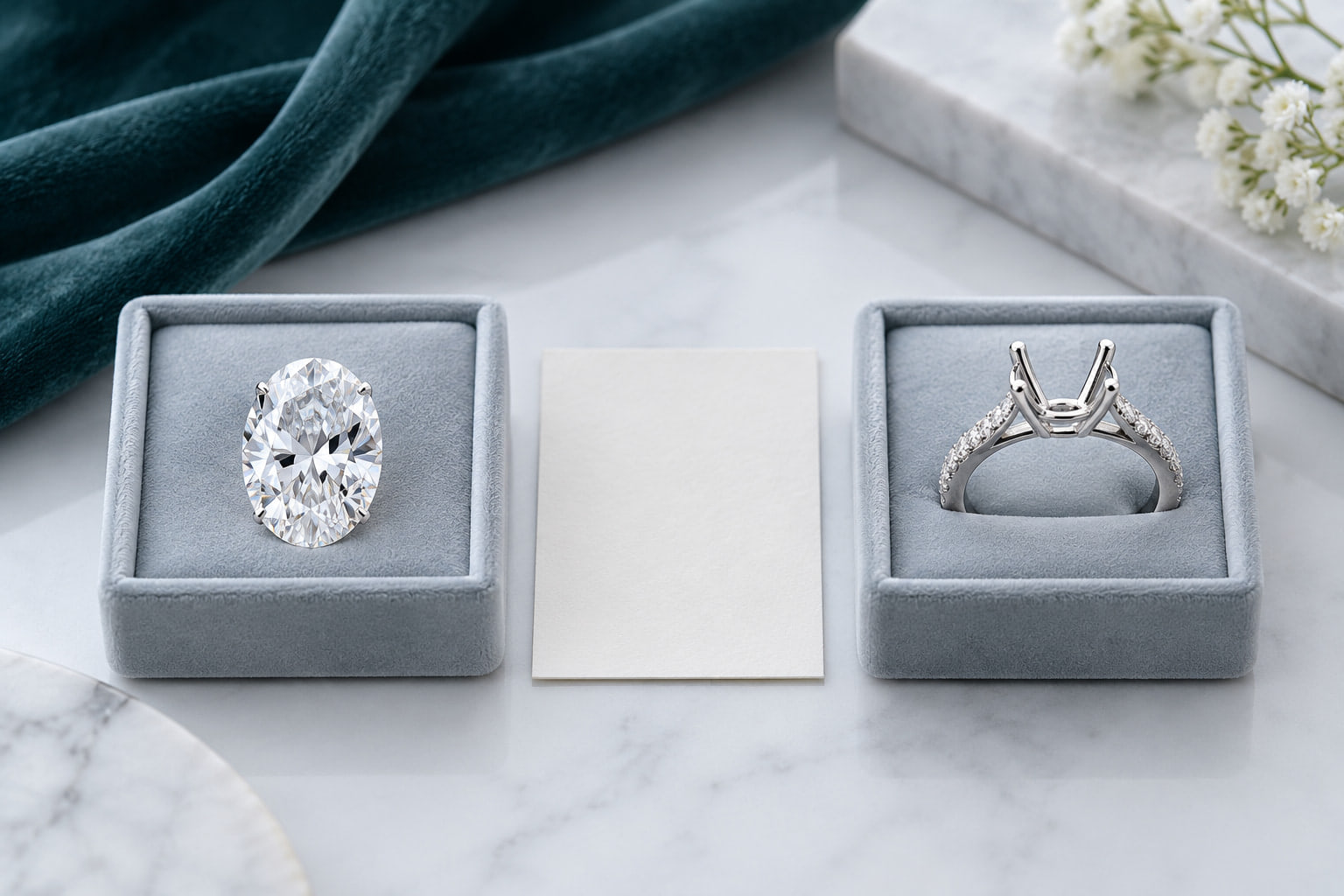
One-Pass Commitment VS Staged Release: What Changes?
Staging can add handling and time, so it is not automatically cheaper. Its value depends on which costs can still be avoided when a review fails. Compare the real offers and the workshop schedule before deciding.
| Decision point | One-pass release | Staged release | Buyer question |
|---|---|---|---|
| Candidate identity | May be selected and committed together | Item is reserved for a defined review | Who controls the exact candidate? |
| Inspection timing | Can occur after more spending is committed | Placed before specified later releases | Which concerns can still change the decision? |
| Custom design work | May begin before loose-stone acceptance | Starts at an agreed gate | What work becomes nonrecoverable? |
| Schedule | Can reduce handovers if everything succeeds | Requires review and reservation coordination | Are the dates compatible? |
| Failed review | May leave committed components or work | Can limit later spending if terms permit | What is the documented remedy? |
| Substitution | Can be overlooked in a fast release | Requires a fresh relevant approval | Does the replacement fit the accepted design? |
A combined stone-and-setting seller may offer a coherent process, while a separately sourced center can require more coordination. Neither structure removes the need to read the terms. Ask who bears each agreed charge if the chosen stone fails the defined acceptance criteria.
The RFQ guide can organize that discussion. Use the loose-center category to state the material request without implying that a website category establishes a current five-carat reservation.
How Can a Hypothetical Staged Purchase Expose Avoidable Cost?
Hypothetical example, separate from the public snapshots: a custom-center offer is US$2,400. The negotiated arrangement uses a US$300 reservation payment credited on purchase and refundable only under the specifically agreed failed-review condition. Inspection and handling cost US$120. CAD work costs US$180, the mount US$540 and setting work US$160. These are invented figures and contractual assumptions, not market rates or standard refund rights.
In the staged plan, the buyer first commits US$300 plus US$120, or US$420. Suppose the loose stone fails the agreed review and the condition for refund is met. The US$300 is returned, leaving US$120 of unrecovered inspection and handling cost. That outcome depends on the stated hypothetical terms; it should never be inferred for an actual order without confirmation.
If the center passes, the remaining stone payment is US$2,100. Total completed-project spending under the listed inputs becomes US$2,400 + US$120 + US$180 + US$540 + US$160 = US$3,400. This amount excludes any other transaction-specific costs. The original US$300 is part of the US$2,400, not an additional charge.
Now suppose the buyer authorizes CAD and casting before the loose review. If the center fails and the new candidate cannot use that design, US$720 of CAD and mount spending may become stranded under the assumed terms. The exact loss would depend on whether anything can be reused or credited. The comparison shows the question to negotiate before release; it does not establish a guaranteed saving from staging.
Record both the cash currently committed and the next authorization. A project can be within its total budget while still exposing money at the wrong time.
What Should Happen When a Reserved Large Center Is Rejected or Lost?
State the rejection reason precisely. A document mismatch, a visible feature outside the accepted reference and a mounting incompatibility are different issues. Keep the item unset while the agreed review is unresolved. Preserve relevant images, measurements and communications so the next proposal addresses the actual failure rather than merely offering another stone of similar weight.
If the reservation expires, confirm whether the item is still controlled before authorizing work around it. Do not retain the old stone's images in the approval file after a substitute has entered the conversation. The new candidate needs its own identity, appearance and relevant fit checks. A weight match does not transfer the original approval.
Ask the workshop what can be retained if the candidate changes. A general sketch may remain useful; a stone-specific seat or cast component may not. Obtain an explicit assessment instead of assuming every custom charge is either fully lost or fully reusable. The bespoke application page provides a useful context for defining those responsibilities.
MEITUO can coordinate candidate information and supplier responses while the buyer and maker own their approval gates. Use matched-set requirements separately when the large center depends on specific side stones. Rejecting a center may also require a fresh set-layout review, even when the side stones themselves remain acceptable.
How Should Staged Large-Center Buying Work Across Markets?
Compare who controls the item, which review steps are available and who authorizes the next cost. A local invoice or production-region contact does not define the commercial remedy. The panels below focus on the handovers needed for a specific large-center transaction.
USA / Listing and release scope
What Should a US Buyer Confirm Beyond the Displayed Five-Carat Amount?
The With Clarity snapshot above is one near-five-carat retail item, while the Genevieve page illustrates a setting-only amount. Neither establishes a combined current transaction. A US buyer should ask the actual seller to confirm the item, included services and the sequence required before setting work begins.
For a locally assembled custom piece, identify who receives and reviews the loose center and whether the seller's actual terms permit that route. Do not infer that an ordinary retail return policy covers a stone after workshop changes or a customized setting. Obtain the relevant transaction terms rather than importing another seller's policy into your plan.
Keep the reservation deadline aligned with the maker's review schedule. If a customer changes the design after accepting the stone, record that as a separate decision and revise the authorized scope. Domestic communication can help coordinate these steps, but it cannot eliminate the need for actual-item control, documented approval and an agreed remedy for a failed review.
CHINA / Approval-linked coordination
How Should a China Coordinator Keep Reservation and Production Separate?
The MEITUO team in Qingdao can coordinate a large-center inquiry, but the buyer needs to know which seller controls the exact item and what reservation arrangement is offered. The coordinator's address does not establish a growth site or create a refund right. Ask for the actual terms and the responsible parties in writing.
Send one approval schedule to the supplier and jewelry maker. Identify when the loose stone is reviewed, when the drawing can be finalized and who may authorize casting. If the center changes, preserve the old and new references rather than allowing a replacement to inherit the original release.
For cross-border handling, confirm the route for an unresolved item before dispatch. Review costs, packing and shipment responsibilities should be scoped for the transaction, not guessed from a public retail example. A clear coordination file distinguishes candidate information from accepted material and separates the buyer's next authorization from the supplier's availability update. That makes the quoted amount actionable without turning it into a guarantee of project outcome.
INDIA / Reservation continuity
What Should a Surat or Mumbai Contact Confirm for a Staged Custom Order?
GreenLab lists Surat and Mumbai contact locations, illustrating commercial contact points in an Indian diamond channel. For a large-center transaction, ask the contracting seller who can reserve the specific candidate through the agreed review. An office address or general inventory claim does not establish control of that item for your project.
If a technical contact proposes repolishing, obtain the resulting weight, dimensions, timing, documentation route and commercial terms before treating it as an accepted remedy. Such work may change the item the designer originally evaluated. Keep it outside the approved scope until the buyer and maker have reviewed the proposed result.
Where export and selection use different contacts, carry the reservation deadline and item reference through both handovers. Ask what happens when the workshop needs more time or the candidate fails the stated review. The negotiated answer may involve a replacement proposal or another remedy; do not assume the answer. A useful quotation identifies those decision points alongside the amount, making it possible to compare actual cost exposure rather than price alone.
How Can MEITUO Coordinate a Staged Five-Carat Inquiry?
MEITUO works from Qingdao, Shandong, China as a sourcing and supply-chain coordination partner. For a five-carat-target inquiry, send the stone specification, actual design limits and the proposed sequence of reservation, review and production approval. The team can help communicate candidate requirements, coordinate supplier responses and follow availability and order questions through those agreed stages.
The broader product scope includes loose centers, melee, side stones, matched pairs and sets, and fancy-color options. Each group can have its own approval and cost-release record. MEITUO does not guarantee a public retailer's listed price, a refund arrangement or a finished project's budget. Confirm the actual supplier's terms, documents, MOQ, lead time, treatment information and shipping scope before commitment. The designer and studio solutions page is a relevant starting point. Contact [email protected] with the review owner and deadlines so a proposed shortlist can be evaluated against the actual process rather than a weight label alone.
What Should a Five-Carat Price RFQ Say About Staged Approval?
Ask for the actual candidate and a clearly scoped quotation. Separate reservation payment, purchase balance, review or shipping charges and any services being offered. State which work requires further written authorization. Do not assume an unlisted charge is included or a cancellation right exists because another seller offers one.
Include the design owner and review deadline. If side stones or a stone-specific mount are involved, identify the approvals that depend on the center. The following brief makes those stages visible. Add the negotiated commercial terms only after the responsible parties confirm them for the actual transaction.
Please quote an identified [five-carat target range] laboratory-grown center for [custom project]. Provide actual-item dimensions, documents and controlled viewing media against [specification]. State current price, included services, currency and exclusions. Explain the proposed reservation period, payment credit and failed-review terms for this transaction. No CAD, casting or setting work is authorized by the shortlist request alone. Identify the review route, responsible party, MOQ, lead time, treatment information, packing and shipping scope. Keep side stones separate. Replacement candidates require renewed approval from [buyer and maker] before any production release.
FAQ: 5-Carat Lab-Grown Diamond Prices: Buying in Stages
Is US$5,108 a Standard Price for Every Five-Carat Lab-Grown Diamond?
No. It is the displayed amount from one retrieved 5.09 ct retail listing with specified characteristics. It is not a market average, current checkout confirmation or wholesale quotation. Obtain an actual offer for the candidate you intend to review.
Does a Ring Photo With a Five-Carat Center Mean the Center Is Included?
No. Read the stated offer. The cited setting page explicitly excluded the center despite showing it in photographs. Request a component breakdown before treating any displayed amount as a finished-ring total.
Is a Reservation Payment Always Refundable?
No. The example assumes particular negotiated terms for illustration. Confirm the real payment, credit and refund conditions with the contracting seller before commitment. No standard refund right is asserted here.
Why Review the Loose Stone Before Casting?
A failed stone review can make a stone-specific mount or drawing unsuitable for the replacement. Staging can limit later spending when the agreed process allows it, but may add time and handling. Compare the actual route and terms.
Can Another Five-Carat Stone Inherit the First Candidate’s Approval?
No. The replacement has its own identity, dimensions and appearance. Repeat the relevant document, viewing and fit checks rather than carrying the original photographs and acceptance across a weight-only substitution.
Does MEITUO Guarantee a Completed Five-Carat Project Cost?
No. MEITUO can coordinate the defined sourcing requirement and supplier responses. The actual material, services, review terms and manufacturing scope must be confirmed. Public retail snapshots and hypothetical arithmetic are not MEITUO price promises.