 English
 Español
 Português
 Deutsch
 Français
 Italiano
 Nederlands
 العربية
 日本語
 한국어
 ไทย
Quick Answer
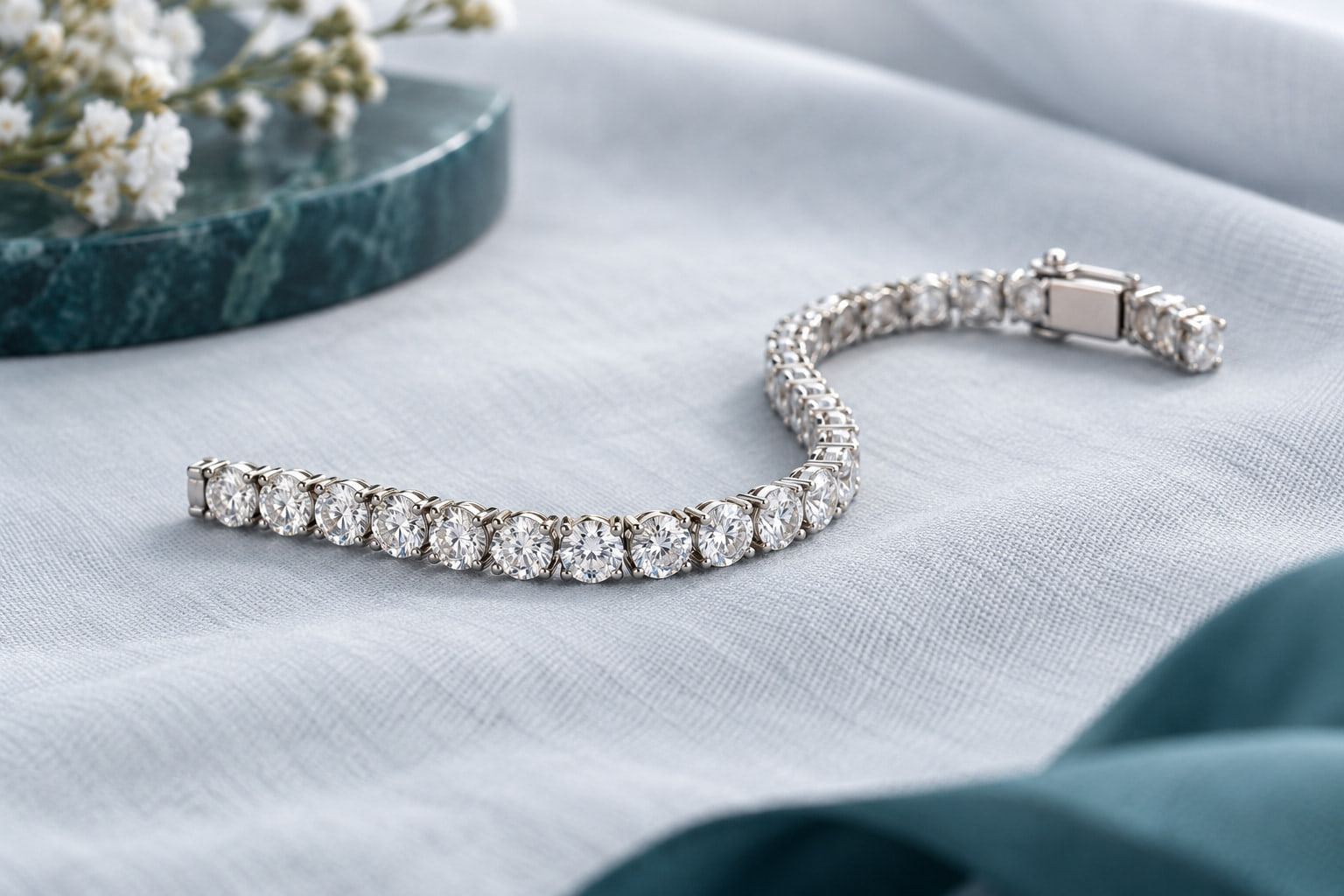
For a 5 ct lab grown diamond tennis bracelet, specify finished length, link count, stone count, individual size window, setting structure and clasp before purchasing loose stones. Five carats is the combined diamond weight, not the weight of each stone. Different counts can produce the same total with different visual scale, flexibility and repair requirements. Request a consistent appearance across the whole row and retain matching replacement stones. Approve an actual bracelet sample for articulation, snag points, clasp behavior and fit. A diamond sourcing partner can coordinate calibrated stones, but finished-bracelet engineering and closure validation belong to the maker unless another scope is explicitly agreed. Confirm the actual total weight and clear laboratory-grown description in the final handover.
How Should Five Total Carats Be Translated Into a Bracelet Specification?
Begin with the intended finished length and the maker's link design. Determine how much of that length belongs to the clasp and connections, then model the stone-bearing section. Do not divide the full bracelet length by a nominal stone diameter and assume the result is a workable link count. Metal gaps and articulation occupy space too.
For a uniform single row, divide the target total weight by the planned stone count to obtain an average planning weight. That is a budgeting and selection input, not a guaranteed diameter. The actual weight of each stone depends on its dimensions and proportions, so the supplier must confirm the measured parcel and the maker must confirm fit.
Ask whether the product promise is exactly five carats, a minimum total or an accurately stated approximate category under the applicable sales requirements. Do not invent a disclosure tolerance here. Agree the final weight wording with the responsible business and verify it from the actual stone schedule.
Use our round melee specifications for the repeated stone requirement and everyday jewelry planning for the wearing context. A bracelet sourced as a long row needs tighter visual continuity than a loose-stone assortment that will be used across unrelated products.
Fewer Larger Stones VS More Smaller Stones: What Changes at 5 Ct?
The same total weight can support different designs. The comparison below assumes uniform stones for planning, without asserting that either layout will reach a particular finished length. The maker must test the actual links and clasp before the buyer chooses a count.
| Design issue | Fewer larger stones | More smaller stones | What to verify |
|---|---|---|---|
| Visual rhythm | Broader repeated flashes and larger individual seats | Finer repeated rhythm and more seats | Finished sample at normal scale |
| Link geometry | Each link may occupy more space | More connections must fit the intended length | CAD pitch and articulation |
| Weight allocation | Higher average weight per stone | Lower average weight per stone | Actual count and measured weights |
| Setting work | Fewer seats, potentially different structure | More seats and repeated setting operations | Maker quotation and process |
| Repair continuity | Need a match for a larger seat | Need a match for a smaller calibrated seat | Retained dimension and reserve records |
| Length changes | Removing a link changes a larger segment | Smaller increments may be possible | Actual maker resizing method |
Compare the full finished cost rather than only the loose-diamond total. Extra seats and connections can change manufacturing cost. A different link count may also change how the row bends around the wrist. Those are reasons to obtain a prototype, not reasons to declare one count universally superior.
If the proposed design changes, ask whether the approved stone parcel still fits. Keeping five total carats constant does not preserve individual seat dimensions. A quotation for calibrated parcels should remain tied to the current link revision, not just the retail weight category.
What Must Be Consistent Across the Entire Tennis Bracelet Row?
Inspect the row as a continuous visual object. Broad color or clarity descriptions can narrow the search, but they do not guarantee that every stone has the same face-up character. Ask for an appearance reference and review outliers under neutral light before setting. A single noticeably different stone can interrupt the rhythm of a long uniform line.
Control diameter, depth and girdle condition against the maker's seat requirements. A stone that is wider or deeper than the accepted range may require a bench adjustment that changes spacing or profile. Record the permitted window in measured terms rather than a general commercial size label.
Request a short set strip or representative link group before releasing the whole production quantity. Review top and side views, stone height and metal intervals. Then inspect the full first article because a short strip cannot show the clasp relationship or the complete bend around a wrist.
The GIA care guidance explains that a loose diamond can wear through metal and that scratch resistance does not prevent all damage. A bracelet has many repeated settings, so final inspection and service instructions matter. Have the maker define its setting-security and articulation checks and keep a reviewable record of the first article.
How Does a Buyer Calculate a 5 Ct Bracelet Order and Reserve?
Hypothetical project, the Fifty-Link Line: a maker proposes fifty stone-bearing links and a separate clasp for a bracelet. A five-carat target divided by fifty stones gives 0.10 ct average per stone. That is an arithmetic planning result, not a fixed diameter recommendation. The maker and supplier must still agree the dimensions that fit each seat.
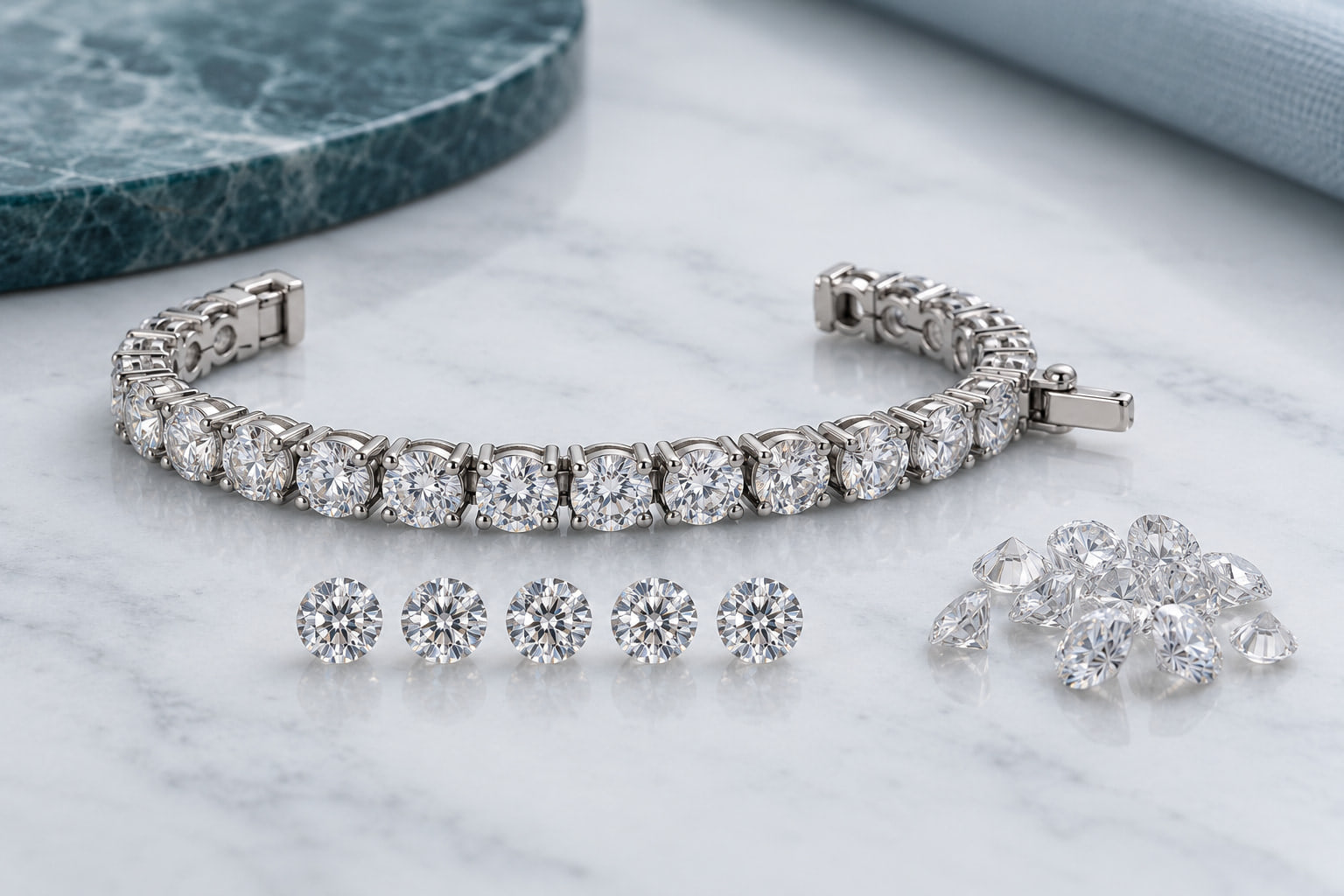
The brand plans forty bracelets. Fifty stones per bracelet multiplied by forty gives 2,000 production stones. It chooses a reserve of one hundred matching stones, making 2,100 accepted pieces required. At the hypothetical 0.10 ct average, the accepted supply would total about 210 ct, including 200 ct for production and 10 ct for reserves. Actual weights must be measured and reconciled.
Now consider an alternative sixty-stone design. Five divided by sixty gives approximately 0.0833 ct per stone. Forty bracelets would require 2,400 production stones before reserves. The alternative changes the seat count by four hundred, even though the finished line still targets five total carats per bracelet. Manufacturing and inspection quotes must reflect that difference.
MEITUO can coordinate candidate laboratory-grown stone parcels against the approved count and dimension window. Ask for accepted-piece quantities, actual parcel weight, screening scope and a separate reserve lot. Do not buy a bulk weight first and assume it will yield the desired number of fully matched bracelets.
At the workshop, issue stones by bracelet batch and record consumption, rejects and unused returns. If the final weight of a particular bracelet differs from the proposed retail description, correct the handover rather than averaging across the whole production order. Each sold item needs an accurate description.
Which Supplier-Market Questions Matter for a Five-Carat Bracelet Line?
A long repeated row rewards suppliers that can preserve calibration and appearance through quantity. Establish whether the offer is for loose diamonds, a stone-and-setting package or finished jewelry. A broad product photograph should not replace a written scope and acceptance process.
USA / Accepted-size continuity
Can a US Trade Channel Replenish a Complete Bracelet Row?
A US trade source can be useful for replenishment and repairs, but a five-carat bracelet needs a consistent individual seat size rather than an arbitrary quantity of small diamonds. Stuller's laboratory-grown resource page confirms a loose-stone offering, not the availability of your complete calibrated row. A domestic sales channel also does not establish US growth origin.
Ask whether the supplier can identify the accepted parcel on repeat invoices and provide a matching reserve before the first production run. Confirm whether returns or re-sorting remain possible once the workshop begins setting. Keep the agreed dimension window attached to the order rather than relying on a catalog category name.
For a retailer receiving finished bracelets from another maker, request that maker's link, clasp and final inspection records separately. A trade diamond supplier's description does not validate the finished mechanism. For repair, send the actual seat dimensions and the original reference, then inspect the replacement in the row rather than accepting a paper-grade match alone.
CHINA / Parcel and reserve planning
How Should a Chinese Sourcing Coordinator Handle Long-Row Consistency?
MEITUO's Qingdao sourcing coordination can help organize a repeated stone requirement when the buyer supplies the validated link dimensions. Request a measured parcel distribution, accepted count and appearance reference. Identify who performs final sorting and how out-of-window stones are removed before dispatch.
For a forty-bracelet program, quote the production parcel and matching reserve as separate lines. Ask whether reserve stones can be selected alongside the main lot rather than sourced later from an unrelated parcel. If multiple upstream lots are needed, review their appearance together and preserve their identities through packing.
Do not describe five total carats as the only specification. The coordinator needs stone count and individual fit limits to obtain meaningful responses. Confirm whether the quotation covers loose diamonds only and keep the actual validated link and clasp engineering with the finished-jewelry maker. A clear scope prevents a coordinated stone order from being mistaken for a validated finished-bracelet offering.
INDIA / Row selection and lot records
What Should an Indian Parcel Offer Show for a Repeated Bracelet Line?
When researching Indian channels, identify the entity selling the parcel and the contact responsible for its selection. Greenlab's official contact page lists Surat and Mumbai locations, illustrating why technical and commercial questions may need different contacts. It does not establish stock for a particular five-carat bracelet program.
Ask whether the quoted stones have been selected to one measured window and visual reference, or are a broader commercial category that still needs sorting. Request actual count and weight so the buyer can reconcile both the number of seats and the intended total weight. A per-carat offer alone may leave a production shortage unexplained.
For replenishment, confirm how a new lot will be compared with the original reference and whether matching reserve stock can be retained. Require approval before substituting a different diameter or depth distribution. The export packing schedule should preserve sublot identities so the receiving workshop can inspect consistency before combining the stones into the bracelet production stock.
How Should a Buyer Approve Length, Articulation and the Clasp?
Inspect finished length using the agreed method and state whether the retail dimension includes the clasp. Compare the sample on a representative wrist form and review how it drapes. A straight tabletop measurement alone cannot establish wearing comfort or the effect of a stiff link section.
Open and close the clasp through the maker's defined review process. Check alignment, access and the relationship to adjacent links. Any safety or closure claim should come from the actual design and validation, not a generic belief that all tennis bracelets use equivalent hardware. Record the sample revision and the responsible maker.
Review potential snag points and sharp transitions, especially where the row meets the clasp. Inspect stone security and row consistency after the articulation trial. If a correction changes link spacing or seat dimensions, revise both the drawing and the diamond specification before volume production.
Prepare the customer description with clear laboratory-grown origin. The FTC diamond disclosure guidance emphasizes origin disclosure near product descriptions. Keep total diamond weight, length and any service statement equally understandable. Use our repeat-order planning guide to preserve the specification and reserve history behind the line.
For a length-change request, ask the maker how removed links and stones will be identified and stored. They may be useful service material, but should not be added to the retail mounted-weight statement. If the design uses a different end link near the clasp, do not assume a stone from that position is interchangeable with the main row.
After shortening or repair, repeat the relevant closure, articulation and visual checks. Record the new finished length and actual mounted stone schedule. A customer's old invoice can remain part of the history while a service record describes the current bracelet accurately. This avoids a later replacement search based on a configuration the customer no longer owns.
How Can MEITUO Support a Calibrated Bracelet Stone Program?
MEITUO is a sourcing and supply-chain coordination partner based in Qingdao, Shandong, China. It works with jewelry brands, wholesalers, retailers and designers on product selection, supplier communication, confirmation of quality requirements and order follow-up. For a tennis bracelet line, the useful brief includes accepted stone count, dimensions, appearance reference and reserve requirements.
The sourcing range covers loose centers, melee, side stones, matched pairs and sets, and fancy-color options. A repeated round-stone line may draw on calibrated parcel selection, but the actual size distribution and documents must be confirmed for the proposed goods. MEITUO should not be assumed to manufacture the links, engineer the clasp or supply a finished bracelet through this sourcing role.
Contact [email protected] with the current link drawing and production plan. Ask for order-specific availability, MOQ, lead time, treatment information and shipping terms. Keep final articulation, closure and finished-jewelry approval with the maker, while preserving one controlled stone specification through the sourcing process.
What Should a 5 Ct Tennis Bracelet Diamond RFQ Include?
Include the planned finished length, number of stone-bearing links and a separate clasp allowance. Provide measured diameter and depth limits, condition criteria, appearance reference and the accepted count per bracelet. State whether total weight is a target or a minimum and who verifies the final item description.
Request quotations by accepted piece and actual weight so the buyer can reconcile both production seats and the finished weight promise. Keep reserves separate and specify how shortage, dimensional outliers or visible mismatches will be remedied before setting.
For a repeat line, ask whether matching parcels can be selected again and what evidence will accompany the new lot. The purpose of the RFQ is a reproducible stone program that fits a validated bracelet design, not merely enough loose carats to reach a headline total.
Please quote loose laboratory-grown diamonds for a [finished length] tennis bracelet with [stone-bearing link count] stones and a target total of [weight basis] per item. We plan [bracelet quantity], requiring [accepted production count] plus [matching reserve count]. Provide [diameter and depth windows], appearance reference, condition criteria and actual parcel count and weight. Identify screening scope, available documents and treatment information. Quote sorting and shortage remedies and require written approval for substitutions. Confirm MOQ, lead time and shipping terms. Link articulation, clasp validation and final item weight disclosure will be approved with the finished-jewelry maker separately.
FAQ: 5 Ct Lab-Grown Diamond Tennis Bracelets: Planning the Line
Does 5 Ct Mean Each Bracelet Stone Weighs Five Carats?
No. In this context it refers to combined diamond weight. The individual stone weight depends on the count and actual parcel. State center or individual weights separately if the design includes different stone roles.
How Many Stones Belong in a Five-Carat Bracelet?
There is no universal count. Finished length, link pitch, clasp allowance and desired visual scale determine the design. Divide the weight target by a proposed count for planning, then verify actual dimensions and prototype fit.
Can One Parcel Be Chosen Only by Total Weight?
That is insufficient for controlled production. The buyer also needs accepted count, diameter, depth, appearance and condition criteria so the stones fill the validated seats consistently.
Should the Repair Reserve Be Part of the Retail Total?
No. Reserve stock is separate inventory and is not mounted in the sold item. Record production consumption and final item weight independently from the purchased bulk parcel.
Who Validates the Clasp and Flexibility?
The finished-jewelry maker should define and perform the relevant checks on the actual design. A loose-diamond sourcing partner should not be assumed to validate mechanical performance.
Can a Replacement Match Only by Reported Color and Clarity?
Those labels help narrow the search but do not establish fit or visual continuity. Compare dimensions, depth and face-up appearance against the actual row and retained reference.