 English
 Español
 Português
 Deutsch
 Français
 Italiano
 Nederlands
 العربية
 日本語
 한국어
 ไทย

Quick Answer
How transparent is lab grown diamond marketing? It depends on whether the seller clearly states laboratory-grown origin, describes the actual product and supports additional claims with relevant evidence. A report reference can support facts about a stone, but it does not automatically substantiate renewable energy, labor practices, resale value or a complete jewelry specification. Audit each claim separately. Ask who made it, which goods it covers, when the evidence was issued and what its limitations are. Then preserve accurate disclosures in the headline, filters, invoice and after-sale documents. Transparency is strongest when a customer can understand what is being bought without interpreting ambiguous terms or searching for qualifications hidden elsewhere. Procurement should approve both the product and the evidence behind its advertised description.
What Does Transparent Lab-Grown Diamond Marketing Disclose?
Begin with identity and scope. Is the offer a loose laboratory-grown diamond, a matched pair, a parcel or a finished jewelry article? Does a quoted weight describe the center, one earring or the entire pair? Which metal and accents are included? These details should be settled before broader brand language is considered.
For US-facing selling, FTC jewelry guidance is a primary reference for accurate material descriptions and weight representations. The practical editorial rule is to make the laboratory-grown origin easy to understand wherever the product is first presented. An abbreviated internal SKU should not become a confusing consumer title simply because it is convenient for a supplier database.
Map each sentence to an evidence category. Identity and quality belong with stone-level records. Availability belongs with current allocation. A delivery promise belongs with an order plan. Environmental and social claims belong with separate documentation covering the relevant operations. Do not let a single report logo act as a badge for all these categories.
Assign an internal owner to approve the final customer wording. Procurement may understand that a supplier phrase is only a proposal, while marketing treats it as verified fact. A shared claim register prevents that handoff from silently strengthening language beyond what the evidence supports.
Evidence-Backed Disclosure Versus Vague Marketing: What Changes?
A claim is useful when its boundary is visible. Specificity does not make weak evidence strong, but it makes the evidence request actionable. The comparison below shows how to turn a phrase into a purchasing question without assuming that every seller using the phrase has acted deceptively.
Use the register as a working file. Record the approved sentence, source document, covered goods, review date and responsible person. If the evidence is not available, narrow or remove the claim before publication rather than treating a pending supplier reply as approval.
| Claim area | Vague statement | More transparent treatment |
|---|---|---|
| Origin | Real diamond, with no origin wording | Identify laboratory-grown diamond close to the product name |
| Weight | Two-carat earrings | State whether 2 ct is per stone or total for the pair |
| Quality evidence | Certified quality | Name the laboratory and service; link the actual relevant record |
| Environmental benefit | Eco-friendly diamond | State a specific substantiated benefit and its covered operations |
| Availability | Ready stock | Confirm allocation, actual item references and release conditions |
| Value | Holds its value | Explain the actual return or trade-in contract without implying resale certainty |
| Treatment | Untreated by default | Request the relevant information and service scope rather than infer from silence |
A stronger claim needs stronger supporting material. A broad promise covering the whole supply chain cannot be justified by a document that covers only one site or a different reporting period.
How Do You Audit a Supplier Claim Before Publishing It?
Consider a hypothetical brand preparing 40 engagement-ring listings. The supplier spreadsheet says certified, sustainable and two carat. Procurement should create three separate tasks. First, identify the laboratory service and match the records to the selected centers. Second, request the specific environmental evidence and covered operations. Third, confirm whether two carat refers to the center or the complete ring.
Suppose the supplier provides center-stone reports but only a company brochure for sustainability. The brand can publish the supported stone details while withholding the broader environmental claim. It should not delay every factual attribute, nor should it imply that a quality document fills the environmental gap. The distinction lets useful information move forward without overstatement.
If the ring has a 1.80 ct center and 0.20 ct of accents, rewrite the specification to distinguish those weights. Add the metal specification and any relevant limitations of the visual images. Record which photographs show the actual piece and which are representative of a design. A shopper should not have to infer the center weight from a total.
MEITUO can help coordinate the supplier questions behind this exercise. Use the RFQ guide to request evidence in a structured format and the supplier qualification guide to evaluate incomplete or inconsistent responses.
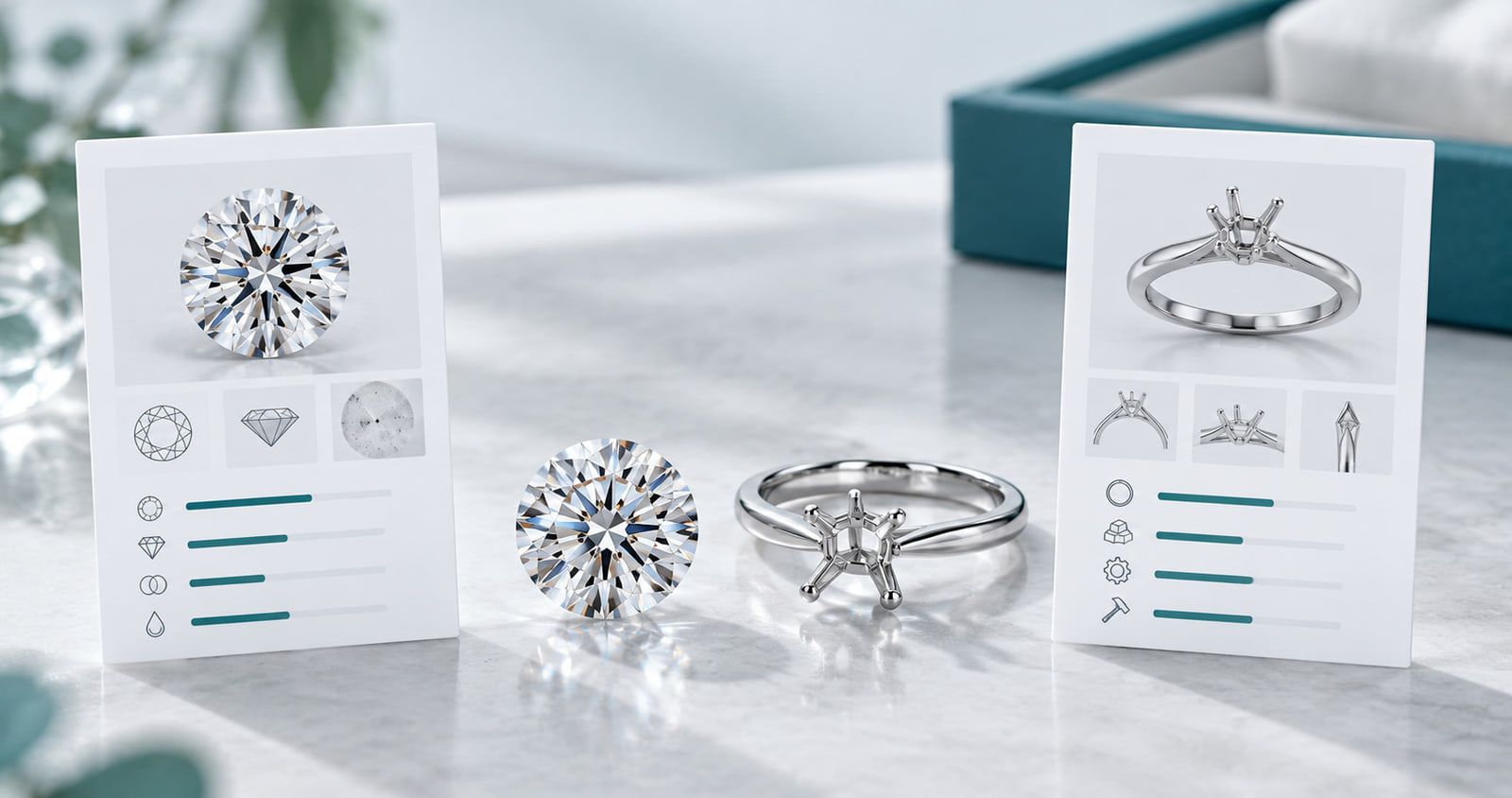
What Can Reports and Environmental Evidence Actually Establish?
Read the service description instead of relying on the word certificate. IGI’s report page states that growth-process and treatment comments are available upon request. An omitted comment is therefore not a sound basis for inventing a treatment conclusion. Request the information needed for the buying decision and verify the selected document’s actual content.
Similarly, environmental evidence needs its own scope. FTC Green Guides guidance cautions against broad unqualified environmental benefit claims and calls for specific substantiation. A renewable-electricity statement about one growing site does not automatically describe cutting, polishing, metal production, setting or shipping. If a seller uses a seal, identify who issued it and what it evaluates.
Do not convert a company’s stated ambition into a completed result. Distinguish targets, purchased instruments, measured performance and independent verification. If evidence covers a time period, retain that period in the internal record and review whether it still applies to current goods. A carefully qualified statement can be more informative than a sweeping green label.
The same discipline applies to social claims. Ask which businesses and activities are covered by an audit or policy. A supplier code of conduct can describe expectations without proving every upstream operation complied. Keep the difference visible when writing the customer explanation.
How Do Transparent Disclosures Survive Feeds, Filters and Sales Scripts?
Audit the whole route from supplier file to customer receipt. A correct product description may be shortened in a mobile card, stripped in a marketplace feed or contradicted by a sales script. The first visible product label should preserve the origin information the buyer needs, rather than relying on a later paragraph to repair a misleading impression.
Create controlled fields for material, origin, center weight, total weight, metal and document reference. Avoid putting every fact into a single free-text field that different channels truncate differently. For online retail programs, test the category filter and checkout summary as well as the product page.
For a mixed assortment, label loose centers and melee parcels according to their actual documentation and quantity structure. A report for one center should not be presented as an individual report for every accent in a collection.
Set a change-control rule. A substituted stone, altered total weight or revised supplier claim should trigger a product-data review before sale. Preserve the prior approved wording and the reason for the change. When a customer raises a discrepancy, correct the affected listing and trace whether the same data was exported to other channels, rather than fixing only the page first reported.
How Should Buyers Qualify Suppliers in the USA, China and India?
Marketing evidence can pass through several businesses before reaching a product page. Identify the original claim maker, the goods covered and the person responsible for updates. These market questions concern how a seller supplies and preserves usable evidence, rather than whether a country or a sales address deserves a blanket trust label.
USA / CUSTOMER DISCLOSURE
What Should a US-Facing Retailer Verify Before Using Supplier Claims?
For US-facing listings, assign someone to review product wording against the actual goods and applicable primary guidance. Ask the supplier for full material descriptions, weight scope and evidence references in exportable fields. A wholesaler’s shorthand may be suitable for a trade discussion but unsuitable as a consumer headline.
Check the retail journey on mobile and in marketplace feeds. Does laboratory-grown origin remain visible? Is total weight clearly different from center weight? Does a document link lead to the relevant stone rather than a generic laboratory homepage? These checks are especially useful when a catalogue contains natural diamonds, laboratory-grown diamonds and simulants together.
Ask the seller to notify you before any substitution or claim revision. A distributor’s environmental brochure should be evaluated separately from its stone-level data. If a trade-in benefit is part of the offer, retain the actual terms and avoid describing it as open-market resale certainty. The most useful supplier is one that can answer the precise evidence question for the goods being purchased.
Stuller documents a trade-only US channel. Qualify the particular offer independently.
CHINA / SUPPLIER RECORDS
How Should China-Based Sourcing Turn Marketing Language Into Evidence?
When a China-based counterparty coordinates several suppliers, ask it to identify the source and scope of each claim. A single sales presentation may combine information from different producers, cutters or service providers. The buyer needs to know which statements apply to the proposed order and which describe a broader company capability.
Request a claim register with the stone or parcel references, document links and any limitations. If a supplier says renewable energy or no treatment, ask what supports that wording and whether the evidence covers the actual goods. Preserve the original response instead of translating it into a stronger English marketing phrase without review.
MEITUO is a sourcing and supply-chain coordination partner in Qingdao, Shandong. Its role can include organizing supplier questions and confirming quality requirements, but that role should not be presented as independent verification of every upstream claim. Confirm availability, document options, treatment information and commercial terms per order. Publish only the claims that the buyer’s evidence review supports.
GIA’s 2024 review documents Chinese HPHT melee production. This industry context does not verify a specific seller.
INDIA / CLAIM BOUNDARIES
What Should an India-Based Seller Clarify in a Transparent Offer?
An India-based seller should identify whether its statements concern growing, cutting, polished stock selection or export supply. Ask which company performed each relevant operation and which goods the supporting evidence covers. A seller’s location does not establish the origin of every stone or the scope of a laboratory record.
For a polished-center offer, request the actual item references, measurements, origin description and chosen assessment service. If environmental information concerns a growing operation, ask how that operation is linked to the selected goods. Do not treat a cutting company’s general policy as a measured result for an unrelated grower.
Agree how supplier data will be used in customer listings and what changes require notice. A practical response includes precise wording the buyer can verify, rather than an instruction to use a logo freely. Keep document authenticity, stone identity and marketing permission as separate checks. This helps a retailer preserve an accurate description when an inventory feed is updated or a substitute stone is offered.
GreenLab lists Surat manufacturing and a Mumbai office. Distinguish those roles in any supplier comparison.
How Can MEITUO Support This Sourcing Decision?
MEITUO supports jewelry brands, wholesalers, retailers and designers as a sourcing and supply-chain coordination partner in Qingdao, Shandong, China. For marketing transparency, its useful contribution begins before copywriting: helping buyers ask suppliers for clear product scope, quality requirements and order-specific information.
The product range covers loose center stones, melee, side stones, matched pairs and sets, and fancy-color options. Buyers can request information appropriate to each category instead of assuming that one center-stone report describes a complete collection. MEITUO supports product selection, supplier coordination, quality-requirement confirmation and order follow-up, while independent laboratories remain responsible for their own services and reports.
Availability, documents, MOQ, lead time, treatment information and shipping terms require confirmation per order. Send [email protected] the proposed product description and the evidence questions behind it. The buyer should approve final customer claims only after reviewing the relevant records. Sourcing coordination does not itself certify environmental performance, labor conditions, resale value or every statement supplied by another business.
What Should Your Purchasing Brief and Acceptance Record Contain?
Before release, compare the approved product wording with the invoice, packing labels and actual selection. Resolve missing evidence by narrowing the claim or obtaining the appropriate record. Do not mark a pending reply as verified. Keep the claim register accessible to customer service so staff can explain the same facts the product page presents.
At each reorder, check whether the supplier, document service, specification or environmental evidence has changed. A previous approval does not automatically cover a new assortment. Record the review date and the person who approved the current wording. The brief below turns a general request for transparency into concrete deliverables that a supplier can answer.
Please supply [product and quantity] with explicit laboratory-grown origin, center and total weights, measurements, metal or accent scope where relevant, and actual item or parcel references. Provide the laboratory service and document links applicable to these goods. For every proposed environmental, social, treatment, availability or value claim, identify the evidence, covered operations, reporting period and limitations. Confirm approved customer wording, update obligations and substitution controls. State MOQ, lead time, shipping terms and discrepancy remedies. Unsupported claims must remain excluded from the final product description. Please identify the contact who will resolve evidence gaps before order release.
FAQ: Lab-Grown Diamond Marketing Transparency: A Buyer’s Checklist
Does a Laboratory Report Substantiate Sustainable Marketing?
Not automatically. A stone report and environmental evidence serve different purposes. Read the actual service scope and request separate records for energy, emissions or supply-chain claims. Do not use a grading logo as a substitute for the evidence behind a broader sustainability statement.
What Is the First Disclosure to Check?
Check that laboratory-grown origin is clear where the product is presented. Then confirm material, weight scope and what the offer includes. Additional claims should be assessed individually rather than allowed to obscure the basic identity of the goods.
Can a Retailer Repeat a Supplier’s Environmental Claim?
Only after assessing relevant substantiation and the final wording. Ask what operations, goods and time period are covered. A supplier brochure or policy may be useful background, but it is not automatically evidence for every item in a retail collection.
Is a Missing Treatment Comment Proof of No Treatment?
No. Read the selected laboratory service and ask for the information needed. Some comments depend on the service or request. Do not infer a universal untreated claim from silence in a document or a shortened supplier inventory field.
How Should Total Carat Weight Be Presented?
Make the scope clear, especially for earrings and multi-stone rings. Distinguish the center stone from accents and one item from a pair. Keep the product title, specification table and invoice consistent so customers can compare equivalent offers.
What if a Claim Cannot Be Verified Before Launch?
Remove or narrow the unsupported claim while retaining accurate supported details. Record the outstanding question and review any later evidence before revising the listing. Publishing an attractive assertion while waiting for proof reverses the intended evidence process.