 English
 Español
 Português
 Deutsch
 Français
 Italiano
 Nederlands
 العربية
 日本語
 한국어
 ไทย
Quick Answer
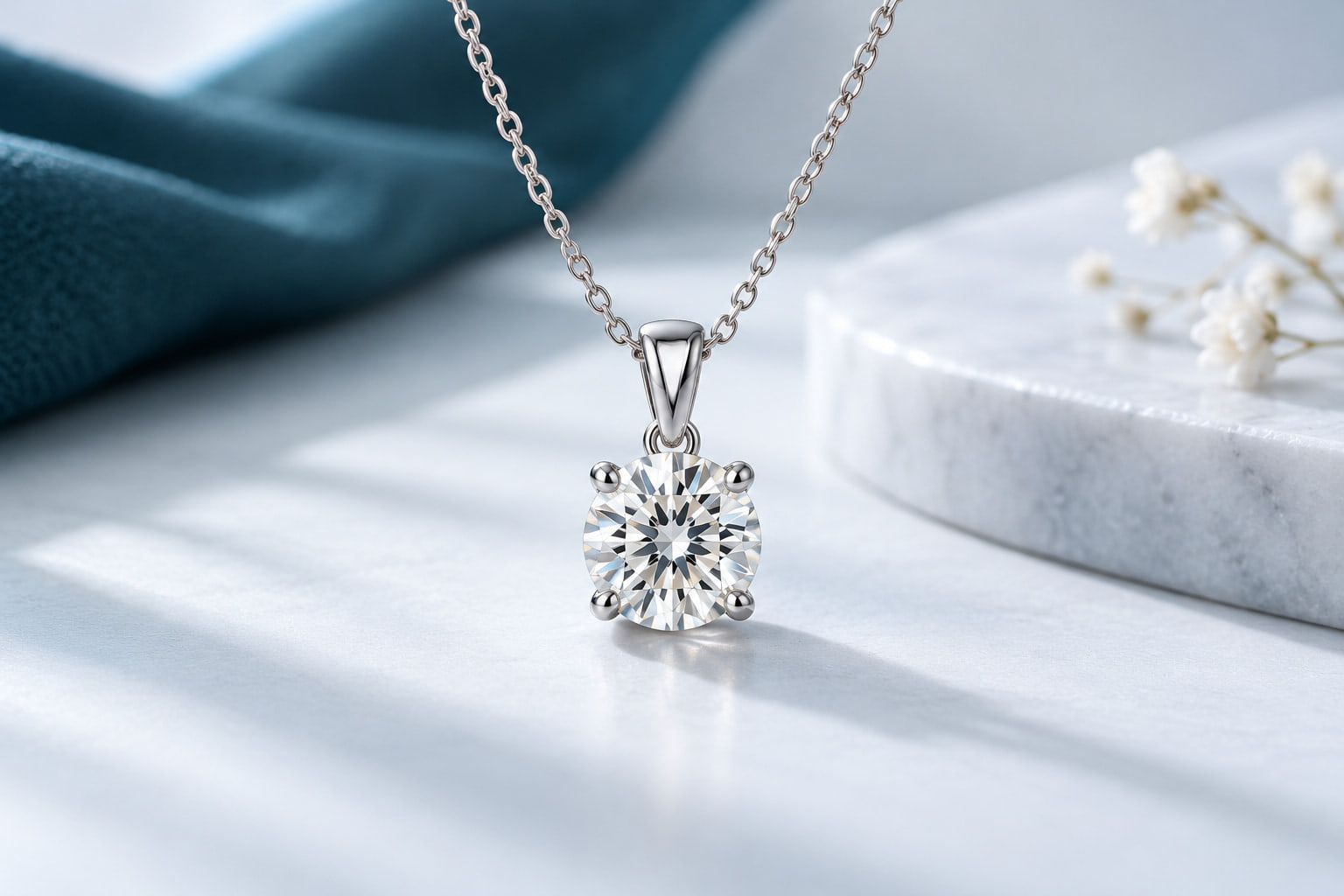
Choose a lab grown diamond solitaire pendant by the center stone's actual dimensions and the approved bail-and-chain interface. Carat weight helps describe the stone but does not establish pendant height, facing direction or chain compatibility. Ask the jewelry maker to show the suspension axis, the back of the head and the complete chain end fittings. Review a physical sample at the intended scale, including how it settles when worn and whether the bail allows the desired movement. Then order loose centers against that accepted geometry. Keep the diamond, empty mount, chain and completed assembly separate in the quotation so the buyer knows who supplies and approves each component and who handles a later repair.
Why Does the Bail Axis Matter for a Solitaire Pendant?
The bail is the connection through which the pendant hangs from its chain. Its position relative to the stone and head defines an important part of the suspension layout. Ask for a side drawing that identifies the chain centerline and the complete pendant profile. A face-up render alone can hide a deep basket or a bail that projects farther backward than the buyer expects.
Decide whether the collection wants a visibly separate bail, a bail integrated into the head or a concealed passage. Treat these as different component specifications. The maker should explain the intended movement of each, including whether the pendant can pivot or slide. Do not assume a concealed attachment automatically produces better balance or that a larger bail is required for a heavier-looking center.
During sample review, note where the pendant rests and whether it returns to the intended facing direction after gentle repositioning. These are observed outcomes for that sample and chain. If the head consistently tips, have the maker review the suspension geometry before changing the stone specification. A supplier should not promise that a particular clarity or growth process will correct an assembly problem.
For the diamond itself, begin with the loose center-stone range and narrow the request by outline, dimensions and appearance. Preserve those actual measurements alongside the suspension drawing so the two decisions remain connected.
Separate Bail VS Integrated Passage: How Do Offers Differ?
| Criterion | Separate visible bail | Integrated chain passage |
|---|---|---|
| Visual brief | Bail contributes to the overall silhouette | Chain interface is partly concealed within the head |
| Dimension to confirm | Internal opening, outer profile and connection to head | Passage route, entry shape and available chain clearance |
| Movement review | Check bail-to-head articulation and facing direction | Check sliding behavior and head orientation on the chain |
| Assembly question | Can the completed chain pass through the bail? | Must the chain be installed before its end fittings? |
| Service question | Can a damaged bail be serviced separately? | Does passage damage require work on the entire head? |
These are questions for the maker, not guaranteed characteristics. Two apparently similar bails may have different internal shapes, and two integrated passages may use different assembly sequences. Compare quotations using actual drawings rather than counting visible metal parts.
Include the full pendant height in merchandising dimensions. If only the stone's length is shown, the customer cannot infer the total drop including the bail. A small center with a prominent bail and a larger center with a concealed passage can have similar outer heights while communicating very different proportions. Approve the silhouette at actual display size.
Which Chain Details Belong in the Center-Stone Brief?
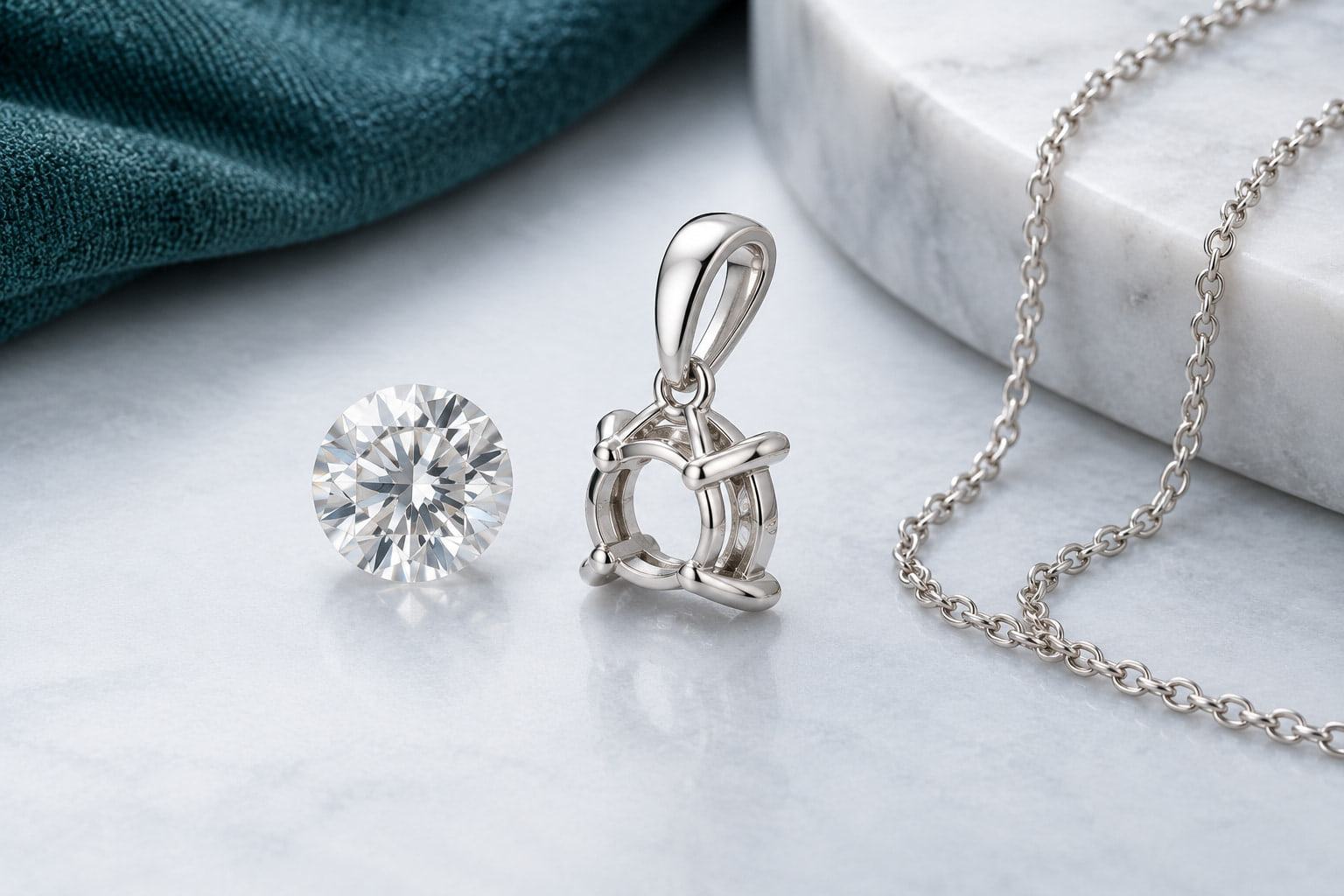
Provide the chain style and the maximum cross-section of the parts that must pass through the opening. A chain body dimension alone is incomplete when the clasp, end ring or tag is larger. Ask the maker to mark the assembly route and show whether removal is possible without opening another component. The buyer should understand this before promising customers easy chain changes.
Compare the pendant on the exact chain reference intended for sale. A display chain borrowed for photography may be visually useful but cannot validate the production interface. Record length, component identity and any alternative chain references separately. If the launch offers two chain sizes, review both rather than assuming the smaller one represents the entire range.
Inspect the front-to-back clearance with the actual stone depth. An accepted face-up outline does not show how the pavilion occupies the basket. Where the maker proposes a deeper head, review the side silhouette and worn sample again. The relevant question is whether the revised combination meets the brief, not whether extra depth is inherently good or bad.
The component scope guide helps separate sourcing tasks. A loose diamond coordinator needs the accepted fit window; the jewelry producer needs to validate the bail, chain and head as an assembly. Keep each party's approval in the same project file.
Hypothetical Example: Equal Centers, Different Pendant Drops
An illustrative retailer compares two solitaire pendant concepts using the same accepted 6.5 mm round center. Concept A has a visible bail extending 4.0 mm above the head; concept B integrates its suspension behind the head and extends only 1.5 mm above it. For this simplified drawing exercise, the head itself is 7.0 mm tall. The resulting outer drops are 11.0 mm and 8.5 mm. These invented measurements describe a silhouette comparison, not universal pendant proportions.
The 2.5 mm difference is about 23 percent of concept A's outer drop. It changes the visual relationship between stone and suspension even though the diamond is identical. The buying team therefore evaluates actual-scale front images instead of assuming that equal center weight produces equivalent pendant scale. It records outer height separately from the center's diameter in its product data.
The side sample introduces a second decision. Concept B's concealed suspension sits behind the accepted head profile, and the first prototype settles with the stone face tilted forward. The maker compares the suspension axis and the complete head, then proposes moving the attachment rather than replacing the center. The buyer asks for a revised side drawing and another sample observation on the same chain.
The accepted revision preserves the 8.5 mm outer drop while changing the attachment location. The project file records both the silhouette calculation and the observed facing improvement. No numeric balance guarantee is inferred from the drawing. If a later supplier proposes a deeper center, the side approval is reopened because the original sample no longer represents the full geometry.
Where Should Pendant Buyers Obtain the Relevant Evidence?
Choose a channel according to the missing part of the specification. A loose center offer, an empty mount listing and a completed necklace each answer different questions. Send all sellers the same scope statement and ask them to identify their own responsibilities for the final bail-and-chain combination.
USA / Component handover
Can a US Retailer Coordinate the Bail With Its Bench?
Stuller is one US loose lab-grown diamond channel. Its loose-stone offering is distinct from approval of your pendant's bail or chosen chain. For a retailer using a separate bench, send the actual center dimensions and component references before the bench accepts an assembly job.
Ask whether the bench needs the physical center before confirming the head. Clarify who receives the loose stone, who checks it on arrival and who retains the paperwork. If the retailer supplies a finished chain, identify whether its end fitting passes through the proposed bail or whether another assembly operation is required.
For service, document whether the pendant can be removed from the chain and which party can repair its bail. A customer-facing promise about chain interchangeability should follow the accepted sample. Retain a photograph of the actual combination in the product record so a later store employee can identify the correct chain version when arranging a replacement.
CHINA / Stone window tied to head revision
What Should a Qingdao Coordinator Know About Pendant Geometry?
When sourcing through a China-based coordinator, distinguish the accepted stone dimensions from the desired retail weight description. MEITUO's Qingdao team can receive the center requirement and organize supplier responses, but the jewelry maker should establish the pendant head and bail geometry. A generic pendant image does not provide those dimensions.
Attach the actual side profile and identify which chain options share the same head. If the design uses two bail sizes, keep them as separate component references even if the loose center is identical. Ask the coordinator to flag available stones that fall outside the approved depth window rather than sending them as unreviewed equivalents.
Agree how stones are packed for the workshop: individually identified centers for specific mounts, or a measured group accepted for a common head. Keep reserve stones separate from production allocations. At replenishment, refer to the accepted head revision as well as the stone window, since an old center specification can become incompatible after the jewelry producer changes the basket.
INDIA / Actual dimensions before allocation
How Should an Indian Center-Stone Offer Support Pendant Fit?
Greenlab lists Surat manufacturing and Mumbai corporate contacts. When researching Indian loose-center offers, identify the seller and ask for actual measurements of the proposed stones. A weight category alone does not tell the pendant maker whether its accepted head can be used.
For a multi-unit pendant order, review the distribution of depths and outlines before allocating stones to the workshop. If one unusually deep center requires a different head, decide whether to exclude it or approve a separate component version. Avoid allowing a single outlier to change the whole collection without a deliberate review.
Before export handover, request item identities or group labels that survive receiving inspection. Ask how a replacement will be matched if a stone arrives outside the accepted window. Keep commercial and technical contacts identified so a fit issue can be resolved without repeating the entire retail story. The key evidence is the offered center geometry, not a general assurance that it is suitable for pendants.
How Do You Inspect Solitaire Pendants Before Release?
Start with the loose center. Reconcile its identity and actual dimensions with the accepted stone record, and document condition before setting. A plain background and consistent lighting help compare the outline. Where individually documented stones are purchased, preserve the connection between the stone and its paperwork through the workshop handover rather than relying on a later visual guess.
For the completed pendant, inspect the bail opening and chain path, the head's front-facing symmetry and the side silhouette. Request the jewelry maker's retention and connection checks. GIA explains that diamond hardness does not prevent impact damage. The buyer's response is careful handling and condition records, not an unsupported claim of an indestructible pendant.
Repeat the agreed settling observation on the final chain. Record any persistent sideways lean or front-to-back tipping with photographs showing the chain and bail. Ask the maker to diagnose the issue rather than replacing the center at random. If a component revision fixes it, identify that revision in the production order and retain the old sample until the difference is understood.
Before packing, confirm the chain reference, finished length and total pendant dimensions against the sales data. A correct diamond in the wrong chain version still creates a fulfillment error. The repeat-order guide is useful for retaining this relationship across later production runs.
Include a simple packing check for two-chain collections. Place the accepted pendant photograph beside the chain code and verify that the retail description matches the packed item. A longer chain with a different end fitting should not inherit the shorter chain's assembly approval simply because both are sold under one style number. Where staff replace display chains, keep the production chain attached to the inspection record until release.
For a one-off custom center, retain its individual side measurements rather than relying solely on a broad size range. That makes a future replacement discussion more accurate if the original stone or head is unavailable.
How Does MEITUO Support a Solitaire Pendant Stone Order?
MEITUO coordinates sourcing and supply-chain work from Qingdao, Shandong, China for jewelry brands, wholesalers, retailers and designers. For a solitaire pendant, its contribution begins with a clear loose-center requirement: actual dimensions, appearance reference, quantity and the accepted head geometry supplied by the buyer or jewelry maker. Its stated product range includes loose centers, melee, side stones and matched sets.
The team can support product selection, coordinate supplier responses, confirm quality requirements and follow the order. Buyers can ask for the production centers and loose repair reserves to be identified separately. A pendant's bail, chain assembly and final facing behavior should be approved with the jewelry producer under an explicit scope.
Send the center brief and sample revision to [email protected]. Availability, documents, MOQ, treatment information, lead time and shipping terms require confirmation for the specific order. Review jewelry application support when describing the project so the request distinguishes loose-stone coordination from any separately discussed component or finished-jewelry service.
What Should a Solitaire Pendant RFQ Settle First?
State that the design contains one focal stone, then identify the accepted outline and dimensional window. Attach the head and bail drawing, including the overall pendant height. Give each chain option a reference and show the largest part that must pass through the opening. List production and reserve quantities separately, with the required condition and appearance evidence.
Ask suppliers to flag any mismatch between available stones and the maker's fit requirement. A proposed alternative should include actual measurements and a clear explanation of what changes in the head or silhouette. Do not approve a substitution using weight alone. Where multiple parties supply components, identify who reconciles the final bill of materials before assembly begins.
Use the diamond RFQ guide for commercial organization. Add sample approval milestones for the chain interface and facing direction. A complete brief lets the buyer compare the accepted combination rather than collecting unrelated prices for a stone, bail and chain that may not fit together.
Please quote [quantity] loose laboratory-grown centers for a one-stone solitaire pendant using head drawing [revision]. Match [outline and dimension window], accepted appearance reference and documented condition requirements. We also need [reserve quantity] loose replacements. The pendant uses [bail type] with chain references [codes]; flag any proposed stone requiring a different head or side profile. Identify available documents, treatment information, MOQ, lead time and shipping terms. Quote stone supply separately from any findings or assembly. Require written approval for substitutions. The jewelry producer will verify bail opening, full chain interface, retention and completed pendant facing direction.
FAQ: Lab-Grown Diamond Solitaire Pendants: Bail and Balance
Is Solitaire Pendant Weight the Same as Total Necklace Weight?
No. State whether weight refers to the single diamond, any additional diamonds or the metal assembly. A one-center design makes the diamond quantity simple, but the sales wording still needs a clear basis.
Can the Chain Pass Through Every Pendant Bail?
No. The largest end fitting may be wider than the chain body. Review the actual chain and complete bail opening rather than assuming compatibility from a catalog chain thickness.
Does a Concealed Bail Always Keep the Pendant Upright?
No. Facing behavior depends on the accepted assembly. Ask the maker to show the suspension layout and observe the sample on the intended chain before approving it.
Should Reserve Centers Be Mounted Immediately?
Only if that is part of the agreed service plan. Loose reserves and completed spare pendants are different purchases, with different component needs and inventory records.
Can Equal-Carat Centers Use the Same Head?
Not automatically. Actual outline and depth can differ. The jewelry maker should confirm the fit window, and the sourcing team should select against that window.
What Belongs in a Repair Record?
Keep the stone identity, head and bail revisions, chain reference, accepted photographs and service responsibilities. These details help a repair team restore the approved combination rather than guessing from the retail style name.