 English
 Español
 Português
 Deutsch
 Français
 Italiano
 Nederlands
 العربية
 日本語
 한국어
 ไทย
Quick Answer
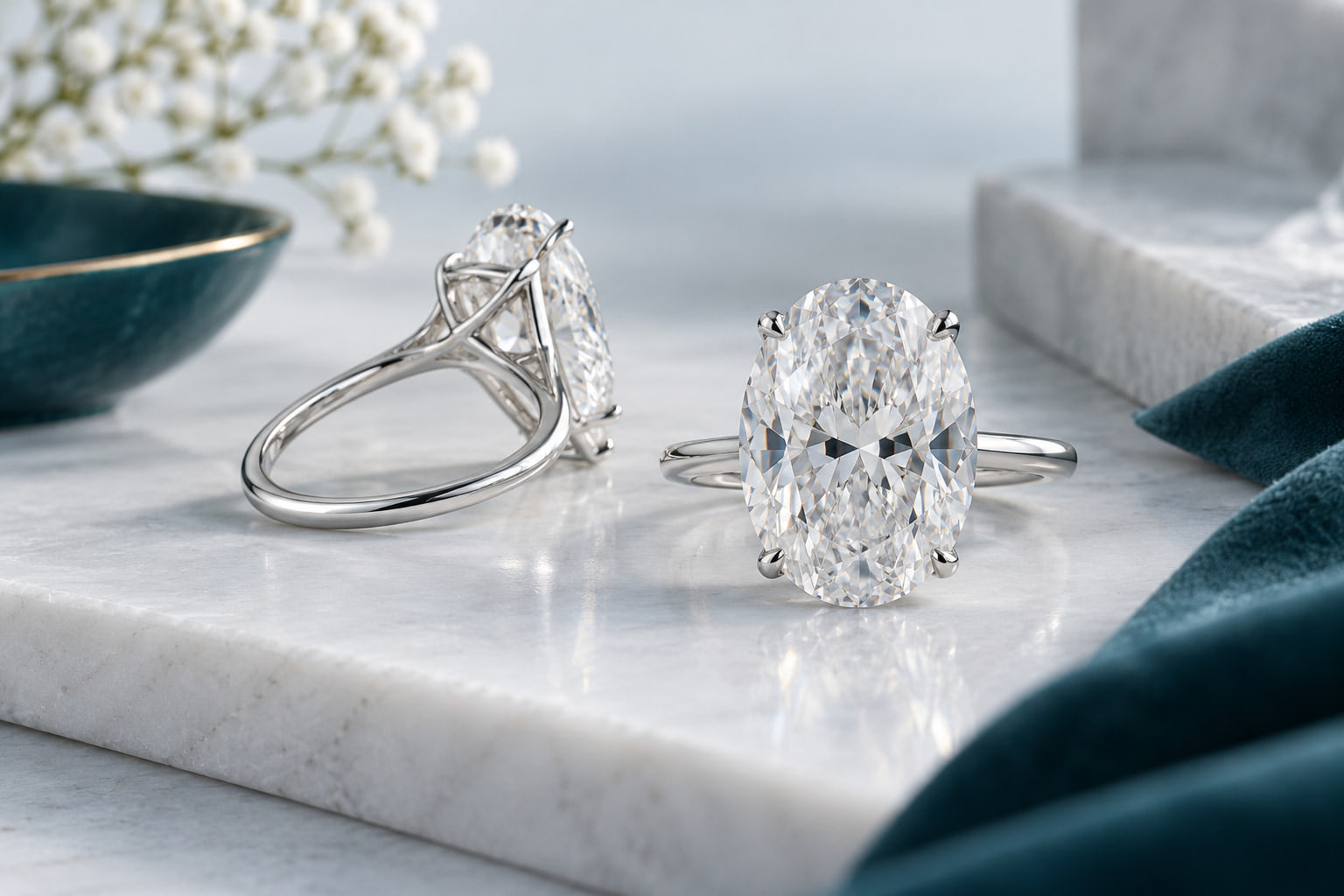
A 4 ct lab-grown diamond is a large-center design decision as well as a stone purchase. Four carats equals 0.80 grams, but the weight does not determine the face-up outline, ring height or comfort of a finished piece. Obtain the actual length, width and depth, then have the setter approve the supporting gallery, contact positions and clearance. Review the center at normal scale and in the proposed mounting rather than judging only a magnified video. For an established design, reserve the actual candidate while engineering checks are completed. A desirable report or a low quotation cannot compensate for a stone that the planned mount does not support. Treat fit, appearance and documentation as separate approvals.
Which Actual Dimensions Matter for a 4 Ct Center?
A metric carat is 200 milligrams, so a four-carat stone weighs 800 milligrams. That conversion does not prescribe a diameter. An elongated shape, a broad shape and a deeper stone can have different visible dimensions at the same weight. Request the measurements of the actual offered item and preserve the report reference with them.
Define the design envelope in three directions. Length and width influence the silhouette and the contact positions; depth affects the space below the stone and the possible gallery profile. Ask the responsible setter which additional features need review, including the shape of the pavilion and the stone's edges at the proposed bearing points. Maximum dimensions alone may not describe every relevant interface.
Use an actual-scale outline with the ring drawing. Do not enlarge every candidate to fill the same presentation box, because that hides size differences. Add a profile view so the designer can compare the stone with the band, shoulders and neighboring wedding band. A convincing top view may conceal an unsuitable projection above the finger.
For an elongated center, establish orientation before choosing a head. East-west and north-south layouts can demand different support decisions even with the same stone. Explore oval options or emerald-cut options according to the brief, then have the actual candidate reviewed. A four-carat category is not a universal mounting specification.
How Should a Buyer Review Large-Center Wearability Before Production?
Begin with the intended wearer and use context. A statement ring and a daily bridal ring may justify different compromises. Do not promise comfort from stone weight alone. The completed ring's shape, height, band fit and distribution of material all matter. Use a physical prototype or representative sample when the project requires a new support architecture.
Review the side profile with the workshop. Ask how the gallery supports the head, where the stone sits relative to the finger and whether the prongs or corners project into likely contact areas. The setter should identify the proposed bearing positions and any limits that would require a different candidate. Avoid creating unsupported universal minimum metal dimensions in a sourcing brief.
Try the intended ring and wedding band together if they will be marketed as a combination. Observe contact during ordinary movement and ask the workshop to review potential interference. A gap that looks unexpected in a photograph may be deliberate clearance; a visually flush arrangement may still need a different profile. Record the approved combination rather than promising every band will stack with it.
Give the reviewer a simple issue sheet: rotation tendency, snagging concerns, band contact, height preference and access for cleaning or later service. These observations do not replace engineering approval, but they help the design owner make an explicit choice. A trial that leads to a lower head, different shoulders or another stone is a useful result, not a failed buying process.
Lower Gallery VS Elevated Gallery: What Should the Buyer Compare?
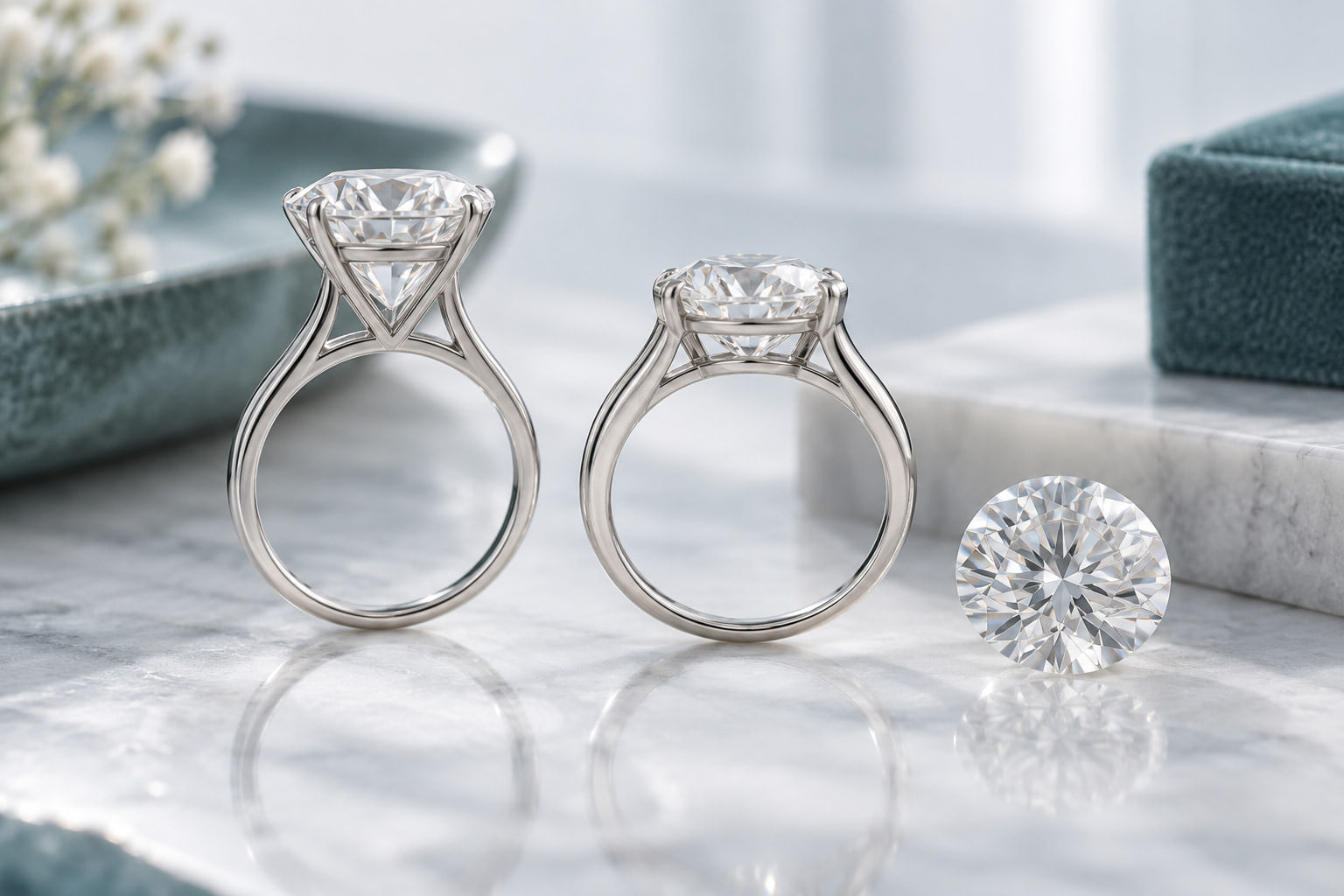
Neither profile is automatically superior for every large center. The feasible design depends on the actual stone and the manufacturer. Compare the tradeoffs with physical or engineering evidence instead of assuming that more height creates more sparkle or that the lowest possible seat is always comfortable.
| Decision | Lower-profile concept | Elevated-head concept | Required review |
|---|---|---|---|
| Pavilion clearance | Can constrain which stone depths work | May create more room in the concept | Check actual stone and gallery geometry |
| Visible projection | Less height in the proposed profile | More prominent head above the band | Assess at real wearing scale |
| Neighboring band | May require a shaped or spaced companion | May permit a different band relationship | Test the actual combination |
| Support architecture | Needs its own bearing and shoulder solution | Needs its own head and shoulder solution | Obtain workshop approval for either |
| Service access | Access can be limited by compact geometry | Access differs with the head design | Discuss cleaning and future repair |
| Selection flexibility | A fixed shallow envelope can narrow candidates | More height is not unlimited interchangeability | Keep exceptions drawing-specific |
A buyer should ask the maker to show the proposed seat rather than treating these conceptual possibilities as a performance promise. The aim is to identify what needs checking. The final design can also fall between the two columns, with a moderate height and a specific shoulder structure.
Freeze the approved profile only after the actual center has been reviewed. If the designer later changes the stone, reopen the relevant fit checks. Carrying an old approval across a materially different pavilion is a preventable source of assembly problems.
How Should a Large Lab-Grown Diamond Be Judged at Real Scale?
Request a clear magnified view for surface and inclusion review, then a separate ordinary-distance sequence. Magnification can help identify a feature, but it cannot establish whether that feature distracts the intended wearer at normal scale. Conversely, a tiny promotional image can conceal an obvious outline or transparency issue. Both views have a purpose.
Use a neutral background and controlled movement. For a step cut, follow the changing bands and any persistent face-up transparency; for an elongated brilliant, follow the central contrast as the stone tilts. State the observation and the viewing setup rather than diagnosing every concern from one edited frame. A supplier should be able to understand which sequence needs repeating.
Compare proposed side stones with the actual center if the design uses them. Large centers can make an imprecise side pair or mismatched visual character more obvious in the complete layout. Approve the set together and preserve all item identities. Do not select unrelated side stones after the center has already been cast into a design that leaves no room for variation.
Document review remains separate. Verify the actual report through the issuer and read its service scope. Do not infer an engineering approval from a favorable gemological finding. If appearance, document or fit evidence is incomplete, put the candidate on hold with a named next action. A clear unresolved status is more useful than a broad quality score that conceals why the stone is not ready.
How Can a 4 Ct Candidate Change the Mounting Decision?
Hypothetical example: a studio has a low-profile oval concept and is considering two four-carat candidates. Candidate A measures 13.0 by 9.2 mm with 5.5 mm depth; candidate B measures 13.4 by 9.0 mm with 6.0 mm depth. These invented dimensions are not a typical-size chart or a claim that either stone is well cut. Both need their own appearance and document review.
The workshop's current drawing has an approved depth envelope ending at 5.7 mm for that specific geometry. A falls within the stated depth limit, while B does not. B's greater length is not a reason to force it into the existing head. The maker can review a revised gallery, the buyer can request another stone, or the project can change its silhouette. Each is a separate approval path.
Suppose the designer prefers B's outline and asks for a raised-head prototype. The workshop produces a review sample and tests it with the intended companion band. The designer accepts the new height but finds that the companion combination needs revision. That creates two outstanding actions: approve the changed head and approve a new band relationship. A stone reservation should cover the review period; otherwise the approved prototype may lose its intended candidate.
MEITUO can coordinate candidate information and supplier availability while the design owner and workshop resolve those actions. The buyer should record which party owns each deadline. A delayed engineering answer should not become an automatic request for the supplier to ship a different four-carat stone. The worked example illustrates why actual-item control matters more than treating a weight family as a pool of interchangeable centers.
How Should Large-Center Sourcing Be Localized by Channel?
For a four-carat design, compare who can reserve the actual stone, answer dimensional questions and support an agreed physical-review route. Commercial proximity may help logistics but does not approve a gallery. A production-region contact may offer technical access without automatically controlling the final export transaction.
USA / Stone and workshop review
What Should a US Large-Center Buyer Arrange Before Selecting Stock?
Stuller describes a US loose laboratory-grown diamond channel. For a large-center project, ask whether the exact candidate can be reviewed with the intended mounting and which services are actually included in the transaction. A broad catalog reference does not establish current four-carat availability, domestic growth or approval of a particular ring design.
Connect the retailer's selection contact with the workshop's engineering owner early. Obtain the real reservation and review terms before asking the customer to choose among candidates. If an existing head is fixed, share the actual envelope rather than a nominal center weight. A local service route can simplify coordination only if the responsible parties are clear.
For US-facing bespoke work, preserve the agreed profile and companion-band review in the order record. If the customer later selects a different stone, identify which design checks must be repeated. Avoid promising a height, fit or completion date from a generic listing before the actual candidate and workshop schedule are confirmed.
CHINA / Reserved-candidate control
How Should a China Coordinator Manage Large-Center Exceptions?
The MEITUO sourcing team in Qingdao can coordinate a large-center shortlist, but the buyer needs to identify the actual inventory owner and reservation arrangement. The coordinator's address does not establish the crystal's growth site or the jewelry assembly location. Put those roles into the order file separately.
Send the same drawing revision and viewing protocol to every candidate supplier. Ask for side-profile evidence as well as face-up images, and list any depth or outline exception explicitly. A seller should not interpret a four-carat target as permission to dispatch a different stone after the designer has approved one candidate.
If engineering review takes longer than the reservation, obtain an extension or reopen selection. Do not conceal the inventory change by retaining the first stone's photographs in the approval file. For a combined center-and-side order, keep each identity linked through consolidation and have the buyer approve the full layout. These controls make the cross-border process reviewable without assuming that a general supplier relationship guarantees access to identical large stones on demand.
INDIA / Technical and commercial handover
What Should Buyers Ask an Indian Contact About Large-Center Selection?
GreenLab lists Surat and Mumbai contacts, illustrating different contact points in an Indian diamond channel. Ask the contracting seller who can provide the actual candidate's profile information and who can reserve it while a jewelry maker reviews the design. The location of a contact does not establish the origin of the offered crystal or approve a proposed mounting.
If a seller proposes repolishing or another modification, request the revised weight, dimensions, report implications and timing before treating it as an available solution. The buyer needs an agreed result and a fresh review, not an assumption that any deeper candidate can be adjusted to fit. Preserve the original and proposed specifications distinctly.
For export through a separate office, ensure that the approved item reference, reservation deadline and exception notes reach the commercial contact. A technically suitable candidate can still be lost if the reservation expires during a workshop review. Ask how a replacement shortlist would be handled and whether the design would need renewed approval. This keeps large-center sourcing tied to actual-item control rather than a generic carat category.
How Can MEITUO Support a 4 Ct Design-Led Inquiry?
MEITUO is a sourcing and supply-chain coordination partner based in Qingdao, Shandong, China. For a large-center inquiry, provide the design envelope, intended mounting revision, reporting requirements and the sequence of appearance and engineering approvals. The team can help communicate those requirements to suppliers, coordinate candidate options and follow availability and order questions during the review.
Its product scope includes loose centers, melee, side stones, matched pairs and sets, and fancy-color options. A large-center layout may connect several of these groups, but each needs its own acceptance record. MEITUO does not replace the independent laboratory, jewelry engineer or setter responsible for their respective findings. Availability, documentation, MOQ, lead time, treatment information and shipping terms require specific confirmation. The bespoke and statement application page can frame an individual large-stone brief. Contact [email protected] with the actual drawing and identify which dimensions are fixed and which can be reviewed before a shortlist is reserved.
What Should a 4 Ct Lab-Grown Diamond RFQ Prioritize?
Put the nonnegotiable design limits first. If the stone must fit a completed head, say so. If a new head can be engineered, identify the responsible maker and the review deadline. Request actual measurements, consistent media and document references for every candidate rather than a general list of four-carat availability.
Separate the center from any side-stone requirement and identify whether the complete set must be approved together. Use the RFQ guide to organize commercial terms and the designer solutions page for the design context. Ask for written exceptions before substitution. A quotation is reviewable when the buyer can see exactly which stone and which approval path it covers.
Please propose four-carat target laboratory-grown centers for [design and quantity]. Our required outline is [shape and reference], within [length, width and depth envelope]. Mounting [revision] is [fixed or open to engineering review]. Provide actual-item documents, scale face-up images, side profiles and controlled movement clips. Identify every proposed dimensional exception and reserve each shortlisted item through [review date]. Quote side stones separately when applicable. Confirm growth and treatment information, availability, MOQ, lead time, shipping and review terms. No substitute may inherit approval without renewed appearance and setting review by [buyer and maker].
FAQ: 4 Ct Lab-Grown Diamonds: Large-Stone Design and Sourcing
How Much Does a 4 Ct Diamond Weigh in Grams?
Four metric carats equal 0.80 grams. This describes stone weight only. It does not establish face-up size, mounting height or the weight and balance of the finished ring.
Can a Four-Carat Stone Use an Existing Smaller-Center Head?
Only if the responsible maker approves the actual stone and seat geometry. A nominal head description is not proof of compatibility. Obtain the relevant dimensions and drawing review before setting.
Is a Low Setting Always Better for a Large Center?
No. The feasible profile depends on the stone and the design. Compare clearance, support, band relationship and service access with the workshop. The lowest-looking concept is not automatically the approved or preferred result.
Can the Same Weight Guarantee the Same Outline?
No. Four-carat stones can differ in length, width, depth and shoulder or corner geometry. Use actual-item measurements and scale images, especially when the design or mounting is already fixed.
Should the Center Be Selected Before the Side Stones?
The selection sequence can vary, but the complete layout should be approved together when the design depends on their relationship. Retain every item identity and avoid treating unrelated side stones as automatic substitutes.
What Should Happen if a Reserved Center Becomes Unavailable?
Reopen the shortlist and identify which appearance and engineering checks apply to the replacement. Do not carry the old stone’s approval, report or photographs over to a different item merely because the nominal weight matches.