 English
 Español
 Português
 Deutsch
 Français
 Italiano
 Nederlands
 العربية
 日本語
 한국어
 ไทย
Quick Answer
A 1.5 ct lab-grown diamond weighs 0.30 grams, but that weight does not define its face-up dimensions or the setting it will fit. For a core bridal assortment, choose a manageable group of shapes and visual references, obtain actual measurements for the offered stones and confirm the mount for each size family. Separate a single center's weight from the finished ring's total diamond weight. Build the assortment around customer and workshop requirements rather than assuming that every 1.5 ct option is interchangeable. A small pilot can reveal which silhouettes, mount heights and reorder limits work together before the brand expands its inventory. MEITUO can coordinate the resulting loose-stone brief and supplier responses.
What Does 1.5 Ct Tell a Buyer About Size and Appearance?
GIA defines a metric carat as 200 milligrams; 1.5 ct therefore equals 300 milligrams or 0.30 grams. This is a weight conversion. It is not a diameter chart. Two stones of the same weight can distribute material differently across length, width and depth, and different shapes create different visible outlines.
A core assortment should store both weight and actual dimensions. For a round, retain the reported diameter range and depth. For an oval or rectangle, retain length, width and depth with a clear orientation. Do not substitute a seller's average size illustration for the measurements of the offered item. If an illustrative chart is used in merchandising, label its purpose and preserve the actual item information separately.
Distinguish center weight from total weight. A ring with a 1.5 ct center and additional side stones has more than 1.5 ct total diamond weight. Conversely, a ring advertised only by a combined total does not establish the center's weight. Product, purchasing and workshop teams should use the same fields so the inventory record does not drift between these meanings.
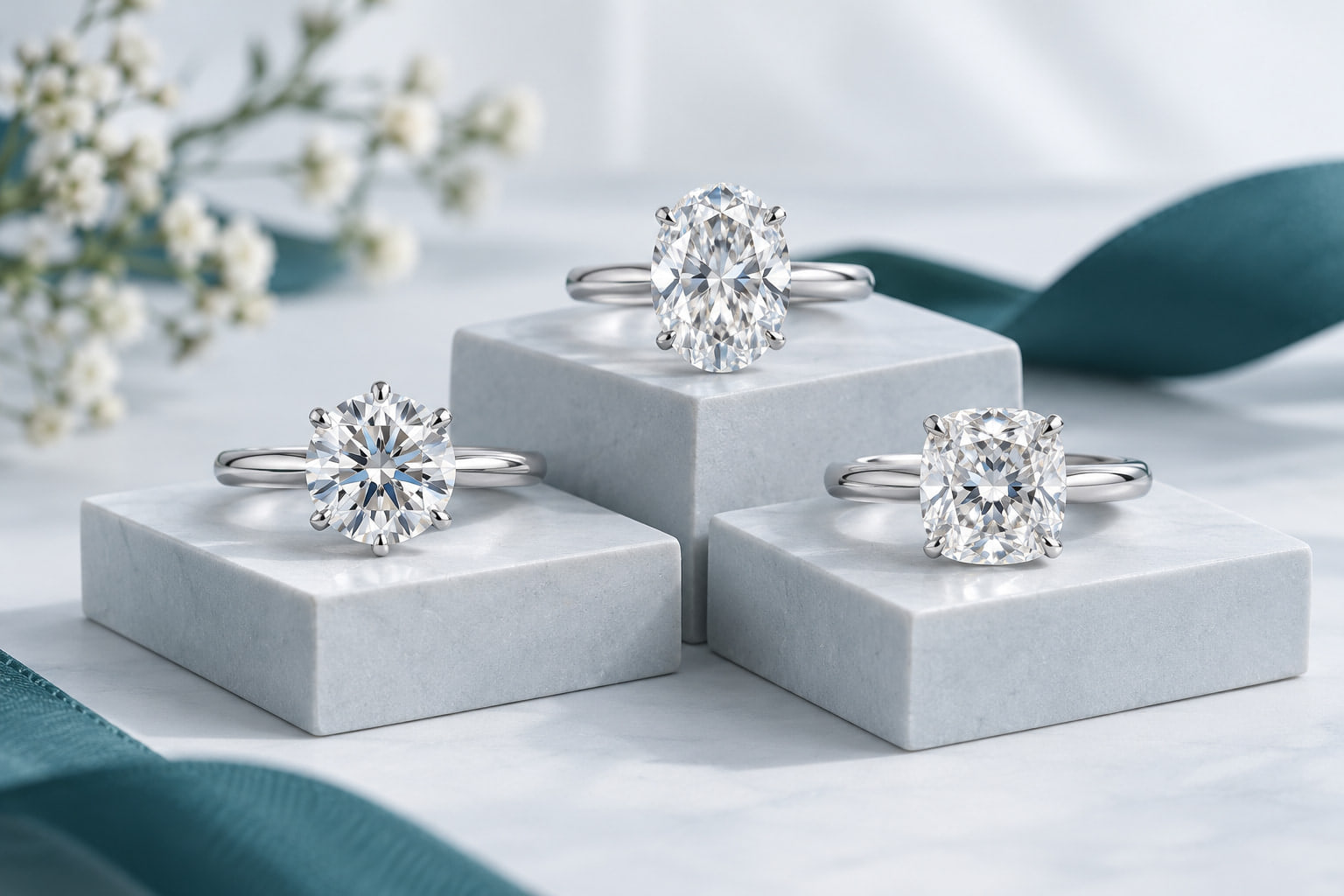
For selection, compare round centers, oval centers and cushion centers at actual scale. These are alternatives within a design brief, not evidence that every candidate will have the same visual size or the same mounting requirements.
How Should a Brand Build a Focused 1.5 Ct Bridal Assortment?
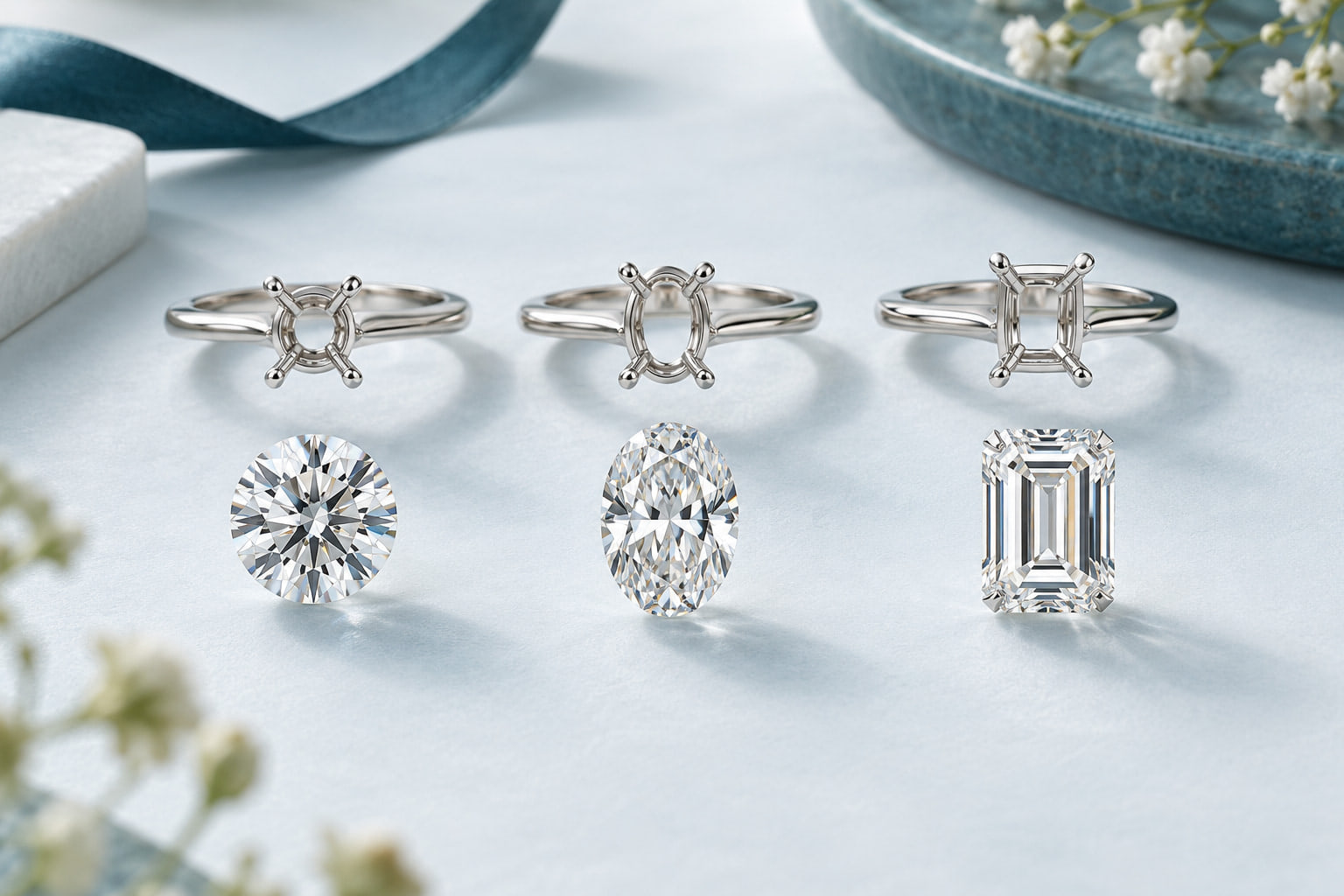
Start with the product roles rather than the maximum number of variations. A compact pilot might contain a familiar circular silhouette, an elongated option and a softer square outline. The actual choices should reflect the brand's customers and design language. Do not interpret this example as a demand forecast or a universal best-selling mix.
For each role, define a visual reference, intended mounting profile and accepted document route. Keep the color and clarity selection consistent with the design, while allowing the responsible buyer to decide where a different shape needs a different appearance threshold. A stepped transparent center and a finely fragmented brilliant pattern need not be judged by identical photographs.
Limit the number of combinations that reach production. Three shapes, three metals and two head heights already produce eighteen variants before ring size is considered. The inventory problem can grow faster than the stone count. Decide which variants are stocked, which are made to order and which remain concept samples. This is a merchandising and operations decision that should be visible in the assortment plan.
Create one approved sample record per released variant. It should identify the actual center, mount revision, side-stone requirements and accepted photographs. When a stone is replaced for the next order, compare it with that record rather than with a broad 1.5 ct collection label. A core size family becomes useful when buyers can replenish it without reopening every original design question.
A 1.5 Ct Center VS 1.5 Ct Total Weight: Why Does the Distinction Matter?
These descriptions answer different questions. Neither is inherently a better product, but confusing them prevents a fair assortment comparison and can create inaccurate stock records. Use the matrix when aligning purchasing, imagery and customer descriptions.
| Field | 1.5 ct single center | 1.5 ct combined diamond total | Control |
|---|---|---|---|
| What the number describes | The center stone alone | The sum of the described diamond components | Keep separate center and total fields |
| Center silhouette | Actual center dimensions still required | Cannot be inferred from total weight | Request the component breakdown |
| Mount planning | Use the actual center envelope | Review every stone group and seat family | Link each group to the drawing |
| Reorder | Replace against the approved center reference | Reconcile centers and accents independently | Preserve the bill of materials |
| Product imagery | Show the center at a consistent scale | Show layout as well as overall appearance | Avoid weight-only visual equivalence |
| Quote comparison | Check center scope and document terms | Check component and setting scope | Compare like-for-like contents |
A halo design may use many small stones while a solitaire concentrates its diamond weight in one center. A buyer can deliberately offer both, but their sourcing files should reflect those different constructions. Do not resolve a missing center size by assuming the finished ring's total answers the question.
Where a supplier's weight language is ambiguous, request a corrected component list before approval. Marketing should receive that same breakdown. A transparent inventory record makes it easier to explain the product and easier to diagnose a later replacement request.
Which Mounting Choices Change a Core Bridal Size Family?
Review the ring in profile as well as from above. A head's height, shoulder connection and basket clearance can change how the same center looks and wears. Ask the setter which actual stone depths the design accepts. A nominal weight target does not establish the lower clearance needed by the gallery or the position of the stone's contact points.
Consider how the engagement ring sits with an intended wedding band. Check the actual samples together for contact and clearance; do not infer compatibility from front-facing photographs. If the line offers a matching stack, store the accepted combination as a separate design record. A revised center head can change the stack relationship even when the face-up stone remains in the same weight family.
For inventory planning, avoid using one stock head across several stone families without approval. A different outline may need different prong positions or a different basket. An engineer can sometimes design a useful envelope, but procurement should use the approved result rather than inventing flexibility. The bridal application page is a relevant context for discussing these connected requirements.
MEITUO can coordinate center options while the manufacturer reviews the mount. Keep those responsibilities explicit. If the pilot includes side stones, use the side-stone requirement as its own line item. Accepting the center should not automatically release a different accent parcel or a revised mounting.
How Does a 1.5 Ct Pilot Become a Controlled Inventory Plan?
Hypothetical example: a brand plans twenty-four sample rings in three silhouettes. It allocates twelve to round centers, eight to ovals and four to cushions. The figures describe an invented pilot allocation, not measured customer demand. Each ring uses one center, so the assembly requirement is twenty-four centers. The buyer requests three separately identified reserves, one for each shape family.
The total request is twenty-seven centers, but the quantities are not a freely interchangeable pool. Four extra rounds would not cover a missing cushion if the cushion mounting is already committed. Give the supplier separate line items and provide the approved dimensions for each family. Keep the reserves linked to the same acceptance rules as the assembly stones.
Assume the receiving review accepts eleven of the twelve assembly rounds, all eight ovals and three of the four cushions. One round and one cushion remain on hold. Twenty-two assembly centers are currently accepted. The team should not describe the pilot as ready for twenty-four completed rings merely because twenty-seven stones were invoiced. Reserves can be reassigned only after their fit and appearance are confirmed and the resulting reserve gap is recorded.
The brand then tests the three finished sample styles with customers using the same presentation conditions. It records observations and inquiries without inventing a statistically representative preference. Reordering can follow those actual signals and workshop results. This is a stronger basis for a core assortment than buying every variation upfront and treating the first allocation as proven demand.
How Should 1.5 Ct Assortment Buyers Compare Sourcing Channels?
A recurring bridal family needs item-level selection and a workable route for replacements. Compare the channels by how they preserve the approved shape and mounting envelope. A country label does not make one 1.5 ct stone equivalent to another or establish where every crystal was produced.
USA / Assortment and mounting
What Should a US Jeweler Ask When Planning a Core 1.5 Ct Range?
Stuller provides a US trade-channel example for loose laboratory-grown diamonds. A retailer considering a core size family can ask which actual stones and compatible mounting discussions are available through the proposed transaction. That channel reference does not establish that every 1.5 ct outline is stocked or that a domestic seller's stones were grown domestically.
For a small US bridal range, identify which variants will be physically shown and which will be selected after a customer order. Ask about actual-item reservation and review terms before promising a delivery date. Keep the center weight and combined ring weight separate in both purchasing and product copy.
Use the pilot to test workshop fit and customer communication together. Sales staff should be able to explain why an oval and a round of similar weight look different without treating one photograph as a universal size chart. Retain the approved sample's actual measurements so a later replacement can be evaluated against the same ring design rather than an assumed standard diameter.
CHINA / Variant-controlled orders
How Should a Qingdao Sourcing Brief Separate Shape-Family Quantities?
The MEITUO sourcing team in Qingdao can coordinate a mixed-shape center brief, but the inquiry should preserve separate requirements for rounds, ovals and cushions. Its location does not establish the growth origin of every candidate. Ask who controls the shortlisted inventory and how item references remain connected through consolidation.
For a pilot, send a simple variant schedule rather than a combined total of 1.5 ct diamonds. State the mounting envelope, accepted visual family and quantity for each line. If a supplier proposes a neighboring weight or different outline, require it to be listed as an exception instead of silently filling the line item.
Confirm how reserves will be packed and identified. A reserve that belongs to another outline family may not be useful to the intended mounting. Keep accents on their own acceptance record when they travel in the same shipment. Before a repeat order, review the actual pilot results and update only the requirements the buyer has approved. This keeps a China coordination route aligned with the assortment rather than with a vague weight-only purchasing target.
INDIA / Family continuity
What Should an Indian Contact Provide for a Replenishable Bridal Family?
GreenLab lists Surat and Mumbai contacts, illustrating Indian diamond-channel contact points. For a 1.5 ct core collection, ask the contracting seller who can prepare the shape-specific shortlist and maintain item reservations. An address or general production description does not establish the availability of your approved outline family.
Request candidates in small coherent groups, with the actual measurements and scale images for each. If a different shape distribution is offered because one family is unavailable, treat it as a new assortment proposal. A larger total quantity does not compensate for a missing variant when its mounting is already produced.
Discuss replenishment after the original lot is exhausted. The next candidate should be judged against the retained visual and mounting reference, not a promise of permanent identical stock. If the export contact differs from the selection contact, preserve the approved item list through both. Ask how held pieces, reserve parcels and accepted assembly stones will be distinguished so the receiving team can reconcile the order without guessing which stone belongs to which collection role.
How Can MEITUO Support a 1.5 Ct Core Collection?
MEITUO is a sourcing and supply-chain coordination partner in Qingdao, Shandong, China. For a core bridal family, send an assortment schedule showing quantities by shape, actual mount limits, document expectations and the approved visual reference for each released variant. The team can support product selection, supplier coordination, quality-requirement confirmation and order follow-up against that schedule.
Its product scope includes loose centers, melee, side stones, matched pairs and sets, and fancy-color options. That supports a discussion of centers and accents while keeping their acceptance records separate. MEITUO does not determine your customer demand or replace the manufacturer responsible for setting fit. Availability, documents, MOQ, lead time, treatment information and shipping terms require order-specific confirmation. The independent-jeweler solutions page is a useful starting point for a focused bridal range. Contact [email protected] with the pilot allocation and identify which variants are intended for stock versus made-to-order selection.
What Should a 1.5 Ct Collection RFQ Make Explicit?
List one line per shape family and separate assembly quantities from reserves. State whether 1.5 ct is an exact item requirement or a target range subject to approval; use accurate weights for the offered stones. Include actual dimensions and the mount drawing rather than assuming the supplier knows the intended profile from the weight.
Request available candidates, item references, consistent scale images and a reservation period. Flag any substitute that changes the outline family, mounting or document route. Ask for commercial terms separately from the visual approval so a favorable quote does not quietly release an unsuitable stone. The following brief provides a concise starting structure for that comparison.
Please propose 1.5 ct target laboratory-grown centers for [bridal collection]. Quote separate lines for [round quantity], [oval quantity] and [cushion quantity], with reserves identified by family. Our accepted weight range is [range]; actual dimensions must fit [drawing revisions and envelopes]. Provide item-level documents, scale images and movement clips against [visual references]. Keep center weight separate from finished-ring total weight. Identify all substitutions before dispatch. Confirm availability, growth and treatment information, MOQ, reservation period, lead time, packing, shipping terms and review conditions. State which candidates remain subject to setter approval.
FAQ: 1.5 Ct Lab-Grown Diamonds: Building a Core Bridal Size
How Many Grams Is a 1.5 Ct Diamond?
It is 0.30 grams because one metric carat equals 0.20 grams. That conversion describes weight only and does not establish millimeter dimensions, outline or setting fit.
Does Every 1.5 Ct Diamond Have the Same Face-up Size?
No. Shape and the distribution of material across length, width and depth affect dimensions. Obtain the measurements of the actual stone instead of relying on an average size illustration.
Is 1.5 Ct Total Weight the Same as a 1.5 Ct Center?
No. Total weight combines the described diamond components, while center weight identifies one stone. Record both fields and request a component breakdown before comparing finished-ring offers.
How Many Shapes Should a Pilot Stock?
Choose a manageable set tied to the brand’s design roles and actual review capacity. The three-shape example is hypothetical, not a sales forecast. Expand after observing customer responses and workshop results.
Can a Reserve From One Shape Replace a Missing Stone in Another?
Only through a newly approved design and mounting decision. Shape-specific seats and visual expectations make the quantities different line items. Preserve reserves by the family they are intended to support.
What Makes a Core-Size Reorder Repeatable?
Keep the accepted visual reference, actual dimensions, mount revision, document route and exceptions for each variant. Ask a supplier to match that record rather than relying only on the weight label.