 English
 Español
 Português
 Deutsch
 Français
 Italiano
 Nederlands
 العربية
 日本語
 한국어
 ไทย
Quick Answer
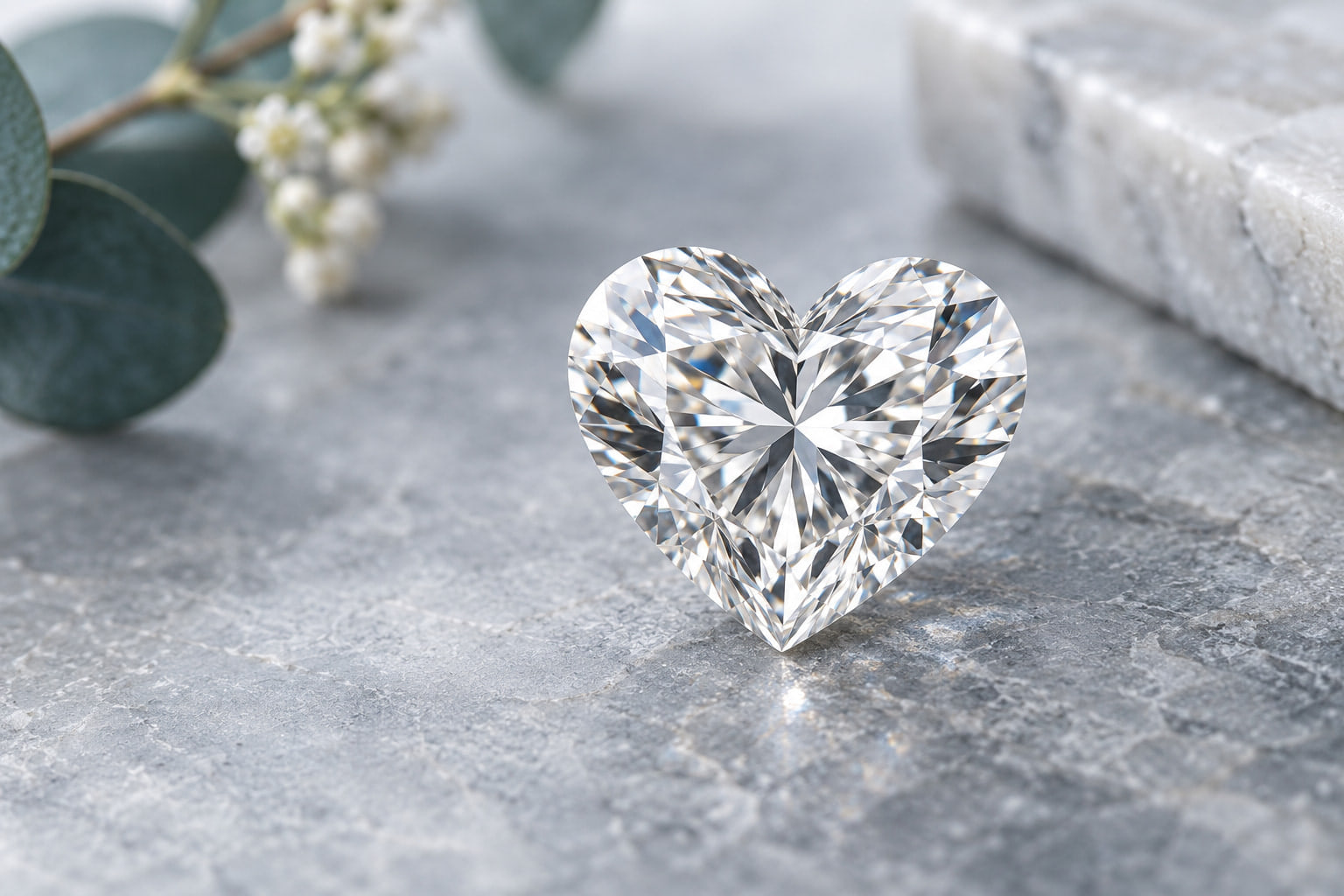
A lab grown heart shaped diamond should show two balanced lobes, a centered readable cleft, coherent wings and a point aligned with the intended centerline. Evaluate those features at actual jewelry size before relying on enlarged supplier photographs. A preferred length-to-width relationship can guide selection, but it does not guarantee a recognizable or balanced heart. Observe moving contrast, inspect the point and cleft condition, and ask the setter to show realistic metal coverage. Small hearts need particular care because prongs or a bezel can obscure the very features that identify the shape. Verify item identity and documents separately. Keep an accepted real-scale mounted reference so a reorder preserves the symbol customers see, rather than merely the nominal shape and carat weight.
Which Heart-Shaped Features Should Buyers Compare First?
Start with a perpendicular face-up view, point down. Imagine a line running through the cleft and point. Compare the two lobes on either side, noting their height, fullness and curve toward the cleft. Then follow the wings down to the point. The two halves should feel balanced within the selected style. A centered point cannot compensate for one visibly taller lobe.
GIA's fancy-shape guide identifies the heart's lobes, cleft, wings and point. Use those named features to describe observations precisely. A supplier can act on left lobe appears fuller in the perpendicular image more easily than on a vague request for a prettier heart.
The cleft needs enough definition to read as a heart, but a buying brief should not impose an unverified ideal depth. Judge the complete outline at the intended size and mounting coverage. A deep-looking cleft in a magnified image can be less visible in the finished product, while metal placement can overwhelm a modest but attractive loose-stone cleft.
Repeat any doubtful image with the stone level and centered. Tilt or an off-axis lens can distort the lobes. If the imbalance persists, compare with the approved silhouette and determine whether it is inside the collection's preference. Avoid inventing a universal perfect ratio: the actual contour and design matter. The heart product category is a useful place to begin a shape-specific request.
Why Is Real-Size Viewing Essential for Heart-Shaped Diamonds?
On an enlarged screen, the cleft and lobe curves are easy to inspect. At jewelry size, the viewer sees the complete symbol quickly, often while the piece moves. The buying process needs both scales. Use magnification to investigate condition and workmanship, then return to an actual-scale image or physical sample to judge recognition and balance.
Print or display the stone at a known width beside the mounting. Check that the image has not been stretched independently in one direction. If the supplier offers a tenfold enlargement, a six-millimeter stone appears sixty millimeters wide; the observer can resolve details that will be far less prominent when worn. That arithmetic explains the inspection difference, not a rule about any minimum suitable size.
Ask several members of the brand's own product team to review the same unlabelled real-scale mock-up. Record concrete observations: cleft remains visible, left lobe looks larger, point appears covered. This is a small internal design review, not a consumer survey or evidence of population preference. It can reveal whether the symbol survives the setting before the brand commits to a production run.
Include intended wear context. A tiny heart accent on a necklace may need a different outline emphasis from a large solitaire heart. Do not assume one master image scales down indefinitely. GIA's shape guide notes that settings should preserve the heart's recognizable shape. The practical response is to approve a mounted reference at each materially different product scale.
Loose-Heart Approval VS Mounted-Heart Approval: What Changes?
| Feature | Loose-stone review | Mounted review |
|---|---|---|
| Cleft | Shows the unobstructed notch and lobe meeting | Checks whether metal or reflections obscure the notch |
| Lobes | Compares their actual contours | Checks equal apparent exposure after prong coverage |
| Point | Inspects alignment and local condition | Checks protection without excessive visual shortening |
| Perceived proportions | Uses the diamond outline | Includes bezel or prong contribution to the silhouette |
| Final decision | Candidate for the intended style | Recognizable, balanced product in the actual design |
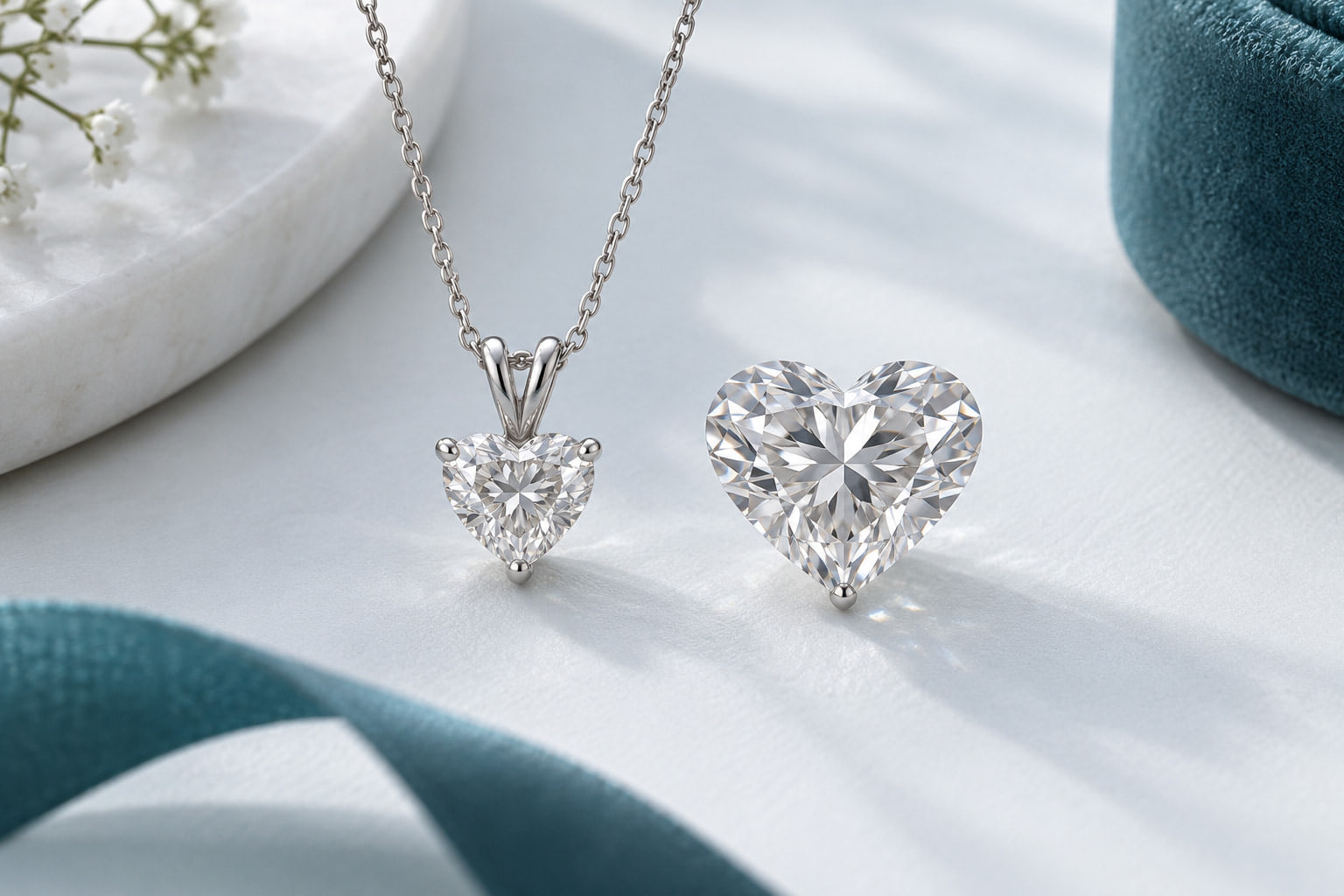
Neither stage replaces the other. A poor loose outline cannot always be corrected with metal, and a good loose outline can be obscured by a poorly chosen frame. Ask the setter to explain contact and protection, while the designer evaluates visible coverage. Keep those responsibilities separate but coordinate the final approval.
For a pendant, include bail position and hanging behavior in the mock-up. If the heart tilts or rotates, the lobes may not present equally to the wearer or viewer. For a ring, inspect the top view and a normal hand angle. The everyday jewelry application page can frame small symbolic pieces, while the bridal page provides a different context for a larger center.
How Can a Heart Collection Test Two Jewelry Scales?
Hypothetical example: the Two-Scale Heart Capsule. A brand plans a six-millimeter-wide pendant center and a four-millimeter-wide accent. Its designer first scales the same outline from six to four millimeters. Every linear feature becomes two-thirds as large. If the drawn cleft opening was 0.60 mm in the larger version, a purely proportional drawing would make it 0.40 mm in the smaller one.
Those invented dimensions do not define a safe cutting or setting standard. They illustrate why a fixed metal feature may consume a larger share of the smaller symbol. Suppose a proposed visual metal overlap remains 0.20 mm at each scale. Relative to the cleft opening, that overlap is one-third of the larger drawing's opening but one-half of the smaller drawing's opening. The mounted result therefore deserves fresh review rather than automatic approval by scaling.
The team obtains real-scale mock-ups and an actual sample where practical. The larger heart remains readable; the smaller version appears more like a rounded triangle because the cleft and upper curves are crowded. The designer can revise the setting, select a different outline or change the product size. Upgrading clarity does not address the geometric problem.
MEITUO can coordinate candidate outlines and evidence against the revised reference. The manufacturer then reviews contact, point protection and finished coverage. Keep separate approval IDs for the two product scales. If the smaller style later needs a replacement, the supplier should not be sent only the larger center's photograph as proof of the intended shape.
What Optical and Condition Checks Belong in a Heart Order?
Observe the clean stone moving under broad and directional light. Compare activity in both lobes and through the wings toward the point. A central dark region may change with viewing, so do not conclude from one frame that the heart will always look divided. Keep exposure and distance consistent when comparing candidates.
Inspect the point and cleft region under magnification, noting any feature that needs professional assessment. GIA discusses the particular exposure of pointed shapes to chipping. Have the setter review the actual contact surfaces. The symbol's point should remain part of the design, but appearance cannot justify an unsuitable setting interface.
Reconcile report reference, parcel identity and inscription where available. Verify the document with the issuer and read its service scope. GIA's current eligible colorless-to-near-colorless lab-grown assessment uses Premium or Standard; do not assume every current document provides historical-style individual grades. Obtain the required growth and treatment information explicitly.
At receiving, repeat actual-scale and magnified checks before setting. Keep a condition record and then a finished mounted reference. The repeat-order guide can connect those records, preserving the cleft readability and coverage decisions that define the product.
What Should Heart-Shaped Buyers Ask in Each Supplier Market?
Heart orders require a supplier who can communicate the actual silhouette at the intended scale. The channel should support exact-stone images, point inspection and an honest distinction between a loose candidate and an approved finished-jewelry design.
For a multi-size capsule, ask whether every size is independently selected or whether the supplier is proposing one visual family across all of them. Request evidence for the smallest version first when symbolic readability is the main risk. A large attractive sample does not establish that the smaller product will communicate the same heart shape.
US / Symbol readability in retail
What Should US Retailers Show Clients Before Approving a Heart Center?
A US retailer should show the heart at actual size in the proposed mounting, not only as a magnified loose-stone image. Stuller's lab-grown trade category illustrates a distributor route, without implying US-grown origin. Ask the seller for exact-stone media and whether the intended head can be reviewed with that candidate.
For a symbolic gift, the client may care most that the cleft and lobes read immediately. Keep the approved real-scale mock-up with the order, including realistic prong or bezel coverage. If a different heart becomes necessary, obtain a new approval rather than assuming the shape name makes it equivalent. For a small accent program, ask the product team to review the smallest size first. Confirm reservation and inspection terms before promising a delivery date, and preserve point-condition records through the setting stage. Local availability helps logistics only when the actual selected center and compatible head are both confirmed. Keep small-heart samples separate from large-center approvals.
CN / Scale-specific silhouette briefs
How Should China Sourcing Communicate Heart-Lobe Requirements?
For China sourcing, send a clearly oriented heart outline with named lobes, cleft and point. GIA's production review describes Chinese laboratory-grown supply, but that context does not establish whether a polished heart suits a particular symbolic design. Ask who controls the exact candidates and who can obtain perpendicular images rather than representative catalog photographs.
A Qingdao coordination brief should preserve the size of each product version. Label the larger center and smaller accent references separately, including any mounted coverage notes. If the supplier offers a visually different cleft or lobe family, request an actual-scale comparison before accepting it as an alternative. Do not let a larger stock sample stand in for a smaller production parcel. For receiving, keep heart centers individually identified and isolate any unresolved point condition. Coordinate the final candidate with the manufacturer early enough to review the metal coverage, rather than discovering after shipment that the intended setting hides the cleft.
IN / Cutting style and final scale
What Should Indian Heart Suppliers Clarify Before a Production Run?
Indian contacts may discuss polished heart stock or a proposed cutting program, but buyers should establish who controls each stage. GreenLab lists Surat and Mumbai contact points; those addresses do not identify the cutter of a particular heart. Ask who can supply final face-up media and answer questions about lobe balance or cleft contour.
For a custom proposal, agree on a physical or well-documented approval sample at the intended size. A drawing alone should not become a guarantee of identical hearts in every dimension. Specify how variation in lobe fullness, point position and final measurements will be reviewed. If a supplier suggests altering the cleft to improve readability, obtain the effects on weight, contour, documentation and timing before authorizing the work. For stock selection, a coherent group of existing hearts may be more practical than an exact-copy requirement. Keep the mounted reference available so the cutting or trading contact understands which visible features the final jewelry must preserve.
How Can MEITUO Support Heart-Shaped Product Selection?
MEITUO is a Qingdao, Shandong-based sourcing and supply-chain coordination partner. For heart-shaped projects, buyers can ask it to gather candidate silhouettes at the required size, communicate lobe and cleft preferences and follow up on unresolved supplier information. Its support covers product selection, supplier coordination, quality-requirement confirmation and order follow-up.
The range includes loose centers, melee, side stones, matched pairs and sets, and fancy-color options. For a symbolic collection, the buyer can present separate references for a large center and a small accent instead of assuming one outline will work at every scale. MEITUO should not be described as the grower, cutter, independent laboratory or final setting engineer. Confirm availability, MOQ, documents, treatment information, lead time and shipping terms for the specific order. Email [email protected] with actual-scale mock-ups, intended metal coverage and the product quantities. A clear inquiry lets coordination focus on preserving the visible heart while the designer and manufacturer retain their approval responsibilities.
What Should a Heart-Shaped Diamond RFQ Include?
Specify the intended product size and the accepted cleft-and-lobe reference. Request exact-stone face-up media at a known scale, magnified point views and profile information for the setter. If several sizes belong to the collection, give each a separate approval ID and describe whether visual consistency or identical relative proportions matter more.
Ask the supplier to flag any candidate whose lobes, cleft or point depart from the reference. Include document fields, reservation timing and review terms. The RFQ guide can support commercial completeness. Final acceptance should follow both a loose-stone decision and a mounted-shape review, especially where small metal features materially change the symbol.
Please quote [quantity] heart-shaped laboratory-grown diamonds for [product], at [actual dimensions and scale]. Match silhouette reference [ID], preserving balanced lobes, readable cleft and centered point. Provide perpendicular scale images, exact-stone motion media, profiles, point and cleft condition views, report references and growth or treatment information. Our intended setting coverage is shown in [drawing revision]; flag any candidate likely to change the visible symbol. Quote each size separately. Confirm availability, MOQ, lead time, shipping terms, reservation and inspection conditions. Outline substitutions or alterations require written approval by [buyer and manufacturer].
FAQ: Heart-Shaped Lab-Grown Diamonds: Selecting Balanced Lobes
Does a Heart Diamond Need One Exact Ratio?
No universal buyer ratio guarantees the right heart. Compare lobe balance, cleft readability, wings and point at actual scale. A collection may establish its own preferred range without presenting it as a global quality rule.
Why Can a Good Loose Heart Look Unclear After Setting?
Metal can cover the cleft, lobes or point and change the apparent outline. Review realistic mounted coverage before production. A loose-stone approval and a finished-design approval answer different questions.
Can a Small Heart Use the Same Approval as a Larger One?
It should receive its own actual-scale review. Proportional scaling reduces visible details, while setting features may not scale in the same way. Keep separate references when readability changes materially.
Should the Two Lobes Look Balanced?
They should form the intended coherent symbol, judged from reliable images and the actual stone where possible. Repeat a tilted photograph before deciding that one lobe is larger. Record the specific departure rather than using a vague shape complaint.
Does a Heart Point Need Protection?
Yes, the actual point and contact surfaces need professional setting review. Inspect and document condition before setting. A protective concept should preserve the symbol while fitting the real stone geometry.
What Should Be Retained for a Heart Reorder?
Keep the exact size, accepted silhouette, motion clip, condition record and realistic mounted reference. Include the product scale and metal coverage so a new candidate is compared with the symbol customers actually see.