 English
 Español
 Português
 Deutsch
 Français
 Italiano
 Nederlands
 العربية
 日本語
 한국어
 ไทย
Quick Answer
For a lab grown pear shaped diamond ring, inspect the rounded head, shoulders, wings and point as one balanced silhouette. Align the tip with the center of the rounded end, compare the two sides, and check both outline and moving contrast at actual scale. A length-to-width ratio cannot describe shoulder fullness or wing curvature. Choose the intended ring or pendant orientation before approving media, and have the setter review tip protection and actual pavilion clearance. For earrings, compare the two pears together in their mounted directions, including their face-up color and reflection pattern. Verify identity documents separately from visual approval. Keep a scaled outline, tip-condition record and grouped clip so a future replacement reproduces the design rather than only the weight.
How Can Buyers Inspect a Pear-Shaped Diamond Outline?
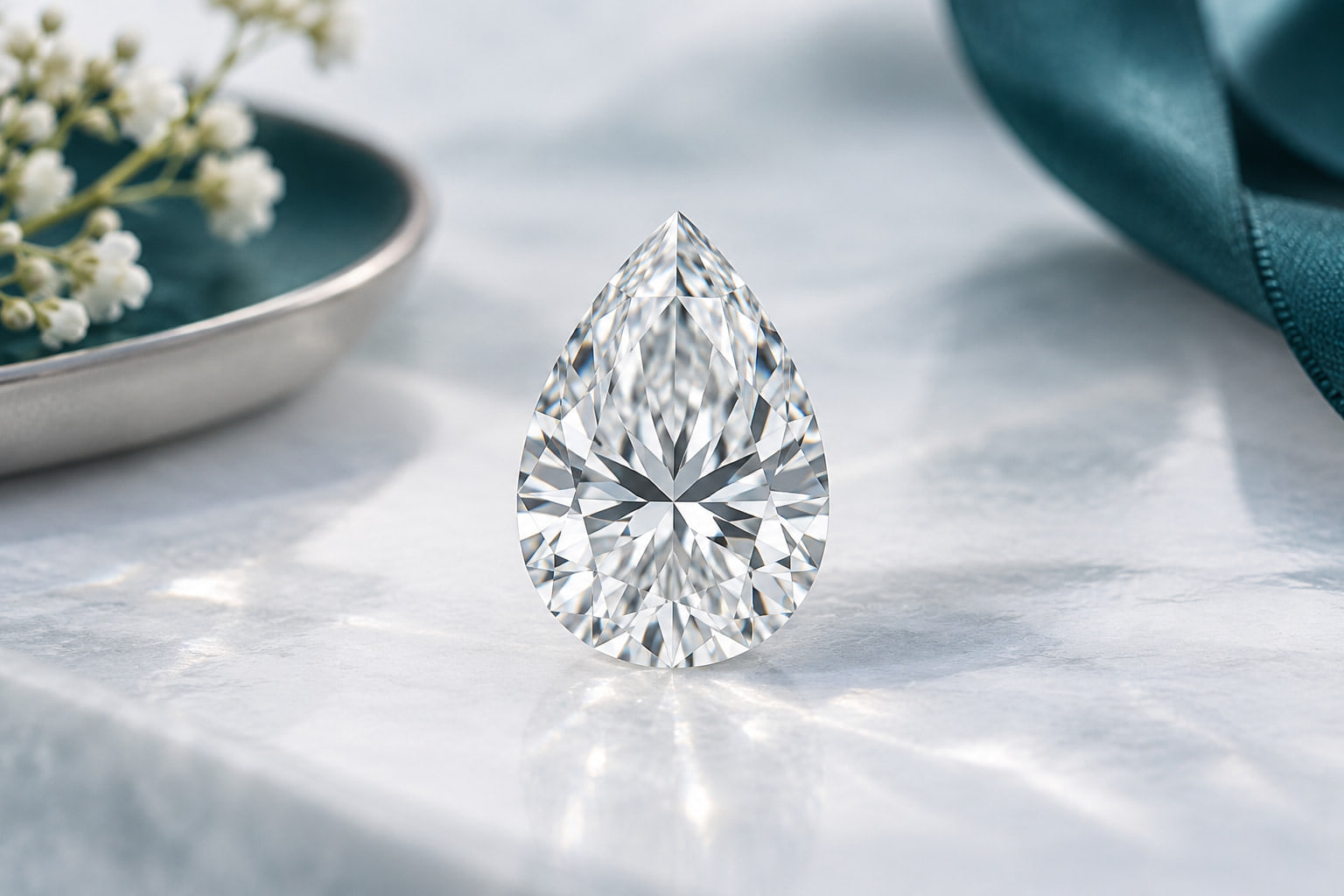
Place the pear point upward in a perpendicular top view. Draw an imaginary centerline from the tip through the middle of the rounded end. Compare each shoulder where the full rounded section transitions into the tapered wings. Then follow both wings toward the point. A pleasing intended outline should read coherently as one shape, rather than having one shoulder fuller or one wing noticeably straighter without a deliberate design reason.
GIA's pear buying guidance discusses balanced outline and symmetry. Buyers can use those concepts without reducing every selection to one numerical ratio. A pear with fuller shoulders and curved wings may look softer than a slender pear with straighter taper, even when their overall dimensions divide similarly.
Repeat questionable photographs with the stone level. Camera tilt can make the tip appear displaced or one shoulder higher. A symmetry concern should be based on the actual stone or repeatable images, not a single imperfect stock photograph. If the supplier can provide only a glamour angle, the buyer lacks enough evidence for a close matching decision.
Keep a silhouette reference for the whole design. For a solitaire, the visual balance of one pear may dominate. For a pair of earrings, the relationship between two outlines is equally important. Do not assume a report symmetry assessment guarantees that two independently attractive stones look like a pair. The pear product category is a starting point for those different briefs.
Why Should Pear Orientation Be Approved Before Selection?
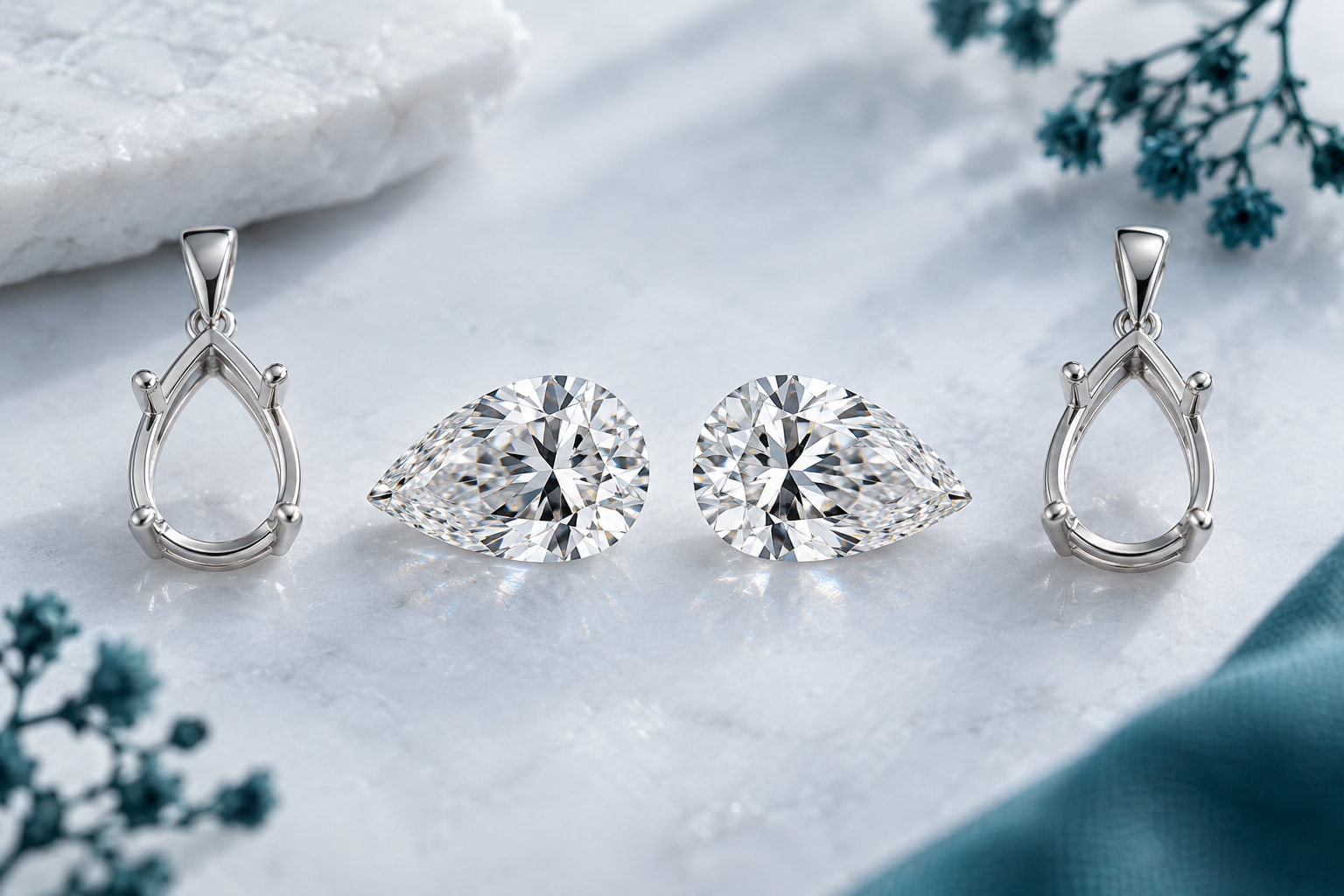
A pear ring can point along the finger in either direction, or form part of an angled design. A pendant often hangs from the rounded end or from a design element that changes the perceived balance. Earrings may hang point down, point up or at mirrored angles. The buyer should state the intended arrangement before asking for a matched pair.
Turn the actual candidates into that arrangement and compare them together. The light, camera and background should remain consistent. A pair that looks similar point-up on separate inventory pages may show a conspicuous difference when both hang point-down beneath the same earrings. Color appearance and reflection texture can become more noticeable in direct comparison.
Observe the central region in motion as well as the ends. GIA's fancy-shape research examines pear appearance and varied facet arrangements. The original procurement advice here is to record whether central contrast changes attractively through the intended movement, rather than rejecting a stone from a single dark bow-tie frame.
For a pendant, consider the practical hanging angle with a realistic bail and chain arrangement. A design that rotates can present a different part of the stone to the observer. That is a finished-jewelry issue for the manufacturer, not a defect that a higher clarity grade automatically solves. Obtain a prototype or reliable mock-up where orientation is central to the product concept.
Dimension Match VS Visual Pair: What Does Each Establish?
| Inspection | Dimension-only match | Complete visual-pair review |
|---|---|---|
| Outer envelope | Checks length, width and perhaps depth | Also compares shoulder height and wing curvature |
| Tip relationship | May overlook different point angles | Compares alignment and apparent sharpness |
| Face-up appearance | Does not establish it | Compares color and reflection texture together |
| Mounting orientation | Often uses generic inventory views | Uses the actual planned arrangement |
| Replacement rule | Another similar measurement row | Candidate reviewed beside its retained partner |
The second approach does not require every microscopic feature to mirror perfectly. It establishes what must look coherent at normal viewing distance and what the seats can accommodate. Write the actual tolerance and visual preference for the product instead of calling a pair perfectly matched without a defined basis.
For earrings, examine the gap and alignment between the mounted outlines in a real-scale layout. A small shoulder difference can be more obvious when the two stones sit side by side in a display box than when worn. Decide which contexts the brand considers important. The fancy-shape pair category and matching guide can frame that discussion.
How Can a Pear Earring Pair Be Selected Practically?
Hypothetical example: the Mirrored Drop Pair. A designer needs two pears around 8.0 by 5.0 mm, hanging point down. Candidate pair A measures 8.02 by 5.01 mm and 7.98 by 4.99 mm. Their ratios are both approximately 1.60. The length difference is 0.04 mm and the width difference 0.02 mm. These are invented comparisons, not industry acceptance limits.
The two stones look similar numerically, but one has a higher left shoulder and a straighter right wing in the supplier image. The buyer requests perpendicular images to rule out tilt. If the difference remains, the pair is compared at actual size in the intended drop layout. A visually obvious outline imbalance can outweigh the neat dimension match.
Candidate pair B has a slightly larger dimensional difference but similar shoulder and wing families. Under the same motion test, its face-up appearance also looks more coherent. The manufacturer reviews whether each separate seat can accommodate B. If it can, B may be the better choice for this design. That is a specific project decision, not a universal rule that visual matching always overrides fit.
Now add tip protection and hanging behavior. Ask the manufacturer to show how the setting supports each point without visually shortening one pear more than the other. Request a prototype review if the drops rotate differently. MEITUO can coordinate the pair evidence and supplier questions, while the designer and manufacturer approve the finished arrangement. Keep the complete pair record for repair; a later isolated replacement must be compared with the remaining stone.
What Should Pear Receiving Inspection Record Before Setting?
Inspect the point and nearby girdle under magnification before the stone enters the workshop. GIA's chipping guidance explains the exposure of pointed shapes. A protective prong or bezel proposal still needs to fit the actual geometry. Do not let a generic pointed-stone setting claim replace review of the supplied pear.
Record existing abrasions, chips or features needing a qualified assessment. Identify the wing and point locations on a reference image. Then reconcile the stone to the report, parcel and inscription where available, verifying the document online. For a pair, keep individual identities even if the stones are sold as one set.
Use the actual laboratory service description. GIA currently uses Premium or Standard assessments for eligible loose colorless-to-near-colorless lab-grown diamonds; historical report fields should not be promised on every current service. Ask for the exact document and relevant growth or treatment information before purchasing.
Repeat the silhouette and motion comparison after receiving, then obtain setter approval of point protection, bearing and depth. Keep unresolved items separate from accepted stones. The repeat-order guide helps preserve orientation, pair identity and approved exceptions. A receiving record should answer what arrived, what was observed and what remains undecided, rather than only stating passed quality control.
How Should Pear-Shaped Sourcing Questions Vary by Channel?
The channel must support the intended product: one center, a hanging pendant or a visually coherent pair. Ask who can arrange actual stones together and who can answer tip and profile questions. A seller's location does not establish growth origin or pair quality.
For repair planning, agree whether one pear can be replaced independently or whether the brand may propose a new pair. That commercial decision affects reserve-stock needs and customer communication. Keep the original outline and mounted orientation available, because a generic pear search will return many shapes that fit the measurements but not the design.
US / Pair review through distribution
What Should US Buyers Ask When Sourcing Pear Earrings?
US retailers sourcing pear earrings should ask a distributor to compare the actual pair, not just locate two similar database entries. Stuller's lab-grown trade category illustrates a domestic channel without establishing where a stone was grown. Confirm whether grouped motion media and individual point-condition views are available before the customer approves the design.
For a drop earring, supply the intended point direction and the mounting layout. Ask who is responsible if one pear fits its seat but looks different beside the other. The retailer should retain a real-scale pair image in the order file and clarify whether the client's approval covers the exact stones or only a design sample. A local shipment can make review easier, but it cannot establish pair coherence by itself. Confirm written inspection and return terms, and decide whether a future repair might replace one stone or both. That decision should be compatible with the brand's actual after-sales policy.
CN / Shoulder-and-wing evidence
How Should China Sourcing Coordinate Pear Outlines?
A China supplier search benefits from a contour image showing the desired shoulders and wings. GIA's review describes Chinese laboratory-grown production, but does not establish the outline of a particular polished pear. Ask the supplier who controls the actual parcel and whether candidates can be photographed together rather than assembled from unrelated stock images.
When coordinating through Qingdao, keep point-up and point-down reference versions clearly identified. The intended orientation should travel with the order so a paired comparison is not performed in an irrelevant arrangement. Request tip views before consolidation and isolate any stone awaiting technical review. If the center and accent pears come from different stock sources, require a layout comparison and separate item identities. A shared color and clarity specification does not establish matching shoulders. Make the substitute process explicit: any change in outline family, point direction in the mount or paired appearance needs buyer review before shipment.
IN / Polished pair selection
What Should Indian Pear Suppliers Clarify About Pairing?
Indian polished-stock contacts may offer access to several pear outlines, while a cutting contact may discuss contour changes. Establish the role before relying on either capability. GreenLab lists Surat and Mumbai contacts, illustrating distinct contact points without identifying the origin of every offered stone. Ask who can physically compare the proposed pair and provide the final media.
For matching, send a shoulder-and-wing reference and the intended mounting arrangement. Ask for alternatives grouped by contour rather than a single ratio filter. If a supplier proposes repolishing one pear to improve the pair, request the projected final dimensions, weight, tip condition, documentation and timing. A change that improves one outline can create a seat mismatch. Keep both decisions open until the final pair is reviewed. For repeat orders, ask whether the supplier can maintain a controlled visual family and what evidence would be used to select a future isolated replacement. Preserve the agreed left-right arrangement in every supplier comparison.
How Can MEITUO Coordinate a Pear-Shaped Selection?
MEITUO is a sourcing and supply-chain coordination partner located in Qingdao, Shandong, China. For pear projects, it can support product selection, supplier coordination, quality-requirement confirmation and order follow-up. A useful inquiry gives it the intended orientation and asks for grouped pair evidence, rather than requesting two independent stones with nominally equal measurements.
Its product range covers loose centers, melee, side stones, matched pairs and sets, and fancy-color options. A designer can therefore discuss the center and accompanying stones within one sourcing brief while keeping separate acceptance rules for each. MEITUO does not replace the grading laboratory, designer or setter, and its role should not be expanded into unsupported factory ownership or manufacturing claims. Confirm availability, documents, MOQ, treatment information, lead time and shipping terms per order. Email [email protected] with the shoulder-and-wing reference, point photographs and mounting layout. The designer application page provides context for a pear selection driven by a particular jewelry design.
What Makes a Pear-Shaped Diamond RFQ Useful?
Name the finished product and point direction first. Include absolute dimensions, profile constraints and an accepted silhouette. For a pair, request a shared view in the actual intended arrangement, plus separate identity and condition records. Ask the supplier to identify shoulder, wing or tip departures before quoting them as alternatives.
State whether the head is already cast, who reviews tip condition and how an unresolved candidate is held. Include the inspection period and reservation timing. The RFQ guide can supply the commercial framework, while the pear-specific fields below make the visual request repeatable. A clear brief can allow considered alternatives without allowing an unreviewed substitution.
Please quote pear-shaped laboratory-grown stones for [ring, pendant or earrings], quantity [number], with point direction [orientation]. Match shoulder-and-wing reference [ID] within [length], [width] and [depth] limits. For pairs, provide shared motion media in the intended arrangement and separate item identities. Supply perpendicular scale images, profiles, tip-condition views, report references and growth or treatment information. Flag outline imbalance, paired appearance differences and mounting exceptions before reservation. Confirm stock control, MOQ, lead time, shipping terms and inspection period. Substitutions require approval from [buyer] and fit review by [setter or manufacturer].
FAQ: Pear-Shaped Lab-Grown Diamonds: Symmetry and Setting Fit
Does a Pear Ratio Describe Its Shoulders?
No. The ratio records relative length and width. Shoulder fullness, wing curvature and point angle can differ among stones with similar ratios. Use a perpendicular silhouette and compare the actual outline.
Can a Pear Ring Point in Either Direction?
The orientation is a design choice that should be approved with the mounting. Review actual-scale appearance, point protection and clearance. Do not select the stone first and assume every planned orientation will work equally well.
Does Equal Carat Weight Make an Earring Pair?
No. Compare absolute dimensions, outline family, face-up appearance and moving texture together. Inspect the stones in the intended earring orientation and retain their separate identities.
Should a Pear Bow Tie Automatically Be Rejected?
No. Observe central contrast through controlled movement and different light sources. Decide whether the actual appearance fits the reference rather than drawing a permanent conclusion from one dark photograph.
What Is the First Tip Inspection Before Setting?
Capture magnified top and oblique views and record any observed condition near the point. Send unresolved features to a qualified reviewer. The setter should approve support and protection for the actual geometry.
How Can a Buyer Plan for One Lost Pear in a Pair?
Retain the partner identity, scaled outline and grouped clip. Decide whether the product policy permits a single-stone replacement or may require a new pair. Any replacement needs fresh paired visual and seat review.