 English
 Español
 Português
 Deutsch
 Français
 Italiano
 Nederlands
 العربية
 日本語
 한국어
 ไทย
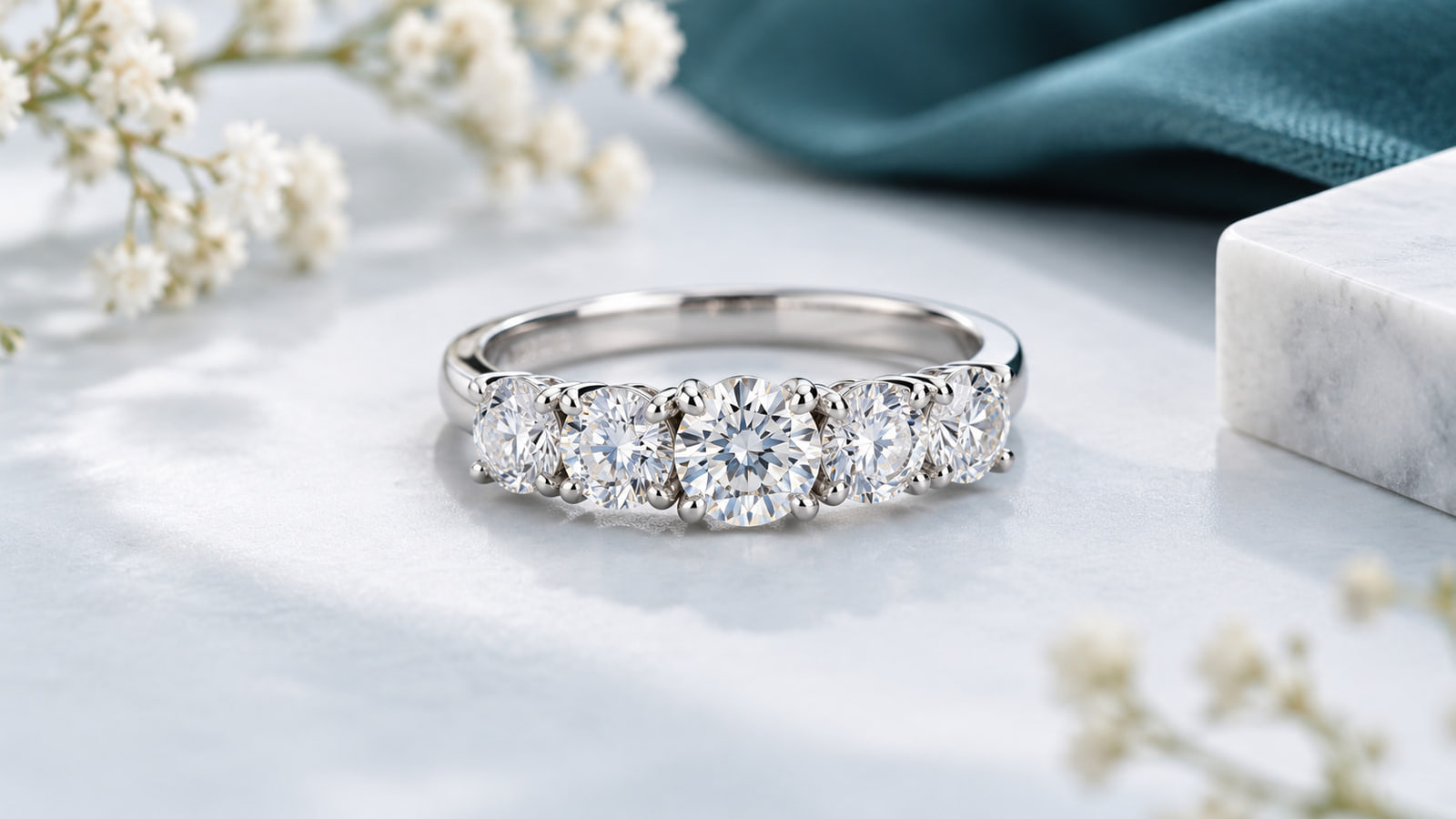
Quick Answer
For a lab-grown diamond anniversary band, choose the finite row as a complete design: five stones and seven stones require different matching, position and setting reviews. Keeping total diamond weight constant does not preserve each stone's size or the row's visible span. Define the intended ring-size family, actual stone dimensions, row progression and the maker's curved layout, then approve the complete set at real scale. A five-stone or seven-stone reference should not be substituted by total weight alone. MEITUO can coordinate loose matched material against the accepted schedule. The manufacturer must approve the band's construction and fit, while the buyer retains the material and visual acceptance record for later replacement.
What Makes a Finite Anniversary Row Different From an Eternity Band?
A five-stone or seven-stone anniversary design places a defined row across part of the band. The remaining shank can be plain or separately decorated, depending on the design. A full-circle eternity construction continues its stone schedule around the circumference. This article concerns the finite row, not a resizing promise for either type of ring.
Specify the visible start and end of the row and how the outside stones meet the plain shoulders. The transition can affect the complete appearance. A row that looks coherent as loose stones may end abruptly when placed into a particular shoulder shape. Review the actual mounting rather than treating the stone count as a finished design.
Decide whether the row uses equal stones or a deliberate center-to-end graduation. Both are possible, but they require different matching rules. For a graduated row, preserve symmetry about the center and identify mirrored positions. For an equal row, compare the stones together for apparent size and visual character under the same conditions.
The matched-diamond category provides a relevant material context. Connect it to the bridal and band application page when developing the complete piece. A loose matched group is one input; it does not approve the maker's band profile or establish that MEITUO manufactures finished anniversary rings.
Why Can Equal Total Weight Create Different Five- and Seven-Stone Layouts?
Total weight is a sum, not a position schedule. Under a simplified equal-weight assumption, a 1.00 ct five-stone row averages 0.20 ct per stone, while a 1.00 ct seven-stone row averages about 0.143 ct. Real sets can use different distributions, so those averages are planning arithmetic rather than a specification for each delivered diamond.
Nor can average weight determine diameter. Obtain the actual proposed dimensions and have the maker review their curved arrangement. A seven-stone design can use smaller individual stones while still extending farther across the finger-facing row. The complete span depends on actual dimensions, gaps, setting divisions and the component's curvature.
For product data, record the row count, total diamond weight and any relevant individual center or position values separately. FTC jewelry guidance addresses accurate weight descriptions; do not let a total-weight headline imply a single stone of that weight. The same principle helps receiving identify whether the supplied group matches the actual bill of materials.
If the line offers both counts, retain separate stock and drawing references. A customer choosing five rather than seven stones may be choosing a different visual rhythm and row length, not merely a lower or higher total. The buyer should approve those differences explicitly instead of allowing a supplier to choose a count that happens to reach a target weight.
Five Stones VS Seven Stones: Which Buying Decisions Change?
Use the comparison to organize a design trial, not to rank one count above the other. The actual outcome depends on the selected stones and mounting. A higher count is not a universal promise of better coverage, comfort or value.
| Decision | Five-stone version | Seven-stone version | Buyer control |
|---|---|---|---|
| Position count | Five identified seats | Seven identified seats | Keep a row-specific bill of materials |
| Equal-total planning | Higher average weight per stone if equally divided | Lower average weight per stone under the same assumption | Use actual sizes before layout approval |
| Visual rhythm | Fewer repeated stone boundaries | More repeated boundaries | Review the complete row at real scale |
| Graduation | Center plus two mirrored pairs if designed that way | Center plus three mirrored pairs if designed that way | Identify positions, do not assume equal stones |
| Shoulder transition | Two outer positions meet the band | The same transition needs its own review | Check the actual curved component |
| Replacement | Match the affected position and row family | Match its own position and row family | Do not transfer a reserve by total weight alone |
For a graduated version, label the center and mirrored pairs in the schedule. The maker should receive the same labels as the stone supplier. A pair accidentally placed in the next position can change the row even when all seven stones are present and their combined weight is correct.
If both versions share a collection name, keep that marketing relationship separate from the material and drawing records. A shared name should not make their seat envelopes, counts or reserve requirements interchangeable.
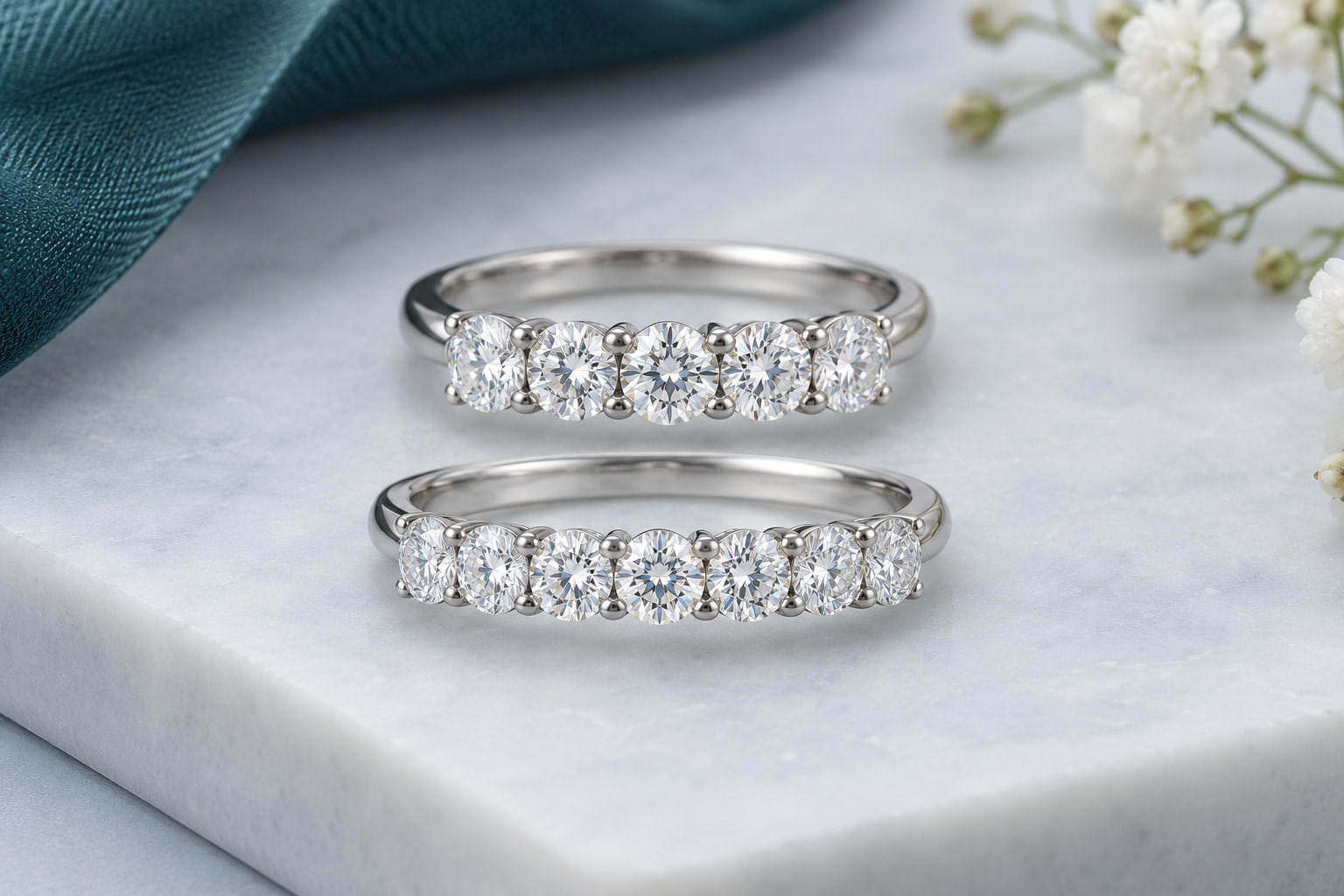
How Can a Simplified Span Calculation Improve the First Layout Discussion?
Hypothetical example: a studio compares five round stones with a nominal 3.8 mm face-up diameter against seven with a nominal 3.3 mm diameter. It uses 0.15 mm between neighboring outlines in a straight planning sketch. The five-stone envelope is 5 × 3.8 + 4 × 0.15 = 19.6 mm. The seven-stone envelope is 7 × 3.3 + 6 × 0.15 = 24.0 mm.
The seven-stone sketch is longer despite its smaller individual outlines. That result helps the designer see why keeping total weight or changing count does not preserve the same visual layout. It does not establish actual finger coverage: the calculation ignores curvature, stone orientation, shoulder geometry and the maker's complete setting construction. The numbers are invented project inputs, not standard sizes or safe setting gaps.
The maker then produces the actual curved layout at the intended ring size. Suppose the seven-stone version turns its outer stones farther away from the face-up viewing direction than the design owner prefers. The team can revise the size family, count or component rather than claiming the longer straight envelope automatically gave better visible coverage.
For a graduated proposal, repeat the sketch using the actual planned diameters and a position map. Do not force an equal-stone formula onto a center-and-pairs arrangement. The purchasing file should preserve the final accepted schedule, including the two outside positions and their shoulder relationship.
MEITUO can coordinate trial stones against the selected family while the maker resolves the curved design. The value of the simple calculation is to expose the next question before ordering a full group, not to replace a physical sample or engineering review.
How Should the Matched Row Be Approved and Retained for Service?
Place the complete loose group in its intended sequence and compare it under consistent lighting. Record actual dimensions and the accepted appearance at normal scale. For a graduated row, preserve the center-to-end order; for equal stones, still identify the family and note any accepted variation. Do not select only the best-looking center photograph as approval of the whole set.
Review the finished sample with the two shoulder transitions visible. If an outside stone appears different, determine whether the cause is its appearance, setting height or viewing angle. Replacing the stone without diagnosing the component can leave the same visual interruption. Assign the issue to the appropriate material or workshop owner.
For service, retain a position map and the approved replacement route. A damaged position may be resolved with one suitable replacement after workshop review, or a broader appearance comparison may be necessary. Do not promise that every repair needs a whole new row, or that every isolated replacement will match automatically. Assess the actual piece and reference.
Use the repeat-order guide to retain the accepted family and the side-stone category when the design uses distinct outer pairs. Keep reserves identified by the positions or family they can support. A generic parcel marked anniversary diamonds is less useful than a small, traceable replacement record.
How Should Finite-Row Anniversary Material Be Sourced by Market?
Choose a channel that can preserve the selected count, position schedule and complete-set approval. The local question is not simply where to find small stones, but who can reserve a coherent group and explain the route for an unmatched position. Country alone cannot establish those capabilities.
USA / Complete-set approval
What Should a US Retailer Request When Developing a Finite Anniversary Row?
Stuller provides a US loose laboratory-grown trade-channel example. For an anniversary-band project, ask whether the actual five- or seven-stone group can be selected and kept together through review. A general catalog category does not establish a matched row for your component, current availability or domestic growth origin.
Give the workshop the same position schedule used by the material buyer. If the customer compares equal and graduated versions, keep their actual weights, dimensions and row images separate. Product copy should not imply that a combined total is the weight of one stone. Review US-facing descriptions against the applicable current guidance and the actual offered item.
Confirm the transaction's review and service terms before setting. Ask the maker what information would be needed for a later outside-position replacement, where the shoulder transition affects appearance. A local contact can simplify communication, but the useful result is an accepted complete-set record and a defined responsibility for the finished band.
CHINA / Count and sequence control
How Should China Coordination Keep a Five-Stone Trial Separate From a Seven-Stone Trial?
The MEITUO team in Qingdao can coordinate a matched-material inquiry for either count. Its location does not establish the growth or cutting site of each offered stone. Ask who holds the actual proposed group and how its identity will remain intact while the buyer and maker compare the layouts.
Use separate group codes for five- and seven-stone trials. For graduation, label the center and mirrored pairs; for equal rows, state the accepted size family and the complete count. A supplier should not rearrange the group solely to reach a total weight after the visual sample has been approved.
Before consolidation, reconcile assembly groups, reserves and held positions. If the maker changes the outside stone size or shoulder transition, issue a revised schedule and identify which material remains usable. Keep unapproved alternatives separate from the accepted set. These controls support a practical China sourcing route without turning a broad anniversary-band title into permission for count, sequence or lot substitutions.
INDIA / Mirrored-pair continuity
What Should an Indian Contact Preserve for a Graduated Anniversary Set?
GreenLab lists Surat and Mumbai contacts, illustrating commercial contact points within an Indian diamond channel. Ask the contracting seller who can prepare and reserve the actual matched group. An address or a broad stock list does not establish a particular five- or seven-stone layout or its production origin.
For graduation, request a complete face-up sequence at equal scale, with the center and mirrored pairs identified. Ask how the group is retained through selection, invoicing and export if those steps involve different contacts. Do not let a replacement for one position inherit approval merely because the new set reaches the same combined weight.
Discuss later service requirements while the reference is available. If original stock is exhausted, the next candidate should be compared against the retained position and completed-row image. A coherent proposed remedy may involve one position or a revised group after review; neither should be assumed in advance. Keep trial groups and accepted production material distinguishable so receiving can reconstruct the intended arrangement without guessing.
How Can MEITUO Support a Five- or Seven-Stone Band Brief?
MEITUO is a sourcing and supply-chain coordination partner based in Qingdao, Shandong, China. For a finite anniversary row, provide the chosen count, actual position schedule, ring-size context and accepted visual reference. The team can help communicate the matched-material requirement, coordinate candidate options and follow supplier responses through the agreed selection and order process.
Its product scope includes loose centers, melee, side stones, matched pairs and sets, and fancy-color options. A five- or seven-stone group can be discussed as a defined set rather than an undifferentiated total weight. MEITUO does not replace the manufacturer responsible for the curved layout, setting or repair assessment, and no finished-band manufacturing claim is made here. Confirm availability, documents, MOQ, lead time, treatment information and shipping terms for the actual inquiry. The jewelry-brand solutions page provides the collection context. Contact [email protected] with the position map and distinguish assembly groups from the reserve material you want reviewed.
What Should an Anniversary-Band RFQ Say About Count and Matched Sets?
State whether the request is for an equal row or a graduated arrangement. Provide the count and actual dimensional requirements by position, with total weight treated as a separate field. Attach the maker's current drawing and identify who can approve a change in stone family or sequence.
Ask suppliers to preserve group identity and quote reserve material separately. If the design is still being compared in five- and seven-stone versions, request separate trial proposals rather than a blended parcel. The following brief keeps the decision tied to the complete row and its intended application.
Please propose matched laboratory-grown material for [anniversary band version], using [five or seven] stones in an [equal or graduated] row. Position dimensions and sequence are [schedule]; total weight scope is [requirement]. Keep the center and mirrored pairs identified where applicable. Provide complete-set scale images, item or lot references and trial material for drawing [revision]. Quote reserves separately by supported position family. Confirm growth and treatment information, availability, documents, MOQ, reservation period, lead time, packing, shipping and review terms. No count, sequence or size-family substitution without [buyer and maker] approval.
FAQ: Lab-Grown Diamond Anniversary Bands: Five VS Seven Stones
Is a Seven-Stone Band Always Wider Than a Five-Stone Band?
Not automatically. Actual stone dimensions, gaps, orientation and the curved component determine the layout. The simplified example shows one longer seven-stone sketch, not a universal rule about finished coverage.
Does Equal Total Diamond Weight Mean Equal Individual Stones?
No. The same total can be distributed across different counts and sizes. Under an equal-weight assumption the averages differ, but the actual delivered stones need their own schedule and acceptance.
Can a Five-Stone Set Be Substituted for a Seven-Stone Set by Total Weight?
Only through a newly approved design and material decision. Count, seat positions, visual rhythm and reserve needs change. Keep separate drawing and stock references rather than treating the groups as interchangeable.
Does the Straight-Span Formula Prove Ring Fit?
No. It is a planning model that omits curvature, orientation and complete setting geometry. Use it to identify questions for the maker, then approve the actual curved layout and sample.
Must a Damaged Stone Always Mean Replacing the Entire Row?
No universal replacement rule is asserted. The workshop should assess the actual piece, affected position and available matching material. Retain the complete-row reference so a proposed remedy can be reviewed for both fit and appearance.
What Should an Anniversary-Band Material Order Include?
State count, equal or graduated arrangement, actual position dimensions, group identity and reserve requirements. Provide the maker’s drawing and approval owner, with total weight recorded separately from the individual position schedule.