 English
 Español
 Português
 Deutsch
 Français
 Italiano
 Nederlands
 العربية
 日本語
 한국어
 ไทย
Quick Answer
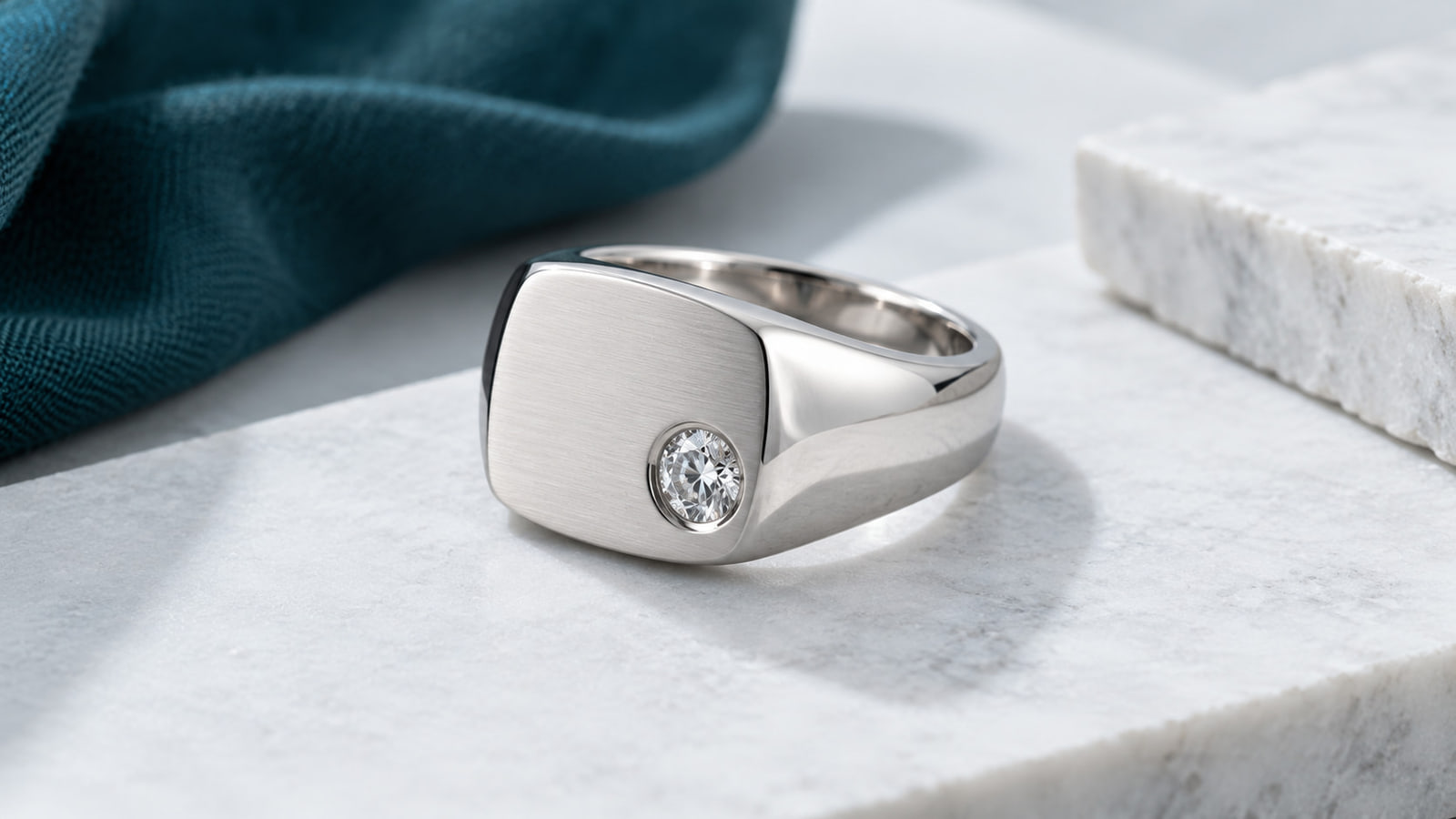
For a men's lab-grown diamond ring with a signet-style face, begin with the face drawing and the intended stone arrangement. Specify a single inset center or a defined cluster, its position, the surrounding metal or engraving area and the setter's actual seat requirements. A broad top does not mean any stone can fit: depth, underside construction and edge relationships still need workshop approval. Review the ring at the intended finger size and in profile, then connect the loose-stone order to that design version. MEITUO can coordinate center or melee options against the brief. The manufacturer remains responsible for the signet-style component, setting method and finished ring, rather than inheriting an approval from a loose-stone quotation.
What Should a Signet-Style Diamond Ring Brief Describe?
Signet-style is a design description here: a broad face that may carry a stone, metal pattern or engraving. It does not establish that the ring functions as an engraved seal or has antique provenance. Describe the actual face outline, finish and intended visual hierarchy instead of relying on the style word to carry all those meanings.
Decide whether the diamond is the focal point or one element within a larger metal face. A small inset center can leave substantial clear metal, while a cluster can create a broader sparkling area. Both can suit a contemporary line. Avoid assigning one preference to all men or presenting a broad face as automatically more comfortable or durable.
Show the intended finger-size family with the design. The same face can look different when mounted on a narrow or broad shank, and the responsible maker needs to review the complete profile. A face-up image alone cannot establish how the ring sits, how the underside is constructed or whether the chosen stone projects into another design element.
For the stone conversation, connect loose centers with melee options only after the arrangement is chosen. These product groups may need different records, documents and replacement routes. The fashion application page provides the collection context without implying that MEITUO manufactures the finished ring.
How Should the Face Plan Connect to the Actual Stone Seat?
Use a controlled top view to locate the stone's center, the face outline and any protected metal or engraving zone. Add a side view showing the proposed stone profile and underside clearance. The drawing should distinguish a visual placement line from an actual setting seat. A supplier can propose a stone outline, but the component maker must determine the contact geometry.
For an offset design, identify which direction is intentional. A ring may look balanced in a photograph while the workshop interprets the offset toward the opposite side. Mark orientation in the drawing and assembly record. If the line has mirrored versions, give them separate references rather than expecting a supplier to infer the wearer or hand from the product name.
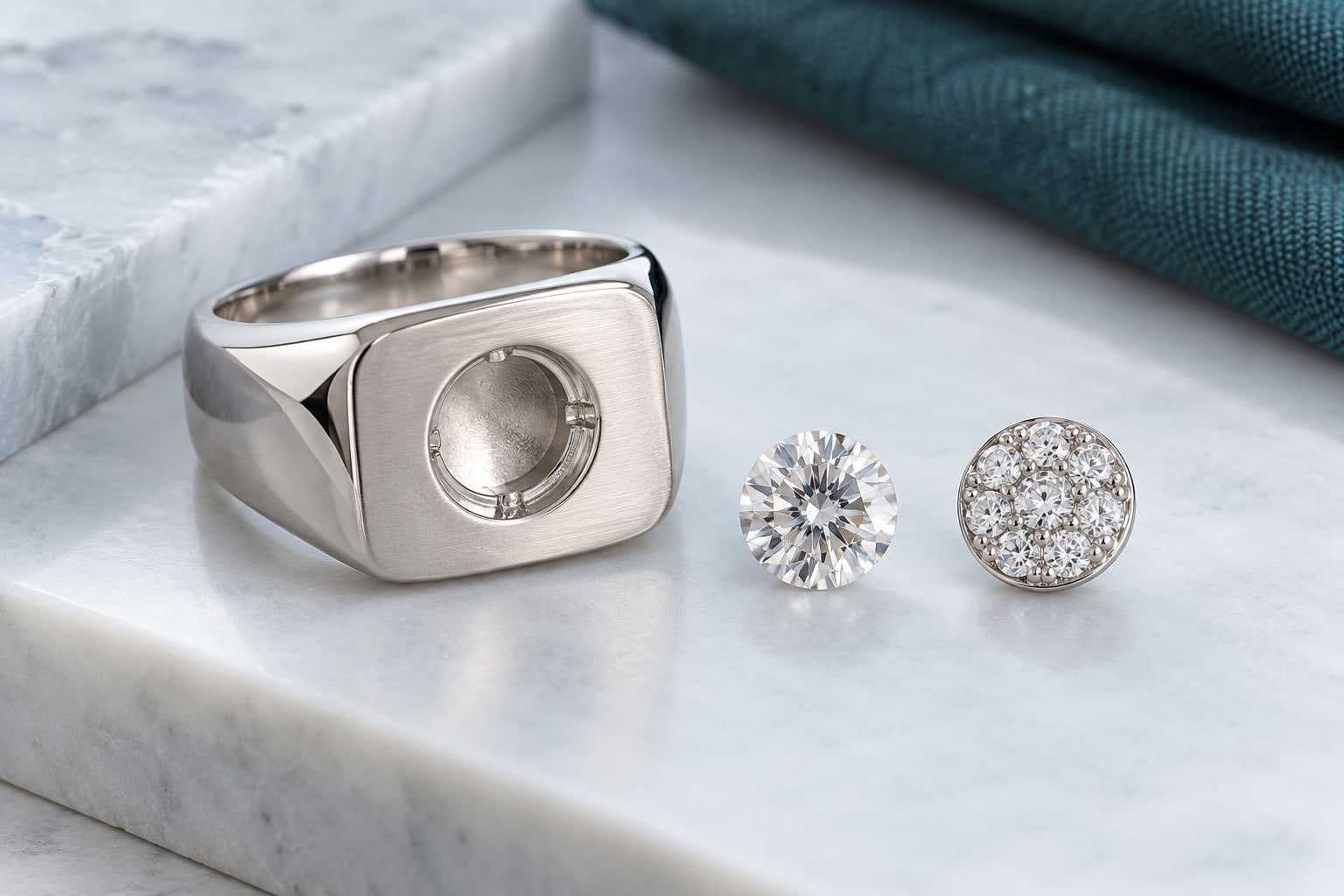
Ask the setter to review the actual stone dimensions, including depth and the relevant edge conditions. An inset appearance can come from different constructions; do not assume every signet face uses the same flush or bezel method. A cluster with a similar outer envelope may require a different underlying seat and metal arrangement from a single stone.
Preserve room for finishing and any intended engraving through the maker's approved process. Do not invent a universal minimum rim or metal thickness from a face-up sketch. When a candidate exceeds a project limit, obtain an explicit design review or request another item. Broad face width is not permission for an undocumented stone substitution.
Single Inset Center VS Cluster: How Does the Procurement Brief Change?
Compare the material and interface requirements before deciding which visual effect to offer. Neither arrangement is inherently better, and a similar face-up footprint does not make their construction interchangeable.
| Decision | Single inset center | Defined cluster | Buyer control |
|---|---|---|---|
| Identity record | One center linked to its item evidence | Several stones linked to the agreed lot and layout | Keep component-level traceability |
| Visual emphasis | One continuous stone pattern | Several reflections and setting divisions | Approve at actual viewing scale |
| Seat design | Based on the actual center geometry | Based on multiple positions and intervening metal | Review each construction independently |
| Clear face area | Depends on center outline and placement | Depends on the full cluster envelope | Preserve the intended metal or engraving zone |
| Replacement | One suitable replacement center may be needed | One position or a wider visual group may need review | Agree the service decision route |
| Quotation scope | Specify one center per assembly | Specify count and family for every cluster position | Do not compare total weight alone |
If the product team wants both versions, give each a separate design and material reference. Do not order a cluster as a low-cost substitute for an approved single-center SKU without a new acceptance decision. Its visual pattern and workshop process have changed.
For a cluster, retain a position map so a later repair request identifies the actual location and stone family. A request for another small diamond of similar weight is too broad when the seat and surrounding pattern were approved for a particular group.
How Can a Face-Layout Example Reveal an Intentional Offset?
Hypothetical example: a studio uses a simplified rectangular face plan measuring 10.0 by 8.0 mm. It proposes a round stone with a 4.5 mm face-up diameter. Centered across the 10.0 mm direction, the nominal visual gap is (10.0 − 4.5) ÷ 2 = 2.75 mm on each side. The example is a two-dimensional layout model, not an engineering clearance or minimum-metal standard.
The designer then shifts the stone center 1.0 mm toward one side to preserve an engraving field. The two nominal side gaps become 1.75 and 3.75 mm. This change needs an orientation reference. Without one, the workshop could reverse the arrangement while still using the correct stone diameter and face width.
Suppose an alternative center has a 4.8 mm diameter. The simplified centered gaps would become 2.60 mm, but that arithmetic does not establish fit in the existing seat or permission to reduce the engraving area. Its actual depth and contact geometry need review. The buyer records it as an alternative candidate, not as the original approved item.
For a cluster proposal, the studio draws the complete outer envelope and setting divisions separately. A 4.5 mm cluster envelope is not the same object as a 4.5 mm single diamond. The maker reviews the construction before the purchasing team compares quotations.
MEITUO can coordinate candidate centers or a melee family against these separate versions. The drawing owner should approve placement and the setter should approve the actual interface. Retaining both decisions makes an offset signet-style design reproducible without claiming that a simple gap calculation proves comfort, strength or final stone retention.
What Should a Finished Sample and Service Record Reveal?
Review the complete ring at actual scale, under diffuse and ordinary directional light. Check how the stone relates to the clear face area, whether the intended offset reads correctly and whether the profile matches the selected reference. A magnified close-up can reveal surface or setting concerns, but it should not be the only view used to approve a broad-face design.
For a single center, keep its identity, dimensions and accepted movement media linked to the ring version. For a cluster, keep the position map, family requirements and accepted completed-face image. A later service request may concern one damaged position, an appearance mismatch or the component itself; those are different questions.
Have the maker explain the replacement route before the line is released. Can an individual stone be removed and replaced under the proposed construction, and what review follows? Do not assume a specific repair is possible because the ring looks simple from above. The responsible workshop must assess the actual piece and method.
Use the repeat-order guide to preserve the accepted version and the designer solutions page for the development context. A reserve stone should be linked to the relevant seat and visual family, not merely labelled men's ring stock.
How Should Signet-Style Stone Requirements Be Localized?
Compare the stone-selection channel with the maker responsible for the face and seat. A seller may provide an excellent loose center without supplying the ring component. The local sourcing question is who can preserve the actual candidate and the approved design version through those separate responsibilities.
USA / Face and stone responsibilities
What Should a US Custom-Jewelry Buyer Ask the Stone Seller and Maker Separately?
Stuller provides a US loose laboratory-grown diamond channel example. For a signet-style project, ask the actual seller which center or melee options can be identified and reserved. A loose-stone category does not establish that a finished signet design or a particular seat is offered. The responsible maker still needs to approve the component and setting route.
Give the seller the stone envelope and give the maker the actual candidate reference. Keep the offset and engraving field on the controlled drawing rather than relying on a sales photograph. If the line offers both a single-center and cluster version, use separate product and workshop references.
For a US retail handover, keep laboratory-grown origin, center versus total weight and finished-ring scope clear in the product record. A domestic purchase does not establish domestic growth. Confirm actual review and service terms for the transaction, then retain the accepted face image so a later repair request can be connected to the correct arrangement.
CHINA / Version-specific candidates
How Should China Coordination Prevent a Face-Layout Change From Becoming an Unnoticed Substitution?
The MEITUO team in Qingdao can coordinate candidate stones for an approved face plan. The coordinator's address does not identify the component manufacturer or the diamond grower. Name those roles separately so a stone-size question and a ring-construction question reach the right owner.
Send the face drawing, seat envelope and orientation reference in one controlled package. If a supplier offers a neighboring diameter, require the actual measurements and a clear exception note. The buyer and maker should review whether the change affects the protected metal area or the construction; the stone seller should not infer permission from the broad face width.
For a cluster, preserve the lot and position-family references through consolidation. Keep the accepted sample version distinct from later design experiments. Confirm which goods are reserved and which remain proposals before packing. This makes a China sourcing response specific to the ring's current design without treating every small round stone or every nominally similar center as an automatic replacement.
INDIA / Actual-item and family control
What Should an Indian Contact Preserve for a Signet Center or Cluster?
GreenLab lists Surat and Mumbai contact locations, illustrating commercial contact points in an Indian diamond channel. Ask the contracting seller who controls the actual proposed center or prepares the cluster's stone family. An address does not establish origin, inventory availability or compatibility with the ring's face construction.
For a center, request actual dimensions and appearance evidence tied to its item reference. For a cluster, request the agreed size family and enough trial stones to populate the intended layout. A single attractive sample cannot demonstrate the full face pattern. If the seller proposes a different outline or mixed family, keep it outside the accepted design until reviewed.
When selection and export contacts differ, carry the same version and item references through both. A later reorder should refer to the accepted face plan and service requirement, not merely men's diamond rings. Ask how a replacement candidate will be compared if the original lot is exhausted. The aim is a repeatable handover that preserves the design decision across commercial contacts.
How Can MEITUO Coordinate a Signet-Style Stone Brief?
MEITUO is a sourcing and supply-chain coordination partner based in Qingdao, Shandong, China. For a signet-style ring, send the selected arrangement, actual face drawing and the setter's stone envelope. The team can communicate the center or cluster requirements, coordinate supplier options and follow the quality-requirement and order questions against that controlled brief.
Its product conversation includes loose centers, melee, side stones, matched pairs and sets, and fancy-color options. A single-center and cluster version can therefore be discussed as separate material scopes without pretending that they share one seat approval. MEITUO does not claim finished-ring manufacturing, engraving services or an independent laboratory finding through this article. Confirm availability, documents, MOQ, lead time, treatment information and shipping terms for the proposed order. The sourcing-team page describes the coordination role. Contact [email protected] with the arrangement reference, quantity and the person authorized to approve changes in stone dimensions or placement.
What Should a Signet-Style Diamond-Ring RFQ Specify?
State whether the inquiry concerns one loose center or a defined cluster family. Attach the face plan and the actual seat requirements supplied by the maker. Identify the orientation, offset and any protected design zone, while making clear that visual gaps are not supplier-defined engineering limits.
Request item-level options for a center and a position schedule for a cluster. Keep those quotations separate if both are being explored. Define who can approve a dimensional exception and when the actual candidate must remain reserved. The following brief helps preserve the design intent without transferring the manufacturer's responsibilities to the stone supplier.
Please propose loose laboratory-grown material for [signet-style ring version]. The approved arrangement is [single center or cluster], with stone dimensions and depth limited by [maker drawing revision]. Preserve the orientation and placement reference [file]; do not infer engineering clearances from the visual face plan. For centers provide actual-item documents and media; for clusters provide the position-family schedule and trial quantity. Quote alternatives separately. Confirm growth and treatment information, availability, MOQ, reservation period, lead time, packing, shipping and review terms. Any size or arrangement change requires [buyer and maker] approval before substitution.
FAQ: Men’s Lab-Grown Diamond Rings: Signet-Style Stone Planning
Does Signet-Style Mean an Antique Seal Ring?
No. This guide uses the term for a broad-face contemporary design. Antique provenance, an engraved seal function or a particular historical construction would require separate evidence and specification.
Can a Broad Face Accept Any Center Stone?
No. The actual seat, depth, underside and surrounding design zones still need review by the maker and setter. Face width alone does not establish a compatible or approved stone interface.
Can a Cluster Replace a Single Center With the Same Outer Diameter?
Only as a newly approved design version. Multiple stones and their setting divisions require a different construction and material schedule. A similar outer envelope does not transfer the single-center approval.
What Does the Offset Example Prove?
It shows how a two-dimensional placement shift changes nominal visual side gaps. It is not a minimum-metal rule, strength analysis or proof of stone retention. The actual construction needs workshop approval.
Can MEITUO Provide Engraving or Finished-Ring Manufacture?
Those services are not established here. This article covers MEITUO’s confirmed loose-stone sourcing and coordination role. Any finished component or engraving requirement needs separate confirmation with the responsible service provider.
What Should a Service Request Identify?
Provide the design version, accepted face image, stone identity or cluster position map and the relevant dimensions. Explain whether the concern is material, appearance, placement or component condition so the responsible party can assess the appropriate remedy.