 English
 Español
 Português
 Deutsch
 Français
 Italiano
 Nederlands
 العربية
 日本語
 한국어
 ไทย
Quick Answer
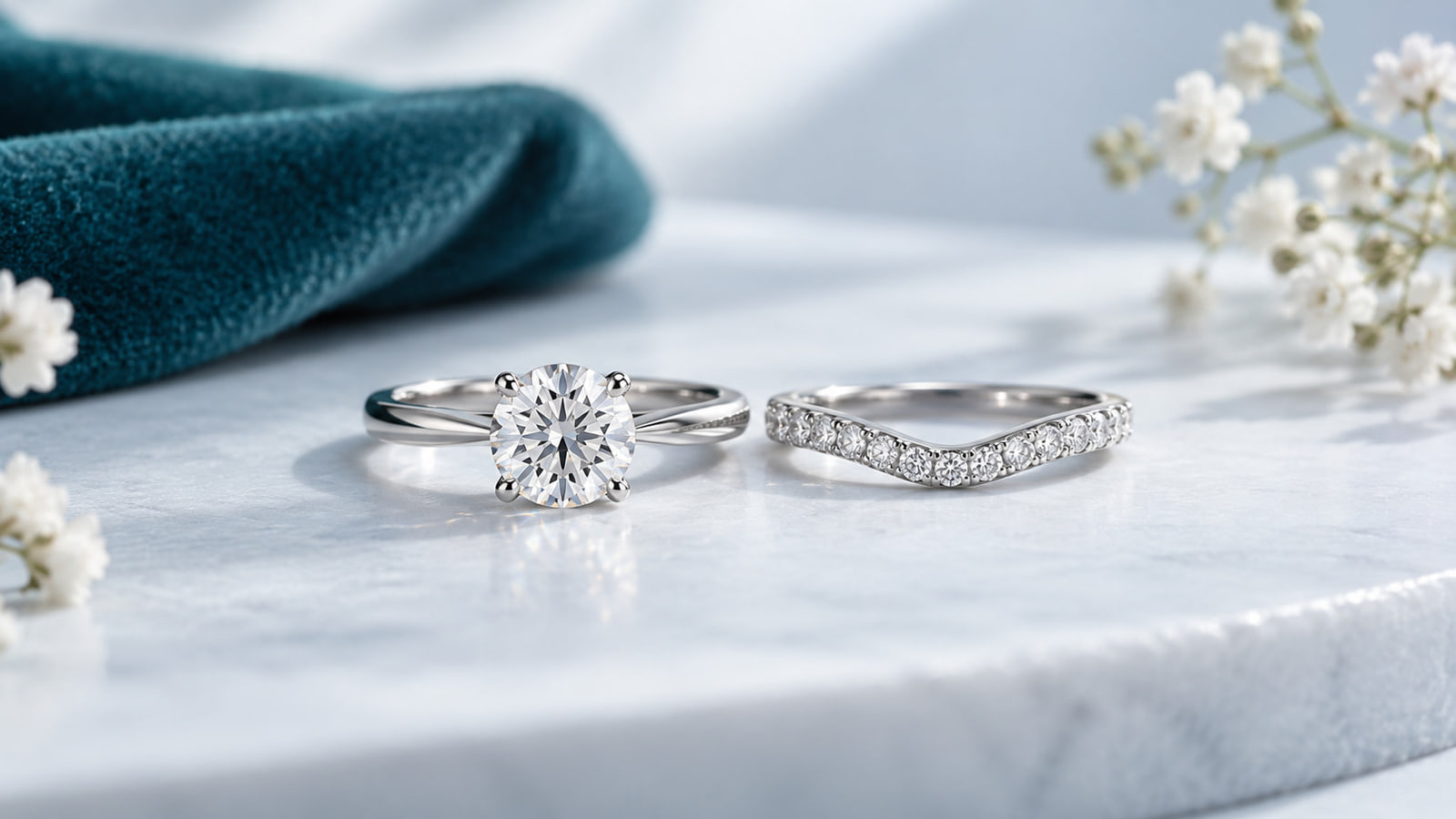
A lab grown diamond bridal set should be approved as two linked rings, not as an engagement ring plus an assumed compatible band. Specify the center, companion contour, intended gap and orientation on a shared drawing. Review the pair in the same sizes and technical versions planned for sale, including side clearance around the center setting. Then link both bills of materials so a stone or body change in one ring triggers a review of the other where relevant. Define whether customers may return, exchange or replace one piece separately. Loose diamonds can be selected by their individual fit windows, but the jewelry maker must validate the exact paired assembly and the buyer must approve its intended appearance.
What Makes a Bridal Set a Paired Approval Rather Than a Stack?
A general stacking collection may invite many combinations. A bridal set makes a more specific promise: these two identified pieces form the offered pair. The buying team therefore needs a controlled pair reference that identifies the engagement ring, companion band and accepted orientation. The pair should not be defined only by adjacent product photographs or a shared collection name.
Decide what the customer is expected to see between the rings. A deliberate gap, a close contour or a nested shape can each be valid. What matters is whether the design team has chosen and documented it. Avoid vague instructions such as make the band sit flush unless the maker and buyer share an actual drawing and sample of that condition.
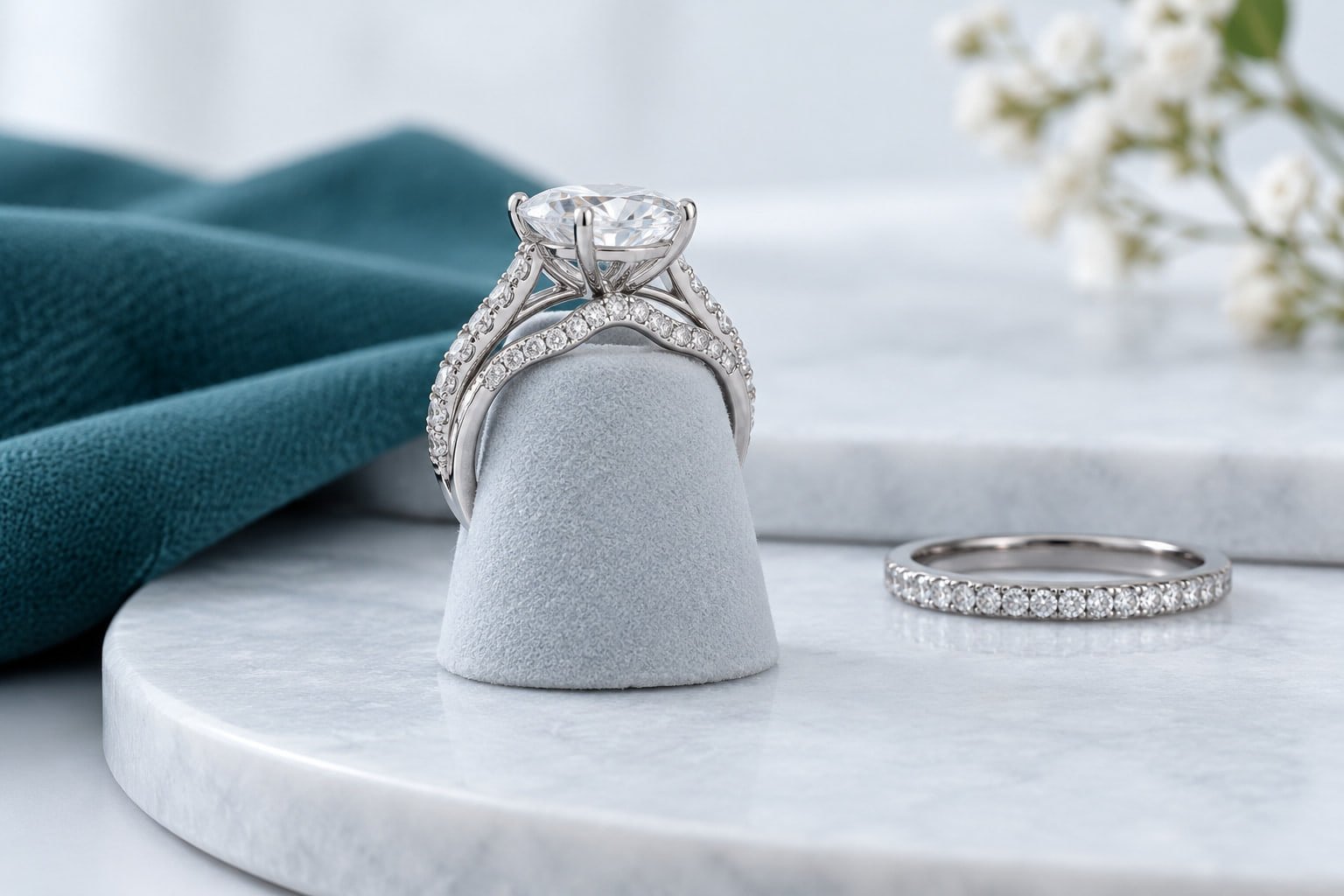
Ask the maker to identify contact or near-contact regions in top and side views. The companion may clear the visible center outline while approaching the gallery below it. A face-up image of the pair does not answer that question. Keep the maker's technical verification distinct from the buyer's aesthetic approval.
The bridal application brief should identify a fixed pair rather than a broad stackable assortment. That boundary makes the sourcing request more precise: center selection and companion stones belong to linked, controlled components.
Matched Bridal Set VS Independently Selected Band: What Changes?
| Decision | Approved bridal set | Independently selected companion |
|---|---|---|
| Compatibility evidence | Exact two-piece drawing and accepted pair sample | New comparison needed with the proposed engagement ring |
| Version control | Two component codes linked to one pair revision | Each ring has its own code, with no assumed pair approval |
| Center substitution | Assess impact on the pair's gallery and silhouette | Assess suitability before promising compatibility |
| Service scope | Define whether one piece can be exchanged separately | Define responsibility for the new combination |
| Sales photography | Show the actual offered pair and orientation | Label the illustrated combination and its limitations |
The comparison does not imply that independently selected bands are inferior. It shows that they require their own compatibility review. A bridal-set label should point to evidence for the exact supplied pieces, while a later substitution creates a new pairing decision.
For contour bands, identify which side faces the engagement ring. If the companion is intentionally reversible, approve both orientations. Otherwise the fulfillment team needs a clear reference so a reversed display is not mistaken for the accepted presentation.
How Should the Two Stone Schedules Stay Linked?
Create an engagement-ring component record with the center's identity or accepted fit window, side-stone schedule and head revision. Create a companion record with its own stone map, contour and body revision. The pair record then links the two approved versions. This makes a change visible without forcing both rings to share an indistinct bill of materials.
For the center, actual dimensions and depth matter to the head. For the companion, the relevant loose stones may be repeated melee or a graduated contour row. Do not allocate the entire order by combined carat weight. The loose center range and melee range address different component roles and should remain identifiable.
If the center changes within a broad retail weight category, ask the maker whether the head or gallery changes. If it does, reconsider the companion clearance. If the companion row changes stone size, ask whether its contour or height also changes. The point is to assess actual interfaces rather than automatically rejecting every variation.
Record each approved size combination. Two rings carrying the same retail size label still need the producer's actual dimensional references. Where the pair is offered in different widths or metal profiles, link each version explicitly. A photograph of one pair should not silently represent every possible technical combination.
Give the pair a release checklist that both component teams can sign against. The engagement-ring team confirms its accepted version; the companion team confirms its own; the final assembly reviewer confirms the intended pairing. This is a practical project control rather than an independent certification. It is especially useful when the pieces are produced or delivered at different times.
Separate pair approval from packaging convenience. Two rings in the same box are not necessarily a controlled set, and rings packed separately can still form an approved pair if their identities remain linked. The packing instruction should state which component codes belong together and what to do when one component is unavailable.
For a split shipment, identify which component is held until its partner is accepted. A dispatch date should not override the compatibility checkpoint or cause an unapproved pair to enter saleable stock. Record partial quantities against the linked version, not merely the shared retail collection name.
Hypothetical Example: A Gallery Revision Changes the Companion Decision
An invented bridal pair has an engagement ring head with a proposed lower side projection of 1.2 mm beyond the shank reference. Its companion band's inward contour allows an illustrative 1.6 mm offset from that same reference. On the simplified drawing, the apparent difference is 0.4 mm. This subtraction is a discussion aid, not a validated clearance or engineering tolerance.
A newly proposed center requires a revised head whose lower projection is 1.8 mm. Against the unchanged 1.6 mm contour, the simplified drawing now shows an apparent 0.2 mm overlap. Even if the center has the same nominal carat label, the previous pair approval no longer represents the proposed geometry. The maker must resolve the actual three-dimensional interface.
The buyer considers retaining the original center window, changing the head, or revising the companion contour. It does not accept a supplier's claim that all rings in the weight range fit the same set. The maker proposes a revised companion, and the buyer reviews the exact two-piece sample in top, side and separated views.
The final pair receives a new linked revision. Existing companion stock is not automatically relabeled as compatible with the revised head. The commercial team decides whether to keep the old pair as a separate version or transition inventory deliberately. This hypothetical example illustrates why compatibility belongs to a named combination and why a stone substitution can become a paired-product decision rather than a simple loose-center replacement.
Which Supplier Channel Can Support a Controlled Bridal Pair?
Ask sellers which components they supply and who approves the exact two-piece combination. A loose-stone channel may support both diamond schedules without producing either ring. A finished-set seller should identify the engagement and companion versions rather than offering a generic compatibility assurance.
USA / Exact pair and service terms
What Should a US Bridal Retailer Verify Before Selling the Set?
Stuller provides a US loose lab-grown trade channel. A retailer can source centers through such a channel while using another producer for the rings. The pair approval still needs the actual engagement head and companion version, not just a suitable center.
Ask the bench or set producer to identify the intended side relationship and any unsupported combinations. If the retailer lets customers select alternate centers, define when that selection changes the head and triggers a new companion review. A broad weight filter should not imply that every selected stone uses the same paired geometry.
For service, decide whether the retailer can exchange the companion alone and how it identifies the correct revision. Keep the accepted pair photographs accessible to store staff. A local repair contact is useful, but it does not remove the need to assess a remade engagement ring before returning it beside the original band. The customer should receive the approved combination and accurate service options.
CHINA / Linked allocations
How Should a Chinese Coordinator Track Two Bridal Stone Schedules?
For China-facing sourcing, send the engagement and companion diamond schedules as separate documents linked by one pair reference. MEITUO's Qingdao coordination can then organize the loose requirement without merging center stones and companion melee into an unhelpful total-weight request. Identify which party manufactures each ring.
When an upstream seller proposes a different center, ask for actual dimensions before approving allocation. The jewelry maker should determine whether the head changes and whether the companion remains compatible. A coordinator can follow that decision, but should not be expected to infer three-dimensional clearance from a retail image.
For packing, label the allocations by component and pair revision. If engagement rings and bands reach the workshop on different schedules, preserve the link so old and new versions are not combined casually. Request a clear exception record when only part of an order changes. This allows the buyer to decide whether existing component stock remains usable or needs to be held for its originally approved pair.
INDIA / Center alternatives with interface consequences
What Should an Indian Stone Seller Know About a Bridal Pair?
Greenlab lists Surat manufacturing and Mumbai corporate contacts. When researching Indian center suppliers, explain that the stone belongs to a controlled bridal pair. The seller needs the actual fit window and approval process, rather than a generic request for any center in a nominal weight category.
Ask alternatives to show dimensions and depth clearly. If the jewelry maker needs a revised head, pause the companion allocation until the paired interface is reviewed. For accent parcels, preserve the engagement and band roles even if both use visually similar melee. Their dimension windows or matching references may differ.
Before export, reconcile item identities and component allocations with the linked pair record. Agree how shortages or rejected centers affect the companion schedule and shipment. The supplier should know whether it is supporting an exact accepted pair or presenting a new design alternative. That distinction prevents a commercially attractive center from being treated as automatically compatible with existing band stock.
How Should Receiving and Returns Protect the Accepted Pair?
At receiving, reconcile each ring with its component code and the pair reference. Check size, metal version, stone allocation and the accepted orientation. Photograph the two rings together and separately so the record identifies both the pair and its individual pieces. A correct engagement ring paired with the wrong companion is still a fulfillment error.
Ask the maker to complete the agreed setting and interface checks. Inspect the side relationship, not only the face-up gap. If the intended contour differs from the accepted sample, mark the specific region and compare the actual revisions. GIA notes that diamonds can scratch setting metals. This supports attention to unintended contact, without creating a universal clearance rule.
Before launch, decide whether one piece can be exchanged or returned separately. If an engagement ring is remade around a different center, determine whether the original companion remains approved. If only the band is replaced, identify which version must be supplied. Keep the technical decision separate from commercial eligibility and charges.
The repeat-order record should preserve the linked revisions and any approved exceptions. This allows a service team to restore the intended pair rather than selecting a visually similar band from a current catalog and assuming compatibility.
For partial returns, keep the returned piece linked to its original partner in the record. If it is reallocated to another set, require compatibility review for that new partner rather than assuming every band with the same retail description is interchangeable. Record condition and disposition before returning it to saleable stock. This prevents the service process from bypassing the paired approval used for new production.
How Can MEITUO Coordinate Stones for Both Bridal-Set Pieces?
MEITUO is a sourcing and supply-chain coordination partner in Qingdao, Shandong, China, serving jewelry brands, wholesalers, retailers and designers. Its product scope includes loose centers, melee, side stones and matched sets. For a bridal project, buyers can provide separate diamond schedules for the engagement ring and companion band while keeping them linked to one accepted pair revision.
The team can support product selection, supplier coordination, confirmation of quality requirements and order follow-up. A useful brief identifies which stone changes would require the jewelry maker to review the head or companion contour. MEITUO's sourcing role does not replace that maker's responsibility for the completed rings or their paired interface.
Contact [email protected] with the center requirements, companion map and launch size mix. Confirm availability, documents, MOQ, treatment information, lead time and shipping terms for the order. The matched-set category can help frame the diamond selection, while the paired jewelry approval remains tied to the actual producer's drawings and samples.
What Belongs in a Bridal-Set RFQ?
Identify the two ring codes and the pair revision. Attach top, side and contour drawings showing the intended gap and orientation. List the center, engagement accents and companion stones as separate allocations. Include the size combinations and the change triggers that require another interface review.
Ask suppliers to distinguish loose diamonds, mounts, setting and completed-pair inspection. Request alternatives as clearly labeled options when a proposed stone changes the head. Confirm how substitutions are communicated before assembly and how the receiving team can identify the correct companion. Avoid a quotation that groups all stones under one combined weight without preserving their roles.
Use the RFQ guide for commercial fields. Add service rules for one-piece exchanges, remakes and replacement components. The copyable brief below gives the supplier a defined pair to support, rather than asking it to guess what the retailer means by a matching wedding band.
Please quote laboratory-grown diamonds for bridal pair [reference and revision], comprising engagement ring [code] and companion [code]. Attach separate center, engagement-accent and band allocations for [quantity and size combinations]. Match [actual dimensions], appearance references and condition requirements. Flag alternatives affecting head, gallery, contour or intended gap for renewed pair approval. Separate loose supply, components, setting and completed-pair checks. Confirm documents, treatment information, MOQ, lead time, packing identities and shipping terms. No component substitution may inherit compatibility automatically. The jewelry producer will verify the exact pair, and our commercial agreement will define one-piece exchange and remake scope.
FAQ: Lab-Grown Diamond Bridal Sets: Approving Both Rings
Is a Bridal Set Simply Any Two Rings Worn Together?
For this buying brief it is a specifically approved engagement ring and companion band. Other combinations need their own review before being promised as compatible.
Does the Companion Have to Touch the Engagement Ring?
No. A deliberate gap or close contour can both be valid. Approve the intended relationship on drawings and the actual pair sample.
Can a Same-Carat Center Change the Pair?
Yes. Different dimensions or depth can require a revised head or gallery, which may affect companion clearance. Review actual geometry.
Should Both Rings Share One Bill of Materials?
Keep separate component records linked by a pair revision. This preserves individual allocations while making compatibility dependencies visible.
Can One Ring Be Exchanged Separately?
That is a commercial and technical decision to agree before launch. The replacement must still be the approved compatible version.
What if an Engagement Ring Is Remade?
Identify the new head and center geometry, then assess whether the original companion remains approved. Do not carry over compatibility solely from the retail style name.