 English
 Español
 Português
 Deutsch
 Français
 Italiano
 Nederlands
 العربية
 日本語
 한국어
 ไทย
Quick Answer
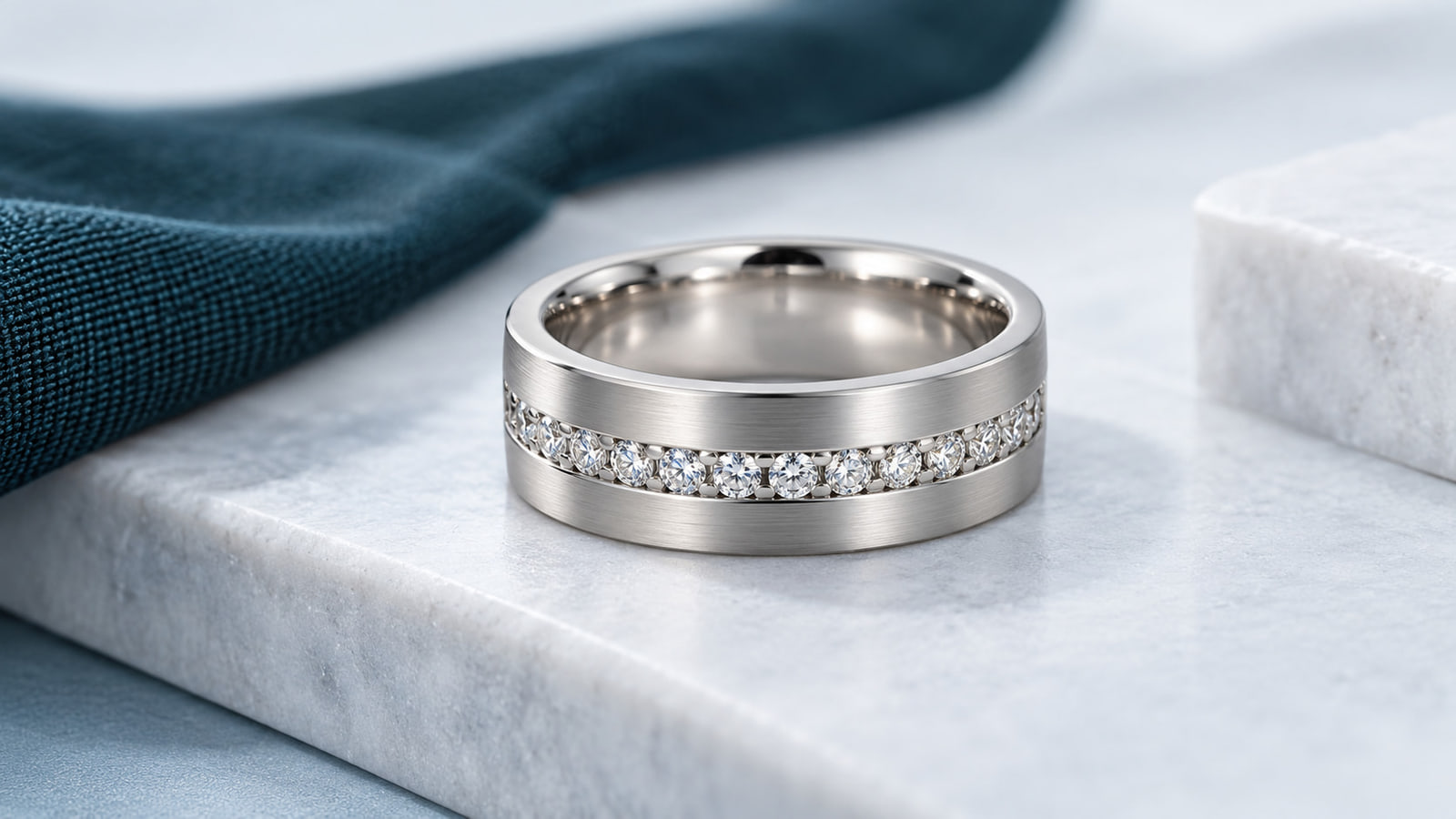
For lab grown diamond men's wedding bands, specify the inset or channel row together with band width, outer profile and inner fit reference. The stones are part of a continuous band design, so a broad-face signet or single-center ring is a different sourcing problem. Ask the jewelry maker to define the seat positions, side margins and size-specific layout, then select diamonds against those accepted dimensions. Compare actual samples from relevant size boundaries and review the interior as carefully as the top view. Keep loose diamond acceptance separate from the maker's verification of setting, band geometry and finishing. Do not infer comfort, security or a universal resizing allowance from the words channel set or men's wedding band.
How Should an Inset Row Relate to the Wedding Band Profile?
Begin with an outer and inner profile drawing. State the nominal band width and identify how the maker measures it. Show whether the diamond row is centered, offset or divided into several rows. The buyer should understand the exposed metal margins and the overall cross-section before choosing a stone family. A face photograph cannot reveal the full interior or the depth occupied by the seats.
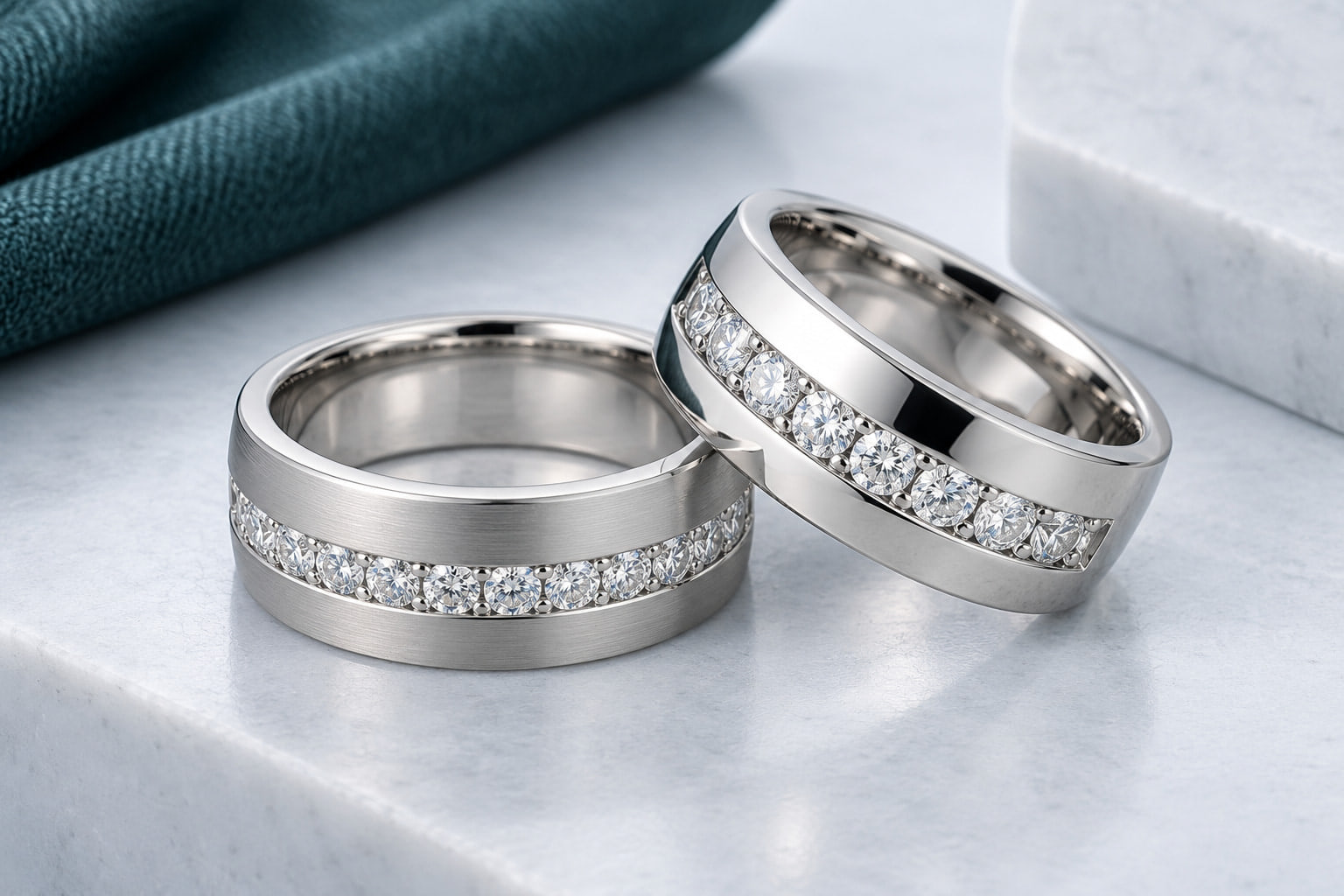
Ask which surfaces contribute to the intended visual contrast. A polished border beside a recessed stone row is a different brief from a broad textured top with individually inset stones. Keep finishing references attached to the drawing because the same diamond layout can read differently against different surfaces. Do not let a changed finish conceal an unapproved change in margin width.
At sample review, inspect whether the stone line appears continuous and deliberately located within the band. Examine both edges and the interior. If the row looks off-center, ask the maker to compare the seat locations and band outline before concluding that the stones are mismatched.
Use the bridal jewelry application brief to describe the project as a wedding-band system. The relevant stone requirement is an inset-row schedule; it should not inherit the center-and-engraving priorities of a signet ring.
Channel Row VS Individually Inset Stones: What Must Buyers Compare?
| Question | Channel-row concept | Individual inset positions |
|---|---|---|
| Visual rhythm | Stone line framed by defined channel boundaries | Separate positions repeated through the metal surface |
| Drawing need | Channel geometry, row span and stone dimensions | Each seat location, spacing and metal margins |
| Dimension control | Fit and alignment through the shared row | Fit and consistency at each repeated seat |
| Size change | Review how row length and boundaries change | Review count, pitch and placement |
| Inspection focus | Row continuity and producer-defined retention checks | Position regularity and producer-defined retention checks |
These are procurement distinctions, not a promise that one method is stronger or easier to service. The maker must define the actual construction. Request a section drawing and an accepted sample rather than treating either commercial term as a complete engineering description.
Where the design uses several rows, identify each separately. The outer row may follow a different span or dimension family from the center. A single total-weight line hides whether the rows can be reproduced with the same spacing and visible borders across the offered sizes.
How Can Buyers Compare Row Width and Metal Margins?
Use a simple width allocation on the approved drawing. Identify the stone-bearing portion and the remaining metal on either side, while recognizing that actual setting geometry needs more detail than a face-up sum. This helps the commercial team understand what changes when the design team requests a wider band or a larger-looking row.
Do not ask the diamond supplier to resolve that tradeoff alone. Increasing stone diameter can change the seat and the producer's required metal geometry. Narrowing a margin may alter the design beyond what the supplier can assess. Have the maker define the acceptable construction and then ask which diamonds meet it.
For repeated small stones, use a measured window and an appearance reference. The round melee category is a supply starting point, not a universal channel specification. If the design uses baguettes or another shape, record length, width, depth and orientation rather than translating the request into a round-equivalent weight.
Keep the inner surface and engraving area in the drawing. If engraving is planned, the producer should identify the available region after accounting for the stone seats and final profile. The buyer should not promise a particular engraving depth or length merely because the top appears broad in a render.
Decide how the row terminates on a partial-coverage version. A deliberate rectangular endpoint, a rounded transition and a tapered reduction are different drawings. Show both ends together so the buyer can judge symmetry. If the row is offset, indicate which side faces the hand in the merchandising reference; otherwise a rotated sample can be mistaken for a manufacturing error.
For multiple-row designs, provide a row-by-row count and matching rule. The buyer may want aligned transverse positions or a deliberately staggered rhythm. A supplier should not select whichever arrangement uses the parcel most conveniently. The approved drawing needs to show that choice before the stones are allocated.
Where a band uses an offset row, include its direction in the packing reference so mirrored versions cannot be substituted without review.
Hypothetical Example: A Wider Band Does Not Imply a Larger Stone Row
An invented wedding-band line compares a 6.0 mm and an 8.0 mm face width. Both concepts initially show a 2.0 mm-wide stone-bearing strip centered across the top. In the simplified front-view allocation, the 6.0 mm band leaves 4.0 mm of combined margins, or 2.0 mm per side. The 8.0 mm version leaves 6.0 mm, or 3.0 mm per side. These are illustrative visual dimensions, not setting wall requirements.
The wider version therefore adds metal presence without changing the apparent width of the diamond strip. A buyer expecting substantially larger diamonds would be approving the wrong concept. The design team should decide whether it wants broader metal borders, an enlarged strip or additional rows before suppliers quote stones.
If the team proposes increasing the strip to 3.0 mm on the 8.0 mm band, the simplified margin becomes 2.5 mm on each side. The maker now reviews a different seat system and cross-section. The buyer cannot obtain this change simply by replacing the diamonds inside the old production drawing.
The accepted sample retains the 2.0 mm strip and broader margins. The merchandising team records that decision with actual-scale photographs so the wider option is presented honestly. The sourcing team keeps the accepted diamond family, while the producer maintains distinct body references. This example shows why band width, diamond-row width and setting geometry need separate fields instead of one vague request for a bigger men's band.
Which Channel Should Supply a Repeatable Wedding-Band Row?
Compare suppliers against the approved row and body versions. Ask which business selects loose stones and which produces the ring. A seller's location or broad wedding-band category does not establish that its proposed diamonds fit the accepted cross-section.
USA / Profile and service clarity
What Should a US Retailer Ask Its Wedding-Band Channel?
Stuller offers loose lab-grown diamonds in the US trade. For an inset wedding-band line, distinguish the supplier's diamond offering from the ring maker's responsibility for the channel or individual seats. A domestic sales contact does not establish the stones' growth location.
Ask the retailer's bench or producer to identify the exact body version before requesting replacement stones. A 6 mm and an 8 mm retail option might share a stone family, but that must follow the accepted drawing. Send the row location and seat information rather than ordering a generic men's wedding-band diamond.
Before publishing size-change or engraving options, obtain the producer's assessment for the actual construction. Keep the service terms separate from product photography: a broad face does not prove a large available engraving area or a particular resizing allowance. Retain the profile reference so store staff can explain which options were approved rather than improvising from the ring's appearance.
CHINA / Row-family specification
How Should a Chinese Coordinator Separate Body Width From Stones?
In a China-facing inquiry, show both the band width and the stone-bearing strip. MEITUO's Qingdao coordination can focus on the loose diamonds once the jewelry maker has defined their seats. A request for a wider ring does not necessarily increase the diamond dimensions, and the sourcing team should not have to guess the intended change.
Provide top and section drawings with each row labeled. If several band versions share one diamond family, identify that explicitly so the quote can combine compatible counts without merging unlike requirements. Where the maker proposes a new seat system, obtain the revised fit window before the coordinator allocates stock.
For the first delivery, label the parcels by row family and technical revision. The workshop should know which stones belong to any offset or outer row. Confirm remedies for dimension outliers and appearance mismatches before setting begins. A clear allocation protects the accepted border proportions and avoids using whatever loose stones happen to remain when the final row is assembled.
INDIA / Selection against the actual row
How Should an Indian Stone Offer Support Inset-Row Continuity?
Greenlab lists Surat manufacturing and Mumbai corporate contacts. When researching Indian suppliers, identify whether the quoted business sells loose selected stones, performs cutting or offers another scope. Those roles should not be conflated with completed wedding-band production.
Give the seller the accepted row dimensions and ask whether its commercial parcel can be selected into that window. For baguette layouts, request actual length, width, depth and orientation information. For rounds, ask for the measured distribution and usable count. A common carat category does not establish continuity in a narrow inset row.
Require the packing list to preserve row identities when the order combines several families. Agree how a replacement will be selected against the retained reference if the receiving workshop rejects a visibly inconsistent stone. The supplier can then respond to a specific row requirement instead of trying to infer a wide band's geometry from the retail name or a cropped product photograph.
What Should Size-Run and Receiving Inspection Check?
For every offered size, identify whether the top row retains a fixed front span or changes count around the band. The maker should specify how the pattern terminates or closes. Review samples where the technical schedule changes. A middle-size sample may not represent the row spacing or finishing at the ends of the range.
At receiving, inspect stones against the agreed dimensional and appearance windows before setting. Keep row families separate if the design uses different sizes or shapes. After assembly, compare the line with its borders and inspect the ring's interior for conformity with the accepted profile. Ask the producer to complete its agreed retention and finishing checks.
GIA explains that diamonds can chip under impact. An inset position should not become an unqualified damage-proof claim. Provide care instructions appropriate to the actual ring and refer suspected movement or damage to a qualified jewelry professional for inspection.
For service, obtain the maker's construction-specific size-change assessment. Do not assume that a row covering only part of the band guarantees a particular alteration range. Record any returned ring's size, body revision and condition before deciding on remake, exchange or another approved remedy. Link the decision to the repeat-order specification.
Review the accepted finish with the same lighting used for the sample photographs. Highly directional reflections can make an otherwise straight border appear irregular. Compare the physical ring and controlled views before concluding that the channel has shifted. When the irregularity remains visible, mark its exact location for the maker rather than issuing a vague request to improve quality.
For mixed-width orders, keep the body references legible through packing. The same diamond family can be used in two approved widths while the rings remain distinct finished items. A correct row installed in the wrong body version is still an order error and should be caught before release.
How Can MEITUO Coordinate Diamonds for Men’s Wedding Bands?
MEITUO is a sourcing and supply-chain coordination partner based in Qingdao, Shandong, China, serving jewelry brands, wholesalers, retailers and designers. For men's wedding bands with inset rows, its useful input is the approved stone schedule rather than a general photograph of a wide ring. The stated product range includes loose centers, melee, side stones and matched sets.
The team can support product selection, supplier coordination, confirmation of quality requirements and order follow-up. Buyers can provide separate requirements for each row, band version or shape family and ask that any alternative be identified before allocation. The actual jewelry producer should establish the band profile, seat geometry, finishing and final verification.
Contact [email protected] with the accepted drawing, size mix and appearance reference. Availability, documents, MOQ, treatment information, lead time and shipping terms require confirmation for the particular order. The matched diamond range can frame a repeated-row inquiry while preserving the difference between loose selection and completed ring production.
How Should the Wedding-Band RFQ Describe the Row?
List band width, outer and inner profile, row position and the size-specific count schedule. Attach section and top drawings so suppliers can distinguish the diamond strip from the overall metal width. State whether the proposed stones are rounds, baguettes or another actual shape, and include the corresponding dimension windows.
Ask the seller to separate loose-stone supply from body, setting and finishing work. Identify the production quantity by technical version, any selected service stock and the point at which substitutions require approval. A proposed larger diamond is a design alternative if it changes the seat or margins; it is not automatically an upgrade the supplier may make without review.
Use the RFQ guide for the commercial fields. Add the accepted finish and engraving-clearance references where relevant. The goal is a band that preserves its intended row-and-border relationship across the size run, with clear responsibilities for every part of the finished object.
Please quote laboratory-grown diamonds for [quantity and size mix] men’s wedding bands using inset-row drawing [revision]. Band width is [dimension], with [row position and stone-bearing width] and attached outer/inner profiles. Supply [stone shape], count and actual dimension windows by technical version, matching our appearance and condition reference. Quote [service stock] separately. Identify documents, treatment information, MOQ, lead time and shipping terms. Require approval for any stone change affecting seats, borders or row continuity. Separate loose supply from body, setting and finishing charges. The jewelry producer will approve the completed profile, retention, engraving scope and service options.
FAQ: Men’s Lab-Grown Diamond Wedding Bands: Inset Layouts
Is This the Same Buying Problem as a Men’s Signet Ring?
No. This article concerns repeated inset or channel rows in a wedding-band profile. A signet face and center or cluster require a different layout brief.
Does a Wider Band Require Larger Diamonds?
No. Width may be added to the metal margins while retaining the same diamond strip. Define overall width and row width separately.
Are Channel-Set Rows Automatically Damage Proof?
No. The maker must verify its actual construction, and diamonds can still be damaged. Avoid universal security or durability claims.
Can a Single Sample Represent All Ring Sizes?
Only when the producer confirms that it represents the relevant versions. Review boundaries where count, row span, seats or profile change.
What Should an Engraving Request Include?
Ask the producer to identify the available region and any restrictions for the actual seats and interior profile. A broad top view alone is insufficient.
Can MEITUO Define the Band’s Comfort Profile?
Its stated role is sourcing coordination. The jewelry producer defines the profile and the buyer reviews the actual sample; loose selection does not establish a universal comfort promise.