 English
 Español
 Português
 Deutsch
 Français
 Italiano
 Nederlands
 العربية
 日本語
 한국어
 ไทย
Quick Answer
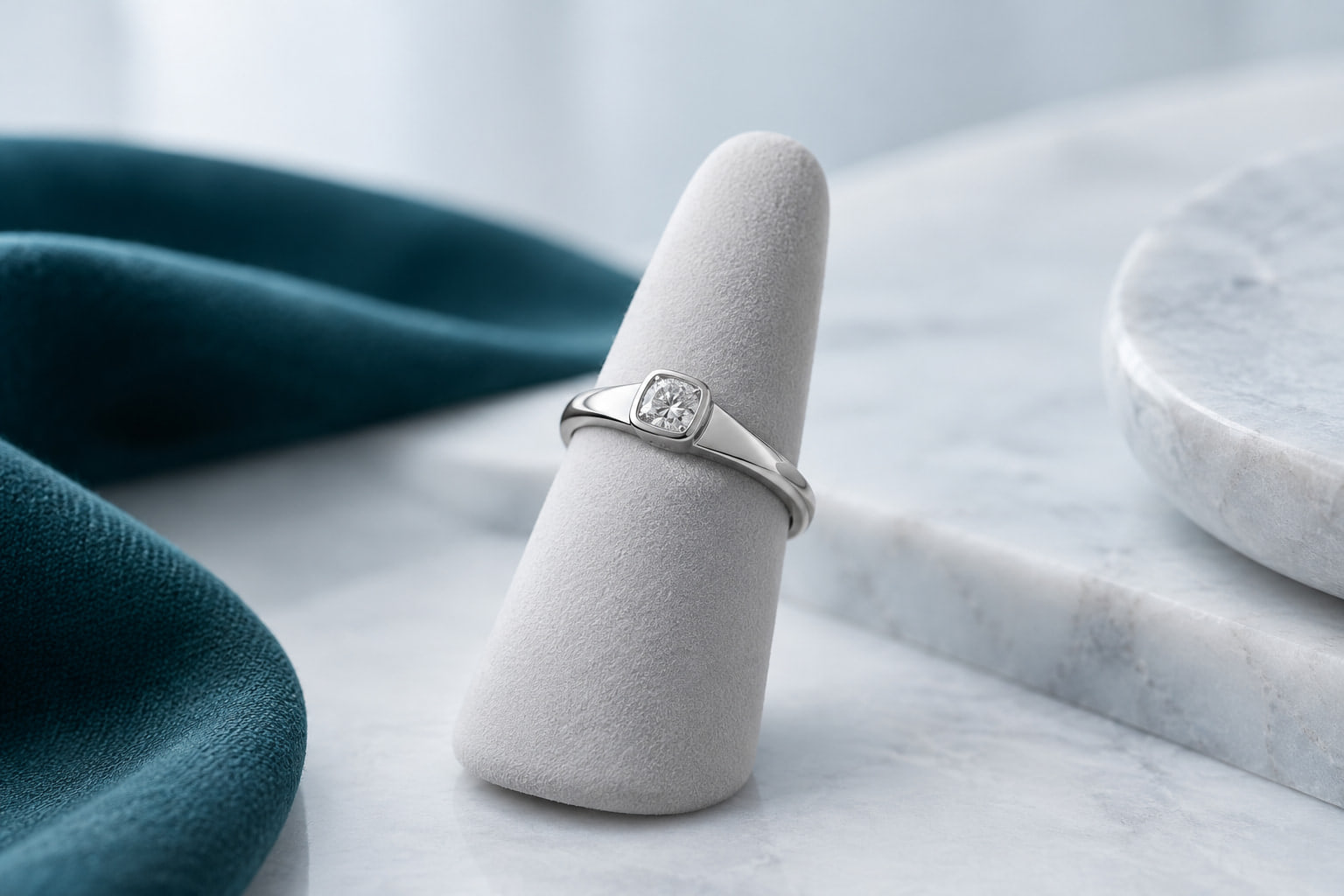
A lab grown diamond pinky ring should be selected by head-to-finger proportion, outer-hand orientation and the accepted size family, not by a universal carat recommendation. The small finger presents a different visual context from a broad signet face or a continuous wedding band. Ask the maker to show the actual head width, shank transition and side profile, then review samples on the intended finger position. Choose loose diamonds against the approved seats and preserve the resulting dimensions in the order. Do not promise comfort for every wearer or assume a larger ring can be reduced without changing its design. The useful buying evidence is a controlled proportion study and physical sample, with service options agreed for the actual construction.
Why Does the Outer-Hand Position Change the Design Review?
Identify the intended hand and orientation in the design reference. A symmetrical head may not care visually which way it is turned, but an asymmetric shape, tilted motif or elongated stone can present differently at the edge of the hand. The buyer should choose that presentation deliberately rather than allowing the photographer or packing team to decide it by accident.
Review front, side and outer-edge views on the actual finger position. A top render can show the diamond clearly while hiding a head that projects beyond the buyer's intended silhouette. Note the relationship between head width and visible finger width, but treat it as a design comparison for the sample rather than a universal fit formula.
Ask the maker to show the shank transition under the head. Reducing a broad-face design can change the apparent balance between the top and the lower band. The stone's carat weight cannot determine that proportion alone. A compact head with a deep center and a broader shallow-looking head may need different sample decisions.
The statement-jewelry application brief can describe the design intention, while the actual dimensions define the purchasing requirement. This article focuses on small-finger scale, not the broad signet-face planning used for another ring category.
Compact Head VS Broad Face: What Changes on a Pinky Ring?
| Decision | Compact head concept | Broad-face concept |
|---|---|---|
| Visual aim | Concentrated focal point with limited lateral span | More visible top surface across the finger |
| Stone selection | Actual center or cluster dimensions tied to a small seat | Center or multiple positions tied to a larger face |
| Sample view | Check head, shank transition and outer-edge silhouette | Check lateral coverage and orientation at the hand edge |
| Size-family question | Does one head remain intentional across the offered sizes? | Does the face need distinct versions rather than simple reduction? |
| Service record | Identify head and seat revision | Identify face, row or cluster map and revision |
Neither concept is restricted to a particular gender or guaranteed to suit every wearer. The comparison makes the proportion decision explicit. A pinky ring can use a broad face, but the buyer still needs evidence for that face on the intended small-finger scale.
When comparing alternatives, use the same hand presentation and photographic distance. A close crop can make a compact design seem larger than a broad face shown from farther away. Keep a dimension reference beside the sample photographs so the commercial team does not confuse presentation with physical scale.
How Should a Pinky-Ring Size Family Be Defined?
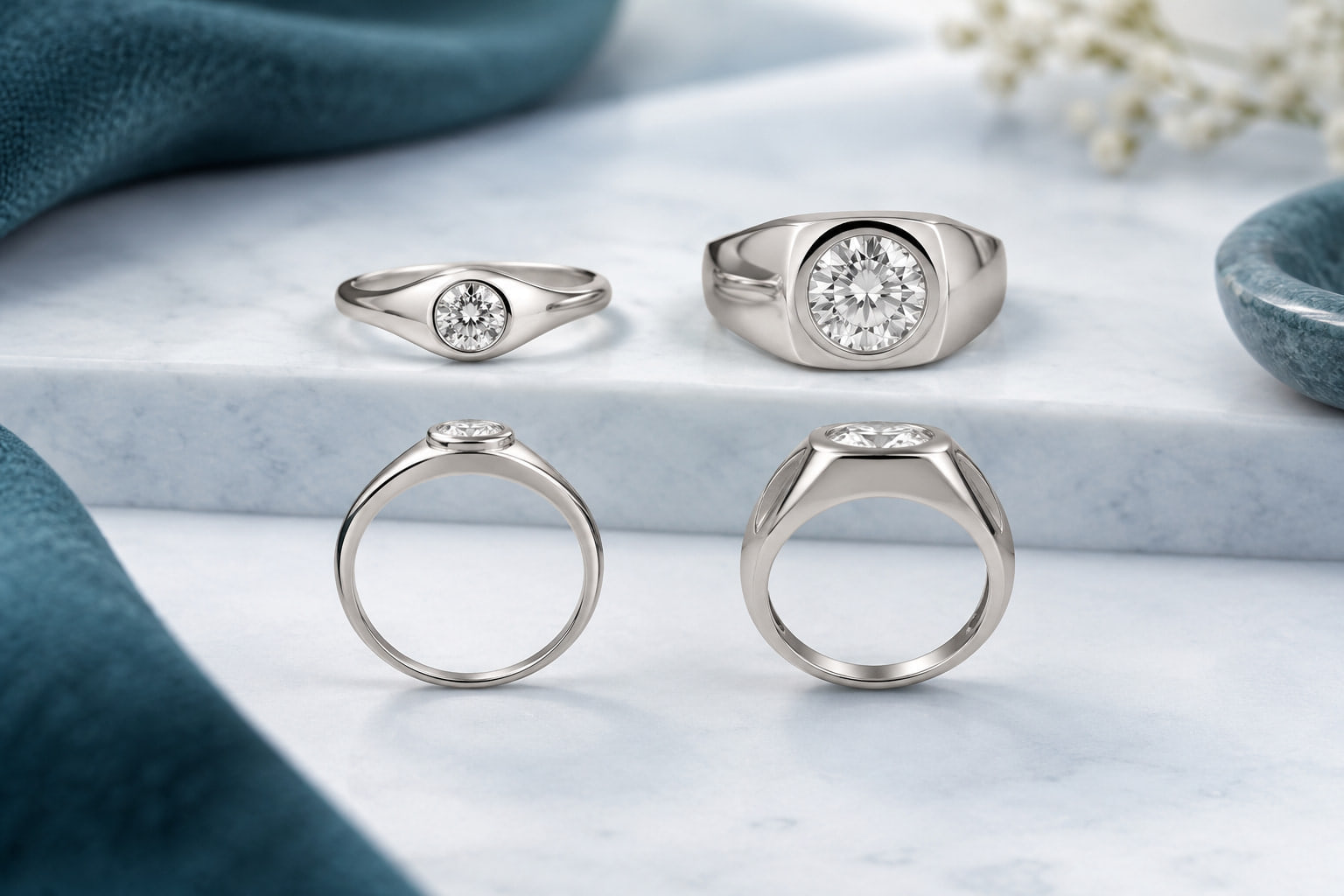
Ask the maker to identify the supported sizing system and actual production dimensions. Group sizes only where the same head and shank geometry remain approved. A shared retail style does not require every size to use one technically identical body. If the producer proposes separate small and large head versions, give them distinct component references.
For a one-center concept, record actual stone length, width and depth. For a small cluster, record position count, dimensions and orientation. The loose center range and matched-set range provide different supply routes. Do not choose between them solely by total weight when the head outline is the primary design decision.
Ask what happens at the smallest and largest offered sizes. Does the head remain fixed while the shank changes, or does the producer alter the top as well? Review the actual boundary samples where needed. Avoid promising unlimited size availability before the maker has approved a workable version.
Set a sample observation plan that includes the intended finger and nearby finger relationship, ordinary hand positions selected by the buyer and the expected facing direction. These observations help assess the collection's design. They should not be described as a universal comfort test or an engineering guarantee of how every wearer will use the ring.
Separate the outline study from stone grading. A higher clarity label does not make a head narrower, and a color preference does not resolve an awkward shank transition. The buyer should first identify which visible feature needs changing, then direct that question to the maker or stone supplier as appropriate. This keeps a proportion problem from turning into an unnecessary search for a different grade.
For sample selection, use the intended offered size boundaries rather than choosing only the most flattering display hand. Record the sample size and presentation conditions. The goal is to understand where the accepted design remains representative, not to claim that one person's hand proves suitability for the entire market.
Keep the chosen finger presentation separate from ring-size measurement. A photographic width comparison can guide design discussion, but the producer still needs the actual sizing reference for the supplied body.
Hypothetical Example: The Same Head Covers a Different Proportion
An invented design study compares an 8.0 mm-wide head against two illustrative visible finger widths of 12.0 mm and 15.0 mm. The head-to-visible-width ratios are about 67 percent and 53 percent respectively. These are simple photographic proportion comparisons, not ring-size conversions or recommended fit thresholds.
To retain approximately 53 percent on the narrower 12.0 mm reference, the design team considers a 6.4 mm head because 6.4 divided by 12.0 is about 53 percent. That does not authorize shrinking the whole ring drawing by twenty percent. The maker still has to establish stone seats, metal geometry and the shank transition for the smaller head.
The buyer compares a physical 8.0 mm concept and the revised 6.4 mm concept on the intended finger position. It discovers that the larger face is deliberately expressive, while the smaller one better matches the compact collection direction. The decision is aesthetic and sample-specific, not proof that one ratio is comfortable for everyone.
The accepted 6.4 mm head uses a different stone window from the broad concept, so the sourcing request changes accordingly. Existing centers for the 8.0 mm head are not automatically allocated to the smaller design. The project file retains both actual head dimensions and the accepted stone geometry. This prevents a later supplier from interpreting small pinky ring as permission to reduce a broad signet without reviewing its components.
Which Channel Can Support Small-Finger Proportions?
Give each seller the accepted head and size-family reference. A loose-diamond supplier can help fill the seats, while the jewelry maker must approve the ring's physical proportions. The term pinky ring is not a universal dimension specification.
USA / Supported size family
What Should a US Retailer Verify for a Pinky-Ring Size Request?
Stuller is one US trade source for loose lab-grown diamonds. For a pinky-ring request, suitable loose stones still need to match an approved head. A domestic trade channel does not establish the finished design's size range or outer-hand proportions.
Ask the retailer's bench which body and head versions are supported at the requested size. If the design began as a broad signet, obtain the actual smaller version rather than relying on a catalog render. Keep the accepted head dimensions and orientation accessible to store staff so they can distinguish compact and broad-face options honestly.
For service, identify whether a size change can retain the head or requires another approved body. Do not promise that any larger ring can be reduced into a pinky ring. The producer's assessment and the buyer's proportion review serve different purposes, and both may matter. Retain a photograph of the actual accepted finger-position sample with the product record.
CHINA / New geometry rather than scaled artwork
How Should Chinese Sourcing Handle a Reduced Head Concept?
For a China-facing project, provide the revised small-head drawing rather than asking a coordinator to reduce an image by a percentage. MEITUO in Qingdao can coordinate stone responses, but the jewelry maker must define viable seats and shank geometry for the actual version. A scaled picture is not a finished technical specification.
Show which head dimensions are fixed and which size families use a separate body. If alternative centers are proposed, ask for actual width and depth before the maker reviews them. A similar weight label may conceal a wider outline or deeper profile that changes the accepted outer-hand presentation.
At packing, distinguish the compact head allocation from any broader version in the same order. Keep appearance references and technical codes linked so the receiving workshop does not fill the smaller seats with stones intended for another design. Ask the coordinator to flag any shortfall before dispatch rather than substituting a different stone family under the broad label pinky ring.
INDIA / Actual outline and depth
What Should Indian Center Suppliers Receive for a Compact Head?
Greenlab lists Surat manufacturing and Mumbai corporate contacts. When researching an Indian center offer, give the seller the compact head's actual fit window. The phrase pinky ring should not be treated as a stone size, shape or weight standard.
Ask for actual outline and depth evidence, particularly when the supplier proposes an elongated or asymmetric option. The buyer needs to know whether the intended orientation and side profile remain represented by the approved sample. A visually attractive alternative can still require a new head or a new proportion decision.
For a repeated line, agree how the offered centers will be allocated to the supported head versions. Preserve individual identities where relevant and keep any cluster families labeled separately. Before export, reconcile the accepted count with those allocations. This allows the receiving workshop to evaluate fit against the correct compact-head reference rather than guessing which stones were intended for the small-finger design.
What Should Receiving and Wear-Position Review Record?
Reconcile delivered stones with the accepted head revision before setting. Check actual dimensions and condition, and preserve identities for individually documented centers. Where the head uses a cluster, lay out the positions in order so the intended outline is visible. An acceptable loose total weight does not establish that the smaller head can be filled correctly.
For finished samples, photograph the head on the intended finger position from top, side and outer edge. Identify any persistent rotation or projection observed during the buyer's chosen sample exercise. Ask the maker to review the actual ring rather than attributing the result automatically to a diamond weight. A changed head or shank may require a new proportion review.
GIA notes that diamonds remain vulnerable to impact. Do not turn a compact profile into an unqualified damage-proof claim. Care instructions and suspected movement should be handled according to the actual jewelry and professional inspection needs.
Keep the accepted orientation in the retail record. For an asymmetric design, show how the piece is intended to face, while allowing the brand to describe any separately approved alternatives. The repeat-order specification should preserve head dimensions, size family and photographs rather than only the retail name.
Check the relationship between the ring and the outside edge of the hand in the product imagery. A rotated wrist can conceal the very projection the buyer intended to assess. Use a consistent neutral pose for the technical record, then allow separate editorial photography for the campaign. Both can be attractive, but the technical view needs to remain comparable across revisions.
If the design includes an asymmetric stone, preserve its direction through the workshop handover. Label the intended tip or long axis on the drawing and confirm the final mounting orientation. A correct stone set in the reverse direction may still create the wrong finished variant. This is a configuration error, not a reason to reject the entire diamond family.
How Can MEITUO Help Source Stones for a Pinky-Ring Line?
MEITUO coordinates sourcing and supply-chain work from Qingdao, Shandong, China for jewelry brands, wholesalers, retailers and designers. Its stated product range includes loose centers, melee, side stones and matched sets. A pinky-ring inquiry should provide the accepted head geometry and size-family references so loose selection serves a defined proportion rather than an assumed small carat category.
The team can support product selection, supplier coordination, confirmation of quality requirements and order follow-up. Buyers can request alternatives with actual dimensions and identify which require a new head sample. The jewelry maker remains responsible for the ring's construction, size versions and completed setting, while the buyer approves the intended outer-hand presentation.
Contact [email protected] with drawings, quantities and appearance references. Confirm availability, documents, MOQ, treatment information, lead time and shipping terms for the specific order. The designer-studio application scope can frame a small-finger collection without promising a universal comfort result or finished-ring manufacturing service.
What Should a Pinky-Ring RFQ Specify?
State the actual head width, orientation and supported size family. Attach top and side drawings, the shank transition and actual-scale photographs. Identify whether the design uses a center or a cluster and give the corresponding seat windows. Do not substitute a broad signet reference and ask suppliers simply to make it smaller.
Ask for proposed stones with actual dimensions, appearance evidence and clear differences from the approved reference. A larger-looking center is a design alternative if it changes the head proportion. Require the maker and buyer to review that alternative before allocation. Keep production and service selections distinct and record which technical version each supports.
Use the RFQ guide to organize commercial fields. Add the accepted outer-hand presentation and change triggers for head or shank revisions. The useful outcome is a reproducible small-finger design, not a nominal carat number claimed to fit everyone.
Please quote laboratory-grown diamonds for pinky-ring head [code and revision], actual width [dimension] and size family [references]. Use the attached top, side and outer-hand sample views, stone-seat windows and appearance reference. Identify center or cluster positions and quote accepted quantities by technical version, with [service stock] separate. Provide actual dimensions and flag alternatives affecting head proportion, depth or orientation. Confirm documents, treatment information, MOQ, lead time, packing identities and shipping terms. No scaled-down substitute is approved without review. The jewelry producer will verify body geometry, sizing and completed setting for the accepted small-finger design.
FAQ: Lab-Grown Diamond Pinky Rings: Small-Finger Proportions
Is There One Ideal Carat Size for a Pinky Ring?
No. Actual head dimensions, finger presentation and the approved design matter more than a universal weight recommendation.
Can a Broad Signet Simply Be Scaled Down?
A reduced concept needs the maker's actual seat and body design. Scaling artwork does not establish viable geometry or preserve the intended proportions.
Are the Example Ratios Comfort Standards?
No. They are hypothetical visual comparisons. They do not convert finger width to ring size or guarantee fit for any wearer.
Should Orientation Be Specified?
Yes when the design is asymmetric or elongated. Record the intended presentation and any separately approved alternatives.
Does One Head Work for Every Ring Size?
Only if the producer and buyer approve that range. Separate technical versions may be needed to preserve the design.
What Belongs in a Repeat-Order Record?
Keep head dimensions, stone window, shank revision, supported size family and accepted finger-position photographs. A retail name alone cannot reproduce the proportion.