 English
 Español
 Português
 Deutsch
 Français
 Italiano
 Nederlands
 العربية
 日本語
 한국어
 ไทย
Quick Answer
For lab grown diamond stacking rings, define the intended combinations before choosing individual bands. Compare band width, setting height, side profile, stone exposure and ring size as a complete stack. Decide whether each design uses half-eternity or full-eternity coverage, then map the accepted stone sizes and counts for every offered ring size. Approve physical combinations for contact and comfort rather than assuming matching finger size guarantees compatibility. Keep a separate matching reserve for repairs and preserve the accepted profile drawings for reorders. A diamond sourcing partner can coordinate calibrated stones, but the maker must validate sizing, settings and metal contact. Describe coverage and laboratory-grown origin clearly so customers understand the actual product and its resizing limitations.
Which Profile Measurements Make Stacking Rings Work Together?
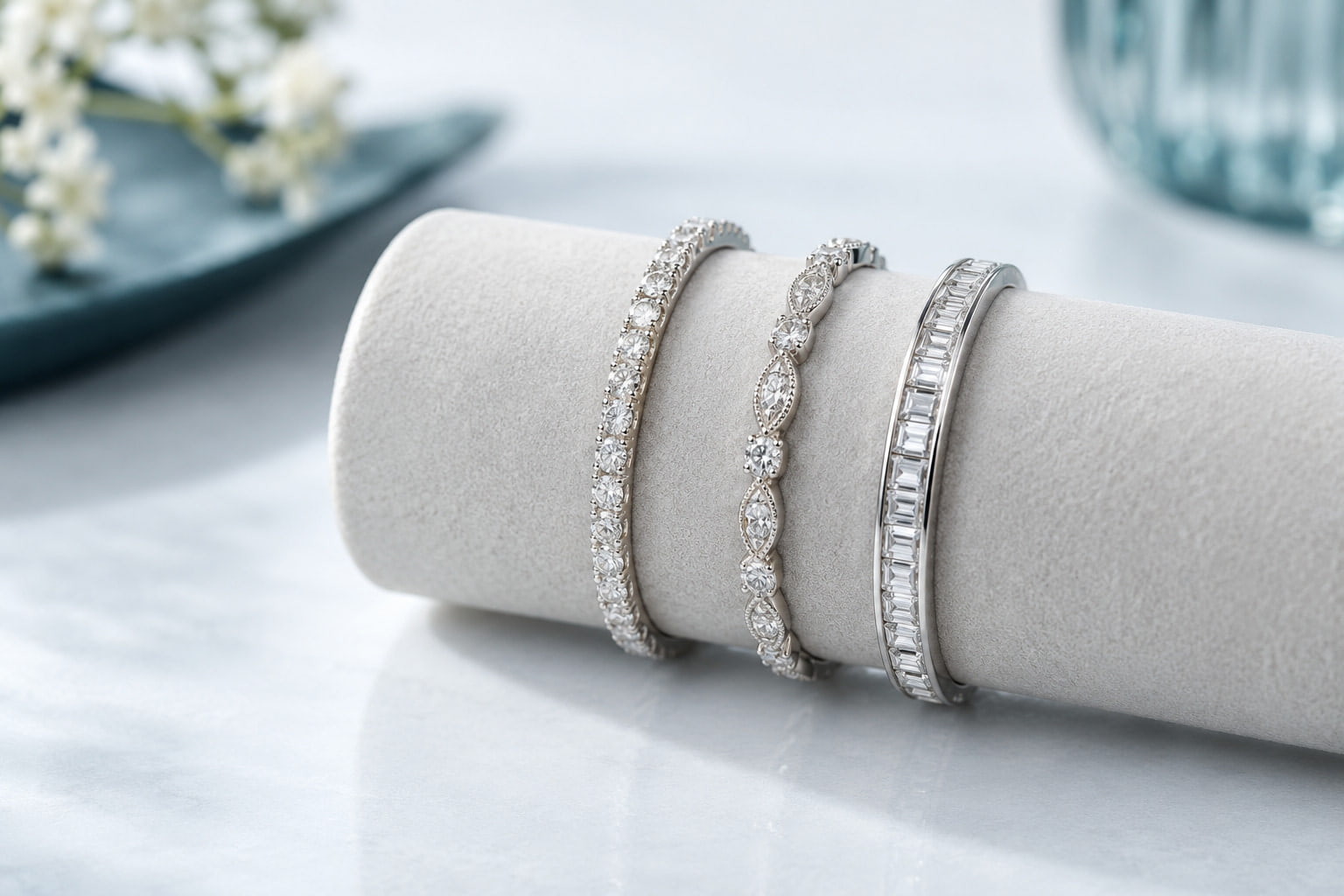
Record band width, total height and the position of stone-bearing metal relative to the neighboring ring. A face-up image hides much of this information. Two slim bands can interfere if one has projecting seats or exposed stone edges at the side. Draw a cross-section of the complete intended stack, not only each ring alone.
Identify which surfaces are intended to contact and which require clearance. The maker should define the practical limits for its construction. Do not invent a universal gap that suits every alloy, setting and wear pattern. A nominal gap in CAD should be checked in an actual sample, especially where polishing and setting alter the final profile.
Review combinations at realistic scale. A straight band may sit well beside one solitaire but collide with another gallery. If a gap is part of the design, show it accurately. If the collection promises a close-fitting stack, test the relevant combination rather than infer it from separate product photographs.
Use our bridal application planning and collection brief to define the combinations customers will actually be shown. Keep the sourcing requirement tied to that geometry so a later stone-size upgrade does not unexpectedly make the band too tall or too exposed at its sides.
Half-Eternity VS Full-Eternity Stacking Bands: What Changes?
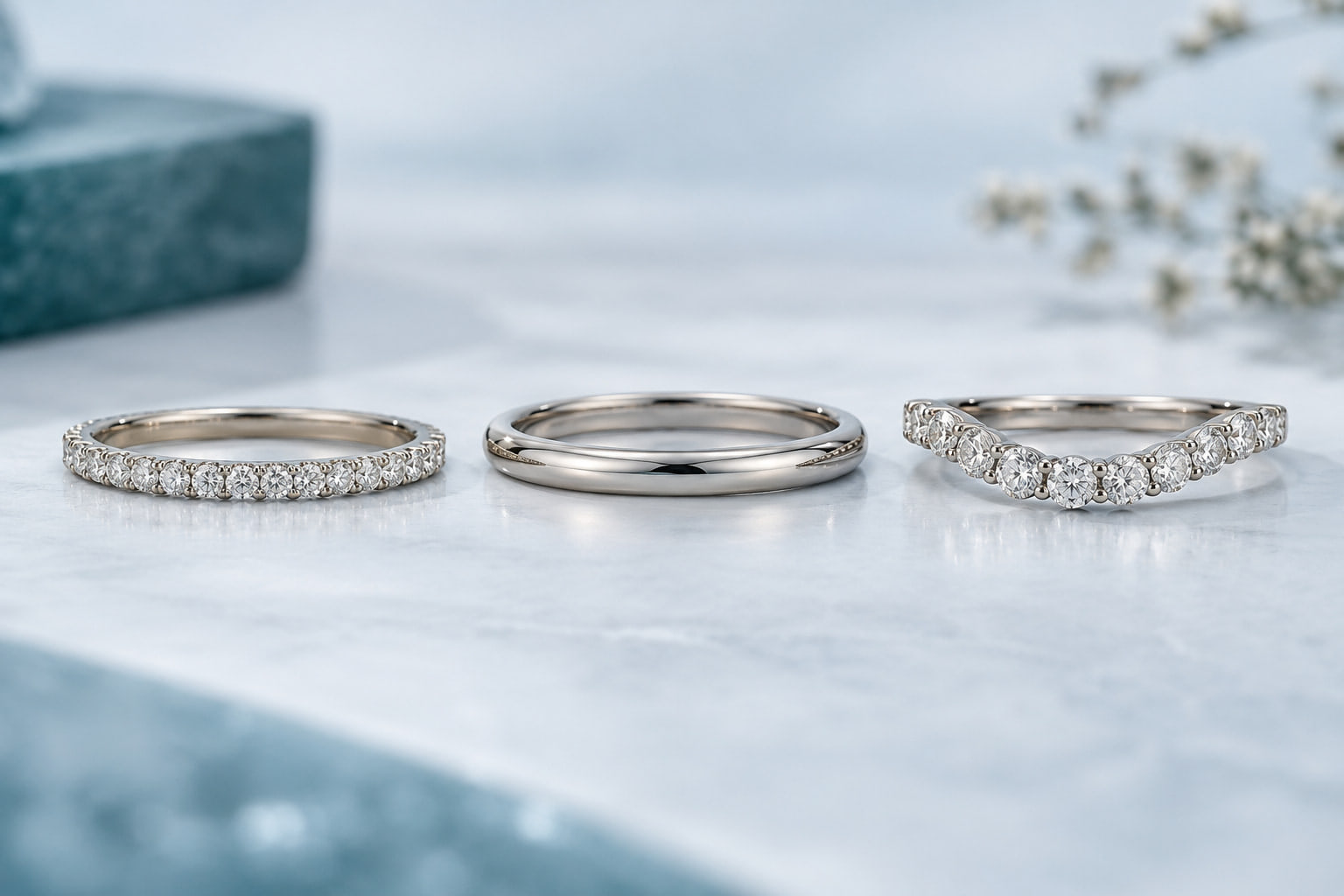
Coverage is a product decision with sizing, appearance and repair implications. The exact possibilities depend on the actual construction and maker, so the comparison below should become a set of questions for the sample review rather than a blanket resizing promise.
| Decision | Half-eternity design | Full-eternity design | What to confirm |
|---|---|---|---|
| Coverage | Stones occupy a defined portion of the circumference | Stones continue around the circumference | Accurate product image and stated coverage |
| Size range | Stone count may be kept or changed across sizes | Count and spacing may need size-specific planning | Maker-approved schedule by ring size |
| Resizing | A plain section may permit some adjustment | Continuous seats may restrict adjustment | Actual maker policy and method |
| Rotation | Plain section may become visible if the ring turns | Continuous stones change the visual effect of rotation | Wear trial and customer explanation |
| Repair inventory | Reserve relates to the used size groups | More repeated seats may need broader reserve planning | Counts and dimensions by SKU and size |
| Stack contact | Side profile still needs review | Side profile still needs review all around | Physical combination approval |
A half-eternity band is not automatically easy to resize, and a full-eternity design is not defined only by its stone count. Setting structure, metal and the allowed adjustment matter. Ask the maker for the actual service policy before sales staff promise a future size change.
For melee selection, quote the size groups against the approved coverage and size schedule. A supplier cannot infer the correct quantity for all finger sizes from a single photograph or a total-weight category.
What Should a Stack Trial Inspect Beyond Appearance?
Inspect side contact while the rings sit together and move naturally on the sample finger or suitable form. Look for projecting settings, exposed girdles and sharp transitions. The aim is to identify foreseeable interference, not to claim that a short trial proves lifetime durability.
The GIA care guide notes that diamond can scratch precious metal and that a loose stone can wear a prong. In a stack, that is a reason to review exposed stone edges and metal contact carefully. Hardness does not make a ring immune to wear or a diamond immune to chipping.
Have the maker assess setting security and any contact revealed by the trial. If the solution is a spacer, contoured band or revised profile, include that solution in the product presentation and bill of materials. Do not photograph a protected combination and sell an untested one without explaining the difference.
Record the actual sample sizes and total stack width. A group of rings can feel different from one band worn alone, so a customer should not be told that a familiar single-ring size guarantees the same fit in every stack. Provide access to the maker's fitting guidance and retain a physical sample of the intended combination.
How Should a Brand Calculate Stones Across a Stacking-Ring Size Range?
Hypothetical project, the Three-Size Stack Range: a brand plans sixty full-eternity bands across three offered sizes, twenty bands per size. The maker's approved drawings use twenty-two, twenty-four and twenty-six stones respectively. Production therefore needs 440, 480 and 520 stones, totaling 1,440. These counts come from hypothetical validated designs, not a universal ring-size formula.
If all three sizes use the same accepted stone window, the brand may choose one matching reserve of seventy-two stones, giving 1,512 accepted stones required. If the larger ring instead uses a different size group, its reserve must be separate. A shared total cannot cover seats that require different dimensions.
For a companion half-eternity band, suppose all three sizes use fourteen stones because the plain back section changes with size. Sixty bands then need 840 stones before reserves. The difference between 1,440 and 840 is six hundred production seats, which affects sourcing and setting quotations. It does not establish which coverage offers better value to the customer.
MEITUO can coordinate calibrated stone parcels for the approved size schedule. Ask for accepted-piece counts, actual weight and a common appearance reference across bands intended to stack. The supplier should know which groups may be shared and which must remain separate.
At production, issue stones by SKU and size, then reconcile unused material and rejects. If the maker changes a count after the trial, recalculate the entire schedule before ordering. A small per-ring change multiplied across the range can consume the repair reserve without anyone noticing until after delivery.
How Should Stacking-Ring Buyers Compare Supplier Channels?
The sourcing task is to preserve compatibility across several SKUs and sizes. Ask whether the channel can maintain a common appearance reference, controlled dimension windows and identifiable reserves. The location of a sales office does not establish the fit of the final stack.
USA / Shared stock and service records
Can a US Trade Supplier Support a Multi-SKU Stack Range?
A US trade channel may help a retailer obtain smaller repeat parcels, but a stacking range needs defined compatibility and dimensions. Stuller's laboratory-grown resource page describes loose-stone offerings with and without reports. It does not confirm the specific calibrated groups, finished-band construction or resizing policy needed for your range. A US sales address does not establish US growth origin.
Ask whether the supplier can preserve the accepted parcel reference across reorders and whether reserves can be selected with the original lot. Give the stone count by SKU and ring size, including which designs share one group. This prevents a convenient shared inventory from becoming an uncontrolled mixture of different windows.
If a separate domestic maker supplies finished bands, obtain its fitting and resizing policy directly. Keep the stone supplier's responsibilities distinct from profile compatibility and finished-setting review. For repairs, send the original seat dimensions and stack context so a replacement does not introduce a new height or exposed edge into an approved combination.
CHINA / SKU-and-size discipline
How Can a Chinese Coordinator Manage Several Band Sizes?
MEITUO's Qingdao sourcing role can support a program when the buyer provides a clear SKU-and-size matrix. State the accepted count and dimensions for each row, and identify whether the same calibrated parcel may serve several bands. Do not ask the coordinator to infer full-eternity counts from ring size alone.
Request that production and reserve material remain separately labeled. If several upstream parcels are needed, compare their appearance before combining them into shared stock. A consistent commercial grade description may still leave visible differences when bands are worn directly beside one another.
Ask who performs final calibration and how a later replacement lot will be checked against the retained reference. Any proposed change in diameter or depth should return to the maker for profile review. Coordination can preserve the stone schedule and supplier communication, but it does not validate stack contact, finished-ring sizing or the amount of resizing a particular construction permits.
INDIA / Calibrated-range continuity
What Should an Indian Parcel Source Establish for Eternity-Band Counts?
When researching Indian channels, identify the selection operation and commercial counterparty. Greenlab's official contact page lists Surat and Mumbai contacts, illustrating why technical and sales questions may follow different routes. The listing does not establish availability of a particular eternity-band size window or complete ring offering.
Send the approved count schedule rather than only the desired total carats. Ask whether the parcel is already selected to your dimension limits or needs additional sorting. Where several band designs share a group, request one controlled appearance reference and a clear record of any source-lot differences.
For repeat orders, discuss how the supplier will reproduce the accepted window and whether matching reserve pieces can be selected alongside production. Keep the final export count schedule connected to SKU and size requirements. A shipment can meet its overall weight and still leave one ring size short of usable stones, so reconcile accepted pieces by group before the workshop combines inventory.
How Can a Brand Keep a Stacking Range Cohesive Over Time?
Create a compatibility map showing which rings have been approved together. Include the drawing revisions and sample sizes. If a new design has not been tested with an older band, do not imply the combination is validated merely because both belong to the same collection.
Control visual rhythm as well as profile. Decide whether the range seeks uniform stone size, alternating textures or intentional contrast. Use actual samples to compare face-up color, sparkle pattern and metal width. A consistent report band alone may not make different stone layouts look coherent.
At reorder, confirm the same accepted dimensions, depth and appearance reference. A new parcel that is slightly deeper can alter band height, and a wider group can change the metal intervals. Ask for written approval before substitutions that affect the profile or coverage schedule.
Use our repeat-order planning guide for the procurement record. Prepare clear customer descriptions with laboratory-grown disclosure, coverage and total weight for the actual size or offered basis. The FTC disclosure guidance reinforces the need to keep material origin clear near the product, including in combination images.
When a customer reports rubbing, record the exact ring combination, sizes and wearing order. Compare it with the compatibility map before assuming the approved stack failed. A different solitaire gallery or a newly added band may introduce contact that the original sample never tested. Ask the maker to inspect the affected surfaces and identify the responsible interference.
If a spacer is proposed, test the revised combination and explain its effect on total width and fitting. A spacer should be a considered product solution rather than an unexplained extra sale. If a profile revision is required, assign a new drawing version and check whether older bands remain compatible.
For customer service, retain a simple compatibility explanation with the sold combination. Do not imply that every ring carrying the same collection name can be worn together without assessment. This record also helps a later replacement order reproduce the intended profile instead of selecting a visually similar band that introduces new contact.
How Can MEITUO Support a Multi-Size Stacking-Band Program?
MEITUO is a sourcing and supply-chain coordination partner in Qingdao, Shandong, China. It supports jewelry brands, wholesalers, retailers and designers with product selection, supplier coordination, confirmation of quality requirements and order follow-up. For stacking bands, a SKU-and-size matrix is more useful than a broad request for matching small diamonds.
The sourcing range includes loose centers, melee, side stones, matched pairs and sets, and fancy-color options. A band program may need one calibrated parcel shared across several designs or separate groups for different seats. Ask what can be selected to the approved windows and which documents accompany the actual lots.
Contact [email protected] with the maker-approved count schedule, dimensions, appearance reference and reserve plan. Confirm availability, MOQ, lead time, treatment information and shipping terms per order. MEITUO's coordination role does not establish finished-ring manufacturing or a resizing guarantee; the maker and buyer should approve profile compatibility, fitting and service policies separately.
What Should a Stacking-Ring Stone RFQ Contain?
Attach the size matrix with SKU, coverage, accepted stone count, dimension window and depth limits. Mark the groups that can share inventory and those that must remain separate. State whether the range needs a common appearance or an intentional contrast between bands.
Quote production and repair reserves separately. Request actual accepted count and weight, lot references and available screening documentation. Require approval before changing a size group, because a substitution can affect stack height, side exposure and compatibility even when total weight remains similar.
Keep the profile drawing and compatibility map with the purchase order. The supplier's stone task should connect to the validated design, while resizing policy, fitting guidance and finished-setting checks remain with the responsible jewelry maker. That gives the range a repeatable basis beyond a collection photograph.
Please quote loose laboratory-grown diamonds for [stacking-band range]. The attached matrix states [SKU, ring size, coverage and accepted stone count], with [diameter, depth and appearance limits] per group. Identify which groups can share inventory without changing the approved profiles. Quote [production quantities] and [repair reserves by group] separately, including actual count and weight, screening scope, available documents and treatment information. Preserve lot references and request written approval before substitutions. Confirm MOQ, lead time, shipping and shortage remedies. Our maker will separately approve stack contact, fitting, setting security and resizing policy for each finished-band construction.
FAQ: Lab-Grown Diamond Stacking Rings: Building a Cohesive Range
Do Rings With the Same Finger Size Always Stack Well?
No. Width, height, gallery shape and exposed settings affect how rings sit together. Review the actual combination and provide fitting guidance for the complete stack.
Is Full Eternity Always Impossible to Resize?
Do not make a universal claim. Possibilities depend on construction and the maker's method. Obtain the actual service policy before promising a future adjustment.
Can Every Size Use the Same Stone Count?
Sometimes a design does, but it must be established by the maker. Full-eternity and half-eternity layouts can use different size strategies. Quote against the approved schedule rather than a generic formula.
Why Keep a Compatibility Map?
It records which combinations and revisions were physically approved. A new band should not be assumed compatible with every older design merely because it shares the collection name.
Can Bands Share One Repair Reserve?
Only if their accepted dimensions, depth and appearance are compatible. Separate groups need separate reserves. Record withdrawals so shared repair inventory is not consumed unnoticed by production.
What Substitution Needs Renewed Review?
Changes in diameter, depth, seat geometry, coverage or side exposure can affect the stack. Keep total weight secondary to actual fit and appearance, and obtain approval before release.