 English
 Español
 Português
 Deutsch
 Français
 Italiano
 Nederlands
 العربية
 日本語
 한국어
 ไทย
Quick Answer
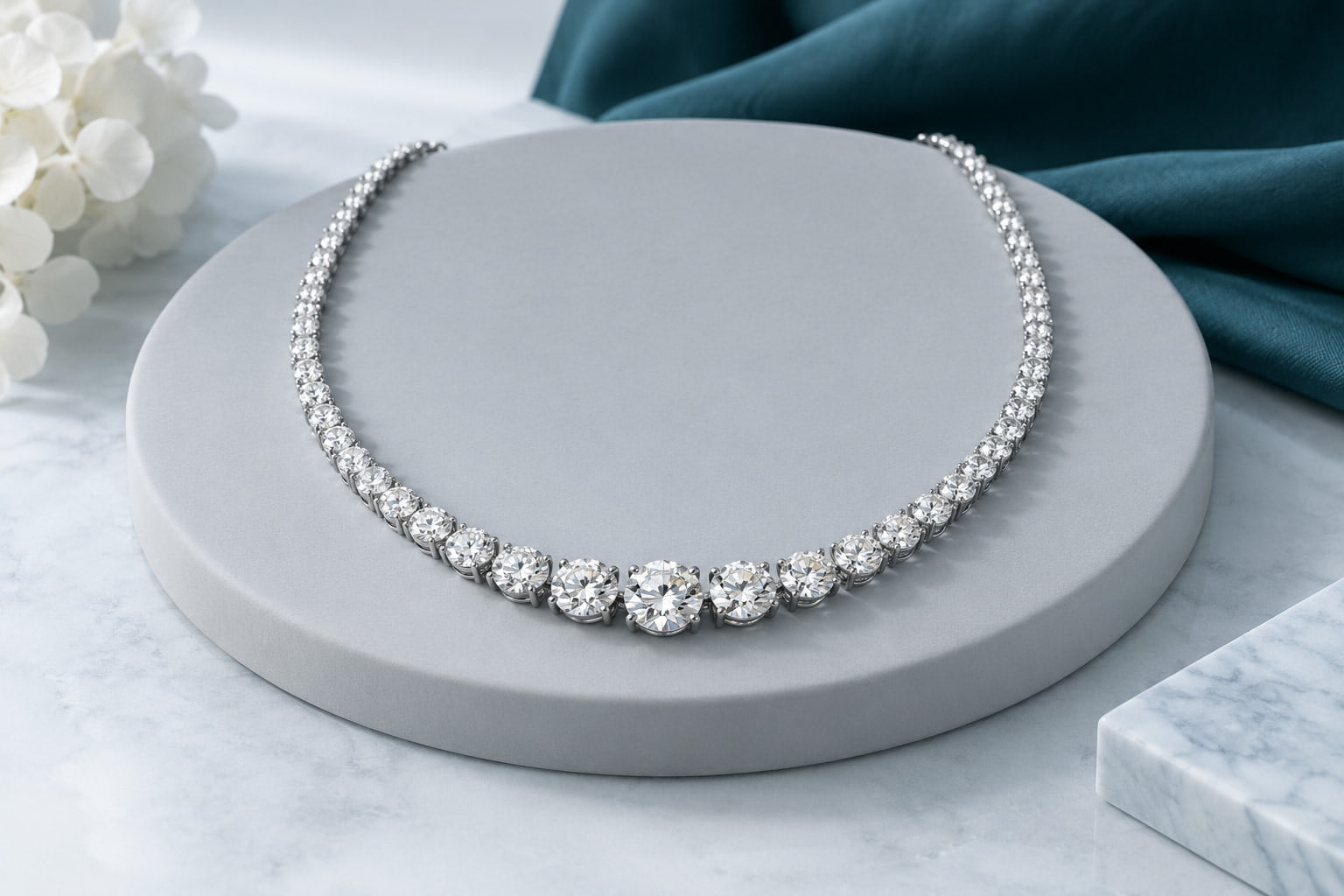
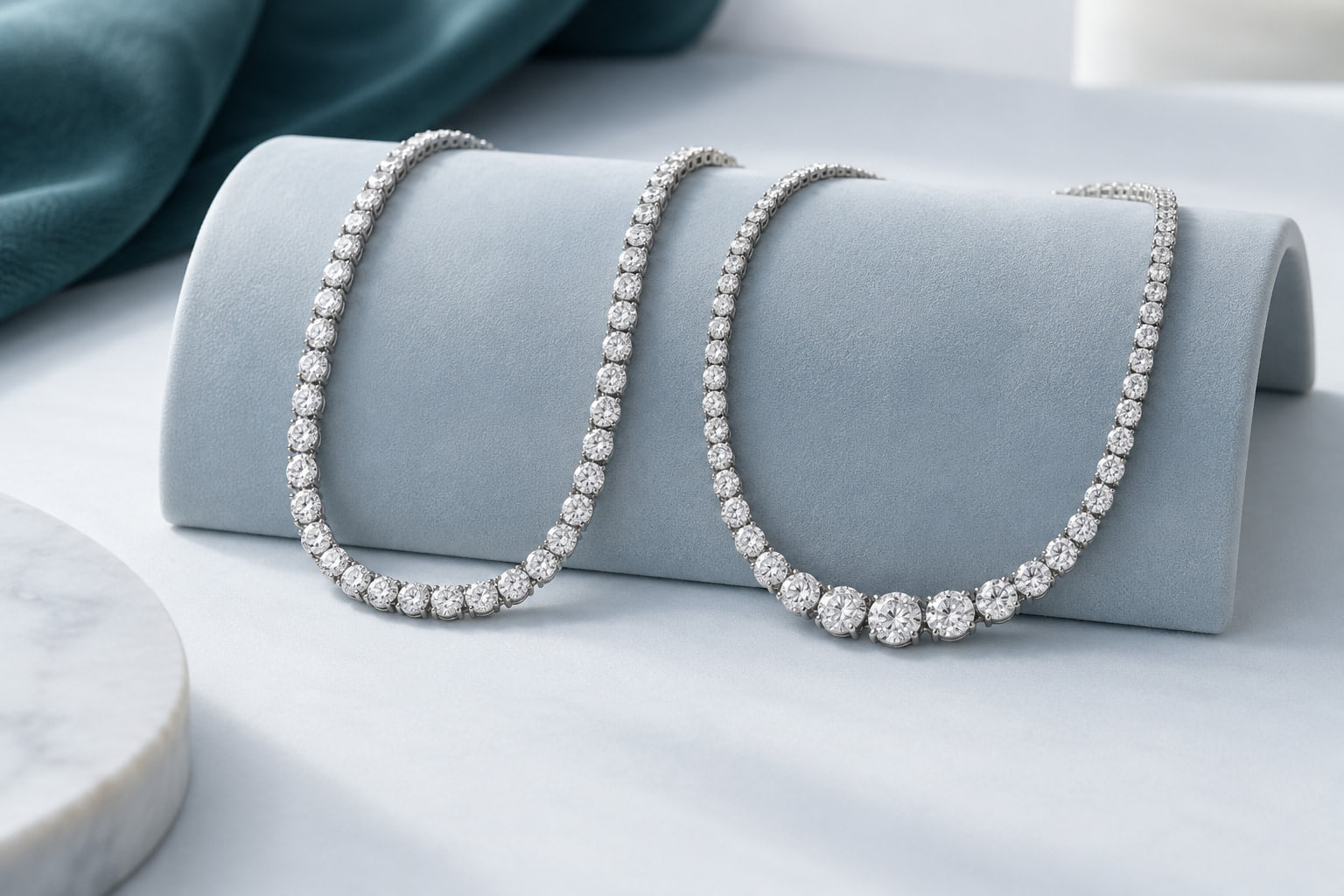
A lab grown diamond tennis necklace should be selected by finished drape, stone position and articulation, rather than total carat weight alone. A uniform line repeats a similar stone size around the neck; a graduated line places larger stones toward the front and reduces size toward the back. Neither arrangement guarantees that the front stays upright. Ask the jewelry maker to approve the intended length, link geometry and center orientation using a physical prototype. Then order loose stones against the resulting position schedule, including measured size windows, left-right matching and replacement quantities. A photographed straight line cannot demonstrate neckline behavior. Keep diamond selection, completed-necklace mechanics and retail weight disclosure as three linked but separately approved purchasing tasks.
Uniform VS Graduated: Which Necklace Line Are You Buying?
Start with the visual rhythm the collection needs. A uniform necklace emphasizes repetition. Its center is established mainly by how the assembly sits, rather than a single enlarged focal stone. A graduated necklace has a definite front, so any shift away from the intended center can become more apparent. The relevant comparison is the assembled neckline, including its transition into the clasp, not two isolated stones on a tray.
| Decision | Uniform line | Graduated line |
|---|---|---|
| Stone schedule | One main dimension family, with documented exceptions at closure | Several dimension families mapped from center to shoulders |
| Visual acceptance | Repeated brightness and consistent spacing throughout | Balanced steps in apparent size, with matched opposite positions |
| Replacement problem | Match the repeated seat and neighboring appearance | Match the exact position, not merely the total-weight category |
| Length change | May involve repeated modules, subject to maker approval | Must preserve center and transition symmetry |
| Sample priority | Repetition without abrupt gaps | Center stability and smooth size progression |
Do not assume that using fewer large front stones makes a graduated line cheaper or easier to repair. Quote the actual schedule. Review the graduated-set requirement as a sequence of positions, including the less conspicuous rear stones, before deciding which alternative fits the collection.
How Does a Tennis Necklace Stone Map Control the Order?
Give the center position its own identifier, then number the left and right sides outward. On an even-center design, identify the central pair and the axis between them. A schedule should show position range, quantity per necklace, measured diameter window, permitted depth range and visual reference. If the design uses fancy shapes, add orientation and actual outline. Weight remains a reconciliation field, not a substitute for those fit dimensions.
For each graduation step, review the junction where one stone family meets another. A pleasant difference on paper can become an abrupt visual ledge when the metal surrounds and gaps are included. Ask for photographs of these transitions at the final scale, as well as magnified views. Approve opposite positions together so one shoulder does not appear to become smaller faster than the other.
The jewelry maker should own the seat dimensions and link pitch. The diamond supplier should confirm what measured stones can be selected for them. Our matched diamond sets page explains the relevant supply category; it does not replace the maker's assembly drawing. Where several necklaces share a reference, keep the pattern revision attached to each packed set.
Record accepted deviations explicitly. If a shoulder stone is slightly outside the original window but fits an approved sample, revise that position's specification before the main order. Informal exceptions passed by a photograph alone are difficult to reproduce when a different team handles replenishment.
What Should a Necklace Drape Prototype Demonstrate?
Have the maker present the necklace on the intended display form and on representative neckline shapes chosen for the collection. Show the clasp position, overall length and front axis in each record. These are buyer-defined sample observations, not a universal performance test. A tall display bust can disguise a fit problem that appears on a flatter neckline, so include more than one viewing condition.
Watch the center as the necklace is placed, gently repositioned and allowed to settle. Note whether the stone faces remain forward, whether a shoulder forms a visible kink and whether the closure pulls the front off center. Ask the maker to diagnose the assembly when the sample fails. Increasing a stone's weight or changing its depth without reviewing the links may merely move the problem elsewhere.
Review front, side and underside photographs. The underside should allow the maker to explain how the necklace follows the curve and where neighboring parts approach one another. Do not infer strength from the amount of metal visible in a render. Require the finished-jewelry producer's own verification plan for link connections and closure function, with responsibilities written into the purchase scope.
For stone condition, GIA's care guidance distinguishes hardness from resistance to impact. That supports careful inspection, not any particular necklace construction. The practical buying response is to document stone edges before setting and examine the assembled line afterward.
Hypothetical Example: A 61-Position Graduated Front
Consider a hypothetical label planning 24 necklaces from a 61-position design. Its approved map has one center, ten large shoulder stones, twenty intermediate stones and thirty rear stones. The production requirement is 24 centers, 240 large shoulder stones, 480 intermediate stones and 720 rear stones: 1,464 mounted stones altogether. These counts describe this invented pattern, not a recommended industry layout.
The buyer requests one spare center and six, twelve and eighteen reserves in the other groups. The purchased count is therefore 1,501. Reserves are labeled separately and do not enter the sold necklace's mounted total weight. Within the ten-stone shoulder group, the map identifies five opposing pairs; the sorting team must preserve the pair assignments instead of treating all ten as freely interchangeable.
Suppose the first prototype turns one intermediate stone inward near the right shoulder. The buyer should not reject every stone in that size family automatically. The maker checks the relevant link and seat, compares the left counterpart and records whether the cause is local geometry, a dimensional outlier or assembly variation. Any revised stone window is approved before the production parcel is sorted.
Now suppose a longer version needs four additional rear positions on each side. It requires eight extra stones per necklace, not a proportional increase to every graduation group. A revised 69-position map preserves the front sequence while documenting a different finished length. This example illustrates why necklace length variants need their own bills of materials and sample records.
At launch, retain one accepted necklace as the physical pattern reference. Keep its center axis and length identified in the storage record. When a later order looks different, compare both assemblies under the same display conditions before changing the loose-stone specification. This helps distinguish a sorting difference from an assembly or presentation difference.
Where Can Buyers Source Stones for a Controlled Necklace Line?
Compare channels on their ability to deliver the approved sequence, not on an unsupported country ranking. A supplier may offer suitable loose diamonds while having no responsibility for necklace assembly. State that distinction at the beginning of the inquiry and use the same position map in all three markets.
USA / Position-based replenishment
Can a US Trade Channel Keep a Graduation Sequence Intact?
Stuller offers loose laboratory-grown diamonds, providing one example of a US trade channel. A US selling location does not establish where the diamonds were grown. For a tennis necklace, ask the trade contact to quote the entire position sequence or identify precisely which groups it can supply.
For a retailer managing repairs locally, retain the original shoulder and rear references with the maker. Request a measured replacement against a named position rather than ordering by the necklace's total weight. Confirm whether the proposed replacement can be reviewed beside adjacent stones before setting, and establish what happens if its appearance is unsuitable despite matching the written grade range.
If the channel offers a finished necklace as well as stones, obtain separate scope and return terms. In particular, clarify whether changing the length changes the front graduation. Ask for images of the exact version being quoted. A convenient domestic repair contact is useful only when the necessary sequence and dimensions remain identifiable.
CHINA / Grouped stone requirements
What Should a Qingdao Coordinator Receive for a Necklace Order?
In a China-facing procurement workflow, give the sourcing coordinator a bilingual position schedule if the workshop and buying team use different working languages. MEITUO's Qingdao location is a coordination point, not evidence that it manufactures necklaces. Define which party selects each diamond group and which party approves the completed jewelry.
Keep center, transition and rear requirements on separate quotation lines. When the order contains several lengths, show exactly which groups change. Ask the coordinator to check whether the same upstream parcel can cover both the main requirement and the reserves. If several lots are necessary, request comparison photographs and preserve their identities through dispatch rather than merging them before approval.
For the first shipment, specify packaging by necklace set or by numbered size group according to the receiving workshop's process. A set-based pack may reduce layout work; a bulk group pack may suit a larger run. Approve that choice explicitly, since count accuracy alone will not preserve a left-right graduation pattern during workshop handling.
INDIA / Sequence and export handover
How Should an Indian Offer Show Shoulder-to-Shoulder Matching?
Greenlab lists Surat manufacturing and Mumbai corporate contacts. This establishes a trade-channel example, not a guarantee that the named business holds the required necklace sequence. Identify the actual seller and the team responsible for selecting the offered parcel.
Ask that team to lay out the center and both shoulders together, with the graduation steps clearly labeled. A general inventory video of loose rounds does not demonstrate that the opposing positions look balanced. Where the supplier proposes a broader commercial size range, ask how it will be sorted into your narrower position groups and what usable count remains after selection.
For export handover, reconcile each group against the packing list before the workshop receives it. Agree whether replacements for rejected transition stones will be drawn from the same selected stock or newly matched. Preserve an accepted front-layout photograph with the shipment record. That record makes a later discussion about a particular shoulder pair much more precise.
How Should Receiving Inspection Preserve the Graduation?
Receive a first production set in labeled position groups before mixing any bulk stock. Reconcile count and actual parcel weight, then examine measured fit and appearance against the approved reference. Lay out the full front and both shoulders in their intended order. A parcel can pass a general color description while still producing a visibly uneven transition once arranged as a necklace.
Separate three outcomes: accepted stones, stones awaiting an agreed review, and rejected items. Record the actual position affected. A request to replace twelve intermediate stones is clearer when it states which dimensions or appearance conditions failed. Photograph the reference and questioned stones together under consistent lighting rather than sending unrelated phone images.
After setting, ask the maker for a final drape record with the approved length identified. Confirm center orientation and transition continuity again, because assembly can change what was visible in the loose layout. The maker should also complete its agreed closure and connection checks. A diamond receiving sheet cannot stand in for those records.
Use a controlled repeat-order specification to preserve the map, retained sample and remedy history. For repairs, locate the original position family before asking for a replacement. A visually close rear stone is not automatically acceptable in a front shoulder seat.
How Can MEITUO Coordinate a Tennis Necklace Stone Program?
MEITUO is a sourcing and supply-chain coordination partner based in Qingdao, Shandong, China. For a tennis necklace project, the useful starting point is the buyer's approved graduation map and prototype reference. Its role can include product selection, supplier coordination, confirmation of quality requirements and order follow-up for the loose diamonds, including matched sets and melee where relevant.
A buyer can ask MEITUO to organize responses by necklace position group, separate production quantities from reserves and identify which dimensional requirements need further confirmation. That helps the jewelry maker compare stone options without losing the front-to-back sequence. The finished assembly, drape approval and closure verification remain defined with the actual jewelry producer.
Contact [email protected] with the map revision, launch quantity and expected length variants. Available stones, documents, MOQ, treatment information, lead time and shipping terms must be confirmed for the order. Review the jewelry application scope and identify whether the inquiry concerns loose supply, a matching exercise or another separately agreed service.
What Belongs in a Tennis Necklace RFQ?
Attach the approved position drawing and describe whether the front is uniform, graduated or deliberately asymmetric. State the number of finished length variants and give a separate stone schedule for each. Include actual dimensions, visual reference, sorting responsibility and the point at which deviations require written approval. Quote the center, shoulders and rear groups separately so a low total cannot conceal an incomplete sequence.
Ask for prices on accepted quantities and clearly identify any sorting or reserve charges. Specify how substitutions will be presented and how shortfalls will be remedied before setting. For mixed production lots, require labels that preserve their connection to the accepted sample. The diamond RFQ guide provides a place to organize commercial terms, while your necklace map supplies the application detail.
Finally, establish who approves the completed necklace and how that approval is recorded. Stone acceptance authorizes use of the parcel; it does not certify the final drape or closure. The copyable brief below makes those boundaries clear without diluting the buyer's practical requirements.
Please quote loose laboratory-grown diamonds for a [uniform or graduated] tennis necklace, drawing [revision], in [length variants]. We require [quantity] finished sets using the attached position counts, dimension windows and left-right appearance references. List centers, shoulder transitions and rear groups separately, with [reserve quantities] outside the mounted requirement. Confirm sorting responsibility, available documents, treatment information, MOQ, lead time and shipping terms. Require our written approval for group substitutions. Provide count and actual weight by packed group, plus remedies for rejected positions. The jewelry maker will separately approve articulation, closure and completed drape.
FAQ: Lab-Grown Diamond Tennis Necklaces: Graduation and Drape
Does a Tennis Necklace Need a Graduated Front?
No. A uniform line is a distinct design choice. Compare repeated stone scale, gaps and neckline behavior against a graduated prototype at the intended finished length, rather than assuming one arrangement is inherently superior.
Can a Straight Photograph Prove That the Necklace Will Not Roll?
No. Request the maker's prototype observations on the intended neckline conditions, including movement and settling. A straight layout shows sequence and spacing but cannot establish the behavior of the curved assembly.
Should Both Sides Use Identical Weight Totals?
Weight reconciliation is useful, but opposite positions also need matched dimensions and appearance. Two shoulders with the same total weight may have different size steps or visibly different transitions.
How Should Longer Necklace Versions Be Ordered?
Create a new position map showing where the extra length is added. Reapprove the assembled drape. Do not multiply every stone group by a length ratio when the front sequence is meant to remain unchanged.
Are Necklace Reserves Included in the Advertised Mounted Weight?
No. Keep loose reserves outside the finished item's mounted diamond total. Record the actual stones consumed by each accepted necklace and apply the appropriate disclosure rules for the selling market.
Can MEITUO Approve the Finished Closure?
Its stated role is sourcing and supply-chain coordination. Assign closure, connection and assembled drape verification to the actual jewelry producer through a separately agreed scope.