 English
 Español
 Português
 Deutsch
 Français
 Italiano
 Nederlands
 العربية
 日本語
 한국어
 ไทย
Quick Answer
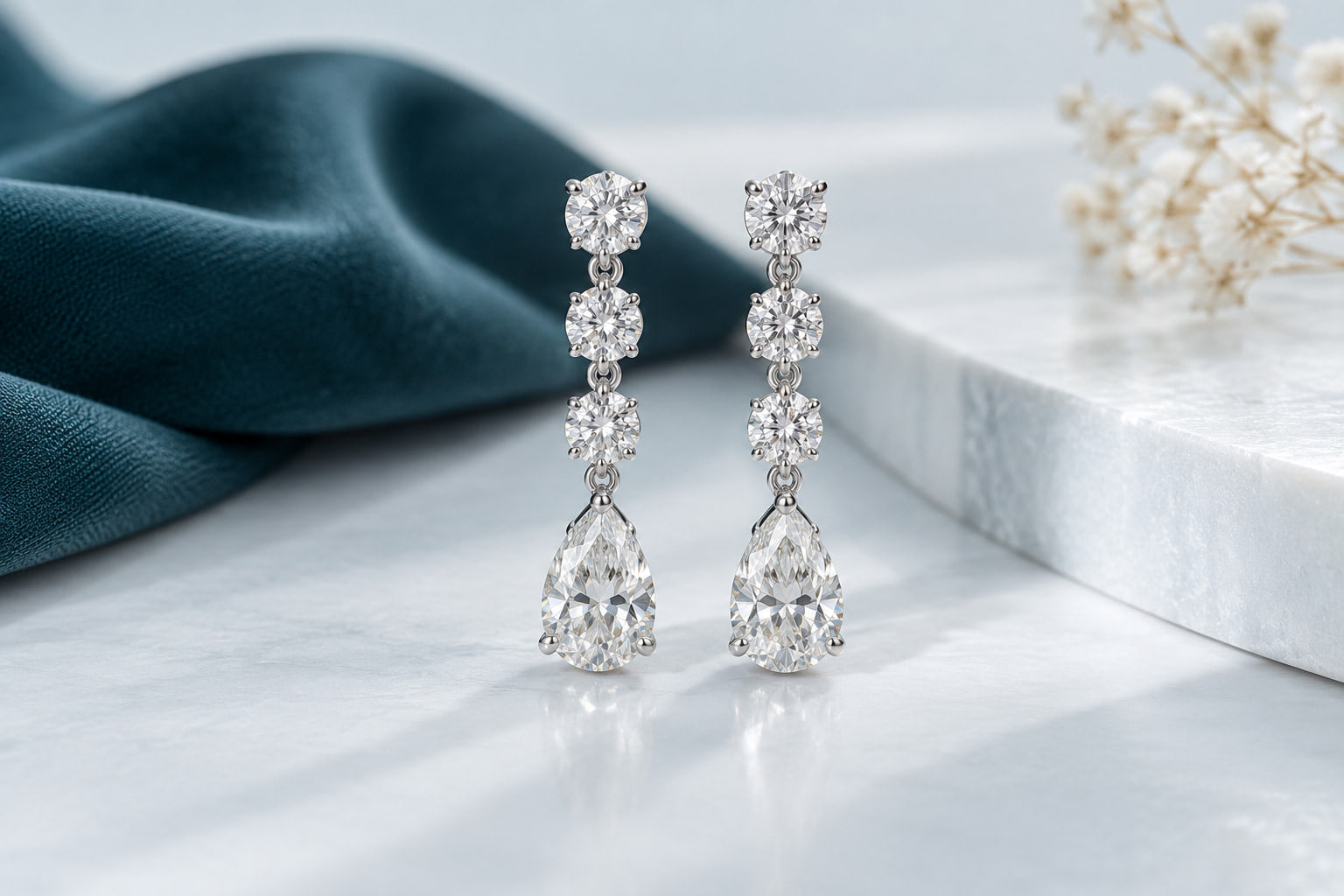
For lab grown diamonds drop earrings, approve the complete hanging pair rather than only a parcel of attractive stones. Define the top position, sequence of stone sizes, connection orientation and terminal-stone direction on a numbered drawing. Match corresponding positions across the two earrings, then inspect the assembled pair at rest and during gentle movement. Equal total carat weight does not guarantee equal hanging length, visual progression or facing direction. A drop can be fixed or articulated, so specify the intended construction rather than assuming the name implies free movement. MEITUO can coordinate loose stones and matched sequences; the actual jewelry maker must confirm joint construction, settings and completed workmanship. Use a sample stage before releasing the production quantity.
What Distinguishes a Fixed Drop From an Articulated Design?
The word drop describes a silhouette more reliably than a joint mechanism. Tiffany's drop-earring category description expressly includes designs intended to move fluidly and designs in fixed positions. This is a verified design-language example, not a laboratory-grown product specification or a source for MEITUO availability.
In the buying brief, identify which connections are intended to move and which are fixed. Mark the desired direction of movement at each joint. A chain-like series of links and a rigid bar can create similar front silhouettes while behaving differently. The maker needs a physical construction reference as well as the outline.
| Review point | Fixed drop | Articulated drop |
|---|---|---|
| Stone sequence | Held in a largely fixed relationship | Relationship changes as connections move |
| Key sample view | Resting front and side silhouette | Resting view plus controlled movement |
| Orientation risk | Assembly angle may present incorrectly | Joint direction can allow unintended turning |
| Length planning | Fixed geometry controls the drop | Stone heads and connections jointly determine length |
| Replacement review | Check seat and overall silhouette | Also check movement and sequence balance |
Neither construction is inherently the better choice. State the desired result and have the maker confirm the actual design. The jewelry application brief should carry that distinction through stone sourcing and assembly.
How Should Drop-Earring Stones Be Matched as a Sequence?
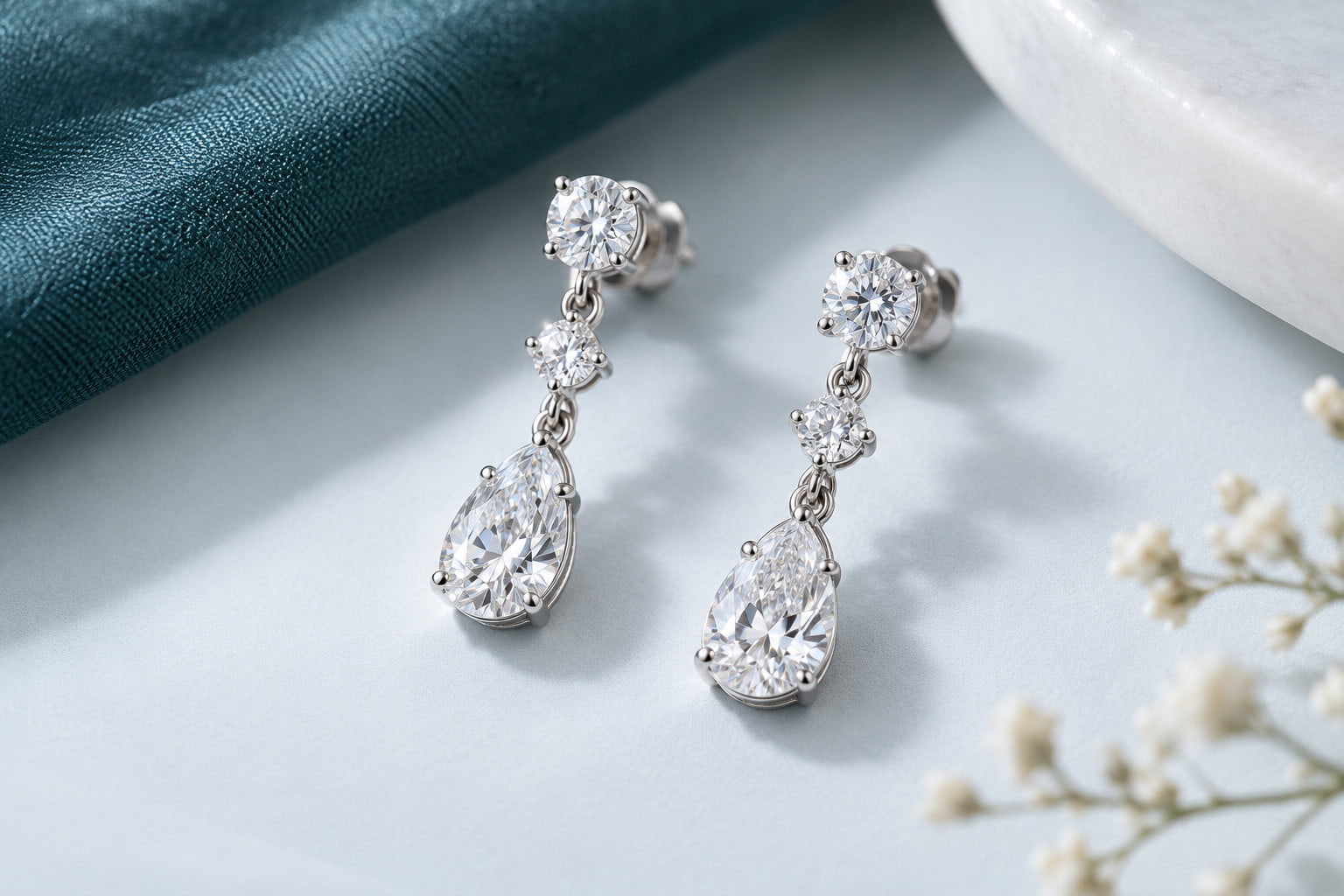
Number the positions from the ear downward. For a short line ending in a pear, the schedule might identify a top round, two graduated rounds and a terminal pear. The names are only an example; the actual design may use another sequence. Match corresponding positions across the earrings before judging the overall pair.
Record dimensions and intended orientation for every position. For a pear terminal, include length, width and the direction of the point in the drawing. For elongated stones, compare outline rhythm rather than relying on a shared carat range. A left terminal that looks broader than the right can dominate the pair even when all intermediate stones are well matched.
Then inspect progression within each earring. A sequence can be individually matched across sides yet produce an abrupt size jump that conflicts with the design. Decide whether the change is intentional. Keep graduation as a set relationship, not merely an assortment of acceptable individual stones.
The graduated-set product scope is relevant to this task. Request the proposed stones shown in their final order with identifiers visible in the accompanying schedule. If the supplier substitutes one member, reopen the sequence review rather than accepting a similar weight as automatic equivalence.
Why Do Joint Orientation and Clearance Need a Prototype?
A front drawing shows where components should appear, but it may not show how they turn. Ask the maker to identify the orientation of connecting loops or other joints and demonstrate their intended motion. A connection that allows the terminal to turn edge-on can alter the visible design even when the loose terminal pair is excellent.
Review a representative prototype suspended from the intended top attachment. Observe the resting direction first, then ordinary gentle movement. Look for a link that binds, a terminal that repeatedly turns away or a neighboring component that obstructs the desired motion. These observations identify issues for the maker; they are not a universal mechanical test or a quantified durability claim.
Separate freedom of movement from excess motion. The project may want restrained articulation rather than unrestricted twisting. Write the intended result in plain language and retain a sample video. A request saying make it swing freely is incomplete if the design also requires every stone to keep facing forward.
Stone depth and head construction can affect the space between connected components. Give the maker actual measurements before finalizing the joints. The component-scope guide helps keep the stone supplier's dimensional information separate from the maker's responsibility for joint design, retention and finishing.
How Can a Paired Sequence Become an Order and Review Plan?
Hypothetical example: the four-position pear-drop line. A brand plans six pairs. Each earring uses three rounds and one terminal pear, so each pair contains six rounds and two pears. The production requirement is thirty-six rounds and twelve pears, or forty-eight stones in total. These are invented planning quantities, not available MEITUO sets.
The round positions are 2.0, 2.5 and 3.0 mm in the concept drawing. Each corresponding position appears once per earring, so six pairs require twelve stones of each round size. The maker confirms the actual dimensional ranges after sample review. The buyer does not calculate total hanging length by simply adding those three diameters and the pear length, because heads and connections also contribute.
In the first assembled sample, the left terminal sits 1.0 mm lower than the right. The loose pear lengths differ by only 0.1 mm. The team therefore inspects the connection and head geometry rather than ordering a new terminal immediately. A different link arrangement accounts for the remaining visual discrepancy in this fictional scenario. The maker corrects it and both earrings are reviewed again.
The approved file includes the numbered stone map, actual finished lengths, individual earring weights and a short movement video. If one reserve complete stone sequence per side is purchased, the additional requirement is six rounds and two pears, making fifty-six stones overall. That reserve is optional and requires confirmed availability. The matching guide can preserve the relationship between the paired sequences.
What Should Drop-Earring Buyers Clarify Across Supplier Channels?
Drop production connects a stone sequence with a moving metal assembly. The stone supplier needs the position schedule; the maker needs actual dimensions and the movement reference. The buyer should retain one revision that links those tasks, rather than let the loose parcel and finished sample develop as unrelated projects.
USA / design sample and retail demonstration
How Should a US Design Buyer Approve Drop Movement?
A US design buyer working with a bench or manufacturing partner should make movement part of sample approval before final photography. A front-facing image may communicate the silhouette while hiding a terminal that turns away or a connection that binds. Request a short suspended-pair video showing the intended resting view and ordinary gentle motion.
Keep the role of brand references clear. Tiffany's cited category language confirms that drops can be fixed or fluid, but it does not define the construction of your laboratory-grown design. Give the actual maker a separate drawing and movement brief rather than asking it to reproduce an undefined category impression.
For retail staff, retain the finished sample reference and explain which components are intended to move. A service complaint about a shortened or twisted drop should be checked against the full assembly file. The replacement decision may involve a link or head rather than a different diamond, even when the visible complaint concerns the terminal stone.
CHINA / position maps and assembly handoffs
How Should China Coordination Preserve a Drop-Earring Sequence?
For sourcing coordinated through China, send a numbered sequence for both earrings with the terminal direction marked. A request for matched stones can otherwise be interpreted as individual pairs without a clear relationship to the finished graduation. Keep corresponding positions linked and identify the actual accepted members before dispatch.
MEITUO can coordinate the loose-stone questions from Qingdao, while the jewelry maker remains responsible for joints and completed construction. Ask who will confirm actual stone dimensions and who will update the assembly drawing if a replacement changes depth or outline. The coordination address does not establish where the stones were grown, cut or mounted.
Pack the accepted sequences with position labels and an image sheet. Do not let a visually similar round move to another position without checking the graduation and seat. If the maker requests a different stone, reopen the relevant position and the complete-pair review so the supplier does not solve one fit issue by disrupting the intended progression.
INDIA / rounds, terminals and sequence matching
How Should an Indian Supplier Assemble Graduated Drop Sets?
An Indian cutter or trader quoting the loose set should receive the round-size groups and terminal-shape requirements as separate lines. Ask for actual dimensions and a view showing the stones in their intended order. Matching the pear terminals alone does not establish a coherent drop if the intermediate rounds create different size progressions.
Where multiple parcels contribute to the set, compare the appearance across the full sequence before assigning positions. A supplier may offer individually acceptable goods that need further sorting for this application. Ask it to identify any uncertain pair relationship rather than treat all stones inside one grade range as interchangeable.
For repeat and service orders, retain the original position map and accepted terminal images. If a new terminal has a different outline or depth, send that information to the maker before approval. The commercial seller should preserve the item and document relationship, while the maker checks whether the revised stone affects head geometry, hanging length or movement.
How Should Finished Drop Earrings Be Accepted and Serviced?
Compare the pair suspended at the same height from the same reference plane. Review total hanging length, terminal direction and the visual spacing between positions. A flat tray view cannot show whether the left and right drop evenly. Keep the camera level so perspective does not create a false length difference.
Next observe a short, repeatable gentle movement sequence. The buyer can compare whether both sides articulate as intended and whether one repeatedly turns or binds. Ask the manufacturer to confirm workmanship, stone retention and joint integrity through its own quality process. Do not improvise destructive pull or twist tests as a substitute for an agreed validation method.
Record each earring's finished weight and the basis of measurement. Equal stone totals do not guarantee equal metal weight, and equal weight does not guarantee identical movement. The aim is the approved visual and functional relationship, with any permitted differences documented. A sample cannot guarantee the same wearing response on every person.
For service, identify the failed position before selecting a replacement. A new terminal can change both appearance and movement; a replacement intermediate head can alter length. Use the repeat-order workflow to retain the full assembly reference. After repair, inspect the complete pair again rather than signing off only the new loose stone.
Use the same suspension method when comparing sample and production. If one view hangs from a display hook and another holds the earring by a different part, the apparent resting direction may change. Record the reference plane and top attachment used, then reproduce that setup for a disputed pair. A controlled comparison is more useful than arguing from two incompatible videos.
When the issue occurs only during movement, identify the connection involved by position number. Ask the maker to review that joint without reshaping unrelated links as a quick cosmetic fix. After correction, repeat the whole-pair view and record any change in length. This keeps a local repair from introducing a new discrepancy farther down the sequence.
How Can MEITUO Coordinate Stones for Articulated Drop Earrings?
MEITUO is a sourcing and supply-chain coordination partner based in Qingdao, Shandong, China. For an articulated drop program, it can support product selection and supplier communication around the buyer's position map, graduation and paired appearance requirements. The starting point should be a defined sequence rather than an aggregate carat target.
Its scope includes loose center stones, melee, side stones and matched pairs or sets. A design with pear terminals may combine a fancy-shape pair with separately scheduled rounds. Availability, documents, MOQ, lead time, treatment information and shipping terms need confirmation for each order. Send the drawing revision and pair quantity to [email protected].
MEITUO supports requirement confirmation and order follow-up; it does not claim to manufacture the completed earrings, engineer the joints or issue independent laboratory reports. The actual jewelry maker should approve the assembly and movement. Keep that division clear so the loose-stone selection remains connected to a reviewable finished-product brief.
What Should a Lab-Grown Diamond Drop-Earring RFQ Specify?
Attach a front and side drawing with numbered stone positions and marked moving connections. State the desired hanging length, terminal orientation and degree of movement in ordinary language. Include a sample video or physical reference where possible, while leaving final construction assessment with the maker.
Give quantities by position and by pair. Identify whether replacements must preserve the whole sequence or whether individually reviewed alternatives can be considered. Require a revised map whenever a head, link or stone changes the approved geometry. The RFQ guide can organize commercial terms and release milestones.
The brief below separates loose-stone evidence from completed-pair acceptance. That makes the supplier's response concrete without pretending that a parcel photograph proves the finished earrings will hang or move as intended.
Please coordinate laboratory-grown stones for [number] pairs of articulated drop earrings. Drawing [revision] defines top position, connecting joints and terminal orientation. Position schedule and dimensions are [details], with desired overall hanging length [range]. Provide the proposed stones as paired sequences with item IDs, measurements, joint-view images and available documents. Identify any size or outline substitution before approval. Finished assembly and joint construction are assigned to [maker]. Confirm sample terms, MOQ, treatment information, lead time and shipping. Release requires our completed-pair review for hanging length, facing direction, movement and visual progression; loose-stone acceptance alone is insufficient.
FAQ: Lab-Grown Diamond Drop Earrings: Movement and Pair Balance
Does Every Drop Earring Have Moving Joints?
No. Drop describes a general silhouette and can include fixed or articulated designs. State which connections should move and provide the actual construction reference. A category name alone does not establish the intended movement.
Can Equal Total Carat Weight Establish a Matched Drop Pair?
No. Compare corresponding positions, outlines, graduation and the completed hanging view. Heads and connections can change length and facing direction even when the stone totals are equal. Accept the whole pair after assembly.
Should Overall Length Equal the Sum of Stone Lengths?
Not necessarily. Settings, links and spaces between components contribute to the finished length. Use the actual drawing and assembled measurements. Adding loose dimensions is a rough concept check, not a final manufacturing specification.
What if One Pear Terminal Keeps Turning Edge-On?
Have the maker review joint direction, connection geometry and the complete assembly. The loose stone may not be the cause. Compare the result with the approved movement reference before selecting a different terminal or changing the design.
Can MEITUO Guarantee Articulated-Earring Performance?
No. MEITUO can coordinate loose-stone selection and supplier follow-up. The actual jewelry maker must assess joints, settings and workmanship, and the buyer should approve the finished sample. No universal movement or comfort guarantee is established here.
How Should a Repaired Drop Pair Be Accepted?
Inspect the full suspended pair again, including length, terminal direction, graduation and movement. Replacing one head or stone can alter the relationship of the assembly. Keep the original position map and sample video available for comparison.