 English
 Español
 Português
 Deutsch
 Français
 Italiano
 Nederlands
 العربية
 日本語
 한국어
 ไทย
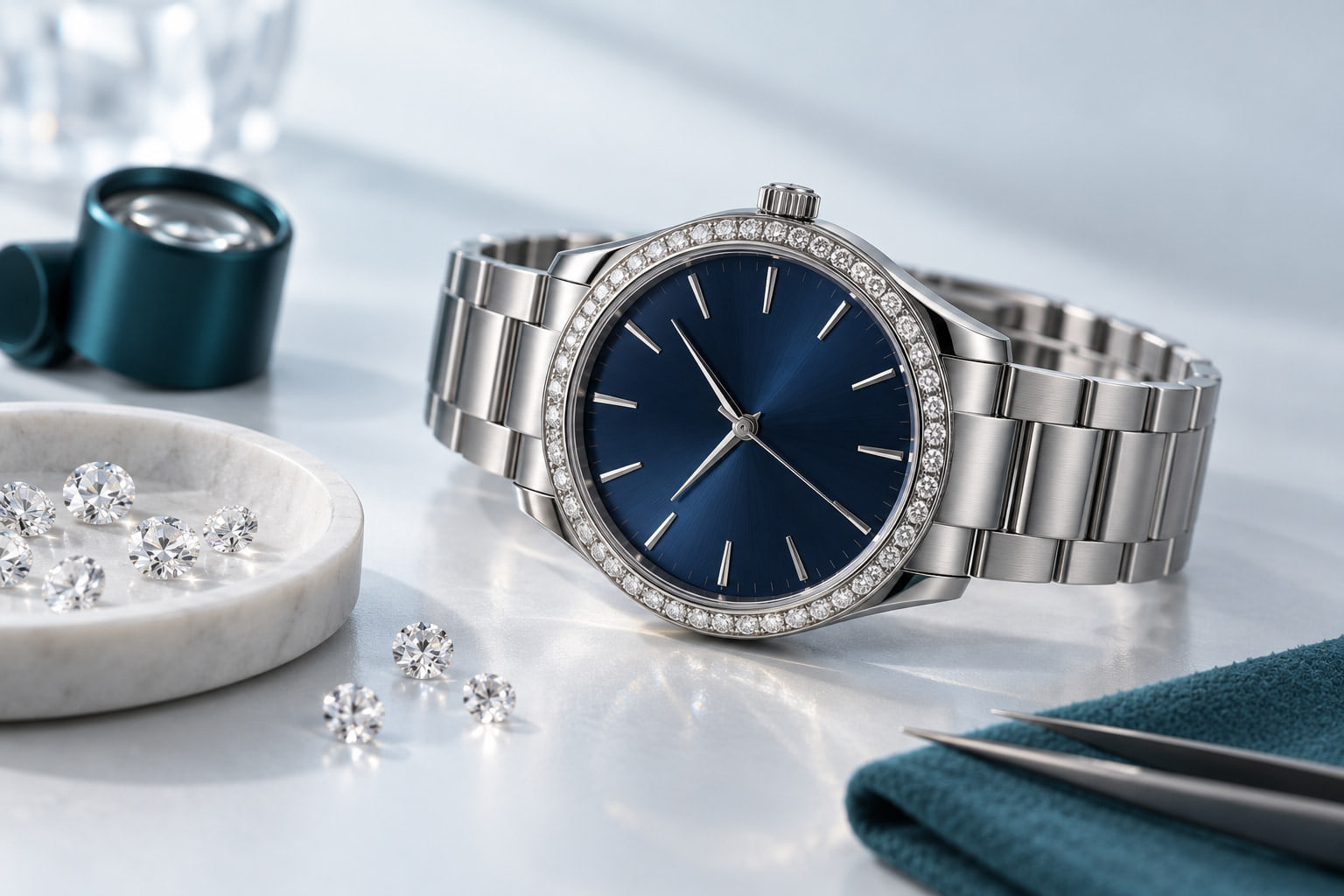
Quick Answer
For a lab-grown diamond watch for men, begin with the watch component and the setting engineer's drawing, not a jewelry stone's nominal carat weight. Specify bezel or dial position, seat geometry, diameter and depth limits, color consistency, retention method and a replacement plan. Small dimensional differences repeat around a watch and can interrupt an otherwise clean circle. Order a fit sample before a production parcel, and keep stone approval separate from watch performance testing. A diamond supplier cannot establish water resistance, case integrity or a watch manufacturer's warranty by supplying attractive stones. MEITUO can help coordinate loose-stone requirements; finished-watch assembly and any performance claim need the responsible watchmaker's confirmation.
Which Watch Component Defines the Diamond Specification?
A bezel surrounds the dial and creates a repeated visual rhythm. A dial marker has a different interface: it may sit in a small carrier, beneath a hand or close to the crystal. A decorative case shoulder creates another geometry again. Calling all three watch diamonds loses the information a supplier needs. Identify the component, drawing revision, stone positions and whether the design uses identical seats or graduated sizes.
Start with the completed component's assembly route. Will stones be set before polishing or after a coating process? Can the setter inspect the underside? Is the component removable for service? These are questions for the component maker and setter, because they affect the approved stone envelope. Do not assume that a diamond's hardness makes every processing sequence acceptable. Protect finished surfaces and verify the proposed method through the responsible production team.
A useful bill of materials lists a position group, stone quantity, allowed dimensions, visual reference and replacement part code. Keep dial stones and bezel stones in separate groups even if both are described as round. Their pavilion clearance may differ. If the concept uses rectangular markers, describe actual lengths and widths rather than converting them into a nominal round equivalent.
Use the watches and accessories application page to frame a loose-stone sourcing inquiry. Pair it with calibrated melee requirements for repeated small round seats. These links support material selection; they do not establish that a finished watch or a particular component is already offered.
How Should Watch Buyers Specify Diameter, Depth and Seat Fit?
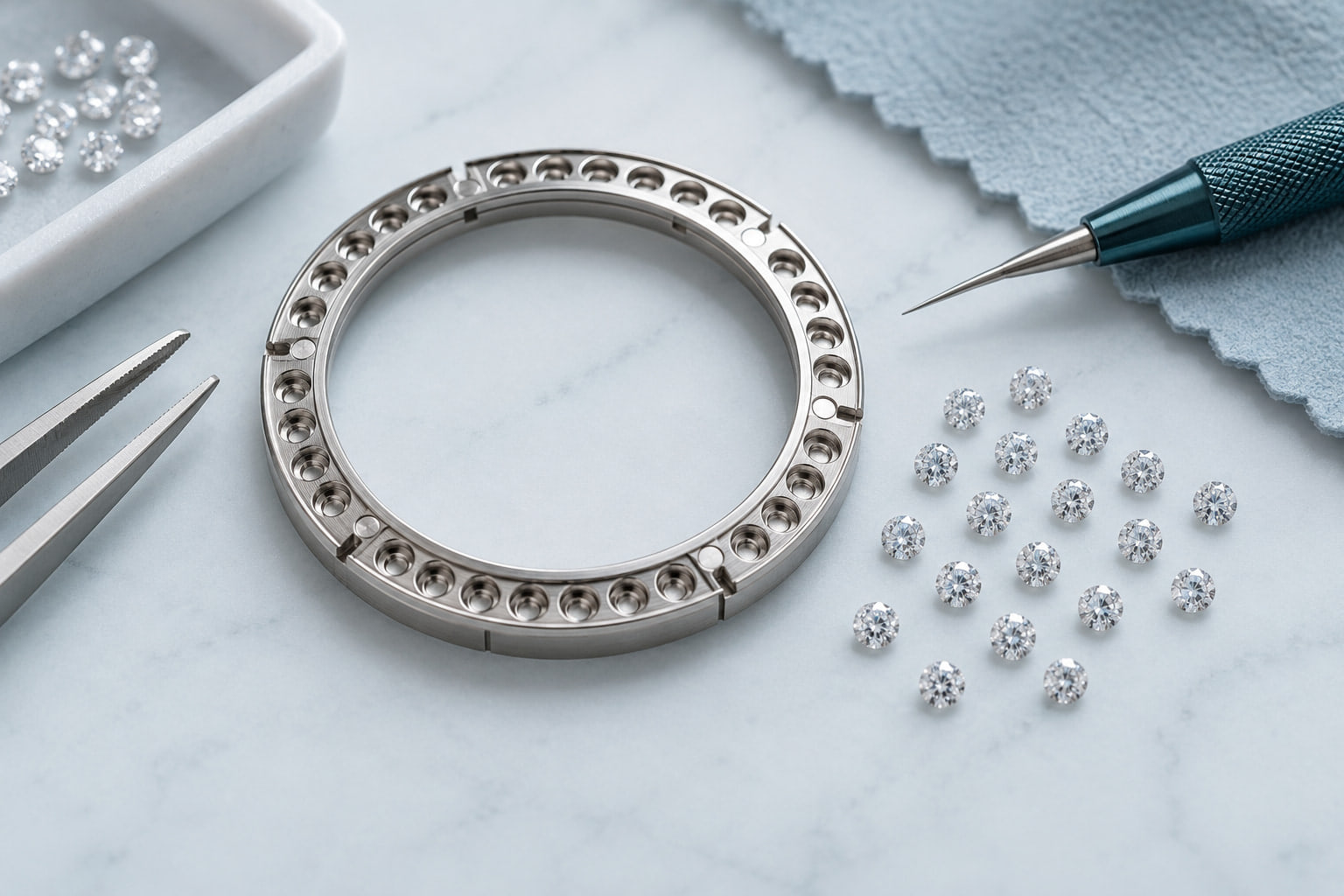
Treat a seat as a three-dimensional interface. Two stones with the same maximum diameter may have different girdle profiles and pavilion depths. A stone that looks correct from above can interfere with the component below. Request minimum and maximum measurements where available and agree how the batch will be checked. Let the setter define what dimensional variation the actual seat can accommodate.
Use a fit matrix rather than one broad size label. For each position group, record diameter or length and width, total depth, relevant girdle conditions, accepted visual character and the applicable drawing revision. Where a particular instrument cannot measure a feature reliably on tiny stones, describe the limitation and use a physical fit sample. Precision language without a workable measurement method creates false confidence.
Photograph the reference component and the accepted trial stones at useful magnification. Include a view showing the setting contact area and a second showing the finished face-up rhythm. The first supports engineering review; the second supports appearance approval. Never present a loose-stone photograph as proof that the final watch passed assembly tests.
Before ordering a full parcel, clarify how rejected or unmeasurable stones will be handled. An agreed sample inspection can help understand variation, but it does not automatically establish every stone's conformity. If the design requires individual fit screening, negotiate that explicitly. Record whether the buyer, supplier or setting workshop performs it, and preserve the accepted method for replenishment.
Calibrated Parcels VS Mixed Parcels: Which Fits a Watch Program?
A broad parcel can be useful during early design exploration. A production watch generally needs a more controlled stone family because one visibly different seat repeats against an engineered circle. The comparison below describes workflow consequences, not a universal claim about supplier quality.
| Decision | Calibrated production parcel | Mixed exploration parcel | Buyer control |
|---|---|---|---|
| Seat planning | Built around an agreed dimension envelope | Requires sorting before seat assignment | Approve a drawing-linked trial |
| Depth | Can be included in the acceptance brief | May vary despite similar face-up size | Verify clearance separately |
| Visual rhythm | Reference family can be retained | Different facet patterns may interrupt the row | Compare the assembled arc |
| Yield | Still requires the agreed acceptance checks | Usable quantity remains uncertain until sorting | Count accepted pieces, not parcel weight alone |
| Service stock | Reserve can follow the production specification | Future matching may be difficult | Retain separately labelled spares |
| Design flexibility | Best after the component envelope is stable | Useful while choosing size families | Do not freeze production from a concept parcel |
The practical distinction is responsibility. A seller may quote a size range without promising that it meets a particular watch seat. A component maker may approve a single sample without approving the entire delivered parcel. Put both decisions into the purchase record. A controlled trial connects them more reliably than either party assuming the other has already checked.
How Does a Watch-Bezel Stone Count Become a Purchase Plan?
Hypothetical example: a design has forty equal stone positions on each bezel and a pilot quantity of twenty-five watches. The assembly requirement is 40 × 25 = 1,000 stones. The buyer proposes a separately controlled reserve of fifty stones, bringing the initial purchase request to 1,050. The reserve is an invented project allowance, not a published loss-rate benchmark or a promise that fifty pieces will be enough.
The setting workshop first tests a small representative fit group. Suppose the trial reveals that the original depth envelope contacts the component underneath. The project should revise the stone envelope or component design before releasing the 1,050-piece order. Simply choosing a lighter parcel by total weight would not identify which individual pavilions clear the seat.
After the specification is frozen, the receiving team sorts the actual lot. Assume 1,012 stones meet the agreed appearance and fit checks, twenty-three need further dimensional review and fifteen fail the envelope. Only the 1,012 are currently available to assembly or controlled reserve. There are enough for the 1,000 planned positions, but the fifty-piece reserve has not been achieved. Record the shortfall instead of describing the order as fully accepted.
Assign accepted stones to the assembly lot and service stock with separate labels. Keep unresolved stones out of both. If a later replacement lot looks slightly different, compare a trial arc alongside an original bezel rather than approving an isolated stone under bright lighting. This arithmetic makes the launch decision visible: proceed with a smaller reserve only by an explicit owner decision, or wait for conforming replacements.
What Should Survive From Assembly Into Watch Servicing?
A useful service record identifies the component revision, stone family and acceptable replacement envelope. Keep a small number of accepted stones with their parcel history where commercially practical. Ask the watchmaker whether replacing one stone requires removing the component, disturbing a seal or repeating any test. The answer belongs in the service instructions, not in a loose-stone supplier's general marketing copy.
Do not describe aftermarket setting as harmless to an existing watch warranty. The owner or authorized service provider must confirm the applicable terms. Likewise, do not infer water resistance from the case style, a sealed-looking bezel or the use of diamond. If the project intends a performance rating, the completed watch requires its own agreed engineering and test route.
For appearance, inspect the complete circle under a diffuse light and under a second ordinary viewing condition. Rotate the component slowly and note stones that remain visually isolated. Determine whether the issue is stone size, setting height, contamination or facet appearance before replacing material. A poorly seated stone and a mismatched stone require different remedies.
MEITUO can be asked to coordinate a replenishment inquiry using the retained specification and actual spare-stock requirement. The repeat-order planning guide can help organize that handover. For a decorative accessory collection that uses paired stones elsewhere, keep those records separate from the watch parcel even if they share the matched-diamond sourcing category.
Where Can Watch Buyers Source and Qualify Loose Diamonds?
Compare channels by their ability to provide the actual size family, fit evidence and continuity of replacements. A nearby invoice or a production-region address does not demonstrate watchmaking competence. The following panels focus on the loose-stone side of a watch project.
USA / Component review
What Can a US Jewelry Trade Channel Contribute to a Watch Brief?
Stuller describes a US trade channel for loose laboratory-grown diamonds. A channel offering jewelry stones may help a watch designer obtain comparison material, but that does not establish watch-specific calibrated stock or watch assembly capability. Ask whether the seller can supply the exact diameter and depth family rather than relying on an online category label.
For a US watch or accessory brand, assign a domestic component reviewer before importing the main parcel. Give that reviewer the same drawing that the seller receives. Confirm the route for returning an unsuccessful fit sample and whether sorting or setting changes any agreed return rights. Commercial terms must be obtained for the actual transaction.
Keep US-facing product copy precise: laboratory-grown describes the diamonds, while case origin and watch assembly are separate statements. A domestic seller's invoice does not establish domestic growth. If a service center will later replace stones, ask it to approve the spare-stock format now so the launch team does not leave an unusable mixed parcel for after-sales support.
CHINA / Drawing-linked parcels
How Should a China Sourcing Coordinator Handle the Component Handover?
A China sourcing inquiry should name the watch component supplier and loose-stone coordinator separately. MEITUO is based in Qingdao and coordinates sourcing; that location does not identify the watch assembly site or the diamond grower. Put the responsible parties on the drawing release so questions about the seat do not circulate through several sales contacts without an engineering answer.
Send millimeter dimensions, orientation diagrams and approved examples in a single controlled file. Avoid informal size names that a sorting workshop might interpret differently. If a candidate parcel comes from several lots, require that the lots stay identifiable until the trial is complete. A visually coherent sample does not justify silently mixing a new source into production.
Before consolidation, agree whether held stones remain with the supplier, travel separately for review or are replaced. Confirm the packing method for tiny stones and separate reserve parcels from assembly quantities. Buyers comparing Chinese offers should compare the scope of sorting and documentation alongside stone cost, rather than treating every quote bearing the same nominal diameter as interchangeable.
INDIA / Parcel continuity
What Should an Indian Trading or Production Contact Verify?
GreenLab lists contacts in Surat and Mumbai, illustrating different commercial contact points within an Indian diamond channel. An address alone does not demonstrate a supplier's watch-stone inventory. Ask the contracting seller which team can provide consistent small-stone dimensions, who sorts the offered parcel and whether accepted samples can be reserved through component approval.
For a circular bezel, request a small complete position group rather than one attractive loose sample. The setter needs to see the repeated row. Confirm whether the same sorting criteria will be used for the replenishment parcel and whether the seller retains the physical reference. Do not infer that a center-stone producer automatically offers watch-ready melee.
Ask how service quantities would be supplied after the original lot is exhausted. A new production run can require a fresh visual and dimensional trial. If stones are exported through a separate trading office, keep the purchase identity and parcel reference connected through that handover. An approved reserve and a documented replacement procedure are more useful to a watch brand than an unsupported promise of permanent identical stock.
How Can MEITUO Coordinate a Watch-Stone Requirement?
MEITUO is a sourcing and supply-chain coordination partner in Qingdao, Shandong, China. For a watch project, provide a position schedule, drawing version, target stone quantities and the setter's acceptance envelope. The team can support product selection, supplier communication, confirmation of quality requirements and order follow-up while the watchmaker retains responsibility for the component and finished assembly.
MEITUO's broader supply conversation includes loose centers, melee, side stones, matched pairs and sets, and fancy-color options. A repeated bezel or dial layout needs its own specification within that scope. Request confirmation of the available size range, documents, MOQ, lead time and shipping terms for the particular order. Do not interpret this introduction as a claim that MEITUO manufactures watches, owns a grading laboratory or guarantees a finished product's performance. The sourcing-team page explains the coordination role. Send the component brief and required trial sequence to [email protected] before approving a production parcel.
What Should a Lab-Grown Watch-Diamond RFQ Include?
Send the same position schedule to every candidate. Separate nonnegotiable clearance limits from visual preferences, and identify who can approve an exception. Include whether the quote covers loose stones only, dimensional sorting, a trial parcel, packing by position group or a reserve lot. These services have different scopes and should not be assumed from a unit price.
Ask for a realistic reservation period and state when the engineering trial will finish. An attractive parcel that cannot remain available through approval may be unsuitable for the launch. Define the next decision explicitly: a trial request is not a commitment to accept the final component. The copyable brief below keeps the loose-stone requirement connected to the watchmaker's drawing.
Please quote loose laboratory-grown diamonds for [watch component and drawing revision]. We need [positions per component] stones for [assembly quantity], plus a separately packed reserve of [pieces]. Target dimensions are [diameter or length and width] with depth and girdle limits defined by [approved drawing]. Supply a trial position group before the main parcel. Confirm available calibration, appearance reference, sorting scope, documents, MOQ, reservation period, lead time, packing and shipping terms. Identify deviations before substitution. Component fit, retention and finished-watch performance remain subject to approval by [engineer or watchmaker].
FAQ: Lab-Grown Diamond Watches for Men: A Sourcing Guide
Can a Watch Use Any Small Round Diamond?
Only if the actual stone fits the component and passes the agreed appearance and setting checks. Diameter alone does not establish pavilion clearance or retention. Have the component engineer and setter approve the relevant stone envelope before ordering production quantities.
Does Laboratory-Grown Origin Establish Water Resistance?
No. Water resistance concerns the completed watch and its engineering and testing. Supplying laboratory-grown diamonds does not establish the behavior of a case, seal, setting or modified component.
Should Watch Stones Be Ordered by Weight or by Pieces?
Use pieces for a fixed position count and record the agreed weight information separately. The number of usable stones must match assembly demand and the approved reserve; total parcel weight cannot establish that every seat has a suitable stone.
Is a Spare Parcel Necessary?
A defined reserve can help service planning, but its quantity depends on the design, setting process and commercial agreement. Keep it separate and traceable. Do not present a hypothetical reserve percentage as an industry standard.
Can MEITUO Supply a Finished Diamond Watch?
This article concerns MEITUO’s confirmed loose-stone sourcing and coordination scope. A finished-watch requirement would need separate confirmation and a responsible assembly partner; no finished-watch manufacturing capability is established here.
What Is the First Practical Approval Step?
Release a controlled component drawing and test a representative stone group in the actual setting route. Record the fit and visual result before reserving the full parcel. Keep watch performance approval separate from this stone-selection decision.