 English
 Español
 Português
 Deutsch
 Français
 Italiano
 Nederlands
 العربية
 日本語
 한국어
 ไทย
Quick Answer
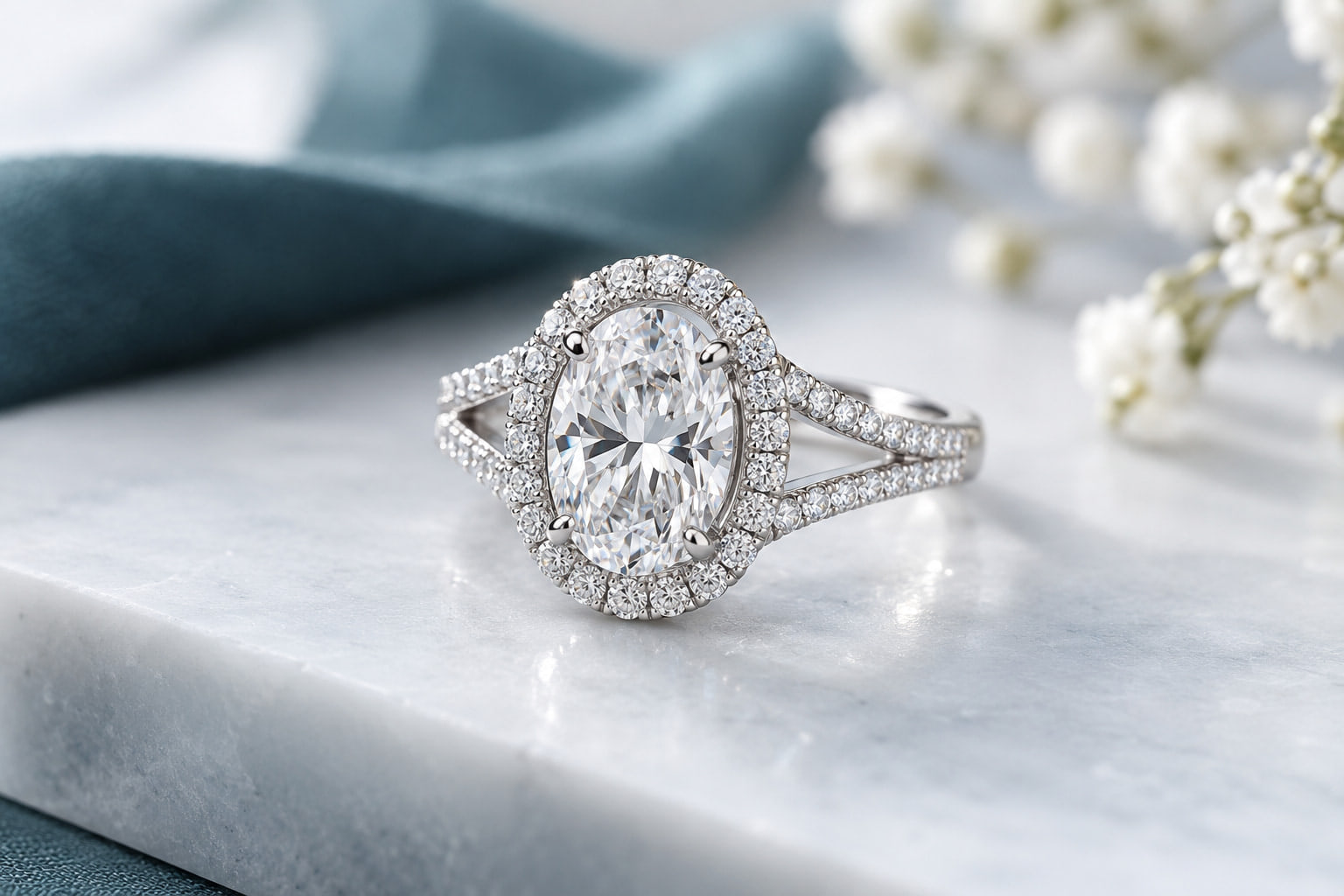
An oval lab grown diamond halo split shank engagement ring needs a center-contour drawing, a visible halo map and a separate shoulder schedule. The oval center's actual outline must suit the halo's inner boundary, while the split shank should meet that assembly in the intended orientation. Do not assume one oval ratio or carat label defines those interfaces. Ask the maker to show top and side views, including the shoulder junctions, then approve actual-scale samples. Select center, halo melee and shoulder accents as distinct allocations. A visible halo differs from an under-center hidden halo, and a split shank adds its own junction and spacing decisions. Keep construction verification with the jewelry producer rather than inferring performance from the rendered silhouette.
How Should the Oval Center, Halo and Shoulder Outlines Relate?
Start with the center's actual length, width, depth and outline image. The maker needs more than an average ratio because end fullness and shoulder curvature can differ between ovals with similar headline dimensions. The halo's inner boundary should be drawn against the accepted center or dimensional family, not an unrelated idealized oval.
Identify the intended visible gap or relationship between the center and halo using the producer's drawing references. Then show the halo's outer outline. The total face-up shape includes the center, surrounding space, accent stones and metal. A larger outer oval does not by itself tell the buyer whether the border looks even at the ends and sides.
Add the split shank as a separate layer. Show where the shoulders divide, how far apart they appear and where each branch joins the head or halo structure. The buyer should see whether the intended top view is symmetrical, deliberately offset or another specified arrangement. A split visible in a render is not proof of how the maker constructs the junction.
The oval center range supports the focal-stone inquiry. This article concerns the complete visible-halo and shoulder layout, rather than repeating the separate optical evaluation of an oval loose diamond.
Uniform Halo VS Graduated Halo: What Changes at Split Shoulders?
| Decision | Uniform accent family | Graduated accent families |
|---|---|---|
| Visual rhythm | Repeated apparent scale around the oval | Deliberate size changes by position |
| Position schedule | One main window with explicit junction exceptions | Several windows mapped around ends and shoulders |
| Split-shank interface | Check how repeated halo positions meet each branch | Check whether a size transition coincides with a branch junction |
| Matching task | Consistent appearance through repeated positions | Balanced opposite positions and smooth progression |
| Replacement task | Identify the repeated or exceptional seat | Identify the exact graduation family and orientation |
Neither choice guarantees a more regular border. Actual seat placement, metal and center contour still matter. Compare the designs at final scale and ask the producer to show the shoulder junctions clearly rather than hiding them behind bright reflections.
Uniform and graduated describe the accent schedule here, not the center cut. A ring may use one repeated halo family and different shoulder stones, or a graduated halo with uniform shoulder rows. Keep those decisions separate in the bill of materials and sales description.
How Should Split-Shank Accents Be Mapped?
Give each shoulder branch an identifier and a direction from the shank toward the head. Number its stone positions and identify where the rows stop or meet another feature. If left and right branches mirror one another, specify the matching pairs. If the design intentionally changes counts or sizes, record that instead of assuming symmetry.
Do not combine halo and shoulder demand solely because both use small rounds. The seat windows or appearance references may differ. The round melee range is a common supply category, while the actual position maps determine which stones belong where. A shared loose family is acceptable only when the maker and buyer approve it.
Ask the producer to explain the junction between each branch and the head. The buyer needs to understand the intended visible transition and the producer's construction responsibility. Avoid inventing a minimum split width or universal branch strength from a photograph. The approved sample should show what the customer sees, and the producer should provide the agreed technical checks.
For size variants, identify whether the split begins at the same visual location or whether the shoulder geometry changes. A new ring size may preserve the halo while changing the body. Keep the head and body revisions linked so a familiar center-and-halo assembly does not conceal a different shoulder layout.
For a graduated halo, inspect the transitions separately from the largest and smallest positions. A smooth list of diameter labels does not guarantee a smooth visible border once gaps and metal surrounds are included. Lay out opposing transitions together and compare the actual accepted sample. The buyer should understand whether the design intentionally emphasizes the oval ends, the shoulders or another region.
Where a branch joins near a graduation step, identify which feature governs the local visual rhythm. The designer may retain a halo sequence across the junction or deliberately interrupt it. Either choice needs a drawing and an actual-scale reference so a later reviewer does not mistake the intended transition for an allocation error.
Record whether branch photographs show the ring from the wearer’s or observer’s perspective. Mirrored images can otherwise reverse the position labels and confuse an asymmetric junction or replacement request.
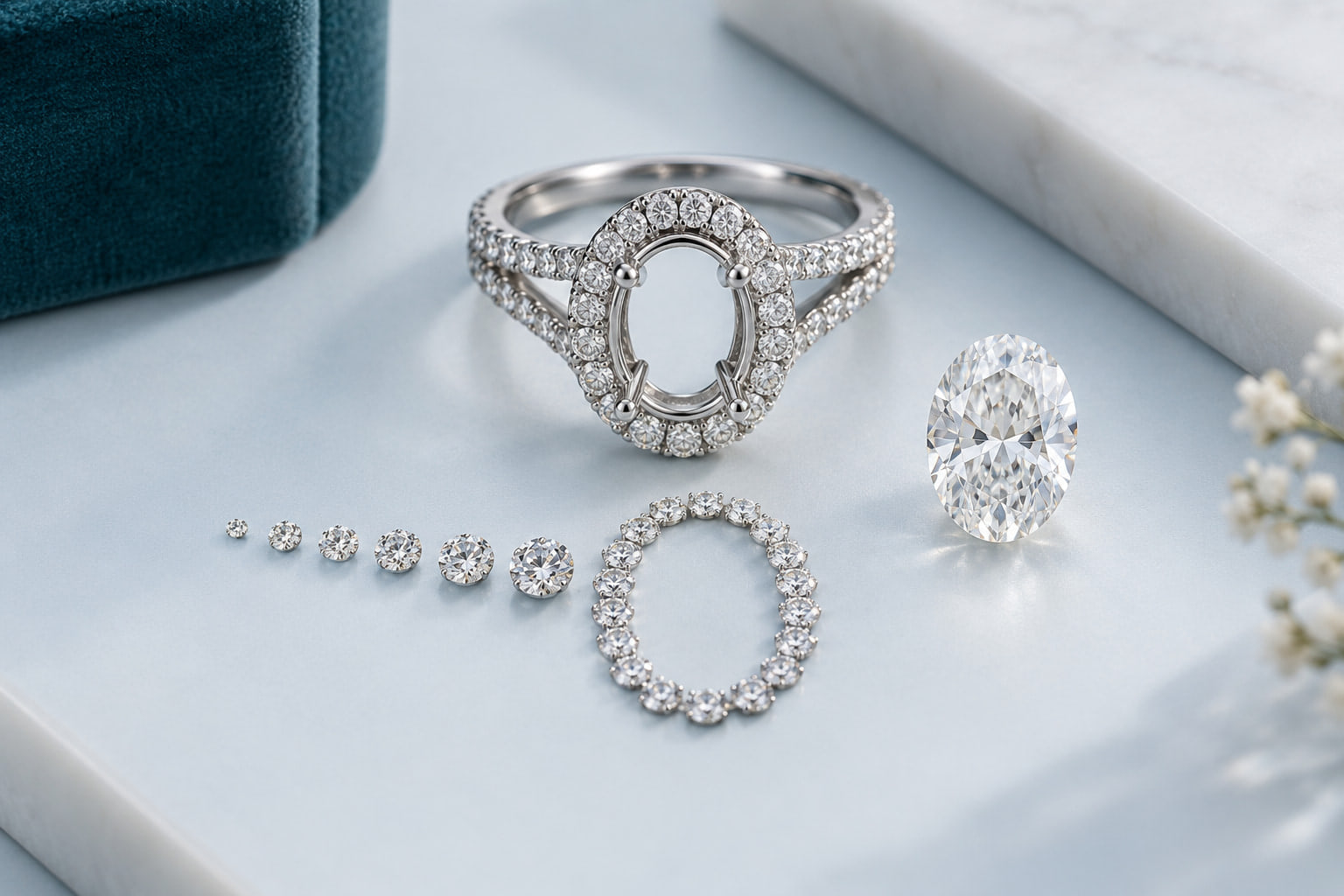
Hypothetical Example: Matching Ratios Does Not Preserve the Whole Border
An invented concept uses a 10.0 by 7.0 mm center inside a 14.0 by 11.0 mm outer halo outline. The simple differences are 4.0 mm in both axes, or 2.0 mm per end and side when centered. This is a face-up envelope comparison only, not a seat clearance or a construction specification.
A second concept keeps the same center and 14.0 mm outer length but narrows the outer width to 10.0 mm. Its simplified side allowance becomes 1.5 mm while the end allowance remains 2.0 mm. Both drawings may look oval, but they communicate a different border proportion. The buyer cannot select between them using only the center's length-to-width ratio.
The team prefers the narrower silhouette, then asks the maker to show how the halo's actual melee and metal occupy that envelope. The shoulder branches must meet this revised assembly deliberately. Moving their junctions to fit the narrower head creates a body change that needs its own drawing and sample, even though the center is unchanged.
Now a proposed center measures 10.4 by 7.4 mm. Within the unchanged 14.0 by 10.0 mm envelope, the simplified allowances become 1.8 mm at the ends and 1.3 mm at the sides. The maker must assess the real inner contour and seats before the buyer approves it. This example exposes linked silhouette consequences while leaving actual fit and construction verification to the producer.
Which Channel Can Support All Three Stone Allocations?
Ask sellers to distinguish center, halo and shoulder supply. A channel may provide all three loose requirements without producing the ring. A finished-jewelry seller should identify the actual head and split-shank revisions so the buyer can compare the exact proposed configuration.
USA / Configuration limits
What Should a US Bridal Retailer Confirm About Center Options?
Stuller provides a US trade loose lab-grown offering. A retailer selecting an oval center through a loose channel should still ask its ring producer which actual dimensions the halo and split-shank configuration supports. A broad carat filter does not establish compatibility.
If customers can choose alternative centers, identify when the head or branch junctions need revision. Keep the actual center outline and accepted halo envelope in the product file. A center that looks attractive alone may change the visible border or require a new shoulder layout, and the retailer should understand that before promising the same ring appearance.
For repairs, distinguish the center, halo and shoulder positions in the service request. A local bench needs the relevant map, not merely a retail style name. Retain the accepted photographs and technical references so the team can restore a graduated position correctly rather than selecting a similar-weight accent from whatever stock is available at the time.
CHINA / Three linked allocations
How Should Chinese Coordination Separate Halo and Shoulder Parcels?
For China-facing procurement, send center, halo and shoulder schedules as linked but separate allocations. MEITUO's Qingdao coordination can organize the loose requirements once the jewelry maker defines the actual seats. Similar small stones should not be combined automatically when their position windows or matching references differ.
Identify any shared families explicitly and label the head/body revisions. If the center changes, ask the producer whether the inner halo contour or shoulder junction changes before reallocating the accents. The coordinator can follow that decision, but a marketing image alone cannot resolve the interface.
For packing, preserve branch and graduation identities where needed. The receiving workshop should be able to distinguish an end-of-halo stone from an outer-shoulder stone without reconstructing the design from memory. Ask for shortages or proposed alternatives to be reported before dispatch. This allows a deliberate design review rather than forcing the setter to improvise the final arrangement with a parcel that does not match the approved map.
INDIA / Center contour linked to accents
What Should an Indian Oval and Melee Offer Show Together?
Greenlab lists Surat manufacturing and Mumbai corporate contacts. When researching Indian suppliers for this design, ask for actual oval outline evidence and separately selected accent families. A common source can simplify coordination without making the three allocations technically interchangeable.
For a proposed center, request length, width, depth and clear end-and-shoulder views. For melee, request usable counts after selection against the halo and branch windows. If the seller proposes an alternative graduated sequence, treat it as a new design option requiring maker and buyer approval rather than a routine same-weight substitution.
Before export, reconcile each allocation with the linked ring revision and preserve the accepted visual references. Agree how rejected center geometry or accent mismatches affect the remaining shipment. The supplier should understand that a center approval may be linked to a specific halo contour, while the shoulder schedule remains a separate controlled requirement. This makes the offer useful to the actual ring producer.
What Should Final Visible-Halo Inspection Examine?
Inspect the center-to-halo relationship at both ends, both long sides and the shoulder transitions. Use the accepted outline reference rather than expecting every visible interval to match an invented universal measurement. If the border looks irregular, identify the location and ask the maker to compare center contour, seat placement and metal outline before choosing a remedy.
Review the shoulder branches together. Check intended symmetry or deliberate asymmetry, stone-family allocation and the transition into the head. A complete accent count does not establish that the pattern matches the approved arrangement. Ask the producer to complete its setting, junction and finishing checks for the actual construction.
GIA notes that diamonds can chip under impact. Neither a visible halo nor split shoulders justify a universal protective or damage-proof claim. The buyer should retain condition records and provide care information appropriate to the actual ring.
For repair, identify the halo or shoulder position before requesting a replacement. A stone from the wrong family can disrupt the graduation even when its weight is similar. The repeat-order record should link center dimensions, head map and body revision so later service restores the accepted configuration.
Use separate photographs for the top outline and the branch junctions. Strong reflections can obscure where two branches meet the head, while a low side angle can hide the halo's contour relationship. A small set of controlled technical views is more useful than one image expected to demonstrate every feature. Keep each view labeled to the same ring revision.
If a replacement center requires a new head, assess whether the original body can remain or whether the branch junctions change. Do not assume that preserving the ring size preserves the whole assembly. The service quotation should identify retained and replaced components, along with any revised appearance. This keeps a future repair from silently converting the accepted visible-halo and split-shank design into a different configuration.
How Can MEITUO Coordinate a Halo and Split-Shank Stone Program?
MEITUO is a sourcing and supply-chain coordination partner in Qingdao, Shandong, China, serving jewelry brands, wholesalers, retailers and designers. Its product scope includes loose centers, melee, side stones and matched sets. An oval halo and split-shank project benefits from three clearly labeled requirements: the center, visible halo positions and shoulder accents.
The team can support product selection, supplier coordination, quality-requirement confirmation and order follow-up. Buyers can submit a linked drawing set and ask alternatives to identify which allocation or geometry changes. The jewelry producer should define the center seat, halo structure, branch junctions and final verification rather than relying on the loose supplier to validate the complete ring.
Contact [email protected] with center dimensions, accent maps and quantity by technical version. Confirm availability, documents, MOQ, treatment information, lead time and shipping terms for the order. The graduated-set category can frame position-based matching where the accepted accent schedule uses several size families.
What Should an Oval Halo Split-Shank RFQ Specify?
Attach the actual center outline, halo inner and outer boundaries, and the branch position maps. Identify uniform or graduated accent families and list junction exceptions explicitly. Include top and side views, the size variants and the linked head/body revisions. A single attractive render is not a complete procurement brief.
Ask suppliers to quote the center, halo and shoulder allocations separately, with accepted counts and actual weights where relevant. Require written approval for substitutions affecting the center contour, halo envelope or shoulder layout. If one loose family is shared across allocations, state that deliberately rather than allowing the workshop to pool unlike seats.
Use the RFQ guide for commercial terms and the bridal application page for project context. The copyable brief gives every party a traceable configuration while keeping the producer's construction and completed-ring responsibilities explicit.
Please quote laboratory-grown diamonds for oval visible-halo split-shank ring [revision], using center outline [reference], halo boundaries and branch maps. List center, halo and shoulder allocations separately with actual dimension windows, accepted counts and matching references. Identify [uniform or graduated] families and junction exceptions, with [service stock] separate. Flag alternatives affecting contour, envelope or branch layout for renewed approval. Confirm documents, treatment information, MOQ, lead time, packing identities and shipping terms. Separate loose supply from head, body, setting and final inspection. The jewelry producer will verify the linked center seat, visible halo and split-shank construction.
FAQ: Oval Lab-Grown Diamond Halo Rings: Split-Shank Layouts
Is This the Same as a Hidden-Halo Ring?
No. This brief concerns a visible face-up halo around an oval center, plus divided shoulders. A hidden halo has a different side-view row and gallery relationship.
Does One Oval Ratio Define the Halo Fit?
No. Actual dimensions and end-and-shoulder contour matter. The producer must assess the center against the halo inner boundary.
Can Halo and Shoulder Melee Be Pooled?
Only when the accepted windows and matching references permit it. Keep allocations identifiable even if one loose family is deliberately shared.
Must a Split Shank Use Graduated Accents?
No. Uniform and graduated schedules are design choices. Map the actual positions and junction exceptions in either case.
Are the Example Envelope Allowances Setting Clearances?
No. They are hypothetical face-up silhouette comparisons. The producer must define the actual seat and construction geometry.
What Changes Reopen the Layout Review?
A changed center contour, halo envelope, accent family or branch junction can affect the accepted configuration. Review the actual proposed revision rather than relying on the style name.