 English
 Español
 Português
 Deutsch
 Français
 Italiano
 Nederlands
 العربية
 日本語
 한국어
 ไทย
Quick Answer
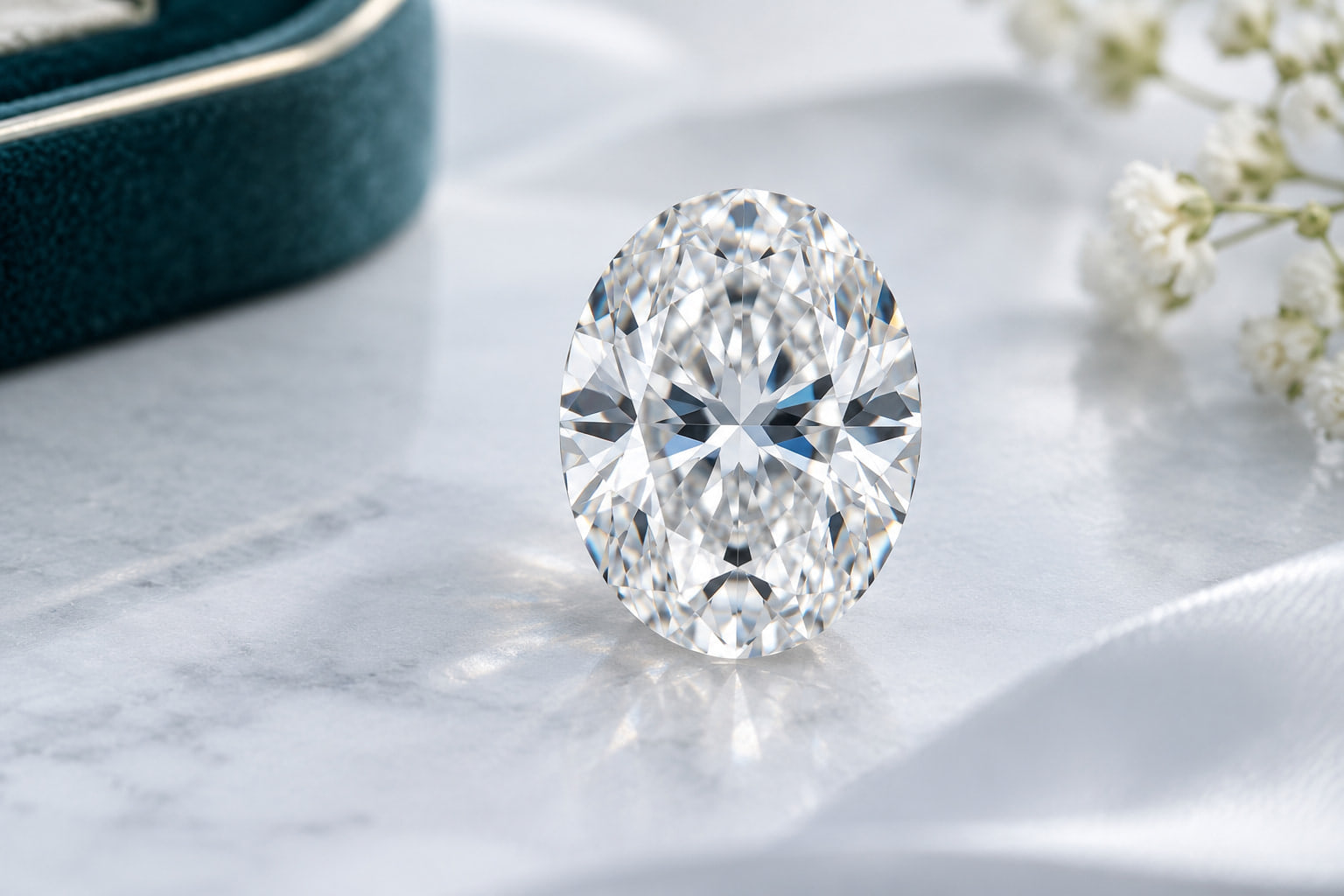
An oval lab-grown diamond should be selected by its complete outline, changing light pattern and actual setting dimensions. A three-carat label does not determine length, width, shoulder shape or bow-tie appearance. Compare the exact stones face-up and through a controlled tilt, using the same background and camera distance. A dark area in one photograph is not enough to reject a candidate, but a broad distracting pattern that persists through several normal views deserves further review. Define the preferred outline family with an accepted sample, then obtain the setter's approval of the actual stone. Ratios are useful for describing elongation; they are not a complete cut grade or a guarantee of appearance.
Which Outline Details Distinguish One Oval From Another?
Describe the oval as a whole before reducing it to a number. Compare the fullness of its ends, the width through the middle and how smoothly the shoulders join those areas. A slender oval and a fuller oval can each be attractive, but they create different ring silhouettes. For a repeated collection, consistency of the intended family may matter more than finding one unusually long stone.
Length divided by width gives a simple elongation ratio. Record the actual measurements as well. An 11.0 by 7.5 mm oval and a 12.1 by 8.25 mm oval both have a ratio of about 1.47, yet the second is larger in both directions. These invented measurements illustrate a geometric point, not a size chart for any particular carat weight. The mount needs the dimensions, not only the ratio.
Place scale images on the same neutral background. If comparing photographs digitally, ensure that the scale is genuinely consistent rather than stretching every image to the same box. An exaggerated crop can hide differences in overall size or make a broad oval look longer. Retain the original image and the measurement source alongside any comparison sheet.
For an earring pair, mirror the two stones and review the outline at normal viewing distance. Similar length and width may still conceal different shoulders or end fullness. For a ring, establish the orientation and the relationship to side stones before casting. Outline approval is a design decision; it should be recorded separately from the report and the price.
How Should Buyers Judge the Bow Tie in an Oval Diamond?
The term bow tie describes a central contrast pattern associated with some elongated brilliant cuts. It should lead to observation, not a binary online verdict. GIA’s 2024 research on fancy-shaped diamonds discusses variation in bow-tie appearance and observer preferences. Broad, persistent patterns and narrower patterns that change with movement should not be treated as identical phenomena.
Begin face-up under diffuse light. Tilt slowly along the long axis, return to center, then tilt across the short axis. Keep the whole stone in focus. Observe whether the central area changes from dark to bright, whether the ends remain visually connected to the middle and whether one region dominates at ordinary viewing distance. Repeat with a different support if the holder appears to be contributing to the image.
Do not demand a completely white image with no contrast. That can encourage overexposure or selective lighting, making comparison less useful. Equally, do not excuse a distracting appearance by saying every oval has a bow tie. The buyer needs to decide whether this stone's changing pattern fits the collection's reference, not settle a universal statement about all ovals.
If the remote evidence remains ambiguous, make physical examination a purchase condition under agreed terms. Ask for the exact item to remain reserved during the review. A supplier's verbal assurance cannot substitute for an approval method when the buyer has already identified a visible concern. Record the viewing conditions and the specific unresolved feature so a second reviewer can repeat the question.
Oval VS Round Lab-Grown Diamonds: Which Approvals Differ?
An oval and a round can occupy similar collection roles while demanding different evidence. Use the comparison to choose a review process, not to claim that one shape is automatically better value or more brilliant.
| Approval task | Oval | Round brilliant | Buyer action |
|---|---|---|---|
| Silhouette | Length, width, shoulders and ends | Diameter consistency and circular outline | Use actual-scale images |
| Central contrast | Follow the bow-tie pattern through movement | Review the full radial pattern | Retain an unedited sequence |
| Orientation | Long axis can be aligned differently in a design | No equivalent elongated axis | Specify the intended ring layout |
| Setting | Directional seat and stone-specific contour | Round seat with its own depth envelope | Obtain independent fit approval |
| Matched pair | Match ends and shoulder family as well as size | Match diameter and visual character | Approve the pair together |
| Reorder reference | Keep outline overlay and movement clip | Keep radial appearance and dimensions | Do not reorder by weight alone |
When the brief remains flexible, compare oval loose stones with round alternatives before committing a mounting. If the brief specifies a three-carat oval, do not assume that a similarly weighted round is an equivalent replacement. The design proportions, face-up dimensions and customer expectation have changed.
A collection can include both shapes if each has its own approved family. Shared document requirements are useful, but shared dimensional limits are not. Give the product and workshop teams a clear shape-specific specification instead of expecting them to interpret one broad quality tier.
How Can a Three-Carat Oval Shortlist Be Compared Fairly?
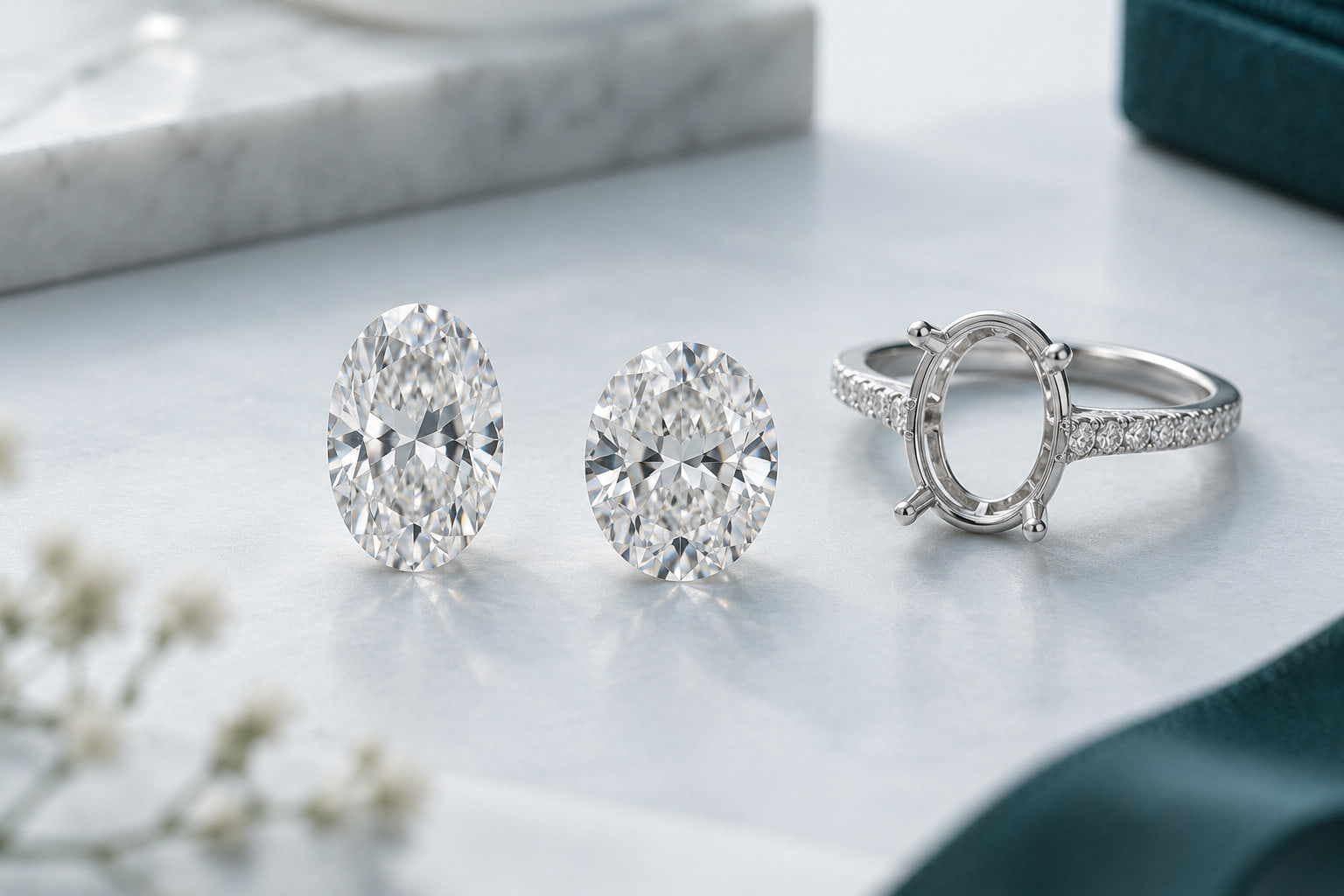
Hypothetical example: a studio is selecting an oval center for a three-carat design brief. Candidate A measures 11.9 by 8.1 mm, giving a ratio of about 1.47. Candidate B measures 12.3 by 7.9 mm, giving about 1.56. These are invented candidates, not market averages or a carat-to-size conversion. Both require review against the actual report and mounting.
The design team prefers the longer silhouette of B in a still image. The workshop notes that its existing head was approved for the fuller family represented by A. Rather than approve B on appearance alone, the studio overlays the actual outlines on the drawing and asks the setter whether the contact positions remain workable. If not, the quotation must include a different head or a different candidate.
The buyer then reviews synchronized clips. Suppose A shows changing central contrast that remains visually integrated, while B has a broad dark region that persists in the initial setup. The buyer repeats B with the same neutral support and ordinary light used for A. If the result persists and does not fit the reference, B remains outside the shortlist even though its long outline was initially appealing.
If the design team still prefers B's silhouette, it can request a third candidate from that outline family. This separates the desired shape from an unwanted optical result. There is no need to choose between the two original stones if neither satisfies the complete brief.
The approval file should show the reason for selection: outline family, viewing result, mounting decision and document check. A single accepted ratio would not preserve those decisions. MEITUO can coordinate a revised shortlist using this evidence rather than asking suppliers for a vague better oval.
Which Media and Receiving Checks Make an Oval Reorder Usable?
Request a face-up scale image, side view, slow long-axis tilt and short-axis tilt. Link the files to the offered stone's identity. Avoid clips in which the stone spins so quickly that the middle never remains visible, or in which exposure changes substantially between candidates. A repeatable sequence gives both buyer and supplier a fairer basis for discussion.
At receiving, reconcile the physical item and document before evaluating appearance. Check the reported measurements against the offered item and verify the report through the issuing laboratory. Do not treat a familiar laboratory name as proof that all historical and current services contain the same fields. Use the document the stone actually carries.
Then repeat the agreed visual review and have the setter check the stone before mounting. If an objection concerns shoulder shape, say so. If it concerns persistent contrast, retain the sequence demonstrating it. If the issue is depth clearance, refer it to the drawing and engineering owner. Different objections require different remedies.
For paired ovals, keep the matched-set approval with both item identities. For center-and-side arrangements, use the side-stone category and approve the complete layout. The repeat-order planning guide can help maintain the record after the original salesperson or designer changes.
How Do Oval Sourcing Questions Change Across Markets?
An oval program benefits from a channel that can show the actual stone and preserve the accepted outline family. Compare item control, media quality and the route for a failed review. Country describes the commercial context; it does not establish a bow-tie outcome or a universal quality level.
USA / Reviewable inventory
What Should US Retailers Request When Selecting an Oval Remotely?
Stuller publishes a loose laboratory-grown diamond selection, providing a US trade-channel example. For an oval search, ask whether the video depicts the exact offered item and whether another setup can be requested. A local commercial relationship can simplify discussion, but it does not establish the growth country or guarantee an attractive central pattern.
Have the bridal buyer and setter review the same stone reference. A retailer may prefer a long silhouette while its stock mounting is suited to a fuller oval. Resolve that mismatch before promising a completed ring. Request the applicable reservation, review and return terms for the actual transaction; do not infer them from a general channel description.
For US-facing product photography, retain one ordinary-light sequence in addition to promotional stills. Customer service can then explain the stone's changing appearance without calling every dark reflection a defect or promising a completely contrast-free oval. If a buyer requires a particular visual family, make that part of the written selection approval rather than a salesperson's undocumented preference.
CHINA / Outline references
How Should a China Sourcing Brief Communicate Oval Shoulder Shape?
For a China sourcing route, send actual outline references rather than relying only on translated style adjectives. The MEITUO team in Qingdao coordinates sourcing; its location is not the growth or cutting origin of every offered stone. Ask who holds the exact candidates and who can repeat the requested video sequence.
Label the long and short dimensions clearly and keep the same orientation across every file. If a request contains both slender and fuller acceptable examples, state whether either family can be supplied or whether the collection needs one consistent family. Mixing them without a rule makes the receiving decision needlessly subjective.
When several suppliers contribute candidates, retain the original item references through the consolidated shortlist. Do not allow a visually similar substitute to inherit the first stone's approval automatically. A changed stone needs its own outline, media and fit review. Confirm where held items remain while the buyer decides, and separate accepted centers from other parcels being consolidated. These controls make a cross-border oval order manageable without assuming country-level uniformity.
INDIA / Cutting and trading contacts
What Should Buyers Ask a Surat or Mumbai Oval Supplier?
GreenLab’s contact page identifies Surat and Mumbai locations. Those locations illustrate contact points, not proof of where a specific oval was produced. Ask the contracting seller who can discuss the actual outline and facet appearance and who controls the offered inventory during review.
For a collection, request a small family of candidates photographed together at scale. If a supplier proposes recutting to make an oval slimmer or to change its appearance, request the revised weight, dimensions, timing and document route before accepting that proposal. A possible recut is not the same as a finished, approved replacement, and its result should not be guaranteed from a photograph.
If your design uses side stones or paired ovals, preserve the complete layout through the trading handover. A Surat technical contact and a Mumbai export contact should reference the same selected item list. Ask how later orders will reproduce the approved shoulder family when original stock is gone. Repeatable comparison evidence is a stronger basis for that conversation than a universal ideal ratio.
How Can MEITUO Help Refine an Oval-Diamond Shortlist?
MEITUO is a sourcing and supply-chain coordination partner based in Qingdao, Shandong, China. A useful oval inquiry gives the team more than weight and a favorable report label: include the preferred shoulder family, actual dimension range, movement-video protocol and the mounting's fixed limits. MEITUO can communicate these requirements, coordinate candidate options and follow supplier responses through the agreed review.
The broader product conversation includes loose centers, melee, side stones, matched pairs and sets, and fancy-color options. For an oval-centered collection, keep each group independently specified while approving the final design together. MEITUO is not the independent laboratory or the setter responsible for the finished seat. Availability, documentation, MOQ, lead time, treatment information and shipping terms must be confirmed per order. The designer and studio solutions page provides a relevant starting point. Send the accepted reference, intended application and unresolved questions to [email protected] so the shortlist reflects your actual decision criteria.
What Should an Oval Lab-Grown Diamond RFQ Say?
State whether the requested weight is a target or a mandatory boundary, then list the actual dimensions that matter to the design. Identify the intended orientation, outline reference and review sequence. If the mounting is fixed, give its controlled drawing; if it can change, state who can approve that change and when.
Ask candidates to be grouped by the preferred outline family rather than ranked only by elongation. Request an explanation of any exception before dispatch. Define the time allowed for visual and setting review, and record which items remain reserved during that period. The following brief helps a supplier return evidence that can be compared consistently.
Please shortlist oval laboratory-grown centers for [collection], targeting [weight range] and [length, width and depth envelope]. Our outline reference is [file], with [orientation] in mounting [revision]. Provide actual-item document references, scale face-up images and slow neutral-light tilt videos in both axes. Identify the preferred shoulder family and flag persistent central contrast for review. Keep proposed substitutes separate from reserved stones. Confirm growth and treatment information, MOQ, reservation period, lead time, shipping terms and physical-review conditions. Final appearance and setting fit require written approval by [buyer and setter].
FAQ: Oval Lab-Grown Diamonds: How to Evaluate Shape and Bow Tie
Is Every Oval Diamond Supposed to Have a Visible Bow Tie?
Oval contrast patterns vary. Review the actual stone through controlled movement and compare it with your accepted reference. Neither a blanket rejection of all contrast nor a promise of no contrast is a useful substitute for that review.
Is There One Ideal Oval Ratio?
A ratio describes elongation. It does not capture shoulder fullness, absolute size or the complete light pattern. Use a preferred range as a design choice and verify the actual outlines rather than presenting it as a universal grade.
Does a Three-Carat Oval Have a Fixed Millimeter Size?
No. Weight does not uniquely determine length, width or depth. Obtain actual measurements for the offered stone and use them for the mounting review. The hypothetical dimensions in this article are not a size chart.
Can a Bow Tie Be Judged From One Photograph?
A still can reveal a concern but cannot show how the pattern changes. Request controlled tilt in both axes with consistent lighting and support. Arrange physical review when the evidence remains ambiguous.
Can Two Ovals With the Same Ratio Form a Matched Pair?
They still need comparison for absolute size, shoulders, end shape, color appearance and changing contrast. Approve the actual pair together and retain both identities with the layout.
What Should Be Saved for an Oval Replacement?
Keep actual dimensions, a scale outline, both tilt sequences, the accepted appearance reference and the mounting revision. Record the original exceptions so a replacement does not silently widen the collection standard.