 English
 Español
 Português
 Deutsch
 Français
 Italiano
 Nederlands
 العربية
 日本語
 한국어
 ไทย
Quick Answer
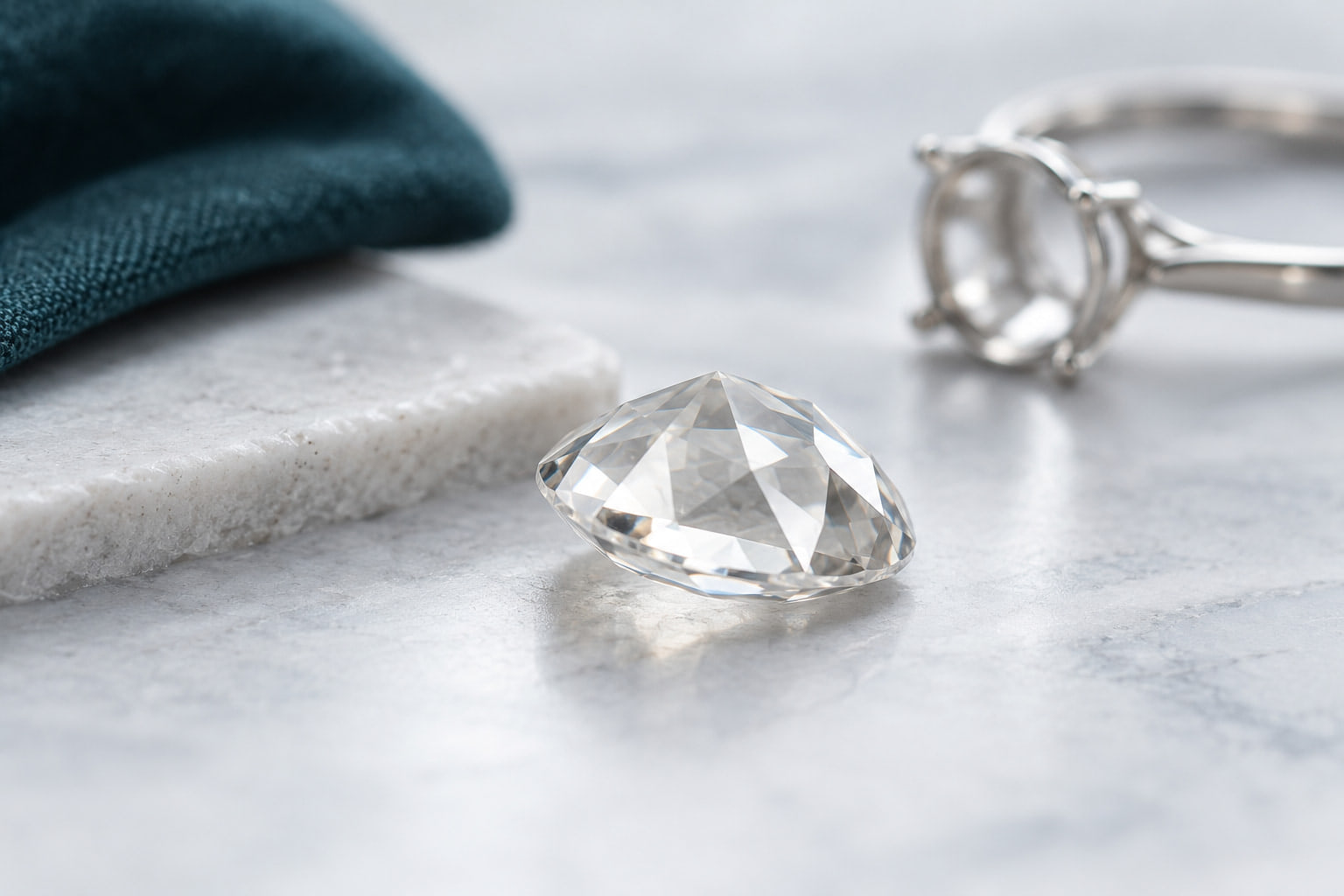
A rose cut lab grown diamond is laboratory-grown diamond fashioned with a flat base and a faceted dome, rather than the table-and-pavilion architecture associated with a modern brilliant. Choose it by actual outline, dome height, facet arrangement and appearance over the intended background. Do not assume every rose cut has the same facet count, weight-to-size relationship or optical pattern. A low stone profile can support a low-profile design, but the final height also depends on the setting and clearances. Approve a loose sample, inspect it in multiple lighting conditions and then review it in a representative mounting. For matched sets, compare dome height and visual transparency as well as length, width, color and weight.
How Does Rose-Cut Architecture Differ From a Brilliant Cut?
GIA's study of historical rose cuts describes common diamond rose-cut arrangements with flat bases and domed upper facets. It documents variation, which is the useful lesson for a modern procurement brief. The name identifies a family of architecture, not a promise that every supplier will deliver an identical facet diagram.
For a present-day laboratory-grown stone, request photographs of the actual top, side and base. The top view establishes the outline and facet layout. The side view reveals the height and shape of the dome. The base view confirms the contact geometry the setter must accommodate. A promotional top photograph alone can hide the very feature that makes the cut different.
| Review point | Rose cut | Conventional brilliant-style stone |
|---|---|---|
| Basic profile | Flat base below a faceted dome | Crown and pavilion divided by a girdle |
| Design emphasis | Broad reflections, transparency and background relationship | Pattern of returned light through crown and pavilion |
| Seat planning | Base support and dome clearance need explicit review | Pavilion clearance and girdle seat need explicit review |
| Matching task | Compare dome, see-through appearance and outline | Compare spread, depth and visible return pattern |
| Weight comparison | Use actual dimensions; do not apply a fixed conversion | Use actual dimensions; depth still affects spread |
Neither column is a universal quality ranking. The successful choice depends on the intended appearance and construction. The shape selection guide helps place the rose cut within the collection rather than present it as a substitute for every brilliant.
Why Does the Background Matter for a Rose-Cut Lab-Grown Diamond?
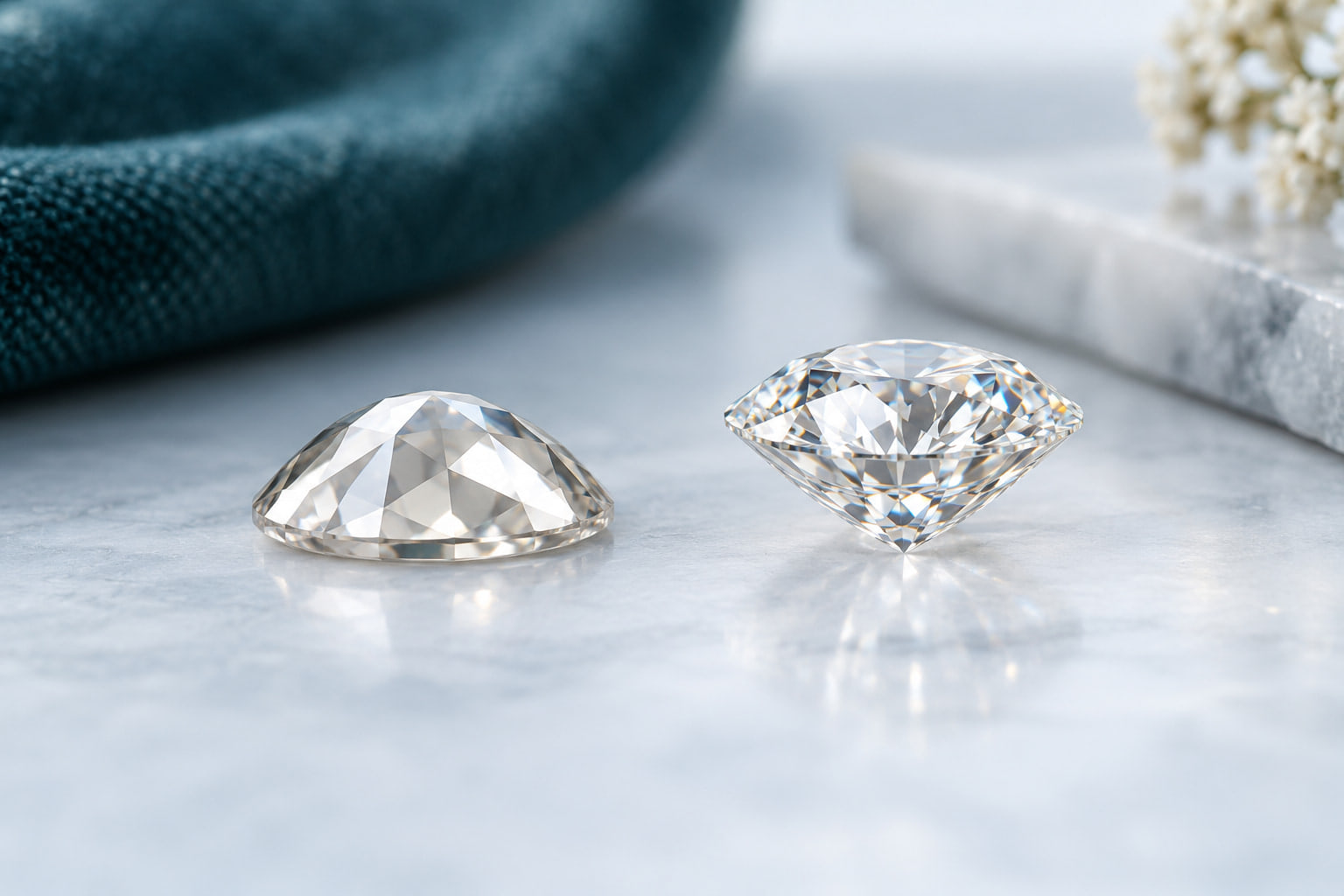
Inspect the stone over the surfaces the customer will actually encounter. A white presentation card is only one condition. Try neutral gray, a skin-tone reference and representative polished or matte metal. A transparent-looking central area can show those backgrounds differently. The buyer should decide whether that interaction is part of the desired aesthetic before treating it as an exception after setting.
Keep the comparison controlled. Clean the loose sample, use the same camera exposure and move one background at a time. Record a short face-up video under broad diffuse light, then another with a modest directional source. Rotate slowly enough to see how individual facets change. A single frame chosen for maximum flash can obscure extended quiet regions or an uneven dome pattern.
If a closed-back setting is proposed, inspect the real finish intended behind the stone. A rendering of bright white metal does not establish what a polished sample will look like. Also review any opening and the access for cleaning. The setter should confirm construction and maintenance rather than letting the buyer infer them from the stone's flat base.
A jewelry brand can use the designer sourcing scope to define sample deliverables: loose stone, reference mounting and a brief record of the approved viewing conditions. The approved appearance should belong to the combined design, while the stone remains independently identifiable.
Does a Rose Cut Automatically Make a Low-Profile Ring?
No. A flat base can remove the deep pavilion found in many conventional faceted designs, but the ring still needs a supported seat, retention features, finishing allowance and appropriate clearance. The dome itself can be shallow or pronounced. Ask the setting maker for a section drawing that locates the actual base plane, girdle area and highest crown point.
Measure the loose stone in three dimensions and distinguish total stone height from finished head height above the finger. These are not interchangeable. A low stone can sit high if the head is mounted on a tall gallery. Conversely, a design may reduce height by changing the support arrangement, subject to the maker's review. Avoid specifying a universal minimum metal thickness or prong overlap without the actual design and material.
Check the outline against the seat around its full perimeter. A rose cut described as round may not be perfectly circular; a freeform outline needs its own geometry. The setter should identify intended support and retention locations before work starts. For a bezel, the rim may alter the visible outline and background interaction, so the loose-stone approval is only the first stage.
Separate loose-stone sourcing from manufacturing responsibilities using the component and finished-jewelry guide. A supplier offering a stone has not thereby approved a finished ring's strength, comfort or final height.
How Should a Buyer Choose Between Two Rose-Cut Samples?
Hypothetical example: the low-dome capsule. A designer plans 24 rings around an approximately 8 mm round outline. Sample A measures 8.1 by 8.0 by 2.0 mm; Sample B measures 8.0 by 7.9 by 2.8 mm. Both figures are invented. Their mean face-up diameters are 8.05 and 7.95 mm, only 0.10 mm apart, but their stone heights differ by 0.8 mm. A carat-only comparison would miss the most relevant design difference.
The design target favors a shallow appearance, so the team mounts A in a representative sample. Under diffuse light, its central region shows the underlying metal more clearly than the team expected. B's more pronounced dome gives a different facet rhythm but exceeds the preferred finished-height envelope in the first mounting. Neither sample is accepted solely from its measurements.
The team revises the brief: keep A's approximate face-up scale, provide an agreed dome-height range based on the approved prototype and use the actual sample as the optical reference. If a new candidate changes the facet pattern materially, it needs renewed visual approval even when it falls inside the dimensional range. The range is a project requirement, not an industry grading standard.
For 24 rings, the buyer also requests two replacement candidates reviewed against the master sample. The planned stone count is therefore 26, with purchase approval still dependent on availability and commercial terms. This reserve is an illustrative inventory choice, not a universal recommendation or a claim that replacement rose cuts are always immediately obtainable.
What Should Rose-Cut Buyers Request in Three Sourcing Markets?
For this cut, the most useful supplier distinction is who controls the actual facet layout and who can return a sample that fits it. A distributor, cutter and sourcing coordinator can each be useful, but they answer different questions. Keep the approved dome and background reference attached to the inquiry as it passes between them.
USA / designer and retail sampling
What Should a US Rose-Cut Collection Buyer Approve First?
A US designer buying through a trade distributor should request the actual rose-cut sample before preparing final product imagery. A style photograph can establish the general aesthetic but cannot establish the transparency, dome height or base geometry of the offered stone. Ask whether the item shown is individually available or represents a broader sourcing service.
For a retail capsule, review the stone over the intended metal and skin-tone reference before signing off the appearance. Sales associates need photographs that show the finished product honestly, including its quieter reflections in diffuse light. A rose cut should not be presented using a brilliant's sparkle expectation simply because both products are diamond.
Keep the US distributor's loose-stone return terms separate from the setting maker's charges. Agree when a stone becomes nonreturnable, whether a sample mounting is permitted and who approves the final head height. This protects the design decision from being rushed by a commercial deadline that was never part of the initial brief.
CHINA / supplier and drawing coordination
How Should a China Rose-Cut Inquiry Control Geometry?
When coordinating a rose-cut inquiry through China, send the side view at the same time as the top view. An attractive outline alone does not communicate the dome you want. Include the actual depth limit, base preference and photographs over the intended background. If the supplier returns a conventional pavilion-style candidate, clarify the architecture before discussing price.
MEITUO's Qingdao team can coordinate those questions with relevant suppliers. The coordination address is not evidence of the cutting location. Request the identity of the party responsible for confirming dimensions and ask who can explain any discrepancy between the drawing and the sample. That is more useful than assuming a geographic label guarantees a particular cut.
For a repeat order, retain the approved stone reference and measurement method in the purchase file. If a supplier proposes a different facet arrangement, review it as a change even when the outline remains round. A translation of rose cut should carry the architecture and sample reference, not become a substitute for them.
INDIA / sample and cutting handoffs
How Should an Indian Cutting Proposal Handle Rose-Cut Variation?
A buyer discussing a rose-cut project with an Indian cutter or trader should ask whether the proposal covers existing polished goods or a new cutting request. Existing samples can be compared directly; a cutting plan needs a reference diagram and a defined approval stage. The two should not be priced or scheduled as though they carry identical uncertainty.
Where a trader is coordinating the cutter, keep the approved dome and outline reference attached to the order. Ask who confirms the final height and who returns the actual top, side and base photographs. If the new sample differs, resolve the difference before it is distributed among finished jewelry styles.
For pairs or sets, communicate the required visual match rather than specifying only a total weight. Request consistent orientation in the sample photographs and an item map for the accepted set. Do not assume that a shared cutter, parcel or report description automatically produces the transparency and dome balance your design needs.
How Should Rose-Cut Sets Be Matched and Inspected on Receipt?
Match a pair face up first, then compare side profiles. Two stones with similar diameters can look uneven in earrings if one has a higher dome or a more open central appearance. Put them over the same background, orient them consistently and swap their left-right positions. If the perceived difference follows the stone, it deserves review; if it stays with the lighting position, adjust the test before making a judgment.
For a multi-stone design, create a position map. Record which rose cut occupies each position, its orientation and any intentional variation. Freeform designs can accept controlled differences, but the designer should identify those differences as part of the composition rather than leaving the setter to improvise. The fancy-shape pair scope is a useful starting point when outline is the dominant constraint.
On receipt, keep the stones loose until identity, dimensions and visible condition have been checked against the order. Inspect the base for damage or debris that could affect seating, and document any edge concerns for the setter. Do not attempt to resolve an unexplained appearance change by polishing or setting the stone first. Once mounted, access and return options may change.
Save the acceptance photographs with their background and lighting notes. When replenishing, compare new candidates with the retained master rather than a compressed marketing image. If an exact match is unavailable, decide whether the design permits a new approved subgroup or whether the order should wait.
How Can MEITUO Support a Rose-Cut Design Brief?
MEITUO is based in Qingdao, Shandong, China and works as a sourcing and supply-chain coordination partner for jewelry buyers. A rose-cut request benefits from a brief that includes the intended outline, dome-height preference, background conditions and setting concept. MEITUO can support product selection and supplier coordination around those specific requirements.
Its scope includes loose center stones, melee, side stones and matched pairs or sets. A rose-cut design may also require a separate side-stone selection, but the optical brief for those accents should not be assumed to match the center. Availability, documents, MOQ, lead time, treatment information and shipping terms must be confirmed per order.
Send reference photographs and a dimensional drawing to [email protected]. MEITUO can help organize supplier responses and order follow-up; it does not claim to cut the stones, manufacture the finished mounting or issue independent laboratory reports. The buyer and setting maker should approve the final stone-and-setting combination before the project moves into production.
What Belongs in a Rose-Cut Lab-Grown Diamond RFQ?
Attach three views of the desired architecture and mark which features are requirements. State whether the request is for an identical repeat, a closely matched pair or a deliberately varied assortment. Include actual millimeter limits and the background or metal finish used for optical approval. Use carat weight as additional information rather than the sole size instruction.
Specify the sample stage before committing the full quantity. Identify who approves the loose stone, who approves setting fit and which changes require a new sample. The RFQ guide can hold these decisions alongside the commercial terms.
Ask for item-specific images rather than another generic rose-cut photograph. A seller may understand the style perfectly while proposing a dome or outline that does not suit your mounting. A written acceptance reference makes that difference reviewable before dispatch.
Please propose rose-cut laboratory-grown diamonds for [jewelry application and quantity]. Preferred outline is [shape] with face-up dimensions [range], maximum dome height [value] and approved reference images [file names]. Provide top, side and base photographs, full dimensions, actual facet arrangement and available identity documents. We need comparison on [background colors or metal finishes] and a sample review before setting. State acceptable outline variation, matching scope, replacement options, MOQ, lead time and treatment information where applicable. Please quote loose stones separately from any third-party setting work and identify all proposed substitutions before dispatch.
FAQ: Rose-Cut Lab-Grown Diamonds: Light, Profile and Fit
Does Every Rose Cut Have 24 Facets?
No. Rose cuts encompass different arrangements. Ask for the actual facet map or sufficiently clear photographs of the offered stone. A familiar historical arrangement should not be turned into a universal specification for all contemporary laboratory-grown rose cuts.
Is a Rose-Cut Lab-Grown Diamond an Antique?
No. Laboratory origin and a historical cutting style do not establish antique provenance. A modern rose cut can reference an older aesthetic while being newly produced. Describe the style and the origin clearly rather than implying a historical chain of ownership.
Will the Stone Always Look Transparent?
The visible effect depends on the specific stone, facet arrangement, background, lighting and mounting. Review an actual sample over relevant surfaces. A highly selected photograph cannot establish how every candidate will look in ordinary viewing conditions.
Can a Rose Cut Use a Standard Brilliant Setting?
Do not assume so. The flat base and dome require their own seating and retention review. A setting maker should assess the actual dimensions and contact geometry before work begins, even when the nominal outline matches a familiar brilliant size.
How Should Rose-Cut Earrings Be Matched?
Compare face-up outline and appearance, then side-profile dome height. Use the same background and lighting, swap left-right positions and retain pair identifiers. Similar weight is useful information but does not establish a convincing visual pair.
What Is the Most Useful Sample Deliverable?
A loose stone with top, side and base views, full dimensions and a background comparison is a strong start. For a production design, add a representative mounting approved by the setting maker and buyer before treating the loose sample as a complete finished-product approval.