 English
 Español
 Português
 Deutsch
 Français
 Italiano
 Nederlands
 العربية
 日本語
 한국어
 ไทย
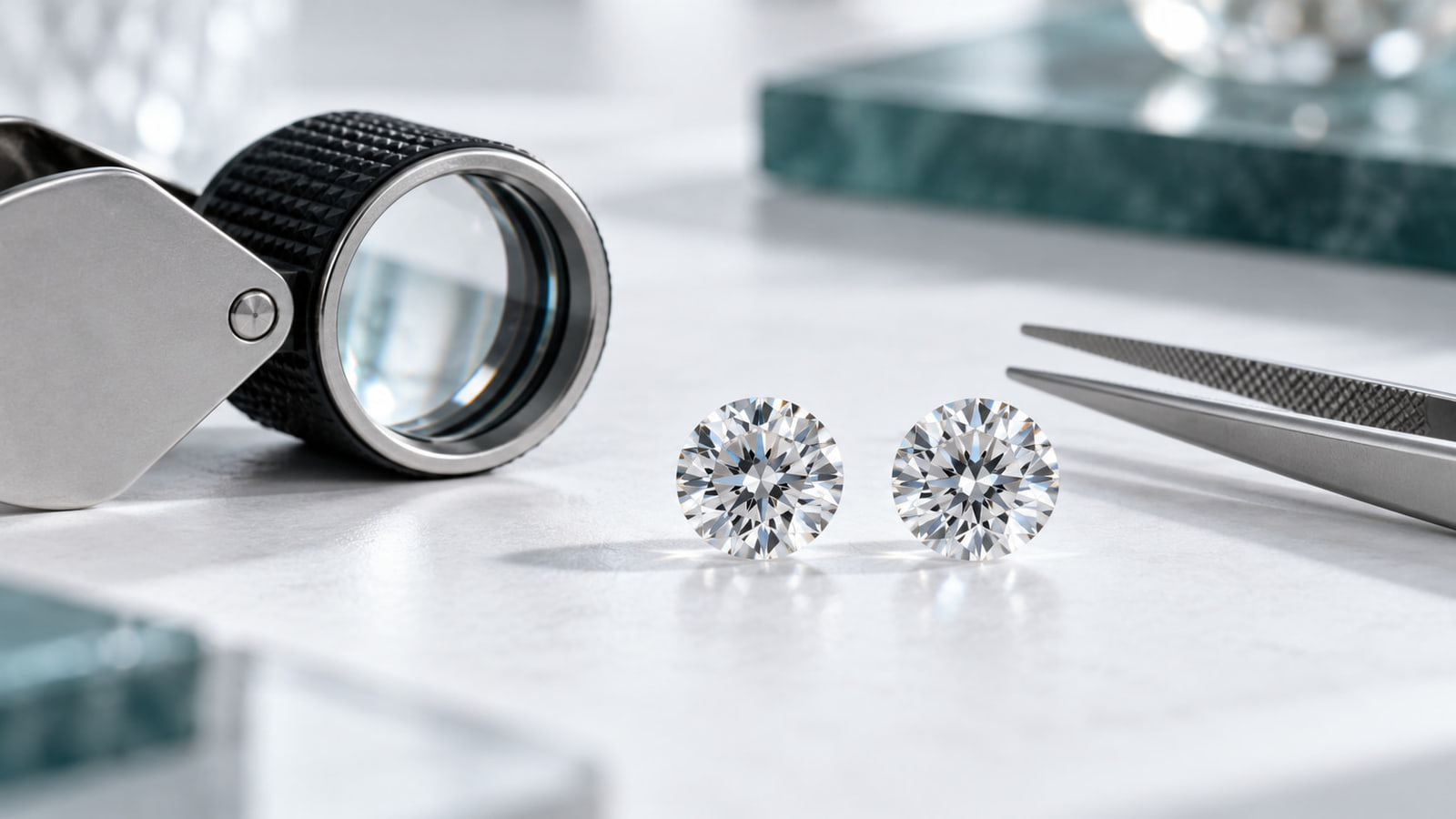
Quick Answer
Can a jeweler tell if a diamond is lab grown? A jeweler may identify reliable markings, inspect characteristics and use suitable screening equipment, but appearance alone cannot reliably establish origin. Specialist laboratories use additional analytical methods when needed. Ask what the jeweler actually examined and what conclusion the evidence supports, particularly when stones are mounted or very small. The most reliable buying decision combines the correct document scope with observations of the actual item and a written acceptance rule. Keep unresolved points visible before payment or setting. A supplier’s confident description is useful context, but the purchase record should distinguish confirmed facts from information that still needs verification.
Can a Jeweler Tell if a Diamond Is Lab Grown?
Experience is useful, but the test scope matters more than confidence. A jeweler can report condition, read an accessible inscription and compare a stone with its paperwork. That work may confirm a consistent item history or reveal a discrepancy. Definitive origin conclusions may require equipment and expertise outside the shop. An honest referral is part of a competent workflow, not a failed examination.
GIA’s research update explains that growth features and responses vary and that exceptions complicate identification. It supports using multiple analytical observations instead of a single visual shortcut. See GIA: Laboratory-grown diamond identification update, 2024.
Retail Examination Versus Specialist Identification
The meaningful distinction is between an in-shop observation and a conclusive specialist finding. Either can be useful when its scope is clear. A jeweler should not be asked to turn a stock photograph into an origin diagnosis, while a laboratory request should state which actual question remains open after the shop examination.
| Decision | Jeweler examination | Independent laboratory identification |
|---|---|---|
| Useful work | Inspect condition, markings and available documents | Apply analytical methods appropriate to origin questions |
| Limit | No universal naked-eye origin determination | Scope still depends on item and requested service |
| Mounted jewelry | Access may obscure markings or features | Confirm whether unmounting or another service is required |
| Evidence supplied | Written observations and screening result | Independent result linked to the examined item |
Which Origin Identification Checks Belong in the Buying Brief?
The following selection checks connect the topic to an actual purchase decision. Record the requirement, evidence and unresolved question against the same stock identifier so the supplier and receiving team review the same candidate.
Question asked. Confirm material identity, origin or report matching. Request a written examination request with separate questions. A clearly framed question helps the examiner choose a suitable service rather than guess the buyer’s need.
Access limits. Confirm covered girdles, closed backs and tiny stones. Request an examination note identifying inaccessible components. List inaccessible components explicitly; silence can be misread as full coverage.
Screening competence. Confirm device coverage and referral rules. Request instrument details and exact result terminology. Ask which result is screening and which is an independent identification conclusion.
Conclusive route. Confirm who can resolve an unresolved stone. Request laboratory service scope and custody documentation. Maintain custody records so the returned conclusion belongs to the original item.
Apply the relevant checks to individual loose centers or matched pairs and sets according to the actual order. Preserve the approved reference and flag substitutions for review before they enter the packing list.
For independent jewelers, MEITUO can help obtain the supplier’s original item references before referral. That supports the inquiry without replacing the examiner’s judgment or expanding a center-stone result to unexamined components.
An effective examination request separates material, origin, document match and condition into four questions. A stone may be diamond while its origin remains unresolved; its report may be genuine while the stone-to-report match is uncertain. Keeping these combinations visible prevents a staff member from converting a partial answer into a complete product representation.
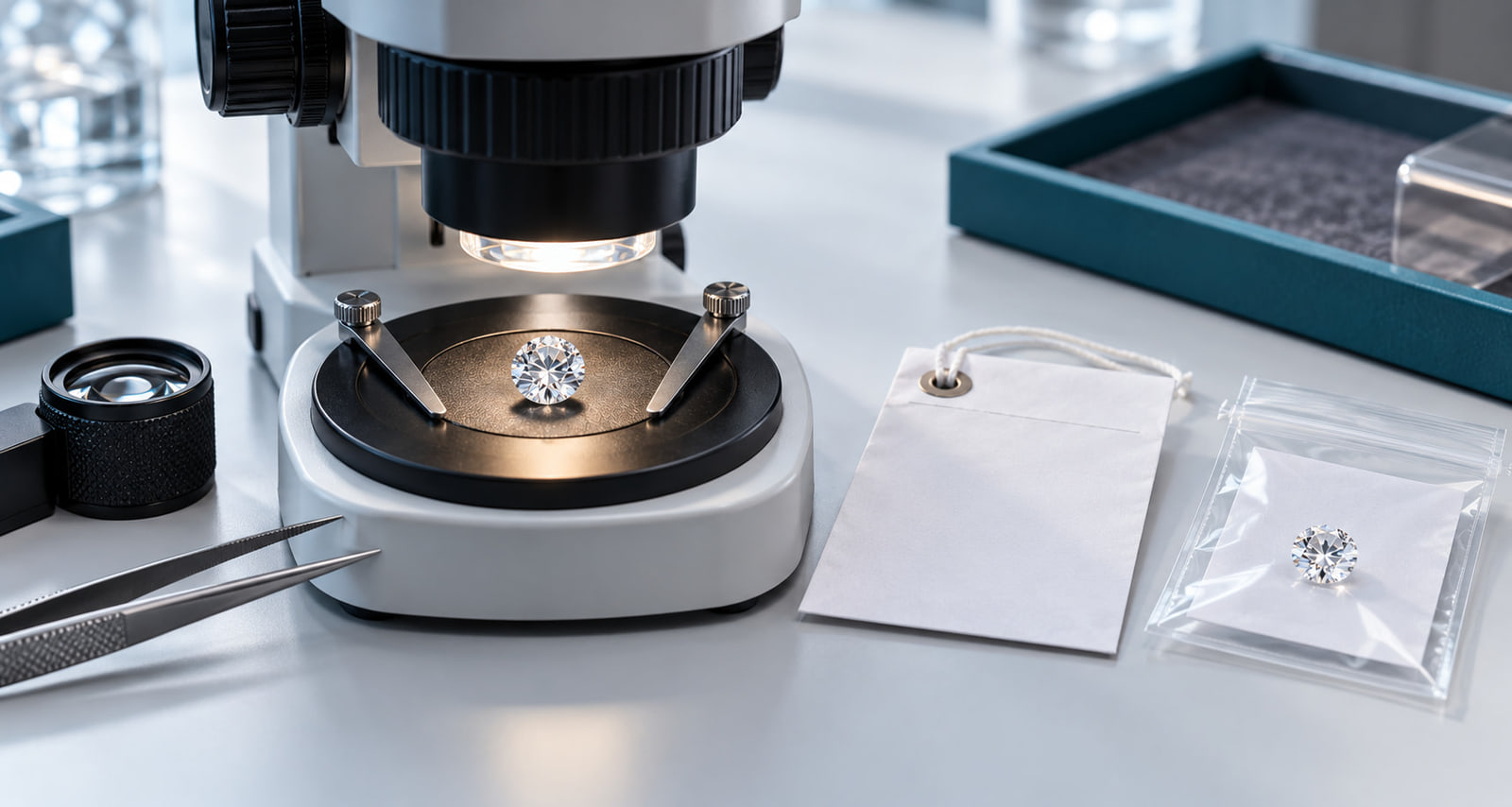
Magnification can reveal inscriptions, recognizable features and surface condition. It cannot be assumed to reveal a diagnostic origin feature in every stone. A jeweler should describe what is observed and distinguish that observation from an inference. Where a feature is ambiguous, an appropriate specialist may need analytical methods beyond ordinary shop microscopy.
A screening device likewise contributes a scoped result. Ask whether it is designed to pass a category or refer potentially unsuitable material for more work. The displayed term should be preserved. Refer does not mean the examiner has conclusively determined CVD growth, HPHT growth, treatment or simulant identity, unless the specific instrument and service genuinely support that conclusion.
For mounted jewelry, a component map can be more useful than a single statement on the whole piece. Identify the center, side stones and small accents, with accessible areas noted. The buyer can then decide what level of identification the transaction requires and whether further access is justified. Do not expand a center report to all stones merely because their appearance is similar.
After referral, reconcile the returned conclusion with the original item photographs and identifiers. Preserve any limits stated by the examiner. If the result changes the proposed product description, update the inventory record and customer-facing copy together. This closes the workflow without relying on a verbal assurance that someone at the shop could tell.
How Does Origin Identification Review Work in a Real Ordering Sequence?
Hypothetical worked B2B example. A hypothetical retailer takes in a three-stone ring for redesign. The center inscription can be read but the side stones have inaccessible girdles. The jeweler records the center match and the limitation for the sides, then proposes the appropriate next examination. The retailer does not advertise all three as natural or laboratory-grown based solely on the center’s document.
For the redesign ring, the center can receive a documented report match while the two side stones remain unresolved. The inventory record can represent this mixed status accurately. That is better than making one origin statement for the entire ring before all relevant components have been examined. The jewelry design work can be scheduled around the actual examination needs.
If the owner wants a definitive statement for all three stones, the proposed service should name all three. The jeweler can explain whether access limits the in-house work and whether specialist testing or unmounting is appropriate. The buyer then authorizes a defined examination outcome instead of asking the shop to make an unsupported visual judgment on a deadline.
Carry the accepted decision into repeat-order planning; where the product depends on several stones, retain the pair or set approval with the candidate schedule.
How Should Buyers Resolve an Origin Identification Mismatch?
Write the examination question before selecting the examiner. Does the buyer need a condition check, a report match, material identification or a conclusive origin determination? A jeweler may be equipped for some of these and refer others. Ask what equipment and service scope support the requested conclusion, especially for mounted items, fancy colors and small companion stones.
At the shop, record which components are accessible. An inscription hidden by a prong is an access limitation, not evidence that no inscription exists. A report for a center does not automatically identify the surrounding stones. Capture item photographs and any readable identifiers before referral, and keep the examination scope visible when communicating with a customer or another department.
If specialist work is needed, arrange a documented handoff. Confirm the item’s condition, count, identifiers and the exact unanswered question. A bench professional should evaluate any proposed unmounting rather than treating it as routine administrative preparation. On return, connect the laboratory conclusion to the same item and preserve any limitations. A conclusive result for one component should not silently expand to the entire piece.
For the ordering record, connect the findings to the RFQ fields and preserve the relevant side-stone specification when companion stones are included.
What Should Buyers Ask Origin Identification Suppliers in the USA, China and India?
Supplier geography can change communication and handling, but it does not settle origin identification. Use these localized questions to understand the seller’s role, where the actual stock sits and who can supply the evidence required for this particular order.
USA / trade channels and handoff
What Can a US Jeweler Document in-House, and What Goes to an Independent Lab?
For a US jeweler, the practical question is which conclusions can be supported in the shop and which require referral. Ask separately about inscription reading, report matching, condition inspection and origin identification. A confident answer to one does not automatically establish competence or equipment coverage for every other task.
Mounted jewelry needs component-level notes. The center may be accessible while side stones remain obscured or below the screening instrument’s supported size. A service description should identify what was examined and what remains uncertain, particularly before the retailer writes one origin statement for an entire pre-owned piece.
If a laboratory referral is proposed, clarify who handles custody, insurance arrangements and any bench work needed for access. The jeweler can be a useful coordinator without pretending that a visual inspection is a conclusive origin method. Ask for a written examination scope and a result attached to the actual item rather than an informal counter opinion.
Stuller’s resource page illustrates trade supply rather than conclusive examination of an unverified customer item.
CHINA / sourcing coordination
Can a Chinese Sourcing Coordinator Define Exactly Which Stones Were Independently Identified?
A China sourcing coordinator may collect several kinds of evidence from suppliers, so the buyer should define the desired conclusion. Report matching, screening and independent origin identification should not all be summarized as checked. The order file needs to show which stone or parcel each step covers and whether anything remains referred or unresolved.
MEITUO’s Qingdao team can coordinate supplier questions and order follow-up, while an appropriate independent laboratory provides its own examination result. The distinction is useful when a buyer asks who actually identified a stone. A seller’s or coordinator’s possession of a document does not by itself establish that every delivered item matches it.
Before dispatch, request a final mapping of candidates and documents. If stones are mounted or supplied as a mixed assortment, ask about component access and evidence scope. Resolve what cannot be examined before the buyer’s production process makes further access difficult. The most useful deliverable is a clear statement of known results and remaining limitations.
For its stated business role and Qingdao base, see MEITUO’s company introduction.
INDIA / manufacturing and export handoff
Who Performs Final Origin Identification After an Indian Seller’s Cutting and Sorting?
For an Indian cutting or trading offer, ask who performs final identification and how the result remains connected to the polished stone. The business that plans or polishes a candidate may not be the independent laboratory issuing its document. Separate those roles so the buyer knows where an unresolved technical question should go.
If a trader changes a candidate during selection, require the new stone’s own identification and report-matching record. Evidence for the previous stone cannot transfer through a shared shape or weight description. For parcels, define the actual coverage rather than implying that one center-stone report identifies every item in the shipment.
When further examination is needed after delivery, preserve the seller’s references and the receiving observations. A recognized cutting location is not a substitute for item-level evidence, and a jeweler’s visual confidence cannot settle every origin question. Agree a suitable referral route and keep the final result linked to the original inquiry and physical stock.
For a documented location example, GreenLab separates Surat manufacturing and Mumbai corporate roles; neither role automatically denotes independent examination.
How Does MEITUO Support Jeweler Origin Identification?
MEITUO is a sourcing and supply-chain coordination partner in Qingdao, Shandong, China, serving jewelry brands, wholesalers, retailers and designers. For jeweler origin identification, its useful role is to turn the buyer’s collection requirement into an actionable supplier request: confirm material identity, origin or report matching, organize available evidence and follow up on unresolved selection questions.
Its sourcing scope includes loose center stones, melee, side stones, matched pairs and sets, and fancy-color options. Ask MEITUO to clarify which stones the supplied identification evidence covers, request notes on access limitations and follow up when a center-stone record does not address companion stones. The final acceptance criteria should remain with the buyer’s approved brief and the evidence supplied for the actual order.
MEITUO does not replace an independent grading or identification laboratory. Available stock, documents, treatment information, MOQ, lead time and shipping terms need confirmation per order. Send the intended application and origin identification requirements to [email protected] so selection and order follow-up can start from specific questions.
What Should an Origin Identification RFQ Specify?
State which components need which conclusion. For a loose center, origin identification and report reconciliation may be straightforward to request as distinct tasks. For a finished piece, identify every relevant stone or define the parcel scope precisely. Ask the seller what the supplied evidence covers and what remains unexamined. Avoid a single checkbox that implies every possible question has been resolved.
Define custody and access requirements before referral. Who holds the piece, who assesses safe unmounting if needed, and how are the original identifiers preserved? Request a written result tied to the examined item. Where the seller relies on screening rather than final identification, require the exact scope and unresolved referral status so your customer-facing statement remains accurate.
Please quote laboratory-grown diamonds for [jewelry application] in [shape and quantity], with [weight range] and [dimensions or tolerance]. Our priority is required origin conclusions, examined components, mounted-access limitations, identification documents and chain of custody for referral. Supply available evidence linked to each stock line or clearly identified parcel. State [accepted document service], current stock location, proposed substitutions and any information you cannot confirm. Please separate product and service inclusions, confirm MOQ and lead time for this order, and provide [shipping destination and terms]. We require written approval before substitution or dispatch and a mutually agreed process for discrepancies identified at receiving.
FAQ: Can a Jeweler Tell if a Diamond Is Lab Grown
Can a Jeweler Identify Laboratory-Grown Origin by Eye Alone?
Appearance alone is not a reliable universal origin method. A jeweler may inspect markings, compare documents and use appropriate screening equipment, but some questions require specialist laboratory work. Ask what evidence supports the conclusion rather than relying on confidence or experience alone.
Does Reading an Inscription Complete Origin Identification?
It is useful supporting work, but the number must be reconciled with the actual stone and verified record. A readable marking should not replace the appropriate identification route when other evidence conflicts or the supplied document cannot be matched confidently.
Can Mounted Side Stones Be Included in a Center’s Result?
Not automatically. Evidence for the center applies to that examined component. Access, size and instrument scope may limit the side-stone examination. Ask for explicit component coverage rather than assuming one report or screening result establishes the origin of the entire ring.
Should a Jeweler Unmount Every Uncertain Stone?
The appropriate service and access needs should be assessed first. A qualified bench professional should consider the setting and condition before any proposed unmounting. The buyer needs a defined examination plan, not an automatic instruction to remove every stone without context.
What Should a Referral Note Say?
Identify the item and components, preserve condition and stock references, and state the exact unanswered question. Distinguish material identity from growth origin and report matching. This helps the laboratory provide a relevant result and keeps the conclusion tied to the correct piece.
Is a Referral Evidence of an Incompetent Jeweler?
No. Recognizing equipment and access limits is part of a sound examination workflow. A useful jeweler can document observations and arrange appropriate specialist work. The problem is claiming a conclusive result beyond the actual evidence, not acknowledging when another service is needed.