 English
 Español
 Português
 Deutsch
 Français
 Italiano
 Nederlands
 العربية
 日本語
 한국어
 ไทย
Quick Answer
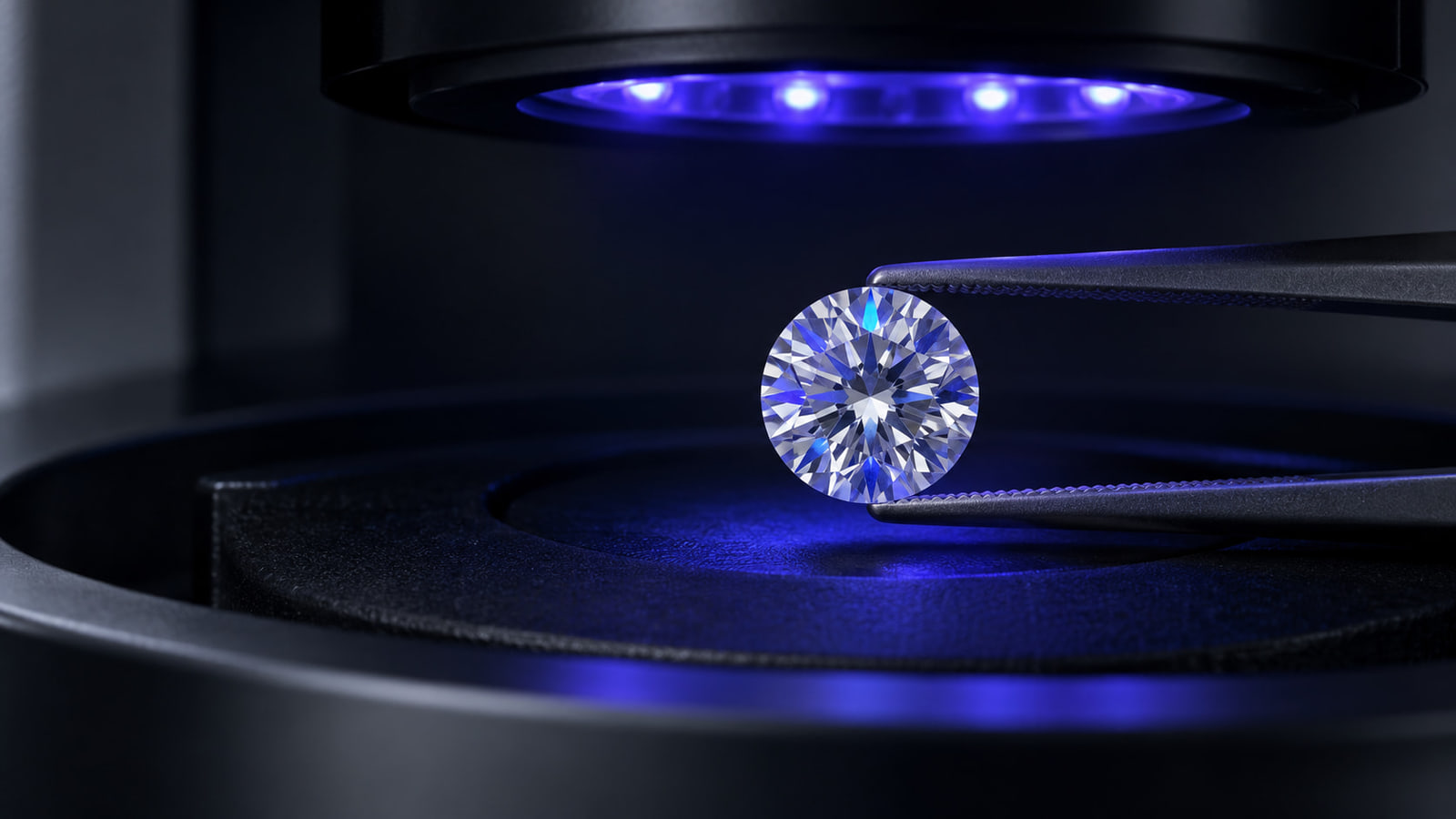
Do lab grown diamonds glow under UV light? Some do, but their responses vary with the stone and the illumination conditions. Fluorescence is observed during excitation; phosphorescence is an afterglow once excitation stops. Neither a visible glow nor its absence is a reliable standalone origin test. For procurement, describe what was observed, how it was observed and whether specialist follow-up is required. The most reliable buying decision combines the correct document scope with observations of the actual item and a written acceptance rule. Keep unresolved points visible before payment or setting. A supplier’s confident description is useful context, but the purchase record should distinguish confirmed facts from information that still needs verification.
Do Lab Grown Diamonds Glow Under UV Light?
A phone clip of a glowing stone omits important variables. Wavelength, lamp output, exposure duration, room darkness, camera settings and observation time can all affect what the viewer sees. The word fluorescence should not be used indiscriminately for the afterglow. Equally, a supplier statement of no fluorescence should not be treated as a promise of no response under every possible ultraviolet source.
GIA’s retailer guide distinguishes observations during UV exposure from phosphorescence afterward and warns that absence of phosphorescence does not establish natural origin. See GIA: UV testing guide for retailers.
Fluorescence Versus Phosphorescence
Fluorescence and phosphorescence describe when light is observed relative to excitation. They are not competing grades and do not by themselves decide origin. Compare like conditions and keep the result descriptive until an appropriate examination supports a stronger conclusion. A standard report field and a separately recorded afterglow should not be merged.
| Decision | During UV excitation | After the source is switched off |
|---|---|---|
| Term | Fluorescence | Phosphorescence |
| Observation | Record response while illumination is active | Record afterglow and observation interval |
| Comparison | Keep wavelength and setup consistent | Keep exposure and elapsed time consistent |
| Conclusion | Descriptive clue, not origin proof | Referral clue, not a standalone diagnosis |
Which UV Response Checks Belong in the Buying Brief?
The following selection checks connect the topic to an actual purchase decision. Record the requirement, evidence and unresolved question against the same stock identifier so the supplier and receiving team review the same candidate.
Excitation conditions. Confirm lamp wavelength and manufacturer operating instructions. Request a recorded setup rather than a generic UV label. Lamp labels and wavelength matter; UV is not a single standardized viewing condition.
Timing. Confirm during-exposure response versus post-exposure response. Request separate observations with clear start and stop points. Mark the point where excitation stops so afterglow is not confused with fluorescence.
Ordinary appearance. Confirm whether the actual jewelry looks acceptable in normal viewing. Request neutral-light comparison independent of the UV clip. Judge ordinary appearance under ordinary viewing conditions as a separate task.
Interpretation. Confirm whether the result requires specialist follow-up. Request an independent identification route for unresolved origin. Use referral for identification rather than turning a glow observation into a diagnosis.
Apply the relevant checks to individual loose centers or matched pairs and sets according to the actual order. Preserve the approved reference and flag substitutions for review before they enter the packing list.
For online retailers, MEITUO can help request context for an actual supplier UV video. Include the reason for the question and the stone identity so the response clarifies a real concern rather than adding an unrelated special-effect image.
Build the observation sheet around two separate time states. During excitation, record the visible response without claiming that the camera reproduces its intensity exactly. After excitation stops, record whether any afterglow is observed and the relevant observation interval. This simple separation avoids a common error in product descriptions: using fluorescence to describe a lingering glow seen only after the light is off.
Control the comparison setup before discussing strength. Unknown lamp output and automatic exposure make two clips difficult to compare. A buyer can request consistent conditions without inventing a laboratory intensity measurement. If a calibrated measurement is needed for a technical use, arrange the appropriate service rather than converting a phone video into a numerical result.
A report’s conventional fluorescence wording should remain in its original field. A separate observation under another source can be informative, but it is not automatically a contradiction of that field. Ask whether the source and method differ before alleging an incorrect report. The buyer should preserve what each examination actually says and avoid rewriting one result into another terminology.
Normal-light transparency must be reviewed independently. A strong-looking special-light image is not proof that the stone will look milky in ordinary jewelry viewing, nor does a dark UV image guarantee optical clarity. If the purchase dispute is about haze, examine that appearance under the agreed ordinary conditions and investigate its cause through a suitable route.
For customer education, use a diagram or clearly described demonstration rather than promising that all laboratory-grown stones behave the same way. The useful message is that responses vary and cannot replace identification. That explanation answers the glow question while keeping the retailer from publishing an origin shortcut that a later customer could misapply.
How Does UV Response Review Work in a Real Ordering Sequence?
Hypothetical worked B2B example. A hypothetical e-commerce team receives a customer video of an afterglow in one pendant. The team first confirms the item identity and asks how the video was made. It separates normal appearance review from origin verification and requests a controlled examination where necessary. The video alone is not presented as proof that the customer received either a simulant or a mined stone.
For the pendant customer’s video, the first useful distinction is whether the source remains on. The service team should not call every bright frame fluorescence if the customer is demonstrating afterglow. It should also avoid demanding a hazardous experiment with an unsuitable lamp. A controlled professional examination is more useful when the conditions of the original clip are unknown.
The team can explain the observation without creating a universal product promise. It records what the customer saw, checks whether the actual supplied item is the one under discussion and determines whether the agreed product description was accurate. Where no special UV requirement was contracted, the investigation still respects the customer’s question without inventing a new retrospective specification.
Carry the accepted decision into repeat-order planning; where the product depends on several stones, retain the pair or set approval with the candidate schedule.
How Should Buyers Resolve a UV Response Mismatch?
Separate normal-light acceptance from special UV observations in the inspection sheet. A diamond can be evaluated for its ordinary jewelry appearance without treating a UV clip as a defect diagnosis. If UV behavior matters to the product brief, state the source and conditions in advance. No-fluorescence wording without a defined observation context is too broad to reproduce across different equipment.
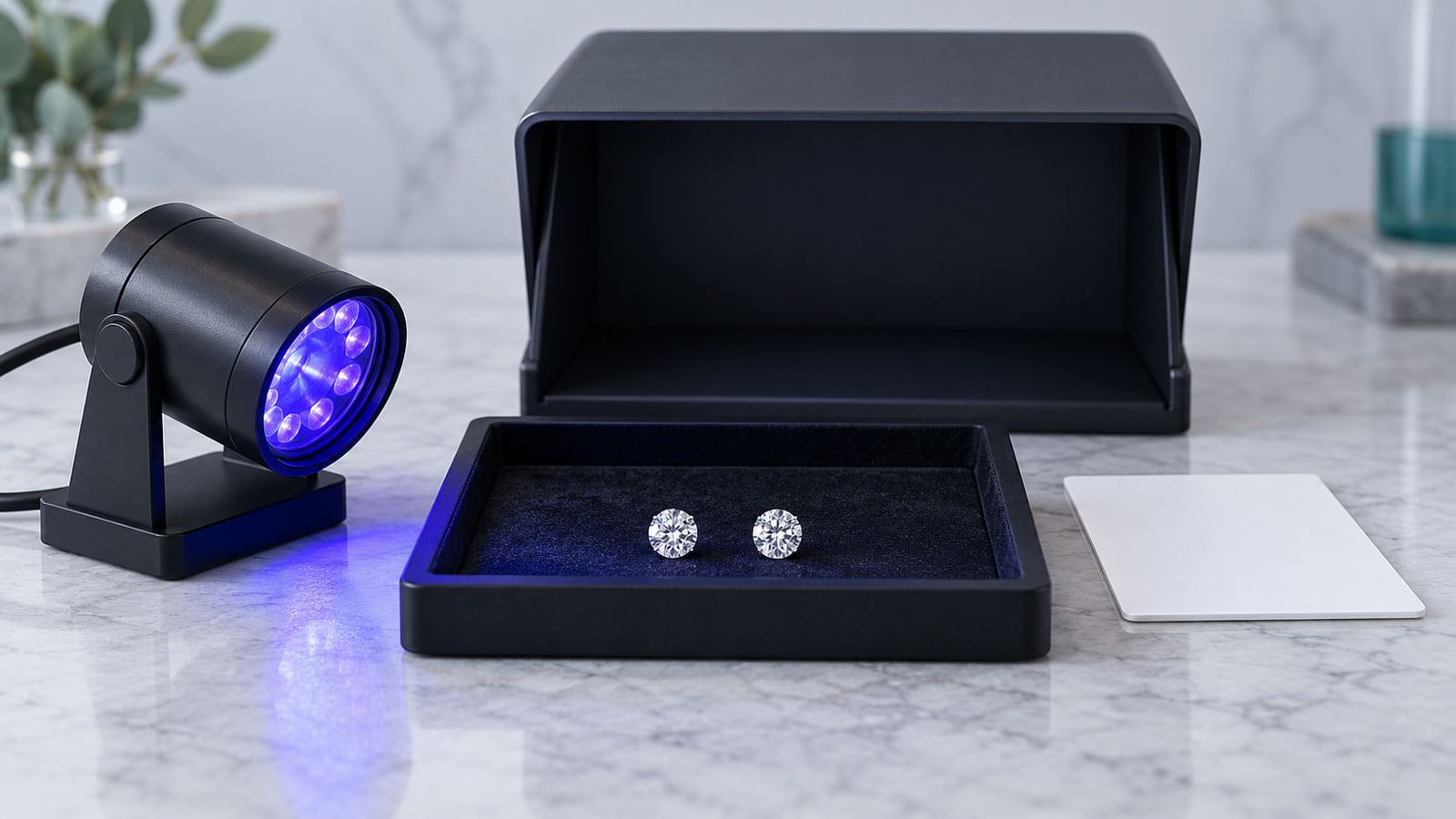
For a controlled observation, follow the enclosed instrument’s instructions and safety requirements. Record whether the light is on or off, the stated wavelength, the exposure protocol and the observation interval. Keep automatic camera changes in mind when comparing images. A long exposure may make a weak afterglow appear more dramatic, so a clip should not be treated as a calibrated intensity measurement.
When the response prompts an origin question, preserve the stone identity and refer it for an appropriate independent determination. Do not infer natural origin from no visible afterglow or laboratory-grown origin from a glow alone. If the dispute concerns ordinary appearance, reproduce the normal-light comparison separately. These two review paths can reach different kinds of conclusions and should remain separate in the purchase record.
For the ordering record, connect the findings to the RFQ fields and preserve the relevant side-stone specification when companion stones are included.
What Should Buyers Ask UV Response Suppliers in the USA, China and India?
Supplier geography can change communication and handling, but it does not settle UV response. Use these localized questions to understand the seller’s role, where the actual stock sits and who can supply the evidence required for this particular order.
USA / trade channels and handoff
Can a US Seller Distinguish Its Report Fluorescence Field From a Separate UV Demonstration?
US retailers should distinguish a laboratory report’s fluorescence field from a seller’s separate UV demonstration. Ask what excitation conditions the demonstration used and whether the source remained on during the video. A glowing image without timing information cannot tell the viewer whether it shows fluorescence, afterglow or a camera artifact.
For customer service, create language that describes an observation without announcing origin. A customer who notices afterglow deserves an accurate explanation and, when appropriate, a professional examination. Do not ask retail staff to replicate the effect with an unsuitable lamp or expose a customer to improvised shortwave testing.
If a collection genuinely has a UV-related acceptance requirement, disclose that requirement to the supplier before selection. Establish an agreed protocol and qualified handling. A US seller’s ability to arrange a demonstration is useful only when the result is reproducible and linked to the actual item, not when it produces the most dramatic promotional clip.
A US trade-channel reference is Stuller’s loose-diamond resource page; request the separate observation method, not a generic inventory label.
CHINA / sourcing coordination
Will a Chinese Sourcing Contact Provide Reproducible Conditions for a UV Comparison?
A China-side sourcing brief should say why UV behavior matters. The buyer may be investigating a specific customer observation, requesting identification support or planning special-light photography. These purposes require different evidence, and a generic request for no fluorescence can leave all parties discussing different conditions.
MEITUO can help coordinate an actual-stone observation request with suppliers, while keeping its Qingdao sourcing role distinct from an independent laboratory’s identification role. Ask for the stated light source, timing and stock reference if a video is supplied. Keep the normal-light appearance approval separate so a special response is not mistakenly recorded as ordinary haze or color.
Before export, decide which unresolved observations require further examination and which are merely descriptive records. Do not infer natural origin from a non-glowing sample or laboratory-grown origin from one bright frame. The final supplier file should explain exactly what was observed and what conclusion, if any, an appropriate independent examination established.
For its stated business role and Qingdao base, see MEITUO’s company introduction.
INDIA / manufacturing and export handoff
Can an Indian Supplier Document Afterglow Separately From Ordinary Face-up Appearance?
For an Indian polished-stone seller, ask whether the supplied UV image relates to the final candidate or an earlier sample used to explain a process. A sample demonstration can be educational, but it should not be copied into the actual candidate’s acceptance record. Preserve the stone reference and the observation conditions together.
When the offer includes several stones, determine whether the UV response was checked individually or only illustrated with one item. A single clip cannot establish the behavior of the entire assortment. If the buyer has a legitimate specification for a special-light application, share the intended conditions before final selection rather than introducing them after shipment.
Clarify who can arrange a qualified follow-up when an observation raises an identification question. The seller’s cutting or trading experience does not remove the need for appropriate equipment and interpretation. Keep afterglow notes distinct from reported fluorescence wording and normal face-up appearance, then let each piece of evidence answer its own question.
GreenLab’s Surat/Mumbai location page provides local role context, separate from any claimed UV examination service.
How Does MEITUO Support UV Fluorescence and Phosphorescence?
MEITUO is a sourcing and supply-chain coordination partner in Qingdao, Shandong, China, serving jewelry brands, wholesalers, retailers and designers. For UV fluorescence and phosphorescence, its useful role is to turn the buyer’s collection requirement into an actionable supplier request: confirm lamp wavelength and manufacturer operating instructions, organize available evidence and follow up on unresolved selection questions.
Its sourcing scope includes loose center stones, melee, side stones, matched pairs and sets, and fancy-color options. For a UV inquiry, ask MEITUO to request the actual observation conditions and stone references, with fluorescence and afterglow described separately and any identification question referred appropriately. The final acceptance criteria should remain with the buyer’s approved brief and the evidence supplied for the actual order.
MEITUO does not replace an independent grading or identification laboratory. Available stock, documents, treatment information, MOQ, lead time and shipping terms need confirmation per order. Send the intended application and UV response requirements to [email protected] so selection and order follow-up can start from specific questions.
What Should a UV Response RFQ Specify?
Specify whether UV behavior is an informational request or a mandatory acceptance condition. If mandatory, define a reproducible observation protocol with suitable equipment and qualified handling. Request the actual item or lot identifiers associated with the observation. Do not ask a seller to guarantee no glow under every conceivable ultraviolet source; that wording is both ambiguous and difficult to validate.
Keep normal-light appearance, reported fluorescence and any separately observed phosphorescence in different fields. State which evidence is required for origin identification and how ambiguous observations are referred. If the product will be photographed under special lighting, share that use case early so the seller understands why the question matters. Approval should follow the agreed conditions, not an unrelated dramatic video.
Please quote laboratory-grown diamonds for [jewelry application] in [shape and quantity], with [weight range] and [dimensions or tolerance]. Our priority is normal-light appearance requirements, any UV observation conditions, separate afterglow notes and independent follow-up for ambiguous identification. Supply available evidence linked to each stock line or clearly identified parcel. State [accepted document service], current stock location, proposed substitutions and any information you cannot confirm. Please separate product and service inclusions, confirm MOQ and lead time for this order, and provide [shipping destination and terms]. We require written approval before substitution or dispatch and a mutually agreed process for discrepancies identified at receiving.
FAQ: Do Lab Grown Diamonds Glow Under UV Light
Is Fluorescence the Same as Glowing After the Lamp Switches Off?
No. Fluorescence is observed during excitation; phosphorescence is an afterglow after excitation stops. Record the timing rather than calling every bright image fluorescence. The distinction helps a buyer ask for the correct observation and avoid comparing unrelated videos.
Does No Afterglow Prove a Diamond Is Natural?
No. Absence of a visible response is not a standalone origin conclusion. Conditions and stone behavior vary. If origin is the purchasing question, use appropriate identification evidence rather than treating a dark frame as proof of mined origin.
Can All UV Lamps Produce Comparable Videos?
No. Wavelength, output, exposure and observation setup can differ, while camera settings change the image. Use a defined professional protocol where comparison matters. An unspecified UV clip should be treated as a limited observation rather than a calibrated measurement.
Does a UV Glow Automatically Mean the Stone Is Defective?
No. Separate ordinary jewelry appearance from special-light behavior. Evaluate the actual contracted specification and seek suitable identification if needed. A dramatic response under one setup does not by itself diagnose haze, poor quality or a material substitution.
How Should a Retailer Handle a Customer’s Glow Video?
Confirm the item and ask enough context to distinguish during-exposure light from afterglow. Record the concern without diagnosing origin from the clip. Arrange qualified examination when appropriate, and avoid encouraging hazardous experiments with unsuitable ultraviolet equipment.
Should UV Response Be a Purchase Requirement?
Only when it serves a defined product or examination need and can be specified reproducibly. State the equipment conditions and acceptance process. Do not demand a universal no-glow guarantee across unknown sources, and keep normal-light appearance and origin evidence separate.