 English
 Español
 Português
 Deutsch
 Français
 Italiano
 Nederlands
 العربية
 日本語
 한국어
 ไทย
Quick Answer
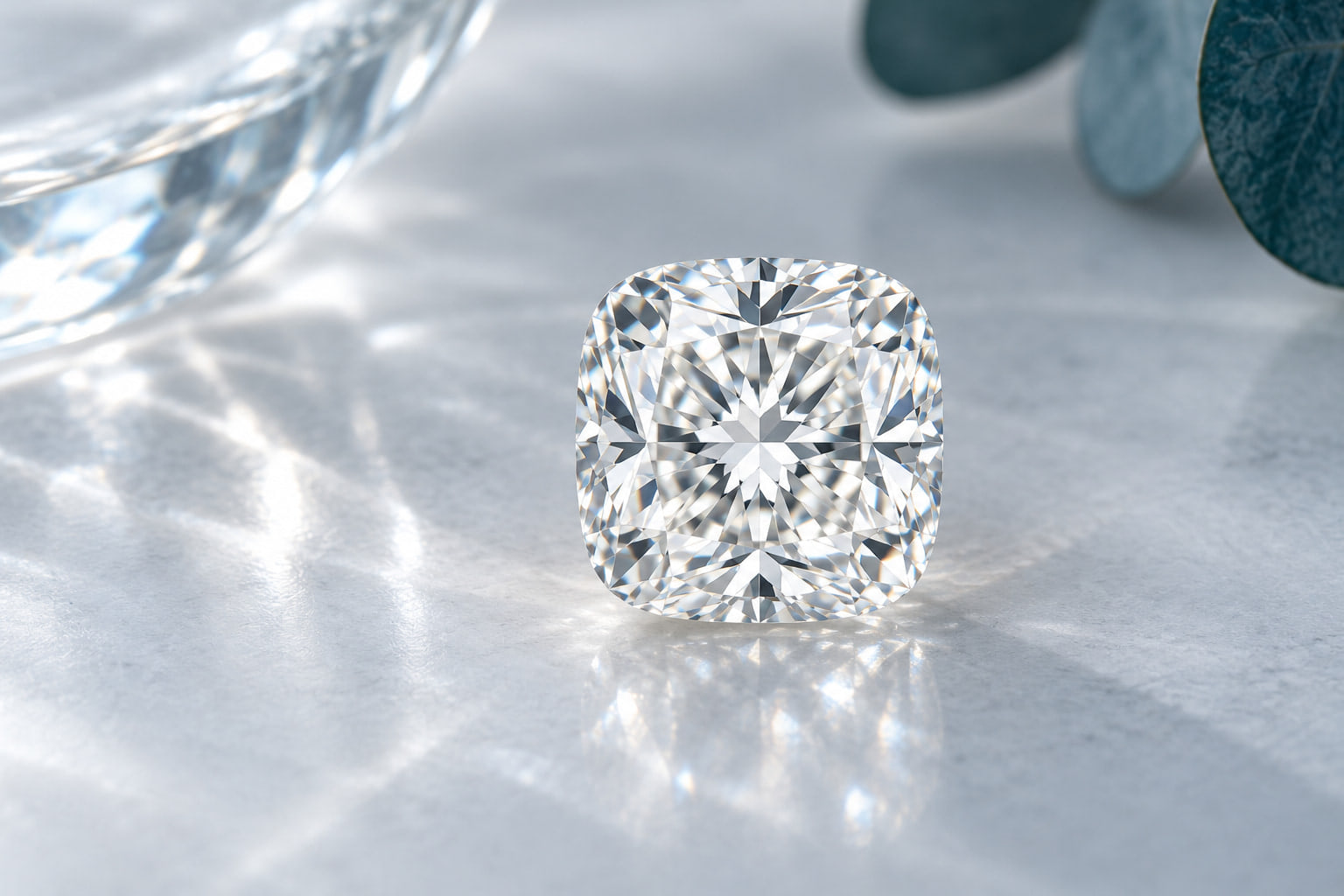
When comparing a cushion cut diamond lab grown for a square-style collection, approve its rounded outline and moving facet pattern independently. Cushion brilliant and cushion modified brilliant descriptions identify cutting styles, but they do not fully predict whether the stone shows large distinct flashes or finer fragmented reflections. Compare actual stones at equal scale under the same light. Check corner fullness, side curvature, face-up dimensions and depth against the intended head or halo. A square-looking cushion can have slightly unequal length and width without being unsuitable; set a collection preference rather than claiming one universal ratio. Keep elongated cushions in a separate buying brief. For reorders, preserve the accepted silhouette and visual family as well as the report, because the word cushion alone is too broad.
What Makes a Square Cushion Outline Consistent?
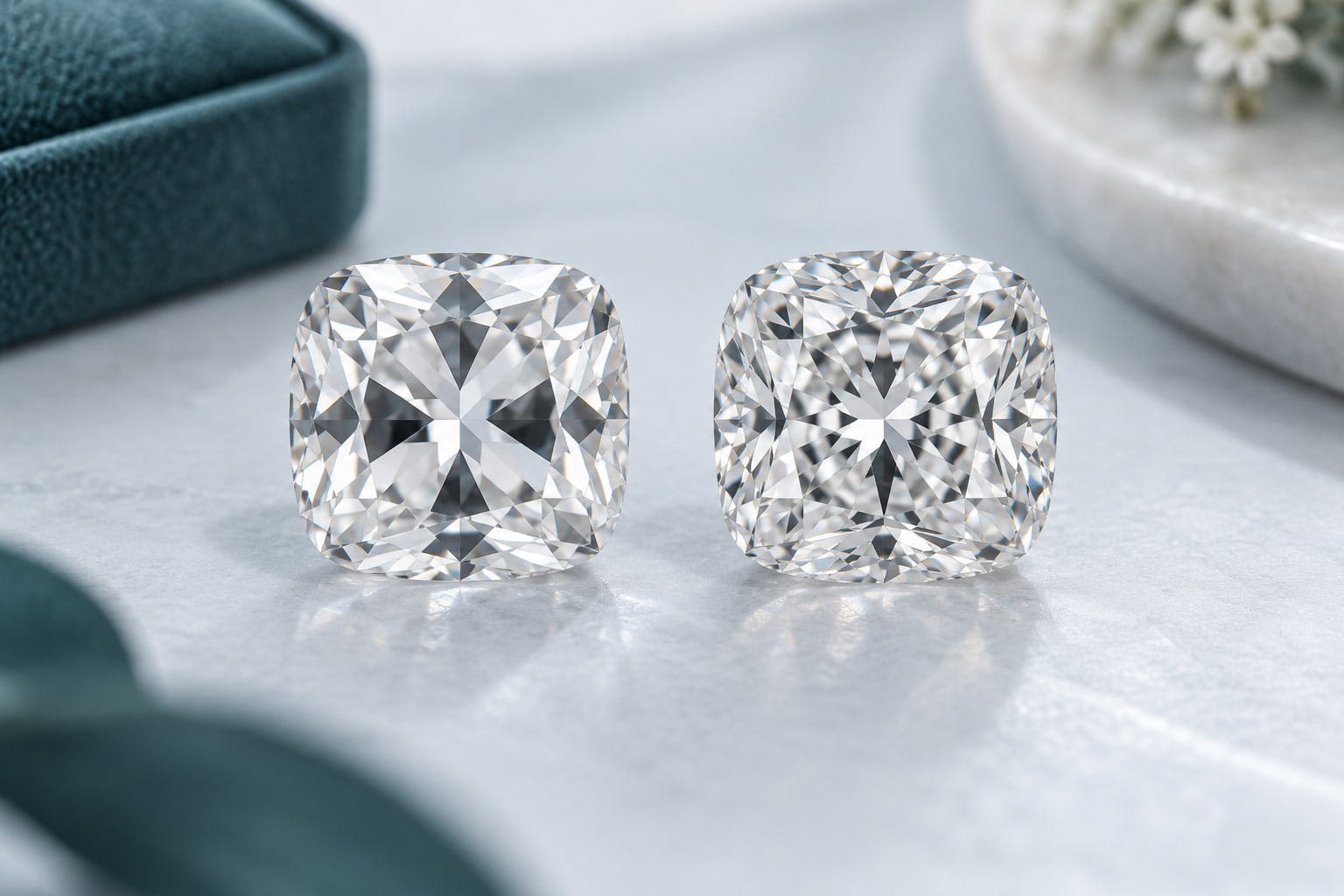
A cushion outline is not simply a square with four identical quarter-circles removed. Some stones have fairly straight middle sections and rounded corners; others have continuously bulging sides. Corner transitions may look full and soft or comparatively tight. These differences remain visible after setting and can change the apparent character of a ring even when overall length and width match.
Compare top-view photographs on a shared millimeter scale. Draw a vertical and horizontal centerline and look at opposite sides first. Then inspect the four corner transitions. If the stone leans in the photograph, the outline can appear uneven, so request a perpendicular repeat before concluding that the geometry is asymmetric. A silhouette overlay is a selection aid, not a substitute for a real stone inspection.
Define square-looking using an approved reference, not a supposed global cutoff. A buyer could prefer a mildly rectangular sample for one collection and a more nearly equal-sided sample for another. The supplier needs the actual acceptable range and the desired appearance. Keep this article's square-style stock code separate from an elongated cushion program, where length is a prominent design feature rather than a small variation.
For a halo, compare the gap around all four corners. A halo drawn around a rounded square may leave a narrow side gap and broad corner void around a pillow-shaped center. That is a geometry mismatch, not necessarily a defective stone. Decide whether to redraw the halo or select a closer silhouette before casting. The cushion product category should therefore lead to a style-specific discussion rather than a single interchangeable inventory bin.
How Should Buyers Interpret Cushion Brilliant and Modified Styles?
Read the shape and cutting-style field literally. A report description is not a promise that every stone with that wording looks alike. A verified GIA report example uses Cushion Modified Brilliant; it documents that specific natural diamond and illustrates terminology, not the report format or quality of the lab-grown stones in your order. Do not transfer its grades, measurements or report-era assumptions to another parcel.
For actual buying, compare reflection scale and organization. A broader-flash sample may show distinct blocks changing as the stone moves. Another sample may show a finer texture across much of the face. A modified designation does not by itself establish which appearance the brand will prefer. Ask for neutral motion clips and identify the visual family in plain language beside the laboratory description.
Examine the middle and the rounded corners separately, then consider whether they look coherent together. A center that seems attractive in a spotlight may look less active under broad illumination. A corner can appear lively in a cropped image while contributing little at normal viewing distance. Move from a full-stone view to close inspection and return to actual scale before deciding.
Be especially careful with antique-style language. A newly grown and newly cut diamond may evoke an older visual style, but that does not make it antique. If a seller uses terms such as old mine inspired, ask for the exact shape, facet evidence and physical details they mean. The collection shape guide can help the brand give that aesthetic its own clear product description.
Full-Corner VS Tighter-Corner Cushions: What Changes?
| Design issue | Full, rounded pillow outline | Straighter sides with tighter corner turns |
|---|---|---|
| Visual character | Soft continuous curvature | More architectural square impression |
| Halo planning | Requires matching curved perimeter | Needs careful corner radius and side clearance |
| Prong coverage | Check whether prongs obscure the rounded transition | Check contact near the sharper direction change |
| Stock matching | Compare side bulge and all four corner fullnesses | Compare straight section length and corner turns |
| Wrong shortcut | Accepting every soft outline because the ratio is nearly square | Calling it princess simply because the sides look straight |
These are practical outline descriptions, not formal quality classes. Either family may be well suited to a collection. The error is mixing them unintentionally. In a tray of solitaires, a small contour difference may be acceptable; in a close-fitting halo, that same difference can become an obvious metal gap.
The princess category is a different square-style choice with pointed corners. Do not substitute it for a cushion without a fresh design review. Similarly, a longer cushion deserves a separate sample and stock rule, even when a supplier's spreadsheet groups all cushion outlines together.
How Can a Square Cushion Halo Order Be Checked Before Casting?
Hypothetical example: the Soft-Square Halo Trial. A manufacturer plans twenty halos using centers near 7.0 by 7.0 mm. The approved center is 7.05 by 6.95 mm, giving a ratio of about 1.014. A candidate at 7.10 by 6.90 mm has a ratio of about 1.029. Both may look square in isolation, yet the second can present a different side and corner gap in a tightly fitted halo.
For an invented initial CAD target of 0.20 mm radial clearance on each side, a 7.05 mm maximum center length implies an internal envelope of 7.45 mm along that axis before the engineering team accounts for local shape and setting requirements. This is arithmetic for the example, not a universal safe clearance. The actual halo contour must follow the chosen cushion and the setter must approve the fit.
Place candidate silhouettes in the same model. A full-corner stone may approach the halo at a different location from a straighter-sided one. Record the narrowest and widest visible gaps. Do not average them and declare a satisfactory fit if one local area is unacceptable. The purpose is to find a consistent family before multiplying the head across twenty pieces.
Suppose fourteen centers belong to the approved full-corner family, four need a separate halo and two lack adequate profile images. The correct next action is not to cast twenty identical heads. Resolve whether to source six replacements or operate two explicitly separate designs, and obtain the missing evidence first. MEITUO can be asked to coordinate that shortlist, with the buyer retaining responsibility for visual approval and the manufacturer retaining responsibility for engineering.
How Can Cushion-Cut Receiving Avoid Style Drift?
Store three kinds of evidence: a report reference for identity and documented properties, a silhouette reference for geometry, and a motion reference for visual texture. Losing any one of these weakens a future reorder. A new supplier may match the shape field while choosing a different corner family, or match the contour while sending a different reflection pattern.
Verify documents with the issuing laboratory and reconcile the actual stone with the parcel and inscription where available. GIA's current loose colorless-to-near-colorless laboratory-grown quality assessment uses Premium or Standard for eligible stones of 0.15 ct and above. Historical reports may contain different fields. Do not use the old natural-diamond example cited for terminology as a template for a current lab-grown report.
At receiving, inspect every rounded corner and girdle edge for condition, then compare the stone in the intended orientation. A nearly square stone can still have a preferred long-axis direction. Mark that direction in the design record so a setter does not rotate it ninety degrees simply because the dimensions are close. Inspect any fit concern before the stone is committed to a finished halo.
Reorder acceptance should include a procedure for borderline silhouettes. Request an overlay and setter review, or reserve the candidate for a separate product family. Use the repeat-order planning guide to keep exceptions attached to the correct stock code instead of allowing them to redefine the reference silently.
How Should Square Cushion Buyers Brief Different Supplier Channels?
A good cushion supplier discussion starts with the particular rounded square the buyer needs. The following channels differ in how a buyer might obtain stock access, manufacturing discussion and local review; none creates an automatic quality advantage.
US / Sample and halo review
What Should US Cushion Buyers Ask a Trade Stockist?
A US trade stockist may help a retailer compare cushion styles close to the customer-facing design decision. Stuller's lab-grown category illustrates this distribution route, without establishing a crystal's growth location. Ask whether the actual candidate can be compared with the planned halo and whether its media are inventory-specific. A generic cushion image cannot approve a particular corner gap.
For a retailer carrying a soft-square signature ring, show the stockist the contour the client has already seen. Request alternatives that preserve its corner fullness before widening grades or weight. Clarify whether the stone and mount are purchased together or from separate businesses; that determines who must reconcile a failed fit. If a customer appointment depends on a comparison, confirm availability and review terms before making the appointment promise. Record whether the client approves the exact center or only the style sample. The distinction prevents a later near-square but visibly different cushion from being described as the same ring.
CN / Silhouette-led coordination
How Should China Suppliers Receive a Square Cushion Specification?
Send a scaled rounded-square outline rather than relying on a translated shape name. China's laboratory-grown supply includes multiple production methods, as discussed in GIA's 2024 review. That production context does not tell a buyer whether an offered polished parcel contains full-corner or straighter-sided cushions. Ask for the exact polished stock and the party controlling its reservation.
A China sourcing coordinator can divide candidates into contour families before assembling a quotation. For a halo order, require each candidate's length, width, depth and perpendicular face-up photograph. Do not let a single representative photograph stand for twenty centers. If the same shipment includes melee, approve the halo accents under their own calibration criteria. A successful round parcel does not resolve a square center's outline mismatch. Buyers working through Qingdao should identify who will communicate fit exceptions to the actual supplier and who will authorize a revised selection. Keep the intended shape after mounting visible in the brief so prong coverage does not erase the soft-square character.
IN / Pattern-family selection
What Should Buyers Ask Indian Cushion Cutting or Trading Contacts?
Indian contacts may be able to discuss cutting styles or select from existing polished parcels, but buyers should establish the contact's actual role. GreenLab lists Surat and Mumbai contacts; the locations illustrate different contact points rather than a guarantee that any particular cushion was cut there. Ask which party can supply the actual facet media and shape description for each candidate.
For square cushions, request a contact sheet grouped by outline and reflection texture. A buyer seeking broad flashes should not simply reject the word modified, since the visual result still requires inspection. If a custom cut is proposed, define the approval sample and acceptable dimensional variation before committing the order. Ask whether the supplier can replenish the same rounded-square family from existing stock; that may be more practical than requiring exact repetition of a unique contour. Keep any antique-inspired styling separate from age claims. Newly produced laboratory-grown stones can express a vintage design language while remaining clearly described as new products.
How Can MEITUO Support a Square Cushion Collection?
MEITUO is based in Qingdao, Shandong, China, and works as a sourcing and supply-chain coordination partner. For a cushion collection, buyers can ask it to circulate one approved silhouette and reflection reference, identify candidate departures and coordinate questions with suppliers before the manufacturing team finalizes a halo. This is especially useful when the design depends on a soft rounded square rather than an arbitrary cushion label.
Its scope includes loose center stones, melee, side stones, matched pairs and sets, and fancy-color options. It supports product selection, supplier coordination, quality-requirement confirmation and order follow-up; it should not be presented as the grower or cutter of the offered centers. Confirm current availability, documents, MOQ, treatment information, lead time and shipping terms for each inquiry. Send [email protected] the intended halo drawing, quantities and a rejected-outline example as well as the preferred sample. The bridal application page is a useful context for that ring-focused request.
What Belongs in a Square Cushion Diamond Buying Brief?
State that the program is square-style cushion and attach its acceptable contour family. Include both maximum dimensions and any depth constraint, but do not let numerical limits replace the silhouette image. Explain whether a halo is fixed, adjustable or still uncast. That tells the supplier whether a slight outline departure is a reviewable option or a likely rejection.
Name the desired reflection scale without pretending that a cutting-style field guarantees it. Ask for exact-stone media and a side-by-side comparison for multiple centers. A quote should distinguish available matching stock from stones that need further review. Finally, agree how unresolved candidates are held and who may authorize a substitution. The RFQ guide can supply the commercial framework after those cushion-specific choices are clear.
Please quote [quantity] square-style cushion-cut laboratory-grown centers for [collection]. Match the rounded-square contour and reflection family in [reference ID], within [length], [width] and [depth] limits. The planned halo is [fixed or adjustable]; provide exact-stone perpendicular photographs, profile views and neutral motion clips before reservation. State the laboratory shape description, document references, inscription details where available, and growth or treatment information. Identify corner-fullness or side-curvature departures individually. Confirm MOQ, stock control, lead time, shipping terms and inspection conditions. Elongated cushions or princess cuts require separate written approval by [contact].
FAQ: Cushion-Cut Lab-Grown Diamonds: How to Compare Patterns
Does Cushion Modified Brilliant Always Mean Crushed Ice?
No. The cutting-style description alone does not establish the complete visible pattern. Compare the actual stone under consistent lighting and use a retained reference for the desired reflection scale. Informal visual labels should support the selection conversation, not replace inspection.
Must a Square Cushion Have Exactly Equal Length and Width?
No. A slightly unequal stone may still look square enough for the collection. Establish a buyer-specific range and inspect contour. Equal measurements also do not guarantee matching corner fullness or side curvature.
Can One Cushion Halo Fit Every Center of the Same Weight?
No. Weight does not determine outline, depth or the local corner gap. Have the manufacturer compare the actual center with the halo design before casting or setting. Separate different contour families when one head cannot accommodate them acceptably.
Is a Newly Cut Vintage-Style Cushion Antique?
No. A contemporary laboratory-grown stone can be antique inspired in appearance without having historical age. Describe its actual origin and current production accurately, and explain the visual style separately.
What Is the Best Reference for a Cushion Reorder?
Use a scaled outline image and motion clip of an accepted stone, together with its dimensions and documented identity. Record the intended long-axis orientation and any accepted exceptions. This preserves both the contour and the optical family.
Should Elongated Cushions Share the Same Stock Rule?
They should have a separate brief when elongation is a defining design feature. Keeping square-style and elongated families distinct prevents a supplier from treating any cushion ratio as interchangeable and protects consistency in the finished assortment.