 English
 Español
 Português
 Deutsch
 Français
 Italiano
 Nederlands
 العربية
 日本語
 한국어
 ไทย
Quick Answer
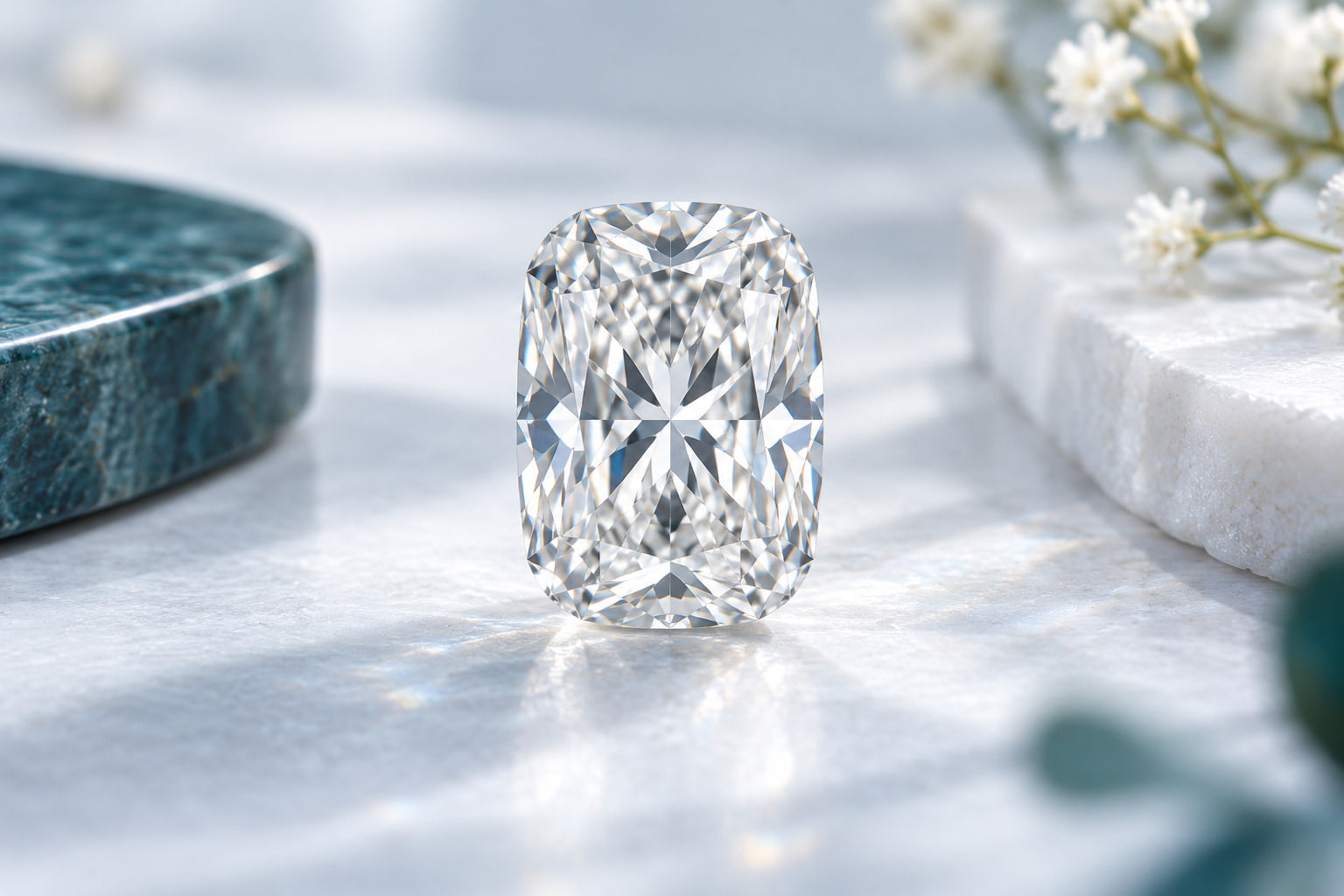
An elongated cushion cut lab grown diamond should be selected by its actual length, width, curved contour and moving appearance, with elongation treated as a buyer preference. There is no single ratio that makes every elongated cushion attractive or interchangeable. Agree on a reference family, then set a practical ratio band and dimensional envelope around the intended mounting. Compare side bulge, corner roundness and end shape as well as the numeric ratio. Approve the reflection texture separately because a longer outline does not guarantee one optical pattern. For collection replenishment, retain an accepted silhouette, actual-scale photograph and movement video. Keep square-style cushions under a separate stock rule so a supplier cannot solve an elongated shortage by sending a nearly square stone with matching weight.
What Does Elongated Cushion Mean in a Buying Brief?
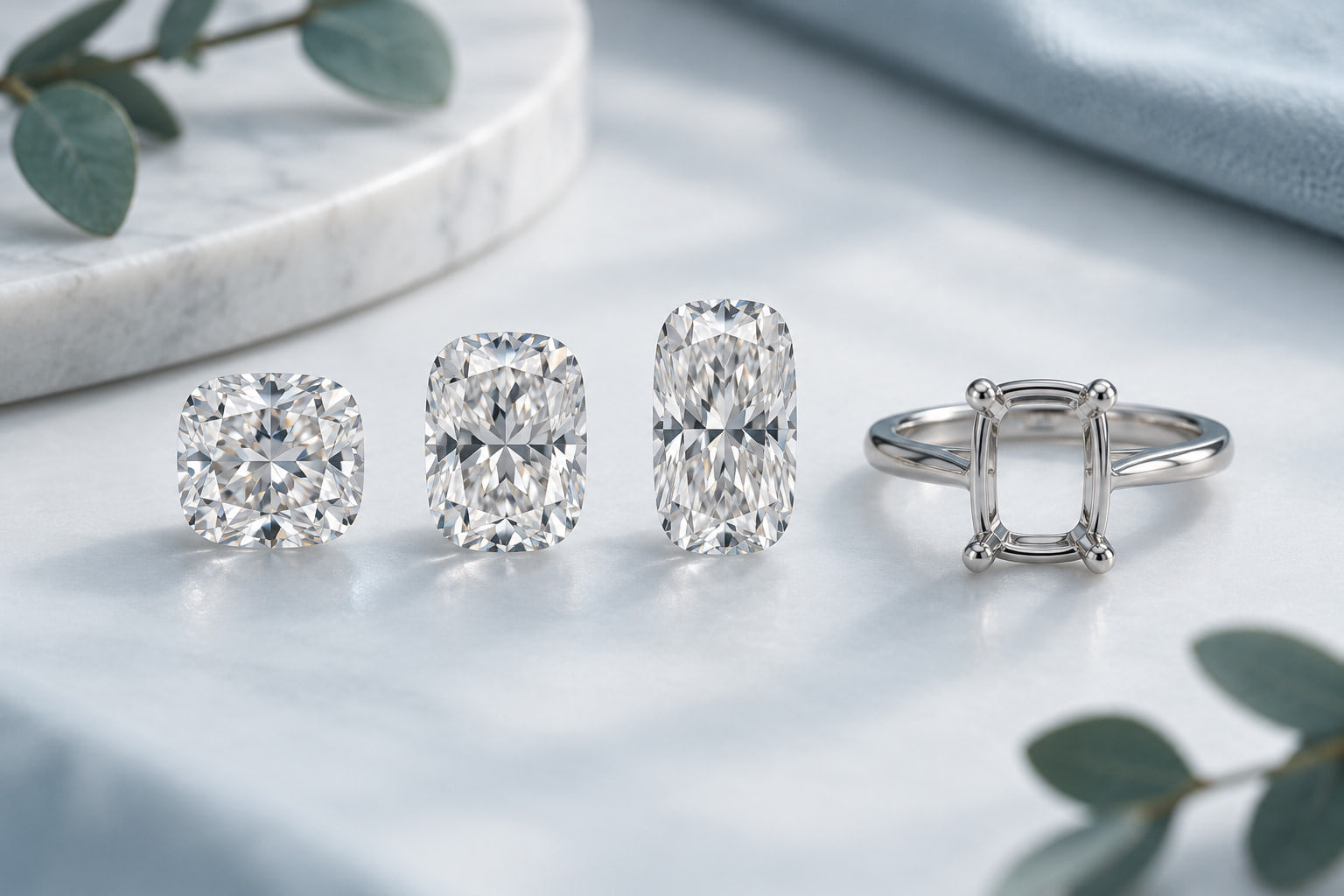
The name tells the buyer that length is a deliberate part of the design, but it does not define how much length or which curved rectangle is intended. Length divided by width is a useful shorthand. It cannot describe whether the ends are rounded, whether the middle sides bulge, or whether the outline narrows toward each end. A more slender ratio can still belong to a fuller silhouette family.
Set three separate controls: the preferred visual family, an acceptable ratio band, and the absolute dimensions the setting can accommodate. The family describes appearance; the ratio controls elongation; the dimensions govern physical fit. A candidate might satisfy two of those controls while failing the third. Keeping them separate makes the exception discussion intelligible.
For instance, a buyer may choose a hypothetical preference band of 1.30 to 1.40 for one line. That is a project choice, not an industry ideal or grading threshold. A stone at 1.39 is not automatically better than one at 1.29. It merely falls within the stated elongation preference if all other requirements are met. Do not convert the brand's preference into a customer-facing scientific claim.
The cushion selection category contains the broader shape discussion, while the collection shape guide helps decide whether elongation is central enough to deserve its own product family. Make that decision before receiving candidates; otherwise the shortlist can become a mix of attractive but incompatible styles.
How Should Elongated Cushion Outlines Be Compared?
Place the long axis vertically and compare equal-scale silhouettes. Start at the middle of each long side, then follow the curve into the corners and across each short end. Check whether the left and right sides appear balanced and whether the upper and lower halves belong to the same contour. A consistent family might have fuller sides and broad rounded ends, or straighter sides and tighter turns. Describe the chosen combination rather than saying simply well shaped.
Ask for a perpendicular image before judging symmetry. A stone leaning toward the lens can make one end appear broader. If the image remains ambiguous, request a second orientation or a physical review. Overlay tools can reveal differences but cannot correct an inaccurately captured source image. Mark those limits in the record so a graphics comparison does not acquire false authority.
The corner transition determines where prongs visually interrupt the outline. On an elongated cushion, the four rounded transitions may sit farther from the extreme ends than a designer expects. A generic rectangular head can therefore cover the wrong part of the shape. Obtain a top-view mock-up with realistic metal coverage and have the setter review actual bearing surfaces.
Depth and pavilion contour remain separate checks. An elongated face does not imply a low profile. Request a side view in both axes if the design has a narrow bridge or limited gallery clearance. The manufacturing team should approve those interfaces before the buyer commits an unusually deep candidate to a production order. This is a fit review, not a judgment that deeper stones are universally worse.
Ratio Matching VS Contour Matching: Which Controls a Reorder?
| Question | Ratio-only matching | Ratio plus contour reference |
|---|---|---|
| What does it preserve? | Relative length compared with width | Elongation and the selected outline family |
| What can change unnoticed? | Side bulge, corner turn, end fullness and absolute size | Still requires profile and optical review |
| Best initial use | Screen a broad list quickly | Approve a shortlist for a known collection |
| Fixed halo suitability | Insufficient on its own | Useful when combined with actual CAD fit |
| Replacement evidence | A numeric band | Scaled silhouette, dimensions, orientation and accepted exceptions |
A ratio filter is efficient early in the search. It removes square-style candidates when the brief needs a visibly long center. It becomes unreliable when used as the final acceptance test. Two stones can divide to the same ratio while having different absolute widths or outlines. That affects the visual mass of a ring and its fit in the head.
Do not overcorrect by demanding a mathematical copy of every curved edge for an ordinary stock program. Establish which differences customers and the mounting will tolerate. A bespoke halo may need a closer silhouette than an adjustable solitaire. The correct level of control follows the product design, replacement policy and inspection capability.
How Can an Elongated Cushion Replacement Be Evaluated?
Hypothetical example: the Long-Pillow Replacement. The approved center measures 9.50 by 7.00 mm, a ratio of about 1.357. Candidate E measures 9.80 by 7.20 mm, a ratio of about 1.361. The ratios are almost the same, yet E is 0.30 mm longer and 0.20 mm wider. In a fixed halo, that additional width would reduce a symmetric side gap by approximately 0.10 mm on each side before accounting for contour differences.
The buyer's existing design has an invented nominal 0.15 mm side gap. Reducing it to roughly 0.05 mm could be unacceptable to the manufacturer, depending on the actual local fit. This arithmetic is illustrative and does not prescribe safe setting clearance. It shows why ratio agreement cannot establish replacement compatibility. The setter must examine the complete geometry.
Candidate F instead measures 9.45 by 7.00 mm, a ratio of 1.35, but has straighter long sides and tighter corners. It may fit the outer dimensions better while changing the visual character. The buyer compares F's silhouette and mounted mock-up with the reference rather than selecting it automatically. If the ring's identity depends on a soft pillow outline, F can still fail the brief.
Finally, inspect reflection texture in both candidates. A satisfactory outline does not guarantee the original broad-flash or fine-textured appearance. Ask MEITUO to coordinate a shortlist carrying all three controls and to label fit exceptions explicitly. A documented replacement decision can then distinguish an approved adaptation from an accidental change in the product line.
Which Optical and Document Checks Belong Beside the Outline?
Observe the entire elongated face as it moves under broad and smaller light sources. Compare the middle, rounded corners and ends. Record whether reflection texture remains coherent or whether a large region seems consistently inactive. Do not treat a single dark frame as proof of a permanent defect. Repeat with the same support and camera distance as the approved reference before escalating a concern.
GIA's cut-evaluation discussion distinguishes contrast and face-up appearance features. The original buying workflow here uses that general distinction without asserting a particular laboratory cut grade for every elongated cushion. Read the actual offered report and service. GIA's current eligible colorless-to-near-colorless lab-grown quality assessment uses Premium or Standard, so older traditional grading descriptions should not be applied universally.
Verify the document online, reconcile the inscription where available and retain the item-specific measurement record. At receiving, inspect the rounded corner and girdle condition before placing the stone in a head. Photograph any existing surface feature. Then repeat the visual comparison and route geometry concerns to the setter while the stone remains unset.
For a reorder, attach the record to the correct collection and mounting revision. The repeat-order guide can support that record, and the matching guide becomes useful if elongated cushions appear together in earrings or coordinated sets.
Where Do Elongated Cushion Sourcing Questions Differ?
Elongated cushions need a channel that can communicate contour, not just search a shape label. Use the supplier's location to plan contact and review, while checking separately who controls the actual polished inventory and who handles a failed replacement.
Ask for a named escalation contact when the contour fits the visual brief but conflicts with an existing head. The useful answer is a route to a revised selection or engineering decision, with the stone still reserved. It is not an unsupported reassurance that elongated cushions normally fit. Record the agreed decision date so a reservation does not expire while the two teams wait for each other.
US / Existing-mount review
How Should US Retailers Source an Elongated Cushion Replacement?
A US retailer seeking a replacement should begin with the ring's actual mounting record, not the remembered carat weight. Stuller's trade category demonstrates one domestic distribution route, but a US seller does not imply US growth. Ask whether the exact candidate can be physically compared with the customer's mount and whether a reservation can cover that review.
Send the original dimensions, scaled contour and photographs showing the visible gap. Explain whether the existing head can be altered and who is authorized to approve that work. A candidate with the same ratio but additional width can create a practical problem even when its sales description sounds equivalent. For an online retailer, retain the originally promised shape reference and obtain customer approval if the replacement changes it materially. Confirm the actual return and inspection terms with the seller. Local delivery may simplify logistics, but it cannot establish optical or dimensional equivalence without the same checks used for any other channel.
CN / Contour translation
What Should China Sourcing Contacts Know About Elongated Cushion Labels?
Provide a long-axis outline and actual dimensions when approaching China suppliers. The term elongated may be interpreted broadly across inventory lists. GIA's laboratory-grown review describes China's production landscape; it does not establish any supplier's stock classification or ability to repeat a particular cushion contour. Confirm access to the polished stones rather than inferring it from a growth-method claim.
A useful coordinated search asks each seller to submit only candidates belonging to the chosen outline family, then flag any dimensions outside the mounting envelope. For Qingdao-based coordination, retain the same reference ID throughout the conversation so multiple image versions do not circulate without context. If the center is shipped with accents, keep its individual identity and fit decision visible on the packing record. Do not allow a supplier to fill a shortage with a square-style cushion simply because the purchasing system uses one cushion category. Resolve the shape distinction before consolidation, especially when a fixed halo leaves little room for later adjustment.
IN / Polished-stock consistency
How Should an Indian Supplier Discuss Repeat Elongated Cushion Outlines?
Indian polished-stock and cutting conversations can be useful when a brand needs a coherent elongated family. GreenLab lists Surat and Mumbai contact points, illustrating that buyers may speak with different commercial roles. Ask who can obtain exact-stone silhouette images and whether the offered group is physically held or assembled from third-party availability.
For replenishment, ask to see several contours side by side at equal scale before discussing whether a ratio band is achievable. If a cutting contact offers to make future stock to a reference, clarify the allowed variation in side bulge and end fullness, the approval sample process and what happens when the final weight changes. Do not assume a custom-cut promise creates exact copies. A practical program may accept a controlled outline family rather than a single immutable contour. Keep report requirements and treatment information separate from that manufacturing discussion, and confirm who is accountable for a replacement that fits the ratio but not the ring.
How Can MEITUO Organize an Elongated Cushion Shortlist?
MEITUO is a sourcing and supply-chain coordination partner in Qingdao, Shandong, China. In an elongated cushion search, a practical role is to preserve the buyer's distinction between ratio, contour family and mounting dimensions as questions pass between businesses. It can support product selection, supplier coordination, quality-requirement confirmation and order follow-up, helping the buyer see exceptions before they become substitutions.
Its product range includes loose centers, melee, side stones, matched pairs and sets, and fancy-color options. For a collection with a characteristic long pillow outline, send an accepted and a rejected contour together with the mounting version. MEITUO is not a substitute for an independent laboratory's identity assessment or the setter's fit approval, and should not be described as owning a growth or cutting facility. Confirm actual availability, MOQ, documents, treatment information, lead time and shipping terms per order. Contact [email protected] with the target quantities. The jewelry brand application page provides context for a repeatable collection inquiry.
What Should an Elongated Cushion RFQ Control First?
Start with the contour reference and intended product. A replacement for a cast halo needs different tolerance discussion from a new solitaire whose head can be designed after selection. State that distinction before giving a preferred ratio band. Add absolute length, width and depth limits, and identify which limits are fixed engineering constraints.
Request equal-scale top views and exact-stone movement clips, with each candidate labeled by identity. Ask the supplier to group matching stock separately from possible exceptions. If the proposed option differs in contour, obtain a mounted mock-up or setter review before approval. Use the RFQ guide to connect these requirements with reservation, documentation and shipping terms. A precise request can still allow alternatives, provided the alternative is clearly identified and reviewed.
Please source [quantity] elongated cushion-cut laboratory-grown centers for [collection or replacement]. Use contour reference [ID] and a buyer preference ratio band of [range], with actual dimensions limited to [length], [width] and [depth]. The mounting is [existing or new]; flag width and corner departures before reservation. Provide exact-stone scale images, two-axis profiles, movement videos and report references, plus growth and treatment information. Confirm who controls the stock, MOQ, lead time, shipping terms and review period. Square cushions and different curved-outline families require separate approval by [buyer contact].
FAQ: Elongated Cushion-Cut Lab-Grown Diamonds: A Buyer Guide
Is There an Official Ideal Elongated Cushion Ratio?
A buyer should not present a preferred ratio as a universal ideal. Choose an elongation range for the intended design and verify the contour and actual dimensions separately. Different attractive stones can serve different collection styles.
Can Equal Ratios Mean Different Mounting Sizes?
Yes. A 9.5 by 7.0 mm stone and a larger stone can divide to almost the same ratio. A fixed head still sees the absolute difference. Use actual dimensions and local contour clearance for replacement decisions.
Does Elongated Cushion Identify One Facet Pattern?
No. The long rounded outline and the internal reflection pattern are different selection decisions. Approve motion media of the actual candidate and retain a separate optical reference for reorders.
What Should Happen When a Replacement Is Slightly Wider?
Have the manufacturer evaluate the existing head before purchase. Do not assume the difference can be absorbed symmetrically or corrected by setting pressure. Obtain a revised fit decision or select another candidate.
Can a Square Cushion Substitute for an Elongated One?
Only as an explicitly reviewed design change. If elongation defines the product, a square-style replacement alters its identity even when weight and report fields match. Keep the two stock families separate.
Which Photographs Are Most Useful for an Elongated Cushion?
Use a perpendicular scale image for contour, profiles for mounting review and controlled movement clips for appearance. Include the intended long-axis orientation. An isolated glamour photograph cannot perform all three jobs.