 English
 Español
 Português
 Deutsch
 Français
 Italiano
 Nederlands
 العربية
 日本語
 한국어
 ไทย
Quick Answer
For a 3 carat radiant cut lab grown diamond ring, compare the exact stone's face-up dimensions, moving facet pattern, clipped corners and pavilion profile before committing the setting. Radiants can show broader organized flashes or a finer fragmented appearance often called crushed ice. Neither description alone is a quality verdict. Check whether brightness is distributed attractively across the whole stone and whether large inactive regions persist through normal movement. Specify the preferred outline with a reference image, since a shared length-to-width ratio does not reproduce corner size. Verify laboratory-grown identity and the actual report service, then have the setter approve depth and bearing locations. Keep the visual acceptance sample separate from any report-based specification so a replenishment stone must satisfy both.
How Do Radiant-Cut Facet Patterns Differ in Actual Viewing?
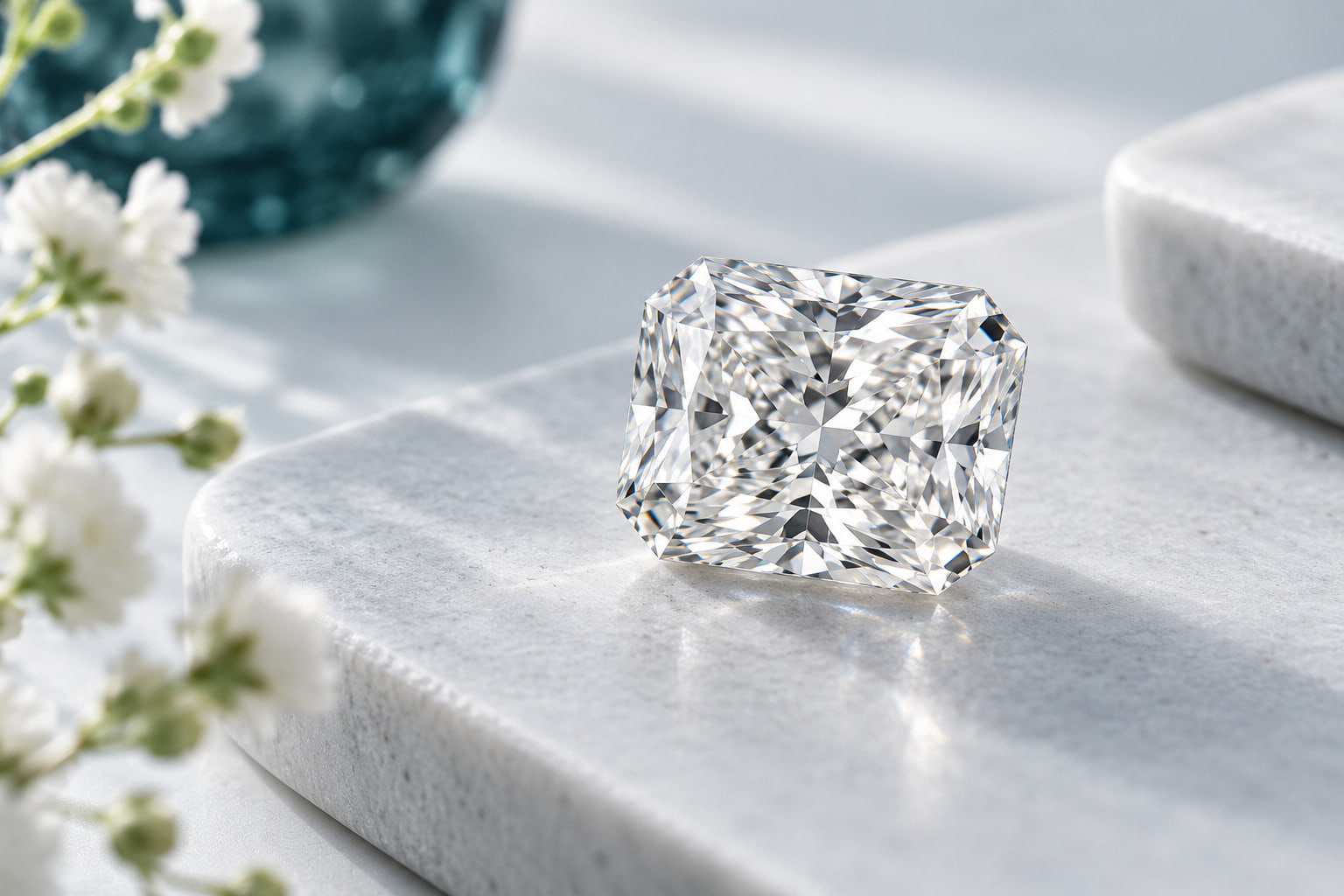
Start by naming what the buyer sees without treating informal vocabulary as a laboratory grade. A broader-flash radiant presents larger distinct bright and dark elements. A fine-textured radiant breaks the image into smaller reflections. The description crushed ice is useful when buyer and seller share a reference, but it cannot identify a precise facet plan from an inventory spreadsheet. GIA discusses this trade description in its review of diamond cut evaluation.
Inspect the center, short ends and clipped corners as three linked zones. Does a busy central texture continue into lively ends, or does the middle seem consistently less active? Turn the stone through a modest range under diffuse light before examining it under spots. A strong isolated flash in a video is not proof that the entire face remains attractive through ordinary movement. Conversely, smaller flashes may look appealing at normal distance even when enlarged photographs appear complicated.
Record both the scale and distribution of the reflections. A useful approval note might say medium-sized flashes across the center, no broad persistent dull strip and lively short ends. An unhelpful note says maximum sparkle, because every supplier can agree with it while choosing a different stone. Retain a rejected reference too, with the particular feature identified. That helps a new sourcing contact understand the boundary between fine texture the brand likes and an appearance it finds too indistinct.
Judge preference at actual scale. Shrink the display image to the intended face-up dimensions or review a physical sample. Magnification remains essential for condition inspection, but a twenty-times-larger image can make the brand choose a texture customers will never resolve on the hand.
Which Radiant-Cut Geometry Should the Manufacturer Approve?
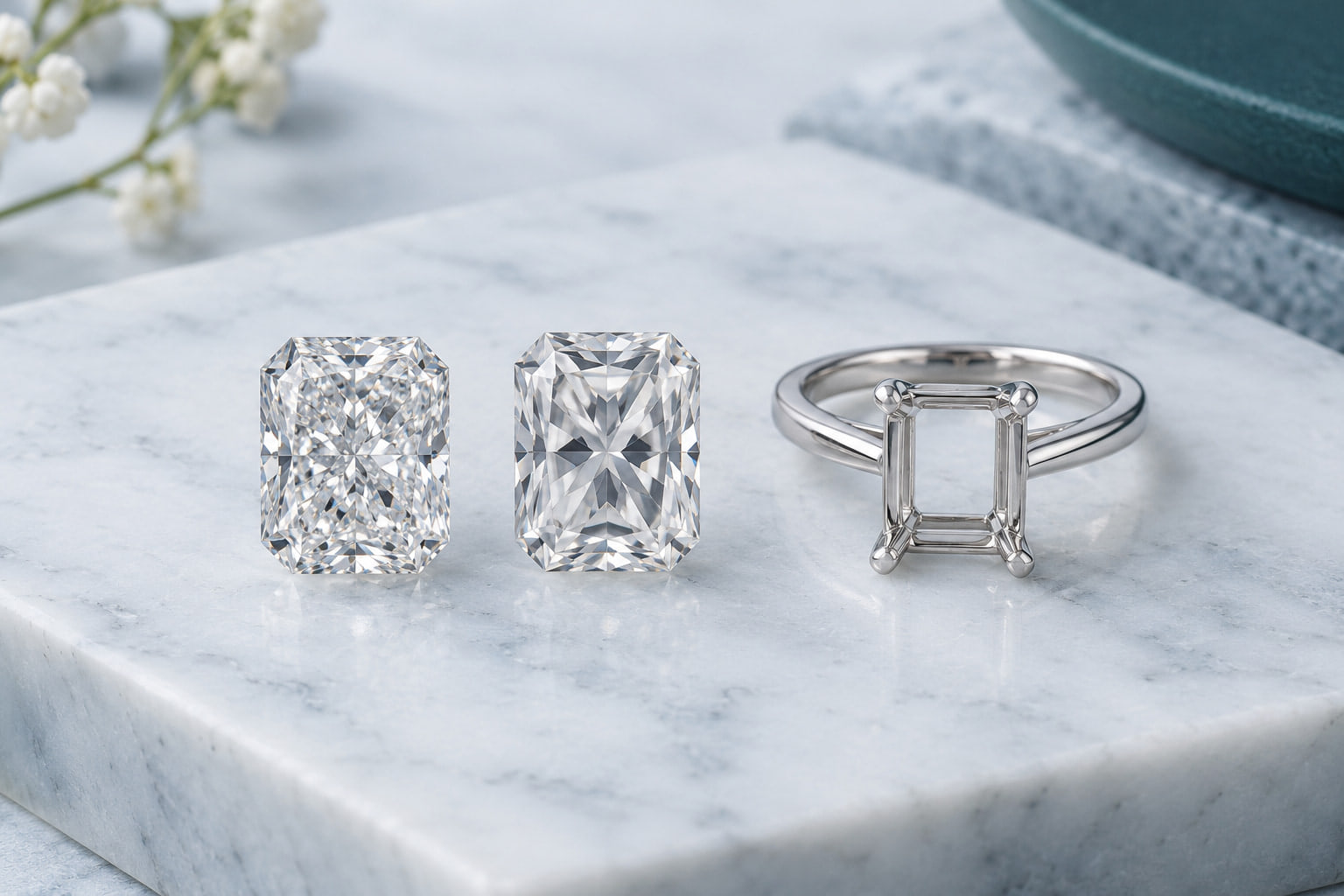
A radiant's outline includes eight principal sides when its four corners are clipped. Maximum length and width describe its outer envelope but not the length of each short diagonal. Compare corner clips to the approved outline using a centered, perpendicular photograph. If one clip looks larger, first rule out camera tilt. Then inspect the actual stone before deciding whether the difference is a cutting issue or an imaging artifact.
For manufacturing, add a pavilion profile and clear oblique views. Two radiants with matching outer dimensions can differ below the girdle, changing the available metal around the seat and the clearance beneath the culet. Do not solve a deep-stone problem by instructing a setter to force the stone lower. Ask engineering whether the head can accommodate it with suitable contact and clearance. If the design requires a low profile, identify that constraint before the supplier reserves candidates.
Check the girdle's condition around every clip. GIA's chipping guidance includes cornered cuts among areas needing attention. A clipped corner is not a promise that impact cannot damage it. Photograph any existing abrasion or surface-reaching feature and send it to the setter with its location. Broad claims about diamond hardness do not answer a question about a local corner condition.
A rectangular radiant can also look visually square after mounting if large prongs obscure its ends. Show a top-view mock-up with realistic prong coverage, then inspect whether the outline still reads as intended. The collection specification should state the desired visible shape after setting, not only the loose stone's dimensions.
Broader-Flash VS Fine-Textured Radiants: How Should Buyers Compare?
| Criterion | Broader organized flashes | Finer fragmented texture |
|---|---|---|
| Normal-distance appearance | More distinct changing reflection blocks | More numerous smaller changes |
| Risk to investigate | A large dark block dominating routine viewing | An indistinct or consistently dull central region |
| Useful evidence | Slow movement showing how broad reflections turn on and off | Consistent exposure showing the center and ends together |
| Matching a collection | Compare block size and arrangement | Compare texture scale and uniformity |
| Unreliable shortcut | Assuming big flashes always mean superior cut | Assuming crushed ice always means poor quality |
Ask the sales team to choose a visual family before spending time on narrow specification upgrades. A report can document important properties, but it does not communicate the brand's preference for larger or smaller flashes. Let the reference image carry that preference. The shape planning guide helps place this decision within a broader assortment.
If the brief calls for open geometric steps instead, compare with the emerald-cut category. Changing the shape description cannot turn a brilliant-style radiant into a step cut. Approve that aesthetic decision before the mounting team spends time on final engineering.
How Can a Three-Carat Radiant Shortlist Be Tested?
Hypothetical example: the Three-Carat Frame Launch. A brand requests six nominal three-carat radiant centers for a rectangular solitaire. Candidate R measures 10.1 by 7.2 by 4.9 mm. Candidate S measures 9.8 by 7.1 by 5.3 mm. These invented measurements are examples, not a recommended proportion range. The first ratio is about 1.40 and the second about 1.38, yet their face-up rectangular envelopes are approximately 72.72 and 69.58 square millimeters.
The difference between those rectangular envelopes is 3.14 square millimeters, about 4.5% of S's envelope. This calculation does not measure actual diamond face area because clipped corners remove part of each rectangle. It simply shows why equal weight and similar ratios cannot be treated as equal apparent size. The brand must still inspect the actual outline and optics.
The CAD team has allowed a maximum stone depth of 5.1 mm in its current design. R is within that provisional limit; S is not. S could remain a visual candidate only if engineering approves a revised head. The buyer should compare the cost and timing of that revision with selecting another stone. A better report grade does not automatically justify changing an entire mounting run.
Now assume R matches the broader-flash reference while S looks finer textured. The selection decision has two independent axes: fit and visual style. Record both rather than declaring one universally better. Ask MEITUO to coordinate candidates matching R's approved family and to flag every depth exception. The radiant selection page is the relevant product starting point, while engineering approval stays with the manufacturer.
How Should Radiant-Cut Evidence Be Packaged for Receiving?
Build a small evidence packet per center: inventory identity, laboratory document reference, dimensions, clean face-up image, profile and motion clip. For a multi-stone order, use a contact sheet with equal image scale. Otherwise a supplier can unintentionally make one smaller stone look more substantial by cropping it more tightly.
At delivery, reconcile the parcel to the packet before judging appearance. Verify any report online and compare the physical inscription where available. Check all four clips and long girdle edges under magnification. Then repeat the approved lighting routine. If the delivered stone appears more finely textured than the reference, verify that the video settings and camera distance match before treating it as a substitution.
Current report systems need careful reading. GIA currently describes Premium and Standard assessments for eligible loose colorless-to-near-colorless laboratory-grown diamonds. This is not a promise of traditional individual color and clarity grades on every current service. IGI describes growth and treatment information in comments upon request. Agree on the document fields needed before the order.
For an exception, state the observation and desired remedy. A damaged clip needs condition investigation; an excessive depth needs engineering review or replacement; an unpreferred texture needs selection against the correct reference. Keeping these reasons separate makes the reorder record useful instead of filling it with vague rejected-stone labels.
What Differs Between Radiant-Cut Sourcing Channels?
Use location to plan communication, inspection and delivery responsibilities. The critical questions remain who controls the actual radiant, who can capture its facet texture honestly, and who can approve a remedy if the corner profile will not fit.
US / Retail shortlist control
How Should US Retailers Request Radiant Comparison Media?
US retailers working through a trade distributor can ask for a tightly edited shortlist without asking for edited images. Stuller provides a US trade-facing lab-grown diamond category, illustrating the channel. A domestic seller's address does not establish the growth origin of a radiant. Confirm the exact inventory holder and the time allowed for review before presenting a center to a bridal client.
The useful request is two or three radiants recorded under the same setup, with their actual dimensions visible beside the clips. Ask whether the retailer can inspect the preferred candidate with its planned head or a realistic temporary mount. A US customer-facing deadline can make immediate availability valuable, but do not let that erase the depth check. If the retailer promises a low-profile ring before a stone is reserved, the supplier may be asked to solve an impossible geometry problem. Approve the center and head as a pair, then confirm shipping and any return conditions in writing.
CN / Translation into visual requirements
What Should a China Sourcing Brief Say About Radiant Texture?
For China sourcing, send image references alongside the words broad flash or fine texture. A request translated only as radiant, white and brilliant leaves the actual appearance undefined. GIA's laboratory-grown review describes multiple production methods and Chinese suppliers; it does not grade a seller's rectangular cutting style. Treat access to polished radiant inventory as a separate capability from access to grown material.
Ask a coordinator to group candidates by appearance before quoting a mixed parcel. Require the full dimensions, not a rounded nominal size, because a deeper pavilion may invalidate the current head. When the order also includes Chinese melee, keep center acceptance separate from accent sorting. Good round-melee consistency does not establish the radiant's texture. Qingdao-based coordination can help carry one drawing and one reference through supplier conversations, provided the buyer confirms who holds the actual stones. Keep written control of substitutions so a supplier cannot fill a shortage with a different visual family simply because carat and report grades match.
IN / Pavilion and stock questions
How Should Buyers Discuss Radiant Cutting With Indian Contacts?
Indian sourcing conversations may involve a manufacturer, a polished-stock trader or an intermediary with access to several lists. GreenLab lists both Surat and Mumbai contacts, showing why a location alone does not explain the role of a particular contact. For radiants, ask who can supply the exact-stone profile and who can answer whether the visible pattern reflects the offered parcel rather than a representative sample.
If the buyer prefers a broader-flash style, request a group showing that character at the intended size. Do not assume that all radiants from one cutting location share a facet arrangement. Ask whether additional candidates can be selected from existing polished stock before discussing a custom cut. A custom proposal should identify the approval sample, minimum commitment, possible dimensional variation and document timing. For an urgent six-stone launch, existing matched visual character may be more practical than theoretical control of every facet. Record the seller's responsibilities for any proposed recut, including weight change and revised fit.
Where Can MEITUO Help a Radiant-Cut Project?
MEITUO supports sourcing and supply-chain coordination from Qingdao, Shandong, China. For a radiant-cut program, buyers can use that coordination to circulate a precise visual reference, collect comparable candidate information and confirm which stones remain available while the manufacturer checks depth. Its work includes product selection, supplier coordination, quality-requirement confirmation and order follow-up.
MEITUO's product range includes loose center stones, melee, side stones, matched pairs and sets, and fancy-color options. A radiant ring project may therefore involve a central rectangle and coordinated accents, each with its own acceptance rules. The company should not be described as the grower, cutter or grading laboratory. Ask it to confirm availability, MOQ, documentation, treatment information, lead time and shipping terms for the proposed order. Email [email protected] with the preferred facet texture and CAD envelope. The jewelry manufacturer application page provides context for converting an approved shortlist into a production-ready sourcing request.
What Makes a Radiant-Cut RFQ Specific Enough to Quote?
Name the intended texture and attach actual references. Add the maximum depth the current design can accept and the corner clip information required by the setter. State whether the quantity is for a visually uniform run or individually selected bespoke rings. The first brief needs tighter appearance consistency; the second may allow more variation if each client approves the exact center.
Ask the supplier to separate ready candidates from candidates requiring additional imaging, a new report or a design exception. Confirm the reservation period before investing in a detailed review. For each proposed substitute, request its own evidence instead of accepting a general statement that it is equivalent. The RFQ guide can support the commercial fields after the radiant-specific approval rules are settled.
Please offer [quantity] radiant-cut laboratory-grown centers for [ring project], targeting [weight range] and [length/width envelope]. Our preferred appearance is [reference ID], with [broad or fine] reflections and balanced activity across center and ends. Provide exact-stone motion clips, scale photographs, clipped-corner views, profile, dimensions and document references. Our present head accepts depth up to [limit]; identify every exception before reservation. Confirm growth and treatment information, stock control, MOQ, lead time, shipping terms and inspection conditions. Substitutes require their own media and written approval by [buyer] before dispatch.
FAQ: Radiant-Cut Lab-Grown Diamonds: Facets, Shape and Fit
Is Crushed Ice a Formal Radiant Quality Grade?
It is a descriptive trade term for an appearance, not a complete quality verdict. Use it with a reference and judge whether the actual stone is attractive in motion. The same words can describe different levels of texture and brightness to different buyers.
Does Three Carats Determine the Radiant Mounting Size?
No. Equal weight can be distributed into different length, width and depth combinations. Obtain actual measurements and corner profiles before finalizing a head. Check the pavilion rather than relying only on a rectangular face-up envelope.
Can a Radiant Have a Darker Central Area?
Yes, a particular stone may show darker regions under some conditions. Compare controlled movement and several lighting setups. Persistent large inactive areas are different from changing contrast that contributes to a lively pattern.
Are Clipped Corners Immune to Damage?
No. Inspect the condition and geometry of the corner and girdle, and have the setter approve protection and contact. Hardness does not eliminate chipping risk or justify forcing a stone into an unsuitable bearing.
Can Report Grades Match While Radiant Appearances Differ?
Yes. An appearance preference such as broad flashes versus finely fragmented reflections needs its own visual approval. Keep that requirement alongside document-based criteria so matching report fields do not become the sole definition of an acceptable replacement.
What Should a Buyer Do if the Best-Looking Radiant Is Too Deep?
Ask engineering whether an acceptable head revision is possible before ordering. Compare its practical consequences with selecting another candidate. Do not approve the stone on the assumption that the setter can later remove an unspecified amount of metal or reduce clearance safely.