 English
 Español
 Português
 Deutsch
 Français
 Italiano
 Nederlands
 العربية
 日本語
 한국어
 ไทย
Quick Answer
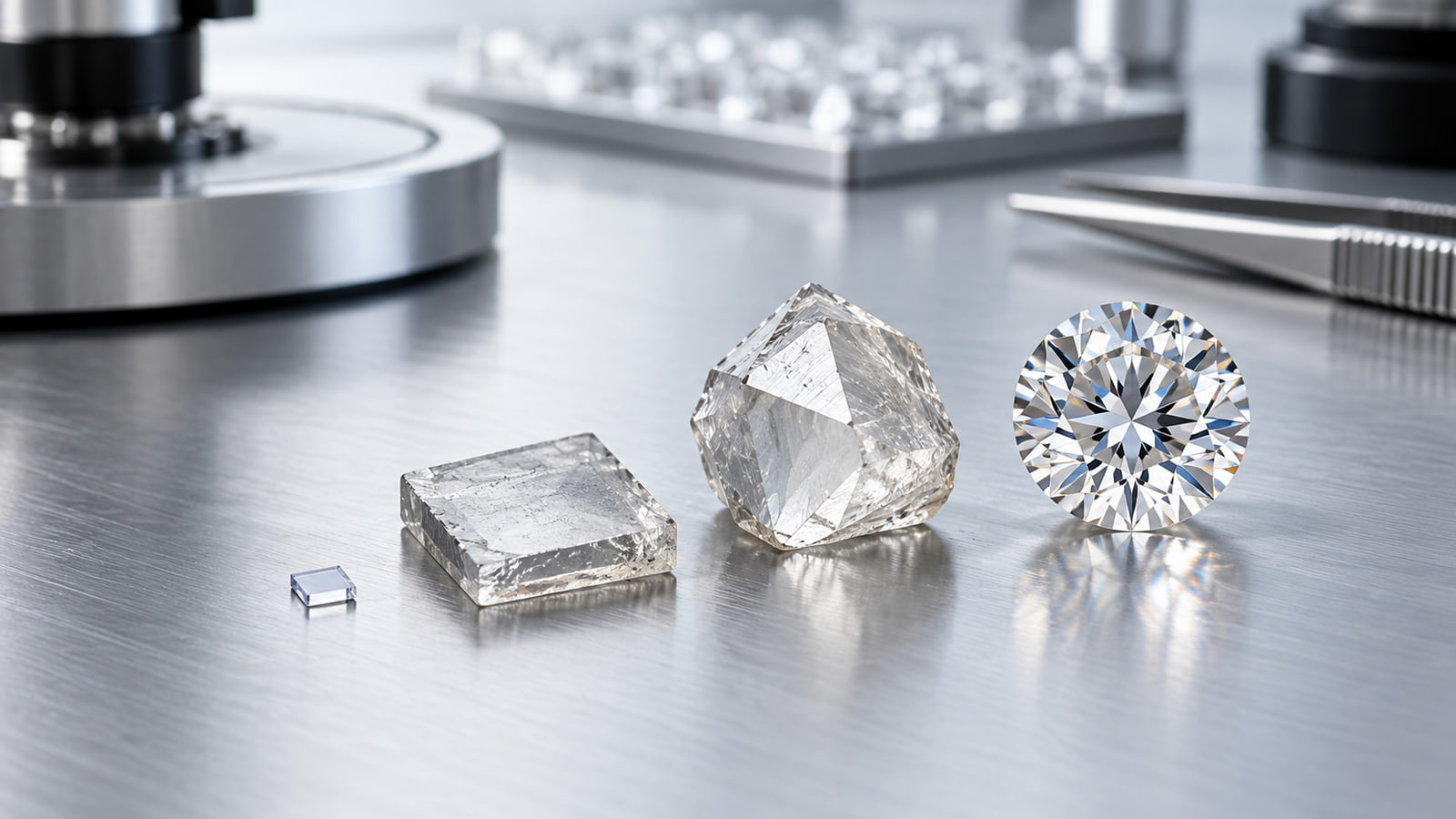
How do they make lab grown diamonds? Producers grow diamond crystal on seed material using CVD or HPHT, then turn suitable rough into polished stones through planning, cutting and polishing. Post-growth treatment may be part of the route. Identification, grading or assessment and final sorting are later steps. A growth completion date is therefore not a finished-goods delivery date. The most reliable buying decision combines the correct document scope with observations of the actual item and a written acceptance rule. Keep unresolved points visible before payment or setting. A supplier’s confident description is useful context, but the purchase record should distinguish confirmed facts from information that still needs verification.
What Happens Between Diamond Seed and Jewelry-Ready Stone?
Think in milestones rather than a single machine cycle. A rough crystal must be evaluated for what can actually be cut from it. The planned shape and weight may change when internal characteristics or yield constraints become clear. After polishing, an independent examination can document the finished item, and the seller must reconcile that result with its stock. Buying teams need visibility of the stage their order has reached.
GIA explains two established growth routes: HPHT uses a pressure chamber and CVD deposits carbon from a gas environment onto seeds. Neither route eliminates the later manufacturing steps required for jewelry-ready stones. See GIA: HPHT and CVD growth processes.
Growth Completion Versus Polished-Stock Readiness
Compare the state of the goods rather than two vague promises. Rough availability can be valuable for a planned manufacturing program, while polished inventory supports immediate finished-stone inspection. Neither is inherently the correct choice for every launch. The decision depends on whether the buyer accepts the remaining manufacturing uncertainty and has time for the required approvals.
| Decision | Rough at growth completion | Documented polished inventory |
|---|---|---|
| What exists | Crystal requiring planning and manufacturing | Finished stone available for physical inspection |
| Dimensions | Projected and subject to cutting decisions | Measured finished dimensions |
| Quality | Expected outcome may change | Observed finished appearance and report scope |
| Scheduling | Cutting, review and documents remain | Reservation, packing and agreed dispatch remain |
How Do HPHT and CVD Grow Diamond Before Cutting Begins?
The following selection checks connect the topic to an actual purchase decision. Record the requirement, evidence and unresolved question against the same stock identifier so the supplier and receiving team review the same candidate.
Production milestone. Confirm whether the offer is rough, in cutting or polished stock. Request a dated stage declaration attached to the order. Require the actual stage name rather than an ambiguous percentage-complete estimate.
Cutting outcome. Confirm actual dimensions instead of only projected carat weight. Request finished measurement list before approval. Review face-up dimensions after polishing; rough planning cannot establish final fit.
Treatment step. Confirm whether processing occurs before final grading. Request a clear sequence and available treatment disclosure. Keep processing before final document review visible in the sequence.
Document release. Confirm whether reports and stock identifiers are reconciled. Request final report list before packing authorization. Match the final result to the stock list after all candidate changes.
Apply the relevant checks to individual loose centers or matched pairs and sets according to the actual order. Preserve the approved reference and flag substitutions for review before they enter the packing list.
For made-to-order sourcing, MEITUO can help coordinate milestone questions with suppliers. The brief should name the finished output and approval dependencies; a request for fast growth alone does not define a deliverable jewelry order.
HPHT: assemble the growth environment. The basic ingredients include a diamond seed, a carbon source and a metal solvent/catalyst in a growth cell. A press supplies the high-pressure, high-temperature environment. These are manufacturing components, not a description of a finished gemstone grade. The buyer should distinguish a statement about the equipment route from evidence about a selected polished stone.
HPHT: move carbon to the seed. Under the controlled conditions, carbon dissolves in the molten metal and is transported toward the seed, where diamond grows. A temperature difference helps drive the process. After growth, the crystal is recovered for evaluation. The resulting rough must still be assessed for what polished output its shape and internal characteristics permit.
CVD: prepare the chamber and seed. Diamond seed plates are placed in a growth chamber with a carbon-containing gas environment. Microwave energy creates a plasma, enabling carbon to deposit as diamond on the seed. The process builds a crystal layer rather than producing a ready-cut oval, round or emerald shape directly from the chamber.
CVD: manage continued growth. Growth conditions influence the deposited material, and a manufacturing route can include interruptions or further growth steps. The purchasing question is not whether every producer uses an identical recipe, but whether the supplied growth and processing descriptions are accurate. Avoid turning a simplified diagram into a claim about the exact proprietary sequence used for a particular stone.
These mechanisms are summarized in GIA’s HPHT and CVD process explanation. The process label explains how diamond crystal can be produced; independent identification and final inspection concern the actual finished item. A buyer does not need to audit a reactor to ask for accurate growth wording and usable finished-stone evidence.
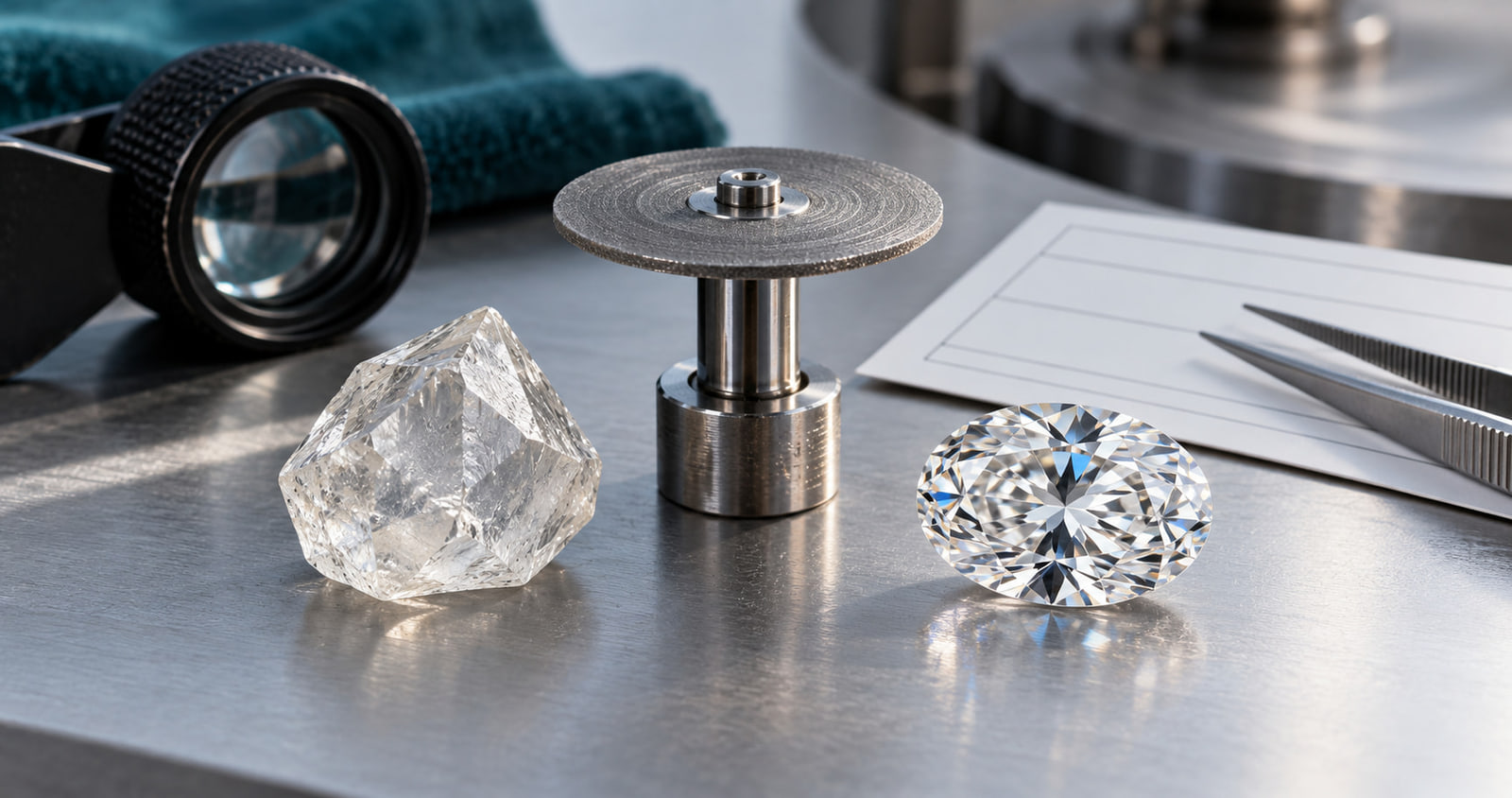
Then turn rough into a jewelry stone. Planning determines a feasible polished output, cutting creates the intended form and polishing finishes the facets. Subsequent processing, where used, must be distinguished from the original growth route. A CVD-grown crystal does not become HPHT-grown merely because HPHT processing appears later in its history. Keep those two fields separate.
Finally document and sort the output. Appropriate independent examination can establish identity and supply the chosen quality information. The seller then reconciles the finished stock, documents and accepted selection. This final stage turns a manufacturing result into an order that can be received and set. It does not retroactively make every projected rough outcome a guaranteed finished specification.
How Does Manufacturing Review Work in a Real Ordering Sequence?
Hypothetical worked B2B example. A hypothetical brand wants thirty cushion centers for a launch. The supplier says growth is complete, but cutting has not begun. The brand treats this as work in progress and sets separate approvals for polished dimensions, optical appearance and final documents. If the cutting plan cannot achieve the requested outline, a replacement candidate is reviewed before the launch schedule relies on that stone.
For the thirty-cushion launch, the milestone list gives the merchandising team a more useful status than an optimistic growth-complete message. It shows which design decisions are still exposed to change. The team can reserve launch photography only after final candidate approval, while packaging planning can proceed on information that no longer depends on the unfinished stones.
If a finished cushion misses the outline requirement, the buyer has several possible commercial responses: select another finished candidate, revise the jewelry only with designer approval, or separate the delayed item from the first delivery. The right choice depends on the actual collection. None requires inventing a universal production timeline from the growth method alone.
Carry the accepted decision into repeat-order planning; where the product depends on several stones, retain the pair or set approval with the candidate schedule.
How Should Buyers Resolve a Manufacturing Mismatch?
Ask for the production status in concrete terms: grown rough, planned rough, in cutting, polished awaiting examination or documented finished stock. Avoid translating all of these into ready. Each stage leaves different decisions open. A projected weight is not a delivered weight, and a proposed shape is not the final outline. The buyer’s schedule should attach approval gates to the actual remaining work.
Before authorizing document submission, reconcile the polished measurement list against the design brief. If the cut cannot deliver the requested face-up dimensions, review the substitute before adding reporting time and cost. Ask whether any treatment or additional polishing remains planned. The document and inspection imagery should describe the final candidate, rather than an earlier condition that will change before shipment.
At release, match the final stone list to the order and accepted revisions. Preserve the relationship between supplier stock references, laboratory numbers where used and packing lines. If one candidate changes late, confirm which approvals must be repeated. A new crystal or polished substitute cannot inherit all the previous candidate’s selection evidence simply because the total ordered quantity stays the same.
For the ordering record, connect the findings to the RFQ fields and preserve the relevant side-stone specification when companion stones are included.
What Should Buyers Ask Manufacturing Suppliers in the USA, China and India?
Supplier geography can change communication and handling, but it does not settle manufacturing. Use these localized questions to understand the seller’s role, where the actual stock sits and who can supply the evidence required for this particular order.
USA / trade channels and handoff
Is a US Distributor Quoting Reserved Polished Stock or Future Production?
A US seller may quote existing polished stock or coordinate future production through another business. Ask which situation applies before relying on a delivery discussion. If the candidate is physically available, request final measurements and document details. If only rough or a production slot exists, identify which finished-stone specifications remain projected rather than confirmed.
The distributor should explain when the buyer sees actual candidates and what happens if the manufacturing outcome misses the brief. A growth-complete update may be useful progress, but it does not supply final optical approval. Avoid scheduling setting or photography solely from that milestone when cutting and examination remain outstanding.
For a launch order, distinguish stock reservation from production planning. Ask who controls the reserved polished stones and whether substitutions require fresh approval. The commercial objective is to make remaining dependencies visible, not to demand one universal growth timeline that ignores the later work between crystal production and jewelry-ready stock.
For a distribution example, Stuller publishes loose laboratory-grown resources; ask whether your candidate is finished stock.
CHINA / sourcing coordination
Which Stages Are Coordinated by a Chinese Seller, and Which Remain With External Suppliers?
When ordering through China, ask the coordinator to identify the manufacturing stages it manages and those handled by external parties. A sourcing business can organize supplier communication without owning the growth chamber or cutting workshop. MEITUO’s Qingdao role is supply-chain coordination, so a clear stage report should say what the actual participants have completed.
A useful milestone list separates rough availability, cutting plan, final polishing, any processing, examination and packing release. For each stage, identify whether the buyer must approve an output. This reveals when a projected shape or weight becomes a finished dimension and prevents premature assumptions that a production update equals stock acceptance.
Before export, request the final candidate schedule rather than only a manufacturing narrative. The finished stones must meet the approved jewelry brief regardless of which growth route produced them. Confirm order-specific document availability, MOQ, lead time and shipping terms, and keep any changed candidates visible as the order moves from planning to final dispatch preparation.
For its stated business role and Qingdao base, see MEITUO’s company introduction.
INDIA / manufacturing and export handoff
Can an Indian Cutting Exporter Identify the Exact Milestone Behind the Delivery Promise?
For an Indian cutting or export offer, ask whether the stock is rough awaiting planning, in polishing or finished and available for inspection. Those stages imply different evidence. A rough photograph can explain progress, while final dimensions and actual-stone video support a selection decision. Neither should be presented as a substitute for the other.
Where the grower and cutter are different parties, clarify which business owns the candidate and who can authorize changes to the planned output. Cutting decisions can affect the delivered outline and measurements. The buyer should learn about a material change before the stone enters later examination or packaging steps that make correction more complicated.
For repeat collections, preserve the finished specification rather than simply requesting the same production route. Ask whether the next order will draw from polished inventory or require new manufacturing. The answer changes scheduling dependencies and contingency choices, while the final acceptance standard for the jewelry should remain explicit and stable.
GreenLab publishes Surat manufacturing and Mumbai corporate locations; clarify which party reports each manufacturing output.
How Does MEITUO Support the Diamond Manufacturing Sequence?
MEITUO is a sourcing and supply-chain coordination partner in Qingdao, Shandong, China, serving jewelry brands, wholesalers, retailers and designers. For the diamond manufacturing sequence, its useful role is to turn the buyer’s collection requirement into an actionable supplier request: confirm whether the offer is rough, in cutting or polished stock, organize available evidence and follow up on unresolved selection questions.
Its sourcing scope includes loose center stones, melee, side stones, matched pairs and sets, and fancy-color options. Ask MEITUO to clarify whether the offer covers rough or polished stock and to request the finished measurement list and available processing information before candidate approval. The final acceptance criteria should remain with the buyer’s approved brief and the evidence supplied for the actual order.
MEITUO does not replace an independent grading or identification laboratory. Available stock, documents, treatment information, MOQ, lead time and shipping terms need confirmation per order. Send the intended application and manufacturing requirements to [email protected] so selection and order follow-up can start from specific questions.
What Should a Manufacturing RFQ Specify?
Name the finished output you need before asking about the production route. Give shape, quantity, weight band and dimensional tolerances, then ask whether the offer comes from existing polished stock or work in progress. For production orders, request the current stage and the next point where your approval is required. Separate projected outcomes from specifications the supplier is committing to deliver.
Ask who coordinates cutting, any processing, independent examination and final sorting. Define what happens if the polished result cannot meet the brief, and which dependencies determine dispatch readiness. Do not confuse a supplier’s ordinary manufacturing route with proof that the exact future candidates are already available. The RFQ should make clear when final measurements, documents and approval images become due.
Please quote laboratory-grown diamonds for [jewelry application] in [shape and quantity], with [weight range] and [dimensions or tolerance]. Our priority is current production stage, finished shape and dimensions, treatment disclosure, inspection gates and dependencies before dispatch. Supply available evidence linked to each stock line or clearly identified parcel. State [accepted document service], current stock location, proposed substitutions and any information you cannot confirm. Please separate product and service inclusions, confirm MOQ and lead time for this order, and provide [shipping destination and terms]. We require written approval before substitution or dispatch and a mutually agreed process for discrepancies identified at receiving.
FAQ: How Do They Make Lab Grown Diamonds, From Seed to Polished Stock
Are CVD and HPHT the Only Stages in Making Jewelry-Ready Diamonds?
No. They describe growth routes. Rough planning, cutting, polishing, any processing, identification or grading and final sorting can follow. A procurement schedule should show those later tasks instead of treating crystal growth as the complete production sequence.
Can a Rough Crystal Guarantee a Finished Shape and Weight?
A cutting plan projects an outcome, but the delivered polished dimensions need final confirmation. Keep projected and committed specifications separate. If the actual result misses the brief, review another candidate or an explicitly approved design change before the order advances.
What Does Growth Complete Mean for an Order?
It means a growth milestone has been reached, not necessarily that polished stones are ready. Ask which steps remain and when finished measurements and appearance evidence become available. The buyer’s launch schedule should depend on the required output, not only the completed growth stage.
When Should Treatment Information Be Requested?
Ask before final selection and confirm the sequence where additional processing is planned. The delivered document and appearance approval should correspond to the final candidate condition. Growth method and post-growth processing belong in separate questions rather than one ambiguous production label.
Is Existing Polished Stock Always the Same as Reserved Stock?
No. Confirm that the seller can actually reserve the identified candidates and state the reservation terms. A shared listing or available catalog entry may change before approval. Keep candidate substitutions visible and repeat the relevant selection checks when the stock changes.
Which Manufacturing Records Help a Buyer Most?
Request a concrete stage declaration, final dimensional schedule, available processing information and the finished candidate-to-document mapping. Not every buyer needs proprietary production detail. The useful records are those that establish what exists now, what remains uncertain and what must be approved before dispatch.