 English
 Español
 Português
 Deutsch
 Français
 Italiano
 Nederlands
 العربية
 日本語
 한국어
 ไทย
Quick Answer
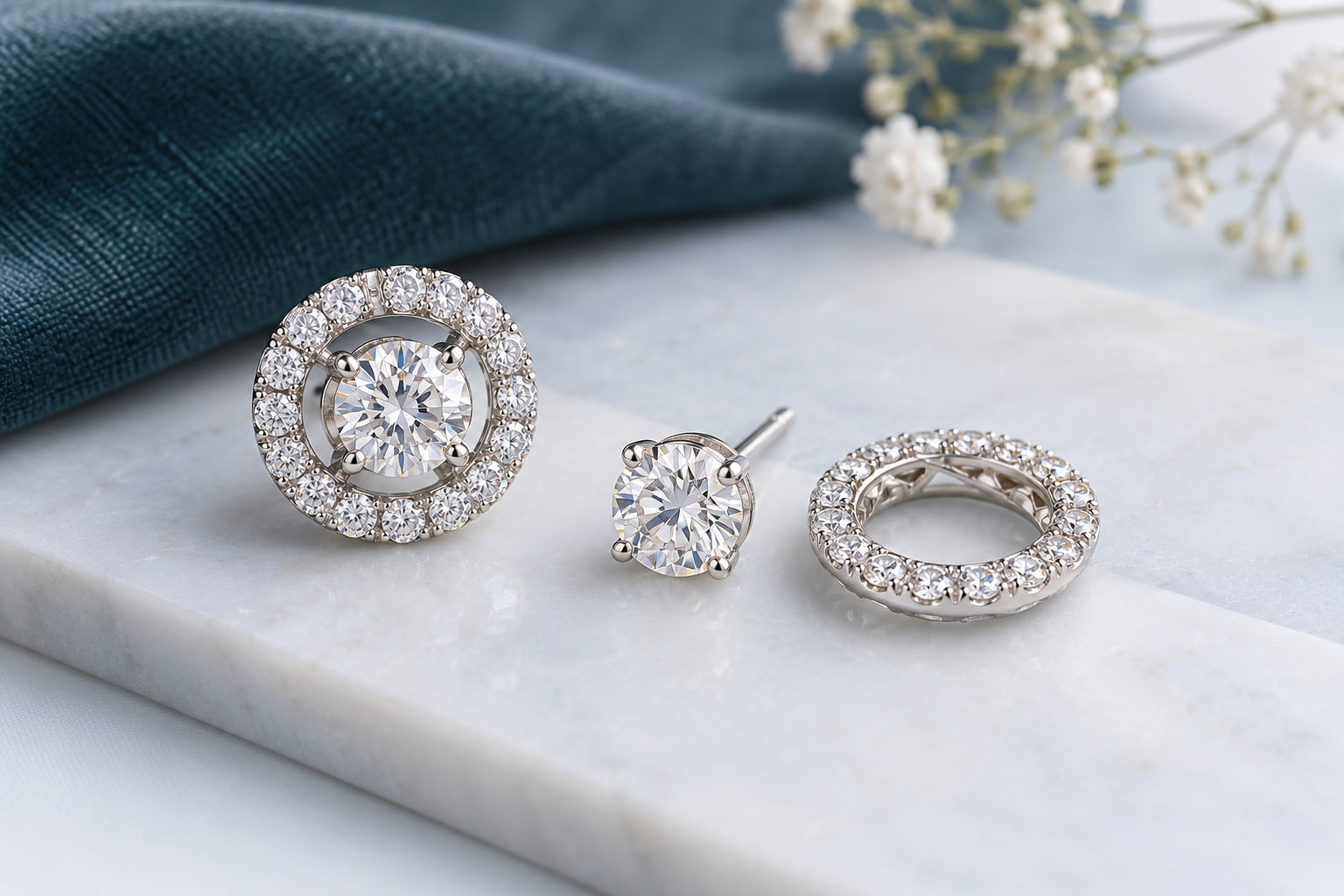
Lab grown diamond earring jackets should be bought as a compatibility system around identified studs, not as a universal accessory selected by center carat weight. Check the opening, basket clearance, support plane and post path, then confirm that the assembled jacket leaves enough usable post for the specified back in the intended wearing configuration. A jacket can clear the diamond outline yet interfere with its basket or prongs. Build a compatibility matrix for every stud model you intend to support and approve a physical assembly before ordering the full accent parcel. Keep removable jackets distinct from permanently assembled halo studs. MEITUO can coordinate the loose-stone requirements; the actual maker must confirm fit, findings compatibility and finished construction.
What Kind of Earring Jacket Is the Buyer Actually Ordering?
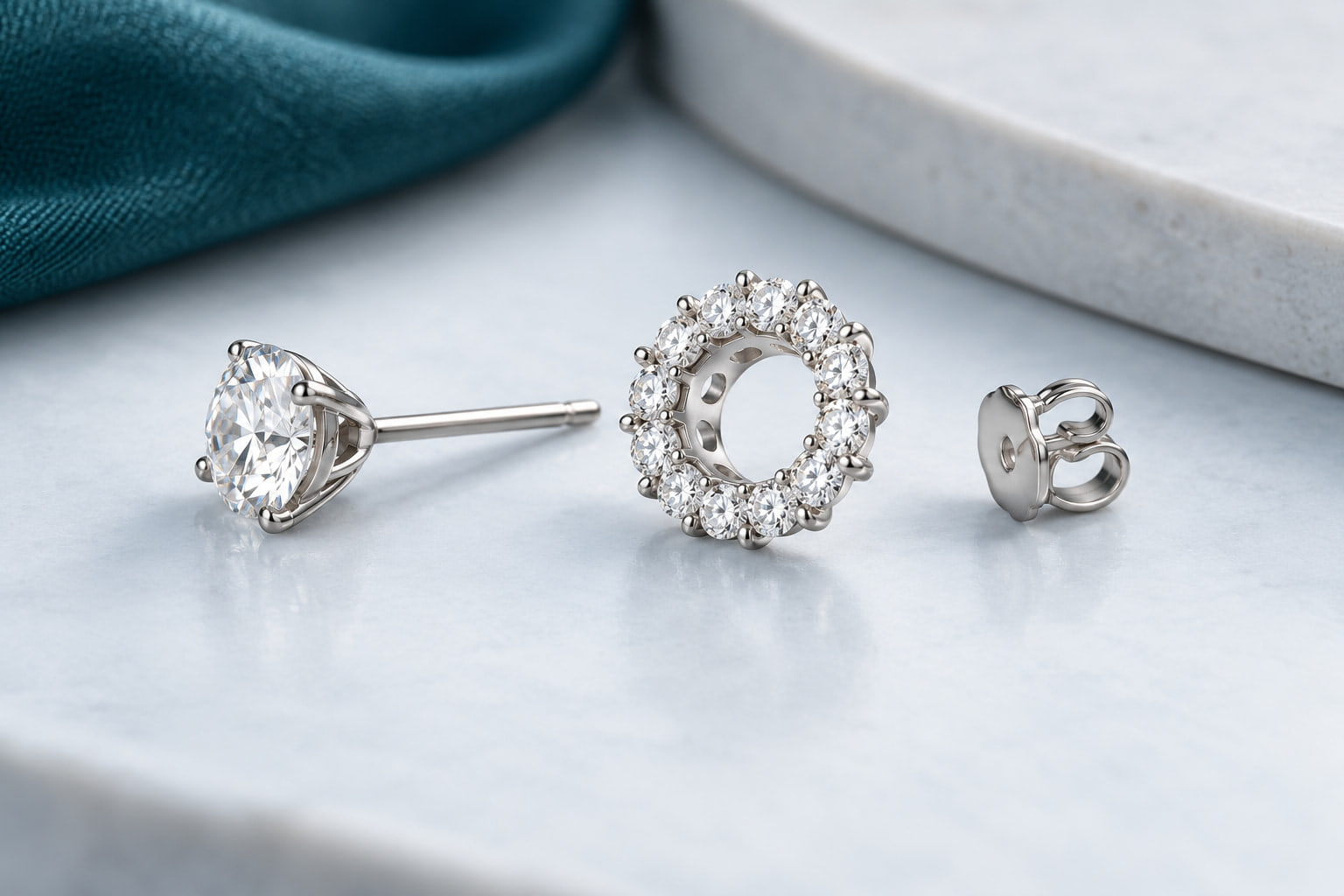
Commercial jacket categories cover more than one construction. Some surround a stud as a detachable halo; others hang below or behind the ear through a post interface. This guide focuses on a removable surround that must work with an existing stud. State that scope explicitly so a supplier does not propose a permanently assembled halo or a different front-back accessory.
A verified Ritani jacket collection lists products described for three-prong martini studs and others for four-prong round studs. Those examples use colored-stone halos, so they are not evidence of a particular laboratory-grown diamond jacket's specification. They do illustrate why the intended stud architecture can be part of the product description rather than a trivial afterthought.
Record whether studs are included in the commercial offer. A photograph may show a complete assembly while the quotation covers only the detachable component. Likewise, a jacket's diamond total can exclude the center studs. Keep component quantity and weight scope visible in the purchase sheet and selling data.
Use the component-scope guide to assign responsibility for stones, jacket metalwork, studs and backs. The buyer needs to know which party is confirming each interface before describing the combined result to a retailer or customer.
Why Is the Center Opening Only the First Jacket-Fit Check?
Measure the actual stud at the plane where the jacket will sit. The diamond's visible diameter may differ from the basket's widest dimension or the projection of its prongs. A circular opening large enough for the stone can still catch the mounting. Request front, side and rear views with the intended contact plane marked.
Review how the jacket is supported. It should reach the intended position without forcing against a stone edge or a retaining feature that was not designed as a stop. The maker should identify the support surface and assess clearance in the real assembly. Do not specify an arbitrary universal gap as though every mounting uses the same geometry.
| Compatibility check | Diameter-only assumption | Assembly-specific review |
|---|---|---|
| Center opening | Compare diamond size only | Compare basket and prong envelope at the insertion path |
| Support | Assume any contact is acceptable | Identify intended support plane and clearance |
| Post path | Assume the hole is centered correctly | Check alignment through the actual assembled parts |
| Backing | Reuse the old back automatically | Review remaining usable post and compatible engagement |
| Product claim | Fits all studs of one carat size | Lists only physically qualified stud models |
The designer brief should include these surfaces and paths. A front-view rendering can express the intended style while leaving the compatibility problem unresolved.
How Does a Detachable Jacket Change the Stud Assembly?
Adding a component consumes space along the post or changes where the stud sits. Measure the actual assembly rather than subtracting a nominal jacket thickness from a catalog post length. The relevant question is how much usable post remains for the specified backing in the intended wearing configuration, with the real support and contact surfaces in place.
Keep the post/back system identified by maker references. A longer post with a different thread or locking feature is not automatically compatible with the existing back. If the maker proposes changing the findings, record that as a revised system and review it accordingly. The jacket project should not quietly alter an established stud product without the buyer knowing.
Review assembly and removal with a sample. Can the wearer identify the correct orientation? Does the jacket bind during ordinary insertion? Can it be removed without disturbing a setting feature? The maker should assess the actual design and finish; this guide does not establish a universal force or clearance standard.
Also review storage and completeness. A detachable accessory creates more loose components than a fixed halo stud. Give the retailer a packing layout that makes a missing jacket or back obvious. The independent-jeweler application brief can include demonstration and service requirements so the product's modular nature is supported after sale.
How Can a Buyer Build an Earring-Jacket Compatibility Matrix?
Hypothetical example: the two-stud accessory program. A retailer wants ten jacket pairs that can work with stud models S1 and S2. Both models use nominally 6.0 mm center stones, but their measured basket envelopes at the jacket interface are 6.4 and 6.8 mm. A proposed opening of 6.6 mm gives only a preliminary diameter comparison: S1 is smaller than the opening by 0.2 mm, while S2 is larger by 0.2 mm. These invented dimensions do not establish safe fit for either assembly.
The maker checks the insertion path and support plane. S1 can reach the intended position in the first prototype; S2 cannot. Enlarging the opening might accommodate S2, but it could change the visual gap around S1. The retailer decides whether to develop two jacket versions or support only S1. It does not publish fits all 6 mm studs.
The accepted jacket drawing uses twelve accent stones per component. Ten pairs require twenty jackets and 240 accents before reserves. If the buyer approves a six-stone reserve, the planned loose order is 246 stones. The count is specific to this fictional design; it is not a standard halo formula.
After the stone layout is accepted, the complete S1 assembly is checked for usable post and backing engagement. Only then does the matrix record S1 as approved for that jacket revision. S2 remains unapproved unless a revised sample passes its own review. The melee inquiry follows this confirmed drawing rather than driving the fit decision.
How Should Jacket Compatibility Be Communicated Across Markets?
The core deliverable is a list of actual stud models qualified for the actual jacket revision. A retailer's accessory name, a component supplier's opening dimension and a stone supplier's accent parcel are useful inputs, but none independently establishes the combined fit. Keep the compatibility matrix attached to each commercial handoff.
USA / accessory compatibility and service
How Should a US Retailer Qualify Jackets for Existing Stud Lines?
A US retailer adding jackets to an existing stud line should qualify each supported model rather than publish a carat-size compatibility claim. Start with the actual basket, prong and post measurements. Two retail studs sold at the same center weight can use different mountings, and the jacket must work with the mounting as well as the stone.
Use a compatibility matrix in the product record and make supported models visible to sales staff. Ritani's cited collection includes examples described for particular prong architectures, illustrating the relevance of that distinction without proving your proposed combination. A physical sample remains necessary for your own accessory program.
For customer-owned studs, define the inspection and measurement process before accepting an order. Do not assume a photograph establishes the post system or remaining usable length. Keep the jacket-only price and weight scope separate from any stud modification or replacement findings, so service staff can explain what the customer is actually buying.
CHINA / assembly drawing and accent parcel
How Should China Coordination Preserve a Jacket Interface Drawing?
For sourcing coordinated through China, send the jacket interface drawing and supported stud references before requesting the accent stones. A supplier may understand the desired halo appearance while missing the insertion path or support plane. Keep those features visible in both the drawing and the written acceptance schedule.
MEITUO can coordinate loose-stone selection from Qingdao, but the actual jewelry maker should confirm fit and findings compatibility. Ask who owns the jacket drawing revision and who authorizes any change to the opening. A stone supplier should not be expected to resolve a metal-interface problem by changing melee size without the maker's approval.
For dispatch, label the accent groups with the intended jacket version. If the program has separate versions for two stud models, keep their bills of materials distinct even when many stones share a size. This prevents a seemingly harmless parcel mix from entering the wrong assembly and makes later replenishment traceable to the supported model.
INDIA / accent arrays and revision control
How Should an Indian Melee Offer Support Matched Jacket Arrays?
An Indian cutter or trader quoting jacket accents should receive the position counts and dimensional groups for the accepted metal design. Ask for a consistent appearance reference across the two arrays, especially when the line uses graduated stones around a central opening. A total parcel weight does not establish the correct count or distribution.
If an alternate size is proposed, route it to the jewelry maker before approval. Changing the accent diameter may affect spacing or the visible relationship to the stud, even when the center opening stays unchanged. The quotation should identify that option separately rather than treating it as a routine equivalent.
For repeat orders, retain the jacket revision and group labels on the parcel schedule. If a customer needs one replacement jacket, the buyer may have to match the surrounding array as well as the physical interface. Ask for actual candidate information and preserve the link to the original accepted pair rather than relying on a generic halo description.
How Should the Jacket Diamond Arrays Be Matched and Received?
Approve the two surrounding arrays as a pair before assigning them to studs. Compare the apparent color, brightness, spacing and graduation around each opening. If the design uses several sizes, label positions rather than treating the jacket as an undifferentiated melee count. A small interruption near the center opening can become visually prominent once the stud is inserted.
Then inspect the combined pair. A jacket can look balanced alone yet show a different visible gap around the left and right studs. Investigate actual basket dimensions, seating and orientation before blaming the accent stones. Keep loose array approval and assembled approval as separate records so the source of a mismatch can be traced.
At receipt, check the jacket revision and supported stud list. A dimensionally revised opening may look almost identical on the tray while changing compatibility. Ask the maker to assess stone retention, surface finish and removable handling through its quality process. Do not force an incompatible component onto a stud to demonstrate fit.
Retain a service sample or a complete measurement and image file where practical. The repeat-order guide can preserve both the accent schedule and the approved stud relationships. If a customer changes the stud head or post, the old jacket approval should not automatically follow the modified assembly.
Pack each jacket with its version identifier and the supported stud list. Where the accessory is sold without studs, include a clear assembly reference so staff can distinguish a missing center from the intended jacket-only scope. If a set includes both components, count them separately during packing. A complete-looking display photograph should not replace a component checklist, particularly when the same retailer sells jackets alone and complete assemblies under similar names.
How Can MEITUO Coordinate Stones for an Earring-Jacket Program?
MEITUO is a sourcing and supply-chain coordination partner in Qingdao, Shandong, China. For an earring-jacket program, its useful input is a confirmed jacket drawing and accent-position schedule, together with the appearance requirements for the surrounding pair. MEITUO can support product selection, supplier communication, quality-requirement confirmation and order follow-up.
Its range includes loose center stones, melee, side stones and matched pairs or sets. A jacket request may use calibrated accent parcels, with size groups kept separate for setting. Availability, documents, MOQ, lead time, treatment information and shipping terms must be confirmed for the specific order. Send the drawing revision and pair count to [email protected].
MEITUO does not claim to make the jackets, modify existing studs or validate post/back engagement. Those responsibilities belong to the actual jewelry maker and the buyer's sample approval process. Keep the compatibility matrix in the project file so stone coordination proceeds from an approved assembly rather than an untested universal-fit assumption.
What Should an Earring-Jacket RFQ Specify?
List the intended stud models, including actual mounting and post information. Attach the jacket drawing with its opening, support plane and stone schedule. State whether you need one accessory version or several model-specific versions. If the stud is an existing customer item, define how its measurements and condition will be checked before a compatibility claim is made.
Request a physical assembly milestone before the full accent order is released. Identify who approves fit, who approves the surrounding stone array and who signs off the completed pair. The RFQ guide can organize those decisions with MOQ, timing and substitution terms.
Keep the quoted weight scope explicit: jacket accents, center studs or the whole assembly. The brief below gives the supplier a concrete interface task instead of an undefined request for jackets that fit everything.
Please coordinate laboratory-grown stones for removable earring jackets intended for [stud models and pair quantity]. Attached are stud measurements, basket profiles, post/back references and jacket drawing [revision]. Aperture, intended support plane and stone-position schedule are [details]. Identify any compatibility assumptions or dimensional deviations. Provide proposed stone sizes, appearance references, sample terms, documents and treatment information where applicable. Finished jacket manufacture is assigned to [maker]. Confirm MOQ, timing, replacement options and shipping terms. Production approval requires assembly with each listed stud model, remaining-post and backing review, removable handling and completed-pair appearance; universal compatibility is not assumed.
FAQ: Lab-Grown Diamond Earring Jackets: Fit Around the Stud
Will a Jacket Fit Any Stud of the Same Carat Weight?
No. Carat weight does not define basket width, prong projection, support plane or post system. Qualify the actual stud model with the actual jacket revision. A shared nominal center size is only an initial screening detail.
Is the Center Opening the Only Dimension That Matters?
No. The insertion path, mounting envelope, intended support surface and post alignment also matter. A jacket can clear the diamond yet interfere with the basket. The maker should review the complete physical assembly before fit is approved.
Can the Existing Backing Always Be Reused?
Do not assume so. Adding a jacket can change the available post length or assembly position. Confirm compatible engagement using the actual post and back references, and record any change to the findings system as a revised approval.
Are Removable Jackets the Same as Halo Studs?
A removable surround is a separate component that can be taken off the stud. A permanently assembled halo stud is a different product scope. State which construction is intended and whether the quoted goods include the center studs or only the jackets.
How Should Jacket Diamond Weight Be Described?
Identify whether the figure covers one jacket, a pair of jackets, the center studs or the combined assembly. Retain component-level quantities and weights in the buying file so a complete product image does not create an inaccurate weight expectation.
What Happens if a Supported Stud Model Changes?
Review the new mounting and post information against the jacket. A changed basket, prong or post can invalidate an earlier fit approval even when the center stone specification stays the same. Update the compatibility matrix after a new physical review.