 English
 Español
 Português
 Deutsch
 Français
 Italiano
 Nederlands
 العربية
 日本語
 한국어
 ไทย
Quick Answer
For a men's lab-grown diamond necklace built from broad chain links, specify the link module before ordering loose stones. Record the visible face width, stone-row arrangement, link direction and the component maker's approved seat envelope. A single-row tennis-necklace specification cannot describe a wide inset chain: different links can carry different stone groups, and reversing a module may change the face-up rhythm. Approve an articulated sample and a complete front-center sequence, then calculate quantities from the actual position schedule. Keep loose-stone acceptance separate from chain construction, clasp and finished-jewelry approval. MEITUO can coordinate the stone assortment and supplier responses; the responsible manufacturer must approve the component interfaces and completed necklace.
What Makes a Broad-Link Diamond Chain a Distinct Sourcing Task?
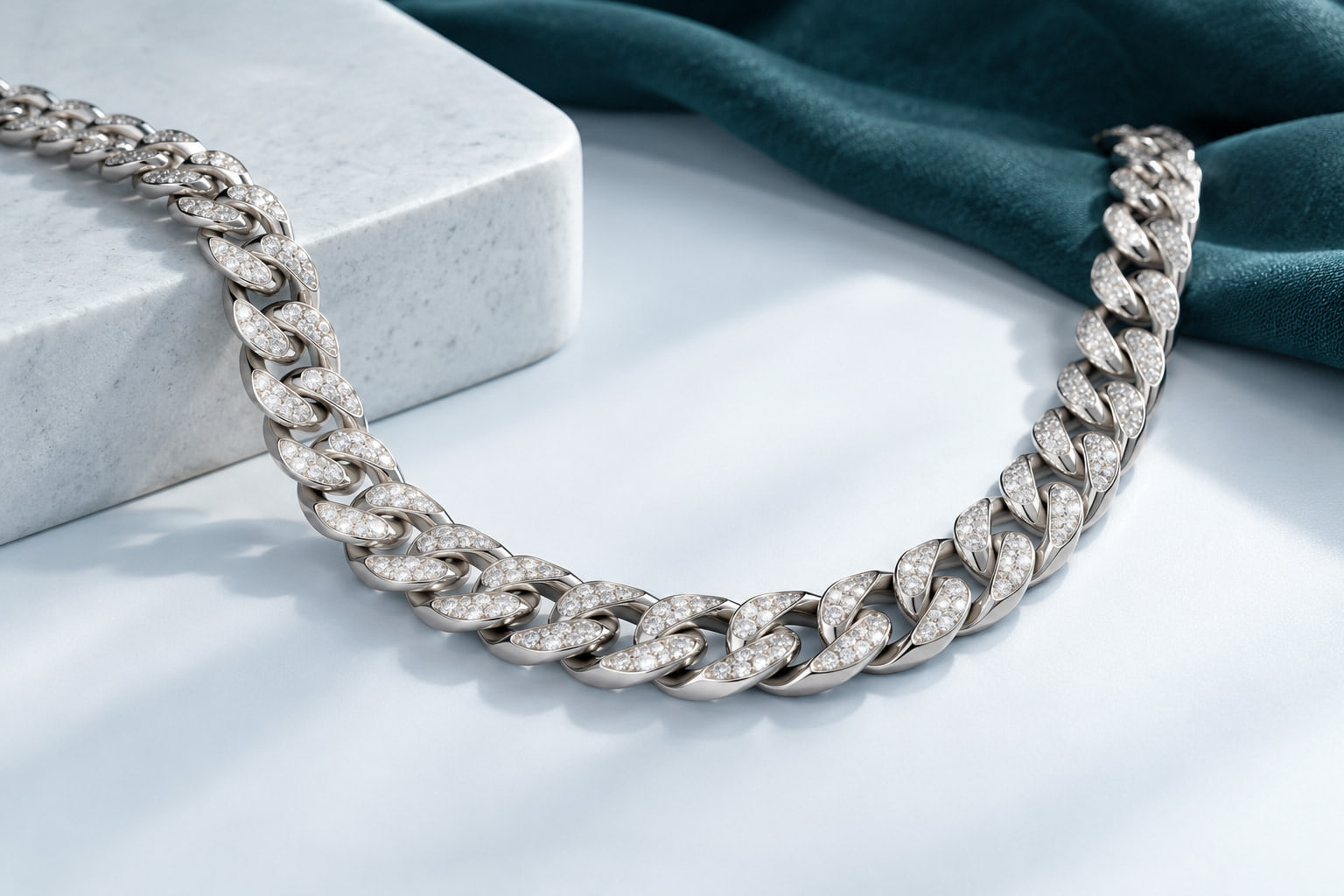
Begin with the chain's architecture. A broad flat link, a domed interlocking link and a decorative plate can each present a different stone-setting surface. The commercial phrase men's diamond necklace does not identify that architecture. Ask the design owner to select a module family and show which surfaces are intended to remain visible when the chain is worn.
Create a module drawing that identifies the top face, joining surfaces and permitted stone positions. Give different modules different codes even if they use similar overall widths. A front-center link may carry several rows while a transition link carries fewer stones. Treating the necklace as a bag of identical small diamonds loses that sequence and makes receiving reconciliation difficult.
Define the design intent without assigning it to a demographic stereotype. A strong face width or restrained inset pattern can be a brand preference, not a claim that all male customers want the same proportions. Compare a small number of physical concepts with the intended chain length and clothing context. Record the selected version and the reasons for it.
The everyday-fashion application page provides a relevant collection context. Connect it to melee requirements when the links use repeated small round stones. These are loose-stone and sourcing discussions, not evidence that MEITUO manufactures a finished chain. The module maker remains responsible for its construction and assembly route.
Which Link-Face and Seat Details Should Accompany the Stone Brief?
For every stone group, record the number of positions and the actual dimensional limits approved by the setter. A broad face can contain several rows with different edge clearances. Do not assume that a slightly larger stone can enter any position simply because the overall link looks wide. The drawing must identify which positions share an envelope and which do not.
Review the link in profile. A domed face may change how adjacent stones point toward the viewer, while a flatter face produces another visual relationship. Ask the workshop to approve the seat depth and contact geometry for the actual stone family. Procurement should not invent universal minimum metal thicknesses or clearance values; those belong to the responsible component design.
Decide when setting occurs relative to the final joining and finishing steps. If the process can alter a contact area or expose a stone to a workshop operation, the manufacturer needs to confirm the sequence. Keep the approved sequence with the module drawing. A successful loose-stone sample cannot approve an unspecified manufacturing route.
Request trial material from the same proposed size family as production. Inspect how the completed module looks from above and across the face. Record whether an uneven reflection comes from stone appearance, setting height, surface finish or the module's orientation. Distinguishing these causes helps the team request an effective correction instead of replacing a whole parcel for a construction problem.
Broad Inset Chain VS Tennis Necklace: What Must Be Ordered Differently?
Both designs can use laboratory-grown diamonds, but their material schedules are different. The useful comparison concerns how the stone positions are organized and approved, rather than which necklace is inherently more luxurious.
| Procurement decision | Broad-link inset chain | Single-row tennis necklace | Record to retain |
|---|---|---|---|
| Basic unit | A link module with one or several rows | An individual setting position in a continuous row | Module or position schedule |
| Visible pattern | Stone rows interact with link faces and gaps | Stone progression interacts with necklace drape | Approved front-center sample |
| Direction | Some modules may have a preferred orientation | Graduation can define center and end direction | Orientation reference |
| Dimensional families | Different rows or modules may need separate envelopes | Uniform or graduated size families | Size-group bill of materials |
| Replacement | May involve a stone or an entire component | May involve a position or short articulated segment | Workshop service decision |
| Acceptance | Review the completed repeating module sequence | Review the continuous worn curve | Full-layout approval |
If the design changes from one architecture to the other, reopen the material plan. An unchanged total diamond weight does not preserve stone count, seat geometry or appearance. The product team should describe a new version rather than treating a broad-link chain as a wider tennis-necklace substitute.
For larger accent elements, consult the side-stone category separately from the repeated melee. Their accepted dimensions and replacement route may be different even when they travel in the same shipment.
How Can a Prototype Reveal Link-Direction and Visual-Rhythm Problems?
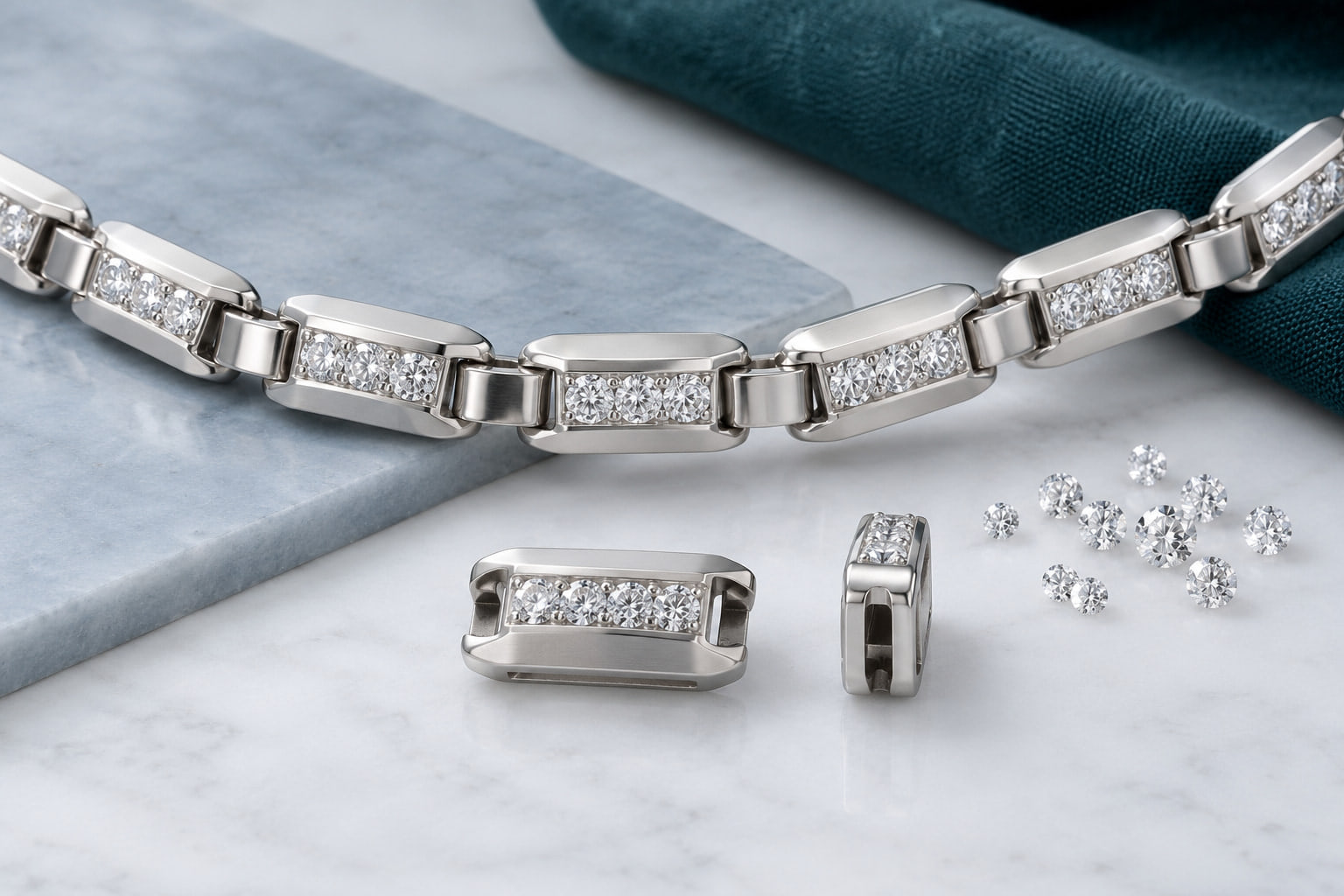
Ask for a short articulated prototype containing a front-center module and its neighboring transitions. Examine it flat, in a natural curve and on a representative display. A straight row on a workbench can hide a module that tips or presents its stones differently once connected. The prototype should contain the actual planned link geometry, not a visually similar substitute.
Mark direction through the drawing and packing record, not by applying an unapproved mark to the jewelry. Compare the sequence when modules are intentionally placed in the correct orientation and when a sample is reversed. If reversal changes the design materially, make that a controlled assembly feature. The receiving team needs a reference it can recognize without depending on the original designer being present.
Evaluate the completed face under diffuse and ordinary directional light. Look for repeated dark interruptions caused by a link gap, an unusually high setting or a different stone family. Record the observation and have the relevant owner investigate it. A darker gap between metal modules is not automatically a defective diamond, and a bright isolated stone does not prove the assembled pattern is coherent.
Keep the accepted prototype version connected to the stone schedule. If the link width or row arrangement changes, check whether the original stone order still applies. An engineering change should not remain only in a workshop message while the purchasing spreadsheet continues ordering the earlier module's quantity.
How Does a Modular Chain Schedule Become a Loose-Stone Order?
Hypothetical example: a necklace design contains thirty-six standard modules with four stones each, twelve transition modules with three each, and one front-center module with eight. The assembly need is 36 × 4 + 12 × 3 + 8 = 188 stones. The figures are invented for planning and do not describe a recommended chain length or construction.
The maker approves two stone-size families: 144 standard-module positions use family A, while the thirty-six transition and eight center positions use family B. The buyer adds eight A reserves and four B reserves. The request becomes 152 A plus 48 B, or 200 stones in total. A combined two-hundred-piece parcel is not enough information; it must preserve the family split.
Suppose receiving accepts 148 A and 46 B, with four A and two B on hold. There are enough accepted stones for the planned 144 A and 44 B assembly positions. The reserve currently contains four A and two B, rather than the requested eight and four. Record that shortfall and decide whether to wait for replacements or release a smaller reserve. Do not count the held pieces as service stock.
MEITUO can coordinate the two families against the approved module brief and request exceptions before dispatch. The chain maker should separately approve the assembled sequence and service route. This arithmetic keeps a coherent stone purchase connected to the design while preserving the distinction between accepted loose material and a finished, approved necklace.
How Should Broad-Chain Stone Sourcing Differ Across Markets?
A supplier location can help identify the commercial and review route, but it does not establish chain-making capability. Compare whether the channel can preserve distinct size families and respond to the actual module schedule. The following questions concern loose stones and their handover to the responsible jewelry maker.
USA / Module-ready material
What Should a US Accessory Brand Ask a Loose-Stone Trade Channel?
Stuller publishes a US loose laboratory-grown diamond channel. For a broad-chain project, ask whether the actual size families can be supplied and separately identified. That channel reference does not establish finished-chain production, a particular module inventory or US growth origin. The accessory brand still needs a responsible component maker and setter.
Give the domestic workshop the same position schedule sent to the stone seller. Ask it to approve the trial module before the full parcel is committed. Confirm the commercial review window for the actual transaction, including whether sorting or setting affects return options. Do not assume a general catalog service applies to a custom chain project.
For US-facing product descriptions, keep stone origin, metal description and assembly location in separate fields. A domestic loose-stone invoice answers only part of that record. Retain a reference to the accepted front-center sequence so later service does not replace one module with a visually different pattern. Local communication is useful when it preserves those specific responsibilities.
CHINA / Family-separated parcels
How Should China Coordination Preserve Several Link-Stone Families?
The MEITUO team in Qingdao can receive a loose-stone schedule for broad chain modules. The coordinator's location does not identify the chain factory, setter or diamond grower. Name those roles separately in the handover so a question about the link face reaches the component owner rather than becoming an ambiguous request to the stone seller.
Specify each family's dimensions, visual reference and quantity in one controlled file. If different suppliers offer different groups, keep the parcel identities intact during consolidation. A buyer should be able to reconcile the accepted A-family stones independently from the B-family stones, even when both are dispatched together.
Request a packing list that distinguishes assembly material, reserve and held items. If the chain design changes its module count, issue a revised schedule rather than explaining the adjustment only in a chat message. Confirm the current reservation and shipment plan after that revision. These practical controls help a China sourcing route support the actual design without treating every nominally similar small diamond as interchangeable.
INDIA / Lot and module continuity
What Should a Surat or Mumbai Contact Show for Modular Chain Work?
GreenLab lists Surat and Mumbai contact locations, illustrating different commercial contact points in an Indian diamond channel. For modular chain stones, ask the contracting seller who prepares the size-family parcel and who retains the accepted reference. An address does not establish the origin or calibration of the offered goods.
Request a trial quantity large enough to populate the representative module sequence. A few attractive isolated stones cannot show how several rows read together on a broad face. Keep the stone approval linked to the maker's actual trial rather than asking a supplier to certify the visual result of an unseen component.
If a future replenishment comes from another lot, compare it with retained assembly and reserve references before release. Ask how mixed-lot proposals will be disclosed and whether the groups can remain separate until review. Where a trading office handles export, preserve the same family codes through invoicing and packing. That continuity makes a later module repair easier to explain than a broad request for the same necklace diamonds.
How Can MEITUO Coordinate a Broad-Link Necklace Requirement?
MEITUO is a sourcing and supply-chain coordination partner in Qingdao, Shandong, China. For a broad-link chain, provide a module schedule, drawing revision and the approved stone families before asking for production quantities. The team can support product selection, supplier communication, confirmation of quality requirements and order follow-up while the jewelry manufacturer controls component construction and final assembly.
Its product scope includes loose centers, melee, side stones, matched pairs and sets, and fancy-color options. That can support a mixed stone requirement without combining every group into one acceptance decision. MEITUO does not claim finished-chain manufacturing or engineering approval through this article. Confirm availability, documents, MOQ, lead time, treatment information and shipping terms for the proposed order. The jewelry-manufacturer solutions page is a relevant starting point for the production context. Send the position schedule and reserve requirements to [email protected], and identify who can approve any proposed dimensional or appearance exception.
What Should a Men’s Diamond-Chain RFQ Specify?
Attach the module schedule and label every stone family. State the quantity required for assembly and the separately packed reserve. Include actual dimensions and accepted visual references, with the maker's review owner identified. If the final chain length is unresolved, describe the request as a trial rather than a frozen production order.
Ask the seller to quote sorting and packing scope explicitly. A price for mixed small stones and a price for two controlled size families are different offers. Use the RFQ guide to organize the commercial terms, then require written approval before substitution. The following brief keeps the request focused on the stone-to-module handover.
Please quote loose laboratory-grown diamonds for [chain module schedule and revision]. Assembly requires [family A quantity] at [dimensions] and [family B quantity] at [dimensions], plus separately packed reserves of [pieces by family]. Our visual references are [files]. Supply trial material for the connected front-center and transition sequence before production release. Identify lot sources, available documents, growth and treatment information, sorting scope, MOQ, reservation period, lead time, packing and shipping terms. No size-family or lot substitution without approval. Component construction, orientation and finished-chain acceptance remain with [manufacturer and reviewer].
FAQ: Men’s Lab-Grown Diamond Necklaces: Chain-Link Layouts
Is a Broad-Link Diamond Chain the Same as a Tennis Necklace?
No. A broad-link design can place several stones across a module face, while a tennis layout organizes a continuous single row. They need different position schedules and assembly reviews even if their stated total diamond weights are similar.
Can One Size Parcel Fill Every Chain-Link Position?
Only if the responsible maker has approved one common envelope for all those positions. Different rows and transition modules may need separate sizes or depths. Preserve the approved family split in the order and packing list.
Why Should the Prototype Be Articulated?
A connected sample reveals how modules orient and present their stone faces in a curve. A flat isolated link cannot show the complete repeating rhythm. Use the actual planned geometry and have the component maker approve the result.
Does MEITUO Manufacture Finished Diamond Chains?
This article covers MEITUO’s confirmed loose-stone sourcing and supply-chain coordination role. Finished-chain production and assembly require separate confirmation with a responsible jewelry manufacturer; no such manufacturing claim is established here.
Can Held Stones Become Reserve Stock Automatically?
No. Reserve should meet the same relevant acceptance rules as the assembly stones it is intended to replace. Keep unresolved items separate and record any reserve shortage before deciding whether to release the production quantity.
What Makes a Chain-Stone Reorder Specific Enough?
Provide the module revision, size-family dimensions, accepted visual reference, assembly quantities and reserve split. Identify changes in orientation or row count so the next parcel supports the current design rather than an earlier version.