 English
 Español
 Português
 Deutsch
 Français
 Italiano
 Nederlands
 العربية
 日本語
 한국어
 ไทย

Quick Answer
A lab grown Portuguese cut diamond should be selected from its actual facet arrangement, depth and optical appearance, rather than the cut name or a claimed facet count alone. A verified seller example, CRTD Diamonds, describes its Portuguese offering using 161 facets; that is the seller's description, not a universal industry specification. Ask each supplier for crown and pavilion views, a facet map or clear equivalent, dimensions and an unedited movement video. Compare the stone with your mounting envelope before reserving it. More facets do not by themselves establish more attractive light performance, better quality or greater face-up size. For repeat orders, preserve the approved sample and cutting revision so the name Portuguese does not conceal a different pattern.
What Does a Real Portuguese-Cut Seller Description Establish?
The CRTD Portuguese product page, checked October 30, 2026, describes a laboratory-grown specialty offering and uses 161 as a typical cumulative facet count. That verifies an example of the commercial terminology. It does not make the seller's origin story, optical claims or preferred mounting a universal rule for all Portuguese-style diamonds.
Use an example to begin a conversation: is the proposed item built to the same pattern, a different recognized diagram or the supplier's own interpretation? Request the actual arrangement rather than accepting yes, Portuguese as a complete response. If the supplier cannot provide a formal map, clear top and pavilion photographs plus a written description can at least expose important differences before the buyer proceeds.
Separate the product family from the exact item. A page offering a cut to order is not proof that a particular weight, color and geometry is presently available. Likewise, a stated lead time on another company's page is not a lead time MEITUO can promise. The commercial offer must identify its own goods, timing and review conditions.
The loose-stone inquiry should therefore include the reference page or image only as a design reference. Write the required geometry and appearance separately so suppliers can identify deviations instead of silently treating every Portuguese description as equivalent.
How Should a Buyer Check the Portuguese Facet Map?
Ask for separate crown and pavilion diagrams with the table, girdle and culet identified. Request the counting convention: whether the table and culet are included, how girdle facets are treated and whether small additional facets belong to the intended plan. Two totals cannot be compared sensibly if their authors count different features.
Then connect the diagram to the actual stone. Look for the number and arrangement of tiers, the placement of facet junctions and the relationship between crown and pavilion. A neat generic line drawing is helpful context, but it does not prove that the offered item follows it. Obtain images carrying the same item identifier as the quotation.
| Procurement check | Name-and-count approach | Actual-pattern approach |
|---|---|---|
| Facet specification | Portuguese plus an unexplained total | Crown and pavilion layout with counting convention |
| Optical approval | Assumes more facets mean better appearance | Inspects real movement, contrast and persistent dark areas |
| Setting fit | Uses nominal carat weight | Uses outline, depth and seat geometry |
| Repeat order | Reorders the same trade name | Reorders the approved pattern and reference revision |
| Supplier alternative | Different layout can remain hidden | Deviation is identified before approval |
A facet map is a communication tool, not a guarantee of beauty. Once the arrangement is understood, the buyer still needs to judge the actual stone. The shape guide helps distinguish outline choice from the pattern inside that outline.
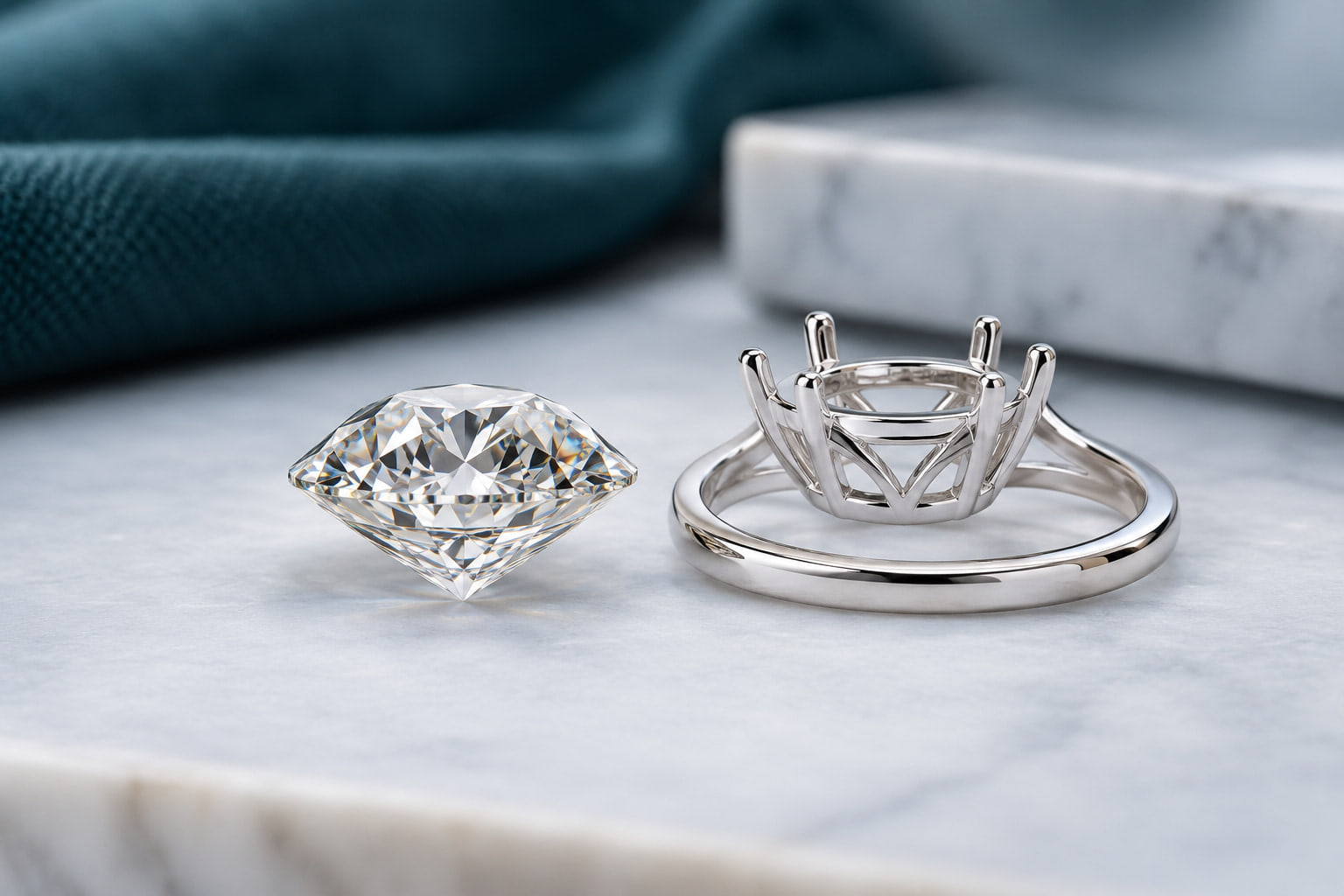
How Should Portuguese-Cut Light Performance Be Reviewed?
Request one video under broad diffuse lighting and another under restrained directional lighting. Keep the background, camera exposure and approximate viewing distance consistent. Begin face up, tilt slowly in two directions and include a complete rotation. The purpose is to see how the pattern behaves, not merely how many isolated sparkles can be captured.
Watch for regions that remain dark over a useful range of movement, a central area that appears different from the rest of the stone, and any uneven visual rhythm that conflicts with the reference. These are buyer observations for a sample review, not laboratory grades invented from a phone video. If an issue may be caused by camera obstruction or lighting, request a controlled retake before rejecting the stone.
Do not compare two different videos as though the stones were tested together. A close camera and strong point light can change the impression substantially. Ask for a side-by-side recording when candidates are available in one place. Where that is impossible, make the limitation explicit and retain a physical inspection stage.
A collection designed for statement jewelry may welcome a dense, intricate pattern. Another design may prefer larger, quieter reflections. State that preference in the brief. The approved response should come from the actual candidate, not a claim that the cut name guarantees a particular kind of fire in every room.
How Can Depth Change a Portuguese-Cut Sourcing Decision?
Hypothetical example: the deep-pattern pendant. A designer has a proposed mounting envelope allowing a maximum 6.5 mm stone depth. Candidate A measures 10.2 by 10.1 by 6.2 mm. Candidate B measures 10.1 by 10.0 by 7.0 mm. Both are invented Portuguese-style proposals. A has 0.3 mm below the stated depth ceiling; B exceeds it by 0.5 mm. Those differences identify a fit issue before any optical winner is chosen.
The designer prefers B's pattern in the first video. The team has three choices: inspect whether a revised mounting can accommodate B, request a different stone with a similar pattern or accept A after its own review. It should not instruct the setter to force B into a seat built for a shallower item. A revised mounting may also alter pendant balance and finished profile, requiring a new prototype.
Next, compare the pattern maps. Suppose both sellers advertise the same total facet count but use different counting conventions. The apparent agreement disappears once the crown and pavilion diagrams are placed side by side. The buyer records each proposal's actual geometry and stops using the shared total as the selection key.
The project purchases one sample before discussing a 12-piece production run. If that sample is approved, the buyer retains its video, dimensions and pattern revision. The example does not imply that a supplier can produce twelve identical stones or that the proposed depth ceiling is a general construction standard. It shows how a design limit can be tested with concrete data.
What Should Portuguese-Cut Buyers Request in Each Supplier Market?
A specialty cut can pass through a designer, trading desk and cutting workshop before reaching the buyer. Identify who can confirm the actual pattern and who can supply the exact candidate. These panels address the handoff needed for the Portuguese-style brief without assuming that a supplier's country or commercial label establishes its cutting capabilities.
USA / merchandising and sample review
What Should a US Specialty-Cut Retailer Verify Before Launch?
A US retailer introducing a Portuguese-style center should establish what the particular supplier means by the name before writing product copy. A facet count borrowed from another seller's page can become inaccurate when applied to a different layout. Keep the approved pattern reference with the retail SKU and publish only the details supported for that item.
Request a physical sample or a defined inspection window when the pattern is important to the sales story. The retail team should see the stone in ordinary store and home-like lighting, not only the supplier's strongest sparkle video. If finished jewelry photography is prepared, confirm that the displayed candidate is the one approved for the product or clearly identify it as a representative sample.
Coordinate the depth limit with the US setting maker before reservation. A specialty crown or pavilion can require a different head than a familiar standard stone. Agree who approves that fit and which costs apply if the stone is declined before setting.
CHINA / drawing and candidate control
How Should China Sourcing Distinguish the Map From the Trade Name?
For a China-facing inquiry, send the crown and pavilion reference in the first file rather than relying on an English cut name in a message. Ask the supplier to identify its actual layout and clarify whether it includes the table, culet or girdle details in the stated count. Translation should preserve this distinction instead of simplifying the request to many facets.
MEITUO can coordinate the supplier discussion from Qingdao, including requests for actual candidate dimensions and images. The coordination role does not establish a cutting location or guarantee that a particular workshop can reproduce the desired map. Ask who is responsible for confirming the geometry and who will approve any proposed changes.
When a sample is accepted, retain its reference revision and item number together. If the production candidate differs, require a deviation note before dispatch. This matters particularly when the same commercial name appears on several supplier options that are not geometrically identical.
INDIA / specialty cutting proposals
How Should an Indian Cutting Proposal Define a Portuguese Pattern?
An Indian cutter or trader responding to a Portuguese-style request should distinguish an existing polished item from a proposed cutting exercise. For existing goods, ask for the actual map or clear crown and pavilion views. For a proposal, request the intended geometry and a sample approval stage before discussing a full matched run.
Identify who can answer technical questions about the layout. A trader may coordinate the offer without designing or cutting the stone. Keep that commercial role useful by routing detailed pattern questions to the party able to confirm them, then attaching the response to the order rather than leaving it in an informal message thread.
For repeat sourcing, ask whether the supplier can hold the accepted design reference and disclose changes. Do not assume a shared facet total proves the same pattern. If a replacement is proposed, review its optical appearance and depth again, especially when the original stone belongs to an earring pair or a mounting with limited clearance.
How Can a Portuguese-Cut Order Remain Repeatable?
Create a master file with the approved sample identifier, crown and pavilion views, dimensions, counting convention and optical reference. Record whether the design accepts a family resemblance or requires a close match. A bespoke one-off center and a paired earring program need different repeatability. The purchase order should say which standard applies.
At receipt, compare the delivered stone with the item photographs and available documents before checking it against the style master. The first comparison asks whether this is the approved item; the second asks whether it fits the collection. Keep those questions distinct. A stone can follow the intended pattern yet still be an unauthorized substitute.
Inspect visible condition under suitable magnification and route concerns to a qualified reviewer. Dense faceting does not justify ignoring edge damage, surface problems or a pattern that differs from the approved plan. Document the issue before setting so commercial remedies remain clear. Use the repeat-order guide to preserve reference history rather than overwriting it with a new candidate.
For pairs, compare pattern scale and contrast as well as outline. Two stones with the same nominal dimensions can create different visual density if the facet layouts differ. Keep each accepted pair together and name its members. If one needs replacement later, inspect the complete pair again rather than treating a single matching weight as enough.
How Can MEITUO Coordinate a Portuguese-Style Diamond Inquiry?
MEITUO is a Qingdao, Shandong sourcing and supply-chain coordination partner serving jewelry brands, wholesalers, retailers and designers. For a Portuguese-style inquiry, the useful input is an actual pattern reference plus the intended size, depth limit and application. MEITUO can help organize supplier responses around those details instead of relying on the trade name alone.
Its product scope includes loose center stones, melee, side stones and matched pairs or sets. A buyer considering matched stones should identify whether pattern similarity or exact dimensional fit has priority. Availability of a particular specialty cut, documents, MOQ, lead time and shipping terms all require per-order confirmation.
Send the crown and pavilion reference to [email protected] with the mounting envelope. MEITUO supports product selection, supplier coordination, quality-requirement confirmation and order follow-up. It does not claim to own a cutting workshop, create the facet design or issue independent laboratory reports. Final approval should remain tied to the actual proposed stones.
What Makes a Portuguese-Cut RFQ Actionable?
Write the request around the desired outcome: visible pattern, outline, depth and application. Attach the preferred map and ask suppliers to mark any deviation. Specify whether the quotation should cover an existing stone, a sample cutting proposal or a repeat set. Those are different offers and need different acceptance milestones.
Include the viewing conditions for approval and the evidence expected before reservation. Request the actual candidate video, item measurements and available document references. State that a different pattern requires approval even if the seller uses the same cut name or facet total.
The RFQ guide can organize commercial terms, while the component-scope guide separates stone supply from setting work. The brief below keeps the geometry request explicit without inventing a universal Portuguese standard.
Please propose a Portuguese-style laboratory-grown diamond for [application and quantity]. Attach the actual crown and pavilion facet map, counting convention and full dimensions, including total depth. Our target face-up outline and size are [details], with mounting envelope [limits]. Provide continuous video under diffuse and directional light, top and side images, item identifiers and available independent documents. Flag deviations from reference [file or sample]. Confirm existing availability versus proposed cutting, sample approval terms, substitutions, MOQ, timing and treatment information. No universal facet count is assumed; approval depends on the actual pattern, appearance and setting fit.
FAQ: Portuguese-Cut Lab-Grown Diamonds: Checking the Facet Map
Do Portuguese-Cut Diamonds Always Have 161 Facets?
No universal count is established here. CRTD provides a verified seller example using 161, but another offer needs its own layout and counting convention. Ask whether the table, culet and girdle features are included before comparing totals.
Does a Larger Facet Count Mean Better Light Performance?
No. A total does not show how the facets are arranged or how the actual stone behaves in light. Compare controlled movement videos and inspect a sample where feasible. Select the pattern that suits the design rather than ranking stones by arithmetic alone.
Can Portuguese Refer to More Than One Outline?
Treat the offered outline as an item-specific fact. Request top-view dimensions and images rather than assuming a cut name defines the perimeter. A setting maker needs actual geometry, especially where corners, curved edges or depth differ from a familiar standard.
What if the Supplier Cannot Provide a Formal Facet Diagram?
Request clear crown and pavilion photographs, a written layout description and the counting convention. This may support an initial review, but retain a sample stage if the pattern is critical. A generic drawing copied from another product is not evidence for the offered item.
Can a Standard Setting Accept the Stone?
Only the setting maker can confirm after reviewing actual dimensions and contact geometry. Check total depth and crown clearance before reservation. A shared carat weight or nominal diameter does not establish compatibility with a stock mounting.
How Should We Replace One Stone in a Portuguese Pair?
Use the retained pair reference and review the surviving stone alongside the proposed replacement. Compare pattern density, contrast, outline and depth. If the replacement changes the pair materially, approve a new complete pairing rather than accepting a matching weight alone.