 English
 Español
 Português
 Deutsch
 Français
 Italiano
 Nederlands
 العربية
 日本語
 한국어
 ไทย
Quick Answer
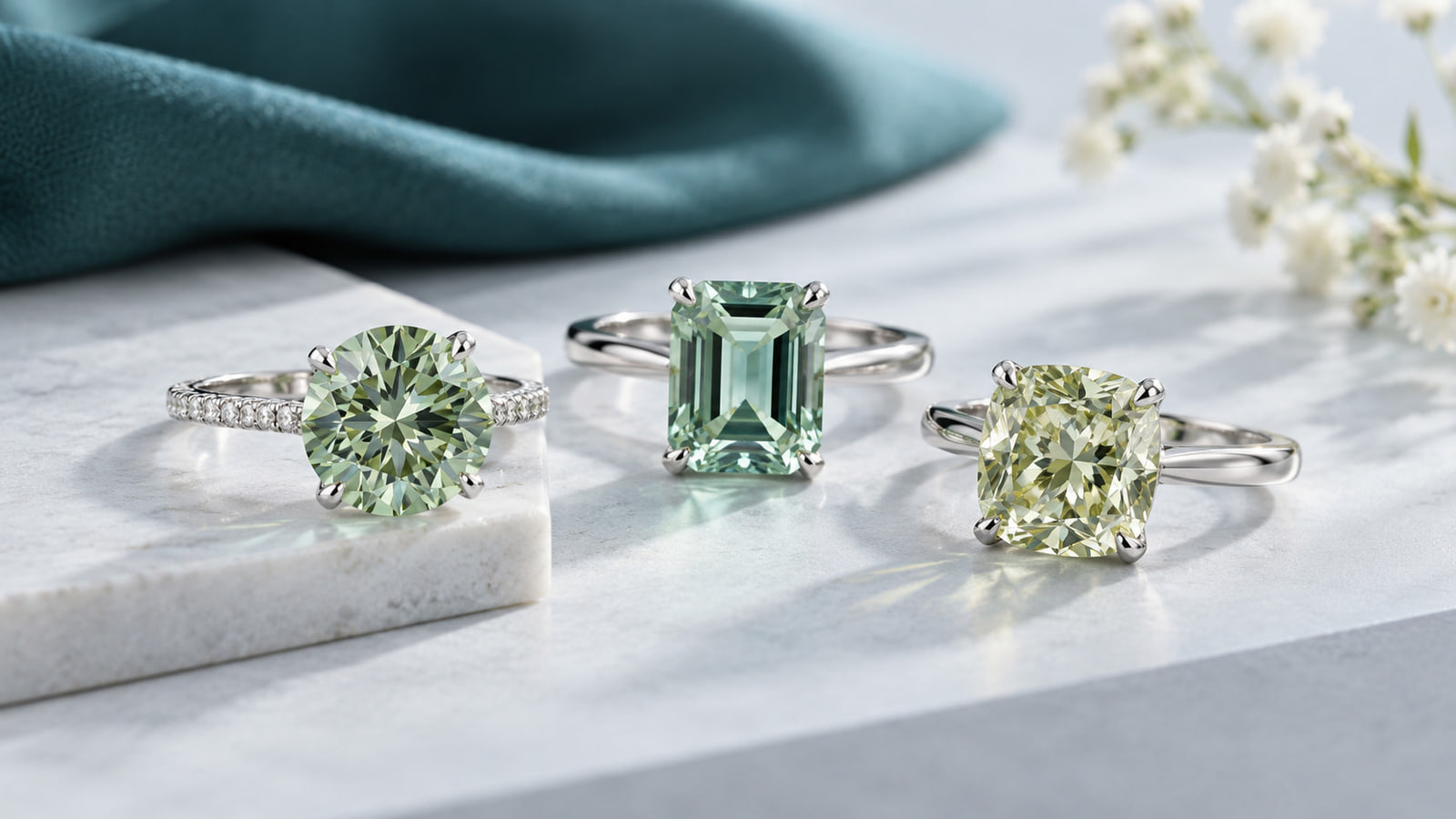
Green lab grown diamonds should be selected by actual face-up hue, modifying colors, tone and distribution, with laboratory-grown identity and color-treatment information checked separately. Green appearance can arise through different mechanisms: GIA documents nickel-related green in HPHT-grown material and distinguishes it from greenish color produced by post-growth irradiation. A photograph cannot establish which mechanism applies to an offered stone. Request item-specific evidence and compare candidates under consistent lighting before approving a sample. Decide whether yellowish, bluish or grayish modifiers are acceptable and whether uneven color conflicts with the design. MEITUO's green availability is unconfirmed; a sourcing inquiry is a feasibility request, not a statement that green inventory exists. Confirm actual candidates before planning a launch around them.
Why Does Green Color Origin Need Its Own Evidence?
GIA's 2024 laboratory-grown diamond update describes green HPHT-grown diamonds associated with substantial nickel incorporation and contrasts that appearance with post-growth irradiation-related greenish material. That technical distinction shows why green should not be treated as the name of a single recipe. It does not identify the mechanism of a stone seen in an online image.
For the offered item, distinguish three questions: is it diamond, is its origin laboratory-grown, and what evidence addresses its color or treatment? A supplier statement may help define the offer, but independent examination has a different evidentiary role. Ask what the available document actually concludes and whether it covers the actual item identifier.
Do not infer untreated color from a growth-method label. HPHT can describe growth, while other processing can occur later; the label alone does not answer every treatment question. Conversely, treatment information should be read accurately rather than treated as a blanket defect. The commercial decision depends on disclosure, the intended product and the buyer's acceptance criteria.
The fancy-color product scope is a place to discuss options. It is not evidence that every green hue or mechanism is available. Keep the inquiry tied to actual proposed candidates and current documentation.
How Should Green Face-up Color Be Described for Buying?
Start with the hue you want and the modifiers you can accept. A design brief saying emerald green may communicate a mood but leaves uncertainty about yellow, blue, gray or brown components. Use a physical reference where possible and describe it in plain language. Keep the supplier's commercial description separate from any laboratory color wording.
Then define tone and distribution. A stone that is strongly colored at its ends and lighter in the center may suit one design and fail another. Inspect face up and at gentle tilts under diffuse light. Change the background deliberately and watch whether dark surroundings exaggerate the impression of saturation. Do not treat a deeply shadowed photograph as a neutral color measurement.
| Decision | Visual-only shortcut | Controlled buying method |
|---|---|---|
| Hue | Accept any listing called green | Define acceptable yellow, blue and gray modifiers |
| Distribution | Judge the strongest frame | Review face-up and tilt views for persistent zoning |
| Mechanism | Infer origin from the photograph | Use item-specific examination and treatment evidence |
| Pair matching | Match grade words alone | Compare actual stones together under agreed light |
| Availability | Assume a category page means stock | Confirm candidate existence and reservation status |
These steps create a shared reference without claiming that a phone photograph can replace laboratory assessment. Use the matching guide when several green stones must work together.
How Can Cut and Mounting Change the Green Impression?
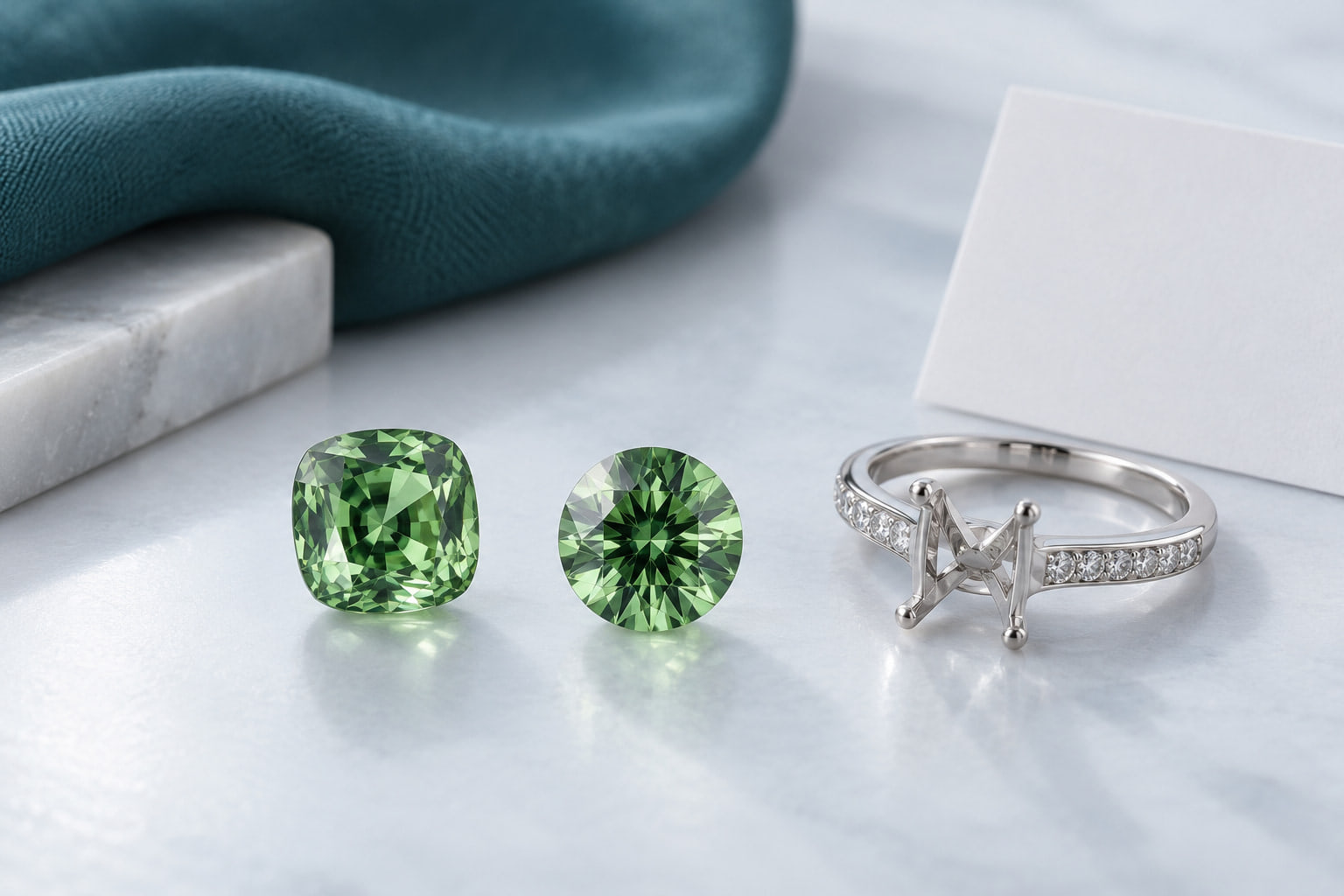
Compare color in the intended viewing orientation. A step-cut candidate can present broad areas of color and contrast differently from a brilliant-style candidate. A deep outline may carry weight without delivering the visible dimensions required by the design. Record length, width and depth so the optical discussion remains attached to a usable physical stone.
Inspect any persistent pale or dark region before deciding whether it is acceptable. A concentrated area of color can be part of the offered material, while a dark region in one photograph may come from the camera or lighting. A controlled retake and a physical sample help separate these possibilities. Do not diagnose a defect mechanism from an ordinary sales video.
Review the candidate against the intended metal finish. Warm and cool surrounds can change the viewer's impression of the same green stone. A close bezel can alter the visible perimeter; open and closed structures can create different background relationships. Those effects need a representative setting sample when color is central to the line.
The statement-jewelry application brief should identify who approves the loose color and who approves the mounted result. If the setting changes after loose approval, revisit the combined appearance before authorizing the full run. A stone's color wording remains its documented description, even when a surrounding metal changes the customer's visual impression.
How Can a Buyer Test a Green Pair Without Inventing a Color Tolerance?
Hypothetical example: the botanical earring pair. A designer wants twelve pairs, or twenty-four stones, with an approximately 6 by 4 mm elongated outline. The first sample pair has similar dimensions, but one stone looks yellowish green and the other bluish green under the agreed diffuse light. Both sellers may call them green; the pair still fails the designer's intended visual relationship.
The buyer requests four additional candidates and photographs all six together using the same exposure and neutral background. Two acceptable pairs emerge; two stones remain unpaired. The team has approved four of the six reviewed stones for paired use, about 66.7%, in this invented exercise. That is a sample-selection calculation, not an expected sourcing yield or a forecast of supply.
Before ordering the remaining ten pairs, the designer chooses one accepted pair as the color reference and documents which modifiers were rejected. The supplier is asked to identify candidates close to that reference and flag uncertain matches. The buyer does not invent a numeric color tolerance from ordinary photographs or claim that a common color grade guarantees perfect matching.
Finally, one pair is inspected in the representative mounting. If the metal shifts the visual balance, the buyer revises the mounted reference before approving production. A request for fancy-shape pairs should therefore specify both the loose matching task and the final application. Current availability remains a separate commercial question throughout.
How Should a Green Diamond Inquiry Differ Across Sourcing Channels?
Green-colored material can arrive through a distributor, a grower-linked offer or a trading desk. The buyer needs the offered stone's evidence and a consistent color reference regardless of channel. Do not assume that a familiar country specialization identifies the mechanism, treatment history or availability of a particular green candidate.
USA / launch evidence and disclosure
How Should a US Green-Jewelry Launch Separate Sample and Stock?
A US retailer considering a green line should verify actual availability before publishing a launch promise. A supplier's color category or inspirational image is not a reserved assortment. Request the proposed item identifiers, current status and the point at which a candidate can be held while color review takes place.
Build product copy from the actual document wording and supplier treatment information. Keep laboratory-grown identity clear and review treatment disclosure for the selling context. The FTC jewelry guidance discusses material descriptions and treatment disclosure circumstances; it does not substitute for checking the offered item's evidence.
For a US store sample, compare the green candidate under the planned display light and a broad neutral source. If the appearance differs substantially, decide which images and explanations the customer needs. Do not create a named shade promise that the supplier has not demonstrated it can repeat across the required quantity.
Retain the accepted sample as the service reference.
CHINA / growth and treatment questions
How Should China Sourcing Distinguish Green Mechanisms?
A China sourcing inquiry should ask for the offered item's growth and treatment information without assuming that green implies a single production route. The GIA research cited above distinguishes nickel-related HPHT green from irradiation-related greenish appearance. That distinction makes item-specific evidence more useful than a broad statement about a supplier's preferred growth technology.
For coordination through Qingdao, give MEITUO a color reference and a short list of acceptable modifiers. Request actual candidates with top and tilt views, then ask what documents and treatment statements can accompany each. Do not interpret the coordination location as the place where the stone was grown, treated or examined.
If several suppliers respond, normalize the comparison conditions before ranking the colors. A warm photograph from one seller and a cool photograph from another are poor matching references. Keep each candidate's dimensions, document reference and uncertainty notes together so a visually attractive image does not detach from its underlying evidence.
INDIA / candidate and recutting handoffs
How Should an Indian Green-Stone Offer Preserve Color Evidence Through Cutting?
When an Indian cutter or trader proposes green laboratory-grown material, clarify whether the offer concerns an existing polished stone or a cutting plan. A rough or preform photograph cannot establish the final face-up distribution. If the candidate will be cut again, define when the buyer reviews the resulting color and who approves the changed geometry.
Ask the commercial seller to preserve the link between the item, available document and sample images. If a new report or updated measurement is needed after processing, make that part of the sequence rather than treating the earlier file as unchanged evidence. The supplier should identify any proposed substitution before it reaches the order packet.
For paired jewelry, request the actual proposed pair in one view with consistent orientation. A trader's two individually attractive green stones may differ in hue modifier or pattern after mounting. Keep the pair approval distinct from approval of each stone's material identity and commercial terms.
Which Green Diamond Documents and Receiving Checks Matter?
Request the document type that addresses the information you need. A material identification statement, a color description and a full grading service may have different scope. The current GIA laboratory-grown service page distinguishes colored-diamond services from its colorless-to-near-colorless quality assessment. Confirm eligibility and service details directly rather than assuming one document format covers every green item.
Connect the document to the actual stone through available identifiers and measurements. Keep supplier treatment statements alongside, without rewriting them into stronger conclusions. If information is unresolved, record that status before purchase rather than discovering the gap when a retailer asks for product copy. Ask for relevant care and processing information before the stone reaches the setting workshop.
On receipt, inspect the stone clean and loose under the agreed lighting. Compare it with the approved sample, review color distribution and check visible condition. If the delivered item differs, keep it unset while the supplier reviews the evidence. A new photograph taken under different warm lighting should not be used to dismiss a mismatch without a controlled comparison.
Define remedy options in the order: additional examination, replacement candidate, return or revised acceptance by agreement. A replacement should pass the same color review. For a pair, assess both members again so the remedy does not resolve one item while breaking the visual match.
Keep a separate field for the buyer's preferred shade name and the document's exact color wording. If merchandising calls the sample forest green, that name should not overwrite the report or become an invented laboratory conclusion. When the proposed stone changes, reopen both the appearance decision and the evidence check. A replacement with a similar photograph may have different distribution, dimensions or treatment documentation. This distinction also helps service staff explain why a replacement is being reviewed even when its broad green description appears unchanged.
What Can MEITUO Support When Green Availability Is Unconfirmed?
MEITUO is a sourcing and supply-chain coordination partner in Qingdao, Shandong, China. It serves jewelry brands, wholesalers, retailers and designers with product selection, supplier coordination, requirement confirmation and order follow-up. For a green inquiry, its first useful task is to clarify the requested appearance and seek item-specific feasibility information.
Green availability at MEITUO is unconfirmed. Buyers should not interpret the broader fancy-color scope as a stocked green assortment or a promise of a particular shade. Send the desired hue reference, dimensions, quantity and document requirements to [email protected]. Current candidates, matching feasibility, treatment information, MOQ, lead time and shipping terms need confirmation for the order.
MEITUO can also coordinate related melee requirements where a green center will sit within an accent design, keeping those specifications separate. It does not grow diamonds, own a gemological laboratory or issue independent reports. Final color and mounting approval should remain tied to the actual samples the buyer reviews.
What Should a Green Lab-Grown Diamond RFQ Include?
Begin with a feasible sample question rather than an announced launch date. State your preferred green appearance, acceptable modifiers and whether the request needs one center, matched pairs or a calibrated group. Include dimensions and the intended metal, because the final application affects how the color will be judged.
Specify evidence before reservation: actual item images, available independent documents, treatment information and a clear current availability statement. Ask the supplier to identify uncertain points rather than fill gaps with a generic color claim. If a close visual match is essential, require a joint pair or set review.
The RFQ preparation guide can hold the commercial details. The copyable brief below adds the green-specific acceptance questions without assuming stock or assigning a mechanism from the stone's appearance.
Retain the final approved revision.
We are exploring green laboratory-grown diamonds for [application and quantity]. Desired face-up appearance is [green hue and acceptable modifiers], referenced to [approved sample or images]. Target shape and dimensions are [details]. Provide actual candidate photographs and continuous video under [agreed lighting], showing color distribution and tilt response. Identify laboratory-grown material, available color documentation, growth information and any post-growth treatment evidence. Confirm whether candidates currently exist and are available; no stock is assumed. State sample terms, matching feasibility, MOQ, lead time, care information and substitution procedure. Approval requires our item-specific color and setting review.
FAQ: Green Lab-Grown Diamonds: Color Origin and Selection
Are All Green Lab-Grown Diamonds Irradiated?
No. GIA documents nickel-related green HPHT-grown material as well as a distinction from irradiation-related greenish appearance. That does not identify an individual candidate. Ask for item-specific growth and treatment evidence rather than assigning a mechanism from the color.
Can a Photo Establish a Pure Green Grade?
No. A sales photo depends on lighting, exposure, background and display. Retain the actual laboratory color wording where available and use controlled sample review for the design decision. Do not turn a preferred screen appearance into an unsupported formal grade.
Should a Green Pair Share the Same Report Wording?
Compatible wording can help screening, but it does not guarantee a visual match. Compare the actual stones together under the agreed light and in the intended orientation. Hue modifiers and distribution can matter even when broad descriptions appear similar.
Does Treatment Automatically Make the Stone Unsuitable?
No. The buyer needs accurate disclosure, relevant care or processing information and a product that meets the intended requirements. Review the actual treatment evidence and commercial scope. Do not replace that assessment with either a blanket rejection or an unsupported stability guarantee.
Does MEITUO Stock Green Diamonds?
Green availability is unconfirmed. Send a feasibility inquiry with the desired hue, dimensions and quantity. Any candidate needs current availability confirmation and item-specific review before a buyer treats it as reserved stock or plans a launch around it.
What if the Delivered Green Does Not Match the Sample?
Compare it clean and loose under the agreed conditions, retain photographs and keep it unset while the difference is reviewed. Use the order's remedy process. A replacement must pass the same review, including a complete pair comparison when matching is required.