 English
 Español
 Português
 Deutsch
 Français
 Italiano
 Nederlands
 العربية
 日本語
 한국어
 ไทย
Quick Answer
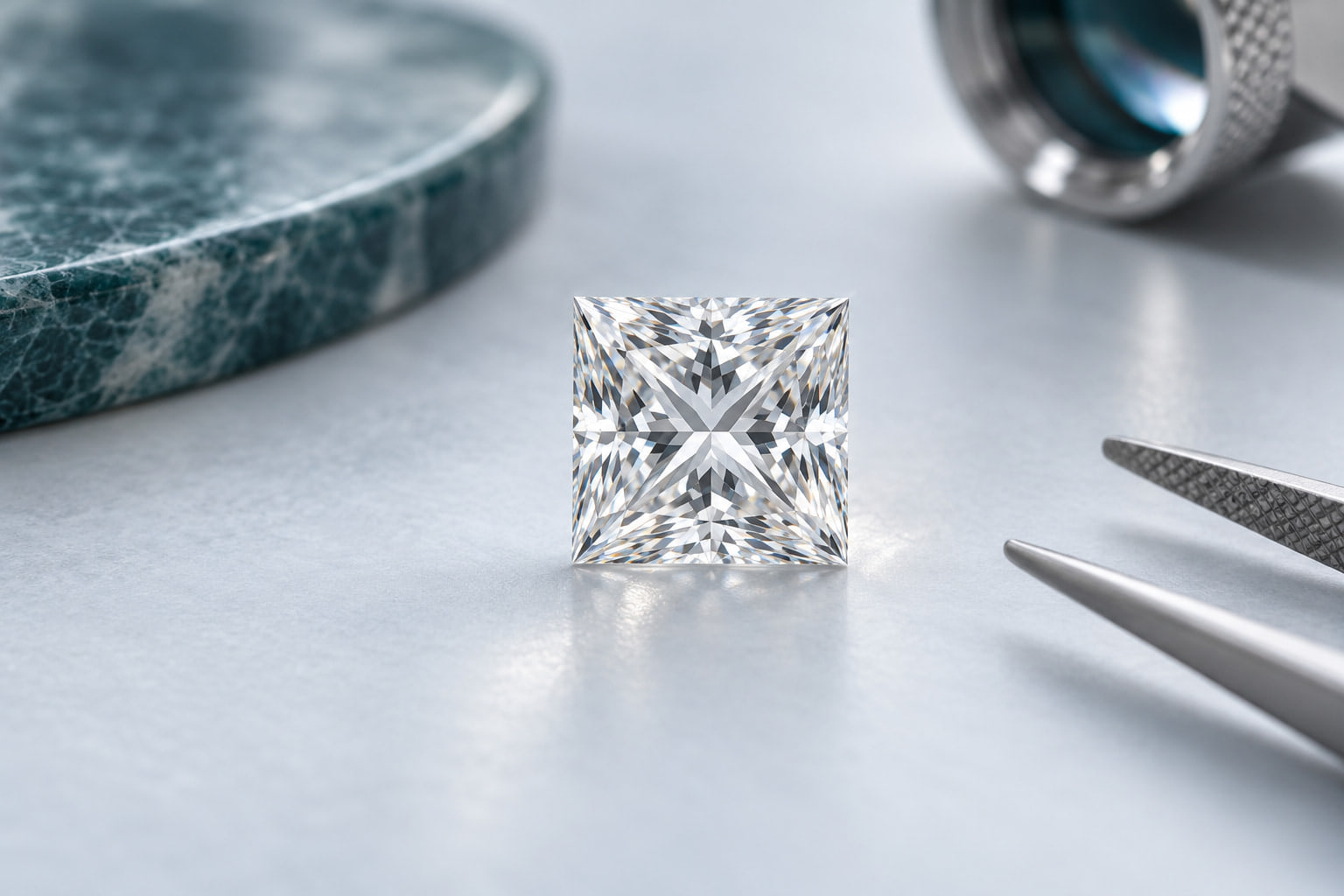
For a princess cut diamond ring with lab grown diamond, approve the square brilliant appearance and the four corner interfaces together. Inspect actual dimensions, pavilion depth, girdle condition and any feature near a point before the setter accepts the stone. Diamond's scratch hardness does not prevent a corner from chipping. Compare the changing pattern created by the facet arrangement, including visible chevron-style reflections, rather than assuming all square brilliants look identical. Obtain a protective setting proposal and enough CAD clearance for the actual pavilion. Keep pre-setting corner photographs, exact-stone media and report references with the order. If a candidate needs an altered head or shows an unresolved corner condition, resolve it before production rather than relying on setting pressure to make it fit.
What Should Buyers Inspect in a Princess-Cut Pattern?
A princess is a square brilliant-style choice rather than a square step cut. GIA describes princess cuts as square modified brilliants. That distinction matters when a buyer compares a lively subdivided image with the broad steps of a square emerald-style stone. The outline alone does not communicate the optical brief.
Look at the center, diagonal directions and the region approaching each corner as the stone moves. Different facet arrangements can produce different scales of reflections. Chevron-style pavilion rows contribute to that visual texture, but the buyer should not assume a particular count guarantees beauty. Ask for actual facet information if it matters to a collection, and compare the result in motion at normal scale.
Use broad light to see the distribution of brightness and directional light to see changing flashes. A dramatic bright corner cannot compensate automatically for a central region the brand finds persistently inactive. Likewise, a dark frame in a clip can be ordinary contrast. Repeat the viewing setup before classifying a concern, then compare the candidate with the accepted pattern reference.
For multiple centers, retain an equal-scale contact sheet and a shared movement clip. A collection may look inconsistent when one princess has broad geometric reflections and another has much finer texture, despite matching report specifications. Decide the acceptable family before buying a large parcel. This is a merchandising control, not a claim that one pattern is universally superior.
Why Does Princess-Cut Corner Inspection Need Its Own Record?
Each corner is both an aesthetic point and a practical risk location. GIA's chipping guidance discusses princess corners and explains why a hard material can still chip. Buyers should distinguish resistance to scratching from resistance to impact and local stress. A high hardness value cannot validate an unsuitable bearing or an existing surface-reaching feature.
Before setting, photograph the four corners under magnification from above and obliquely. Assign clockwise numbers in a fixed orientation and note the report or inventory identity in the inspection record. Record abrasions, chips, unusually thin-looking local edges or features requiring professional assessment. Do not use photographs alone to diagnose the structural significance of a feature; send it to the qualified setter or gemological reviewer.
Compare the corner shape with the intended protective prongs or bezel. The practical question is whether the bearing supports the actual geometry without forcing a point against an unsuitable surface. Do not specify a universal tightening force, bearing angle or metal thickness in a buying article. Those depend on the stone, metal and manufacturing process.
Photograph the same corners after setting. If a problem appears, the paired record helps establish what was visible at each stage. It does not automatically assign liability, but it makes investigation much more useful than a general statement that the stone looked fine. Agree in advance who reviews an unresolved condition and whether the affected stone remains unset while other pieces proceed.
V-Prong VS Bezel Planning: What Should a Princess Buyer Compare?
| Design decision | Protective corner-prong concept | Bezel concept |
|---|---|---|
| Visible outline | More open perimeter with metal at selected corners | Continuous metal framing can alter apparent square size |
| Approval focus | Actual corner fit, seat contact and prong coverage | Perimeter fit, bearing continuity and finished edge |
| Depth issue | Confirm pavilion clearance beneath the head | Confirm sufficient internal volume and access for setting |
| Inspection record | Corner views before and after setting | Corner and edge views before enclosing the perimeter |
| False assumption | Any V-shaped prong makes the ring damage proof | Any bezel compensates for a poor fit |
A setting concept reduces certain exposures only when engineered and executed appropriately. GIA's princess engagement-ring discussion identifies protective setting options. It should not be turned into a guarantee that a finished ring cannot chip.
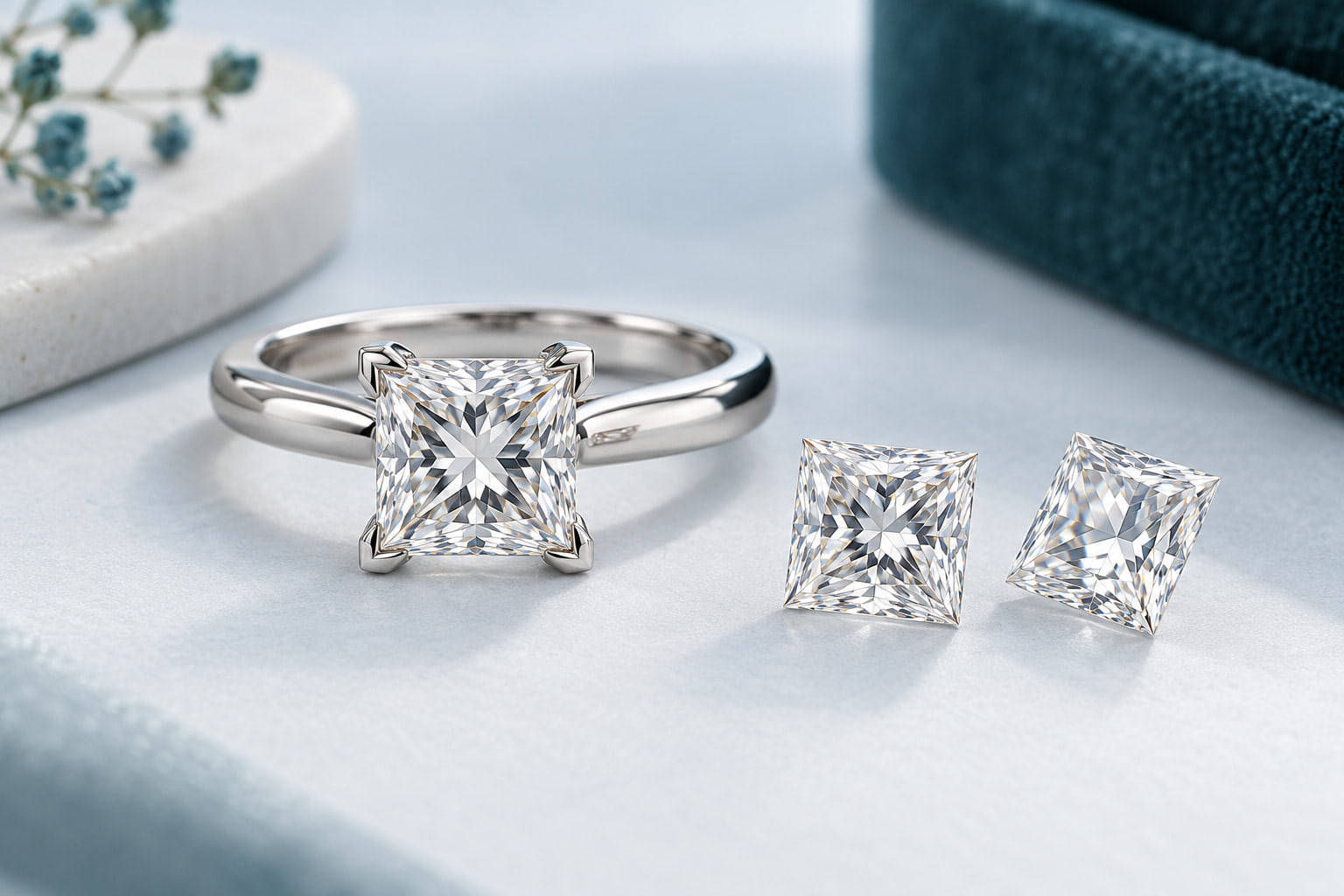
Show the manufacturer the intended visible square and ask for realistic top and side views. A heavily framed stone may read differently from a delicate-prong sample. Match the final presentation to the product promise while keeping corner protection part of the engineering review. The princess product category is a sourcing starting point; the final head remains a manufacturing decision.
How Does a Princess-Cut Fit Check Change a Purchase Decision?
Hypothetical example: the Four-Corner Square Launch. A brand plans ten princess solitaires using a head built around a 7.0 by 7.0 mm sample. Candidate P measures 7.05 by 6.98 by 5.10 mm. Candidate Q measures 7.08 by 7.00 by 5.55 mm. Their face-up envelopes appear close, but Q extends 0.45 mm farther in overall depth. These are invented dimensions for a fit exercise, not recommended proportions.
The manufacturer's drawing leaves an assumed 0.30 mm nominal clearance under P. If every other geometric relationship were unchanged, substituting Q would consume that clearance and extend another 0.15 mm beyond it. Real bearing locations and pavilion shapes must be reviewed, so this subtraction is a warning flag rather than a complete interference analysis. The buyer should ask engineering to examine Q instead of accepting it because its face-up size looks right.
During corner inspection, P has no unresolved observed condition, while Q shows a feature near one point that needs professional review. The correct decision is to hold Q on both fit and condition grounds. A possible redesign does not resolve the corner question, and a favorable condition review does not create missing pavilion clearance. Track the two issues separately.
Suppose seven of ten candidates match the selected chevron texture and three look markedly finer. The brand can either approve two named visual families or request replacements to keep one signature look. Ask MEITUO to coordinate that distinction explicitly. The exercise illustrates why stock selection, pattern approval and setter approval must intersect before a center is committed to a production ring.
What Should a Princess Receiving Checklist Include?
First reconcile item identity, report reference and inscription where available. Verify the report through its issuing laboratory. Then measure the actual stone and inspect the corners before attempting any fit. A report describes the examined stone under its service scope; it is not a manufacturer's approval of a particular mounting.
Read current service details carefully. GIA's current eligible loose colorless-to-near-colorless lab-grown assessment uses Premium or Standard, rather than promising traditional individual color and clarity grades for every current report. If using another laboratory, read the specific document rather than importing assumptions. IGI states that growth and treatment comments are available upon request.
Next compare the approved optical family with controlled motion media. Route a pattern mismatch to selection review and a physical corner concern to the qualified technical reviewer. Keep candidates isolated from accepted stones so a held item cannot accidentally enter setting. Photograph the parcel labels and inspection result together in the order system.
Finally obtain the setter's acceptance against the current CAD revision, not an older head with a similar product name. The reorder guide helps preserve these dependencies. For a new project, the manufacturer application page provides a useful context for sharing the stone and head requirements together.
How Should Princess-Cut Sourcing Differ Across Markets?
Prioritize a supplier's ability to provide corner evidence and actual profile information. A location can affect communication and logistics, but it does not remove the need for individual-stone review or establish where the crystal was grown.
Include the handover sequence in the purchase plan. If receiving occurs at a logistics office but setting occurs elsewhere, decide who captures the first corner record and how the parcel remains identified in transit. A second inspection at the bench should compare against that record before work starts. Keep the stone in a protective individual container rather than allowing loose centers to contact one another. Any observed change should pause the affected item while identity, packaging and condition are reconciled. This workflow is particularly useful when the supplier, buyer and setter operate in three different countries.
US / Corner evidence and appointments
What Should US Princess-Cut Retailers Verify Before Ordering a Head?
US retailers can use a trade distributor to coordinate stone and head review, but should establish which business is responsible for the combination. Stuller's lab-grown assortment illustrates a trade route; a domestic seller is not proof of US-grown origin. Ask whether the candidate's actual corner images and depth are available before promising a finished ring configuration to a customer.
A practical retail workflow reserves a small shortlist, obtains setter review and only then confirms the production appointment. If the existing catalog head is nominally seven millimeters, do not assume every seven-millimeter princess fits it. Ask how the actual point geometry and pavilion will be assessed. Retain pre-setting photographs in the retailer's order file even when a supplier provides its own inspection record. For a return or condition concern, written evidence helps the parties identify the observation under discussion. Confirm actual review terms rather than assuming every distributor offers the same memo or return arrangement.
CN / Item-specific condition control
How Should China Sourcing Separate Princess Selection From Corner Acceptance?
China's laboratory-grown production context includes significant HPHT activity, as described in GIA's review. A supplier's access to that material does not establish the condition of an individual polished princess. Ask for actual-stock corner views and identify who performs the pre-dispatch inspection. Avoid accepting a general statement that the parcel has high hardness or good quality as an answer to a point-specific question.
For a Qingdao-coordinated order, number corners consistently in the reference images so the supplier and setter discuss the same location. Request depth and profile before shipment consolidation, especially if the planned head has limited clearance. If the order includes smaller square accents, give those their own dimensional and condition controls rather than extending a center-stone approval to the whole parcel. Keep any stone needing review in a separate hold group. The buyer should confirm who may release it, whether additional evidence is required and how a rejected center is replaced without delaying already accepted goods unnecessarily.
IN / Pattern and profile dialogue
What Should an Indian Princess Supplier Clarify About Cutting and Fit?
An Indian cutting or polished-stock contact may be able to discuss princess facet arrangements in more detail, but the buyer should establish the actual role first. GreenLab's contact page lists Surat and Mumbai locations; those addresses do not identify the cutter of any offered stone. Ask who can provide a reliable profile and answer a question about an individual point.
For a consistent square-brilliant line, request candidates grouped by visible texture rather than relying on a chevron count alone. Ask for clarification if a proposed alternative has a deeper pavilion, and send the current CAD envelope before it is reserved. If recutting or minor corner alteration is suggested, obtain the projected changes in dimensions, weight, appearance, documentation and timing. Do not assume an alteration is inconsequential because the affected area looks small. The finished head must be reviewed against the final stone, and any condition concern should remain open until the qualified reviewer explicitly resolves it.
How Can MEITUO Support Princess-Cut Production Sourcing?
MEITUO coordinates sourcing and supply-chain work from Qingdao, Shandong, China. For a princess-cut project, buyers can ask it to collect item-specific corner photographs, clarify missing profile data and keep unresolved stones separate from approved candidates. Its support includes product selection, supplier coordination, quality-requirement confirmation and order follow-up, which can help preserve a precise square-brilliant brief through a multi-business purchase.
The company works with loose centers, melee, side stones, matched pairs and sets, and fancy-color options. It is a coordination partner rather than an independent grading laboratory or a substitute for the setter. Do not infer that it grows or cuts the offered stones. Confirm each order's availability, documents, MOQ, lead time, treatment information and shipping terms directly. Send [email protected] the current head drawing, desired visual family and four-corner inspection requirements. The bridal application page provides a relevant route for a ring collection whose purchasing decision depends on both appearance and fit.
What Should a Corner-Conscious Princess RFQ Say?
Specify the mounting envelope and request corner condition images before reservation. Explain whether the head is fixed or may be revised. State who has authority to accept a depth exception and who will review a feature near a point. This avoids making the sales contact guess which observations matter to production.
Include the desired square-brilliant texture and exact-stone video requirements. For multiple centers, request a grouped comparison as well as individual identities. Agree on a hold status for unresolved stones, shipping terms and the inspection period. Keep the commercial RFQ framework tied to the actual technical review, so a deadline does not silently turn a provisional selection into final acceptance.
Please quote [quantity] princess-cut laboratory-grown centers for [ring line], within [length], [width] and [depth] limits. Match square-brilliant visual reference [ID] and provide actual-stone motion clips, profiles and numbered views of all four corners before reservation. Include report references, inscription information where available, and growth or treatment details. Identify every corner condition requiring review and every departure from the current head drawing [revision]. Confirm MOQ, stock control, lead time, shipping terms and inspection conditions. Unresolved condition or fit candidates must remain on hold until [authorized reviewer] approves them in writing.
FAQ: Princess-Cut Lab-Grown Diamond Rings: Corner-Safe Buying
Can a Princess Diamond Chip Even Though It Is Very Hard?
Yes. Scratch resistance and resistance to local impact are different properties. Princess corners need appropriate inspection, handling and setting protection. Hardness should never be used to dismiss a corner feature or justify forcing a stone into a bearing.
Does a V-Prong Guarantee Corner Safety?
No setting guarantees freedom from damage. A protective design still needs suitable fit and execution for the actual stone. Have the setter approve the contact and clearance, and retain condition photographs before and after setting.
Is Every Square Diamond a Princess?
No. A princess is a square brilliant-style cut, while square step cuts have a different facet arrangement and appearance. Read the actual shape and cutting-style description and approve the intended visual family.
Should Buyers Choose Princess Cuts by Chevron Count?
Facet information can help explain a pattern, but the count alone does not establish the appearance the brand wants. Compare exact-stone motion under consistent lighting and retain a reference showing the preferred texture.
What if the Princess Face Fits but Its Pavilion Is Too Deep?
Hold the stone for engineering review or select another candidate. Maximum face-up dimensions do not establish clearance below the seat. Do not ask the setter to compensate through unspecified pressure or unreviewed metal removal.
Why Keep Four Separate Corner Photographs?
They let the buyer, supplier and setter refer to the same locations and compare condition across stages. The images support investigation and approval, while any structural interpretation remains with a qualified technical reviewer.